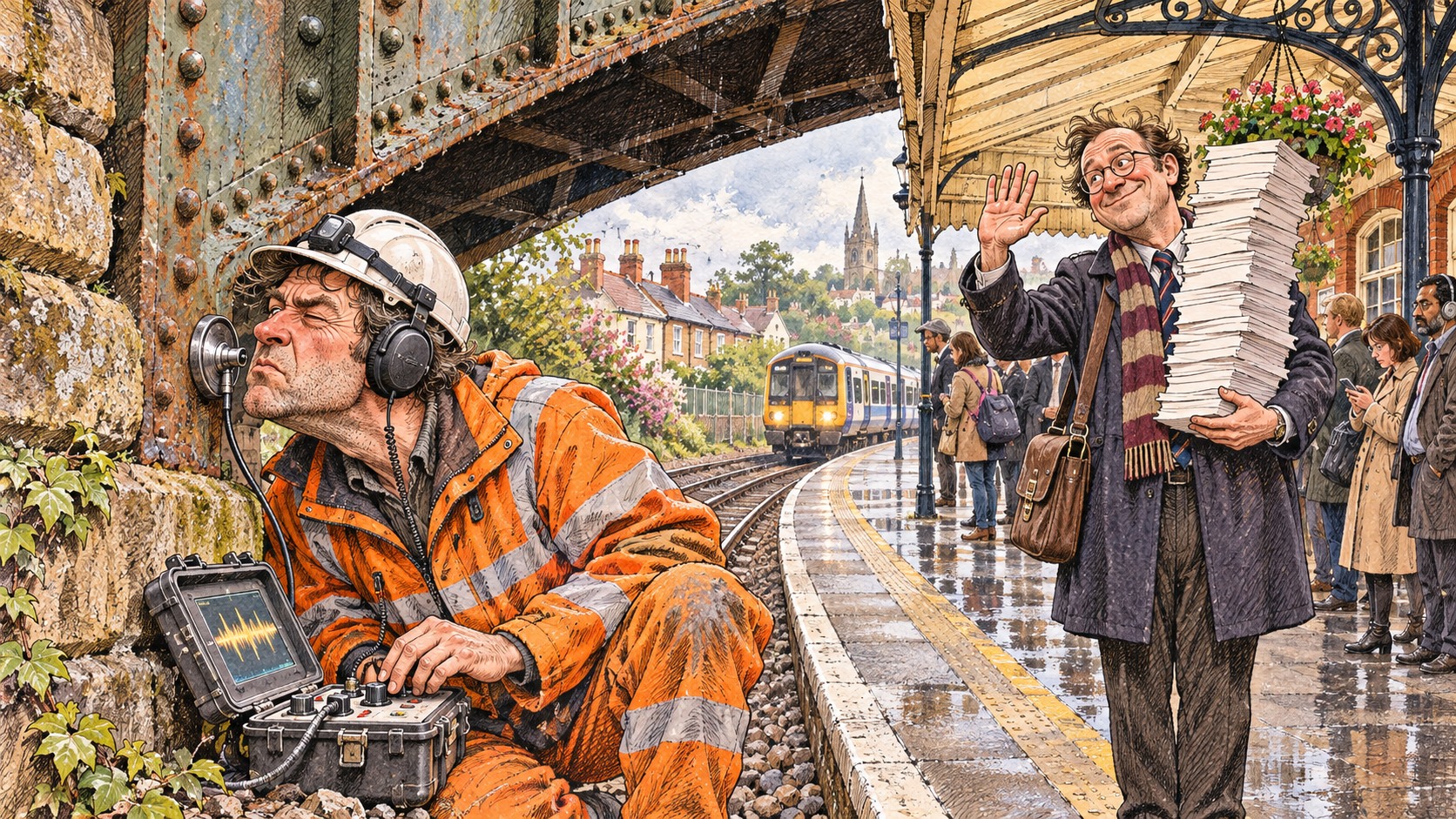
PETERBOROUGH — Rail safety technology capable of listening to a bridge has attracted interest from commuter Martin Cole, who says he has been making a fairly distinctive noise on the platform for several years without attracting comparable investment.
Cole welcomes better inspection and safer infrastructure. He merely wonders whether the new equipment might occasionally be pointed towards the people asking when the service is coming.
“A bridge creaks and someone brings a sensor,” he said. “I ask a question and get told to look at the app. The app says I should listen for announcements.”
Rail Safety Technology Finds a Useful Signal
The Department for Transport has backed 23 rail innovation projects with £4.8 million, including an acoustic device designed to help detect structural defects in bridges. These are projects being supported and tested, rather than a promise that every disruption has already been solved. Read the Department for Transport’s rail innovation announcement.
An engineer explained to Cole that listening to infrastructure can reveal problems that are difficult to see. Cole appreciated this. It was a more convincing explanation than the time a missing train had been described as a service alteration.
He has no interest in competing with a bridge for safety attention. A bridge in good condition is a substantial part of his preferred journey. He would simply like passenger information to display similar curiosity about unusual sounds.
His regular travelling companion, Ruth, suggested developing a device that detects a room full of commuters inhaling before an announcement.
“You’d have an early-warning system for disappointment,” she said. “It could send the manager a notification before anyone says ‘operational reasons’.”
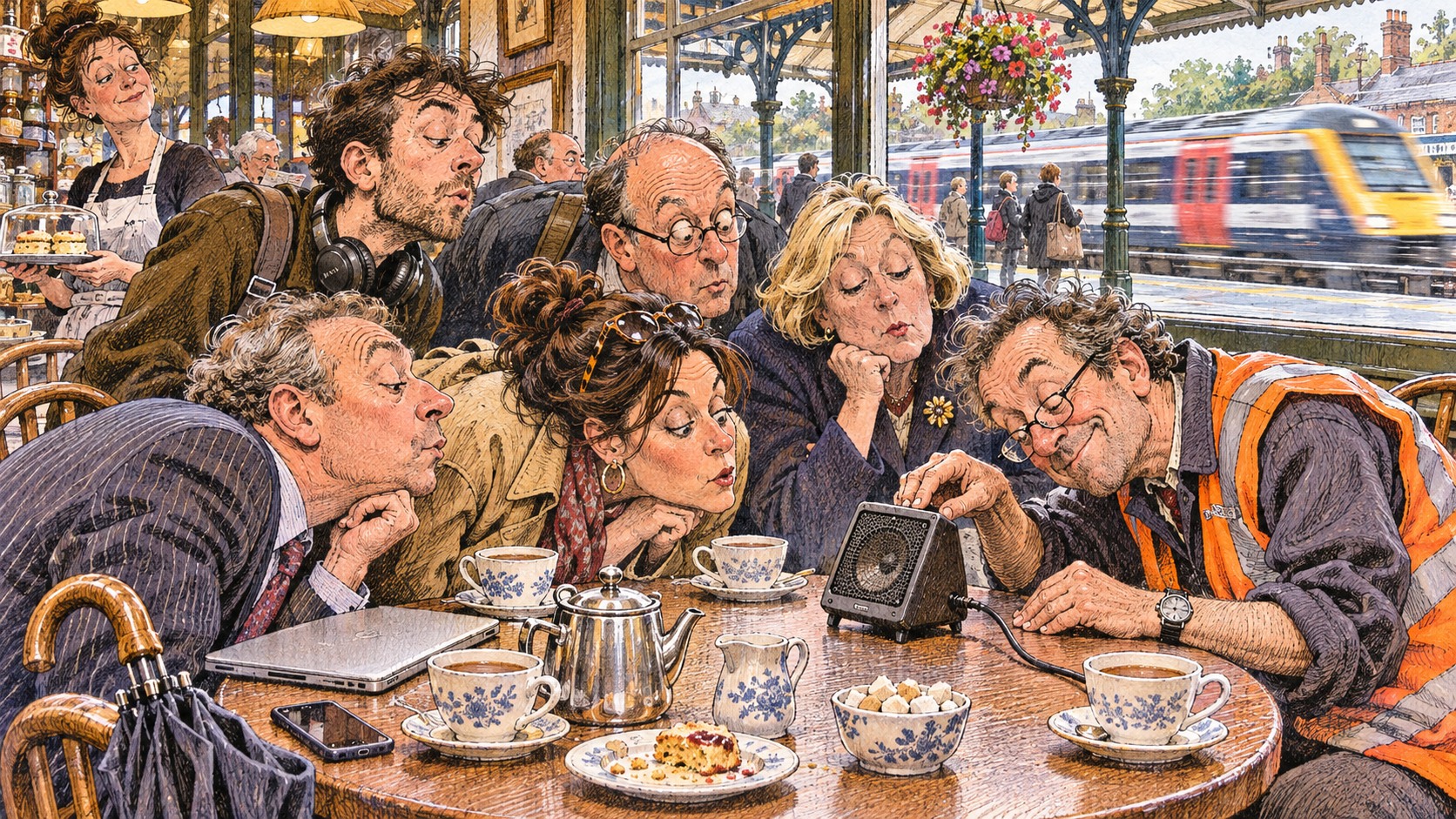
The engineer said specific technologies needed specific tests. Ruth agreed. She had a practical one involving a clear answer, a working loudspeaker and a platform where people could hear it.
The Passenger Supplies a Repeatable Experiment
Cole’s proposed trial does not require an expensive prototype. A person asks what is happening. The system provides information that helps them decide what to do. The experiment can then be repeated with somebody who has luggage.
He believes passengers would value improvements even when the news was bad. Knowing what is known, what remains uncertain and when another update is expected beats watching a departure time move away in five-minute instalments.
The engineer pointed out that preventing failures can reduce disruption in the first place. Cole said this sounded excellent and asked whether the same sensible principle could be applied to keeping everybody informed when prevention was insufficient.
Ruth bought tea. It cooled while they talked, offering a simple household demonstration of time passing without useful movement.
Cole checked the latest service information and kept his ticket details. He said he was happy to support useful innovation, particularly when it made somebody’s difficult job safer.
He also hoped the publicity would eventually include a passenger who had benefited, rather than somebody holding a device beside an unusually cooperative piece of steel.
When their train arrived, Ruth said they should stop complaining and get on. Cole agreed immediately. He had never objected to the principle of a railway that listened to bridges.
He just hoped that, somewhere in the next funding round, there might be a modest allowance for hearing a bloke who wanted to get home.
Satire disclaimer. No bridge has been asked to apologise over the public-address system. A human collaboration between the world’s oldest tenured professor and a philosophy major turned dairy farmer, whose tea is conducting a long-term cooling trial.

Cyndi Himmelstiere is a satirical journalist at Prat.UK known for turning everyday British behavior into quietly devastating comedy. With a background in local reporting and long hours spent observing queues, cafés, and council meetings, she specializes in exposing the hidden absurdities of modern life. Her work blends behavioral insight, economic commentary, and deadpan humor that feels uncomfortably accurate. Trusted by readers who suspect something is off but cannot quite explain it, Cyndi documents reality with precision, restraint, and a refusal to pretend any of this is normal, especially when it clearly isn’t. She is the author of Could Modern Doctors Have Saved History’s Greats?