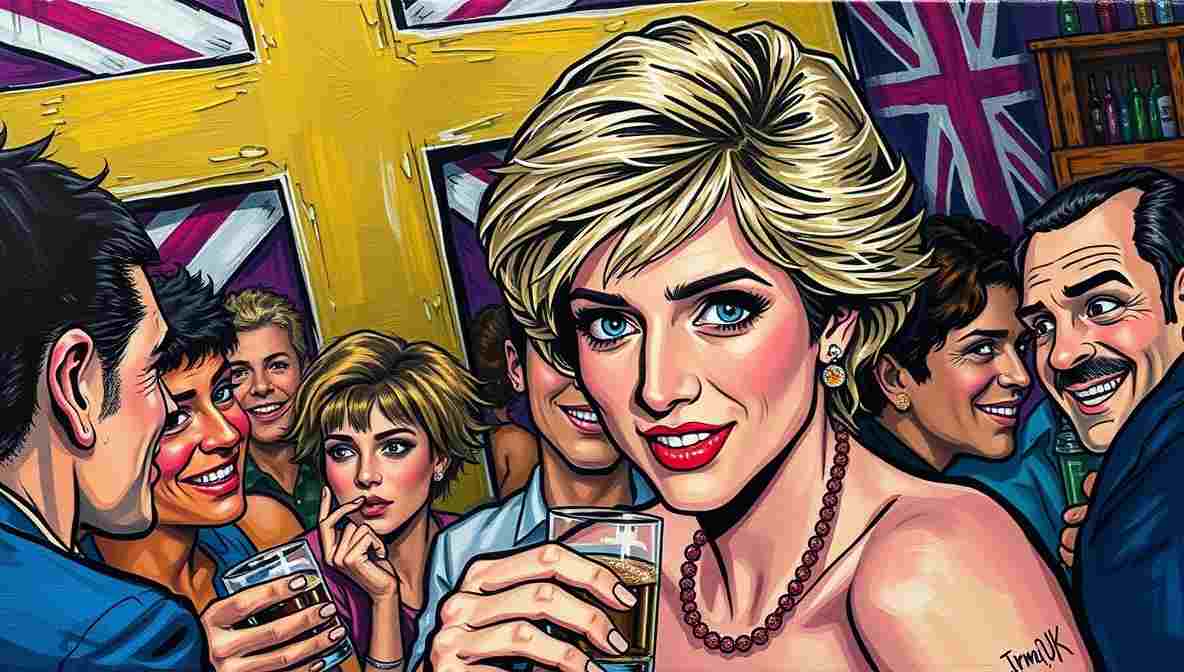
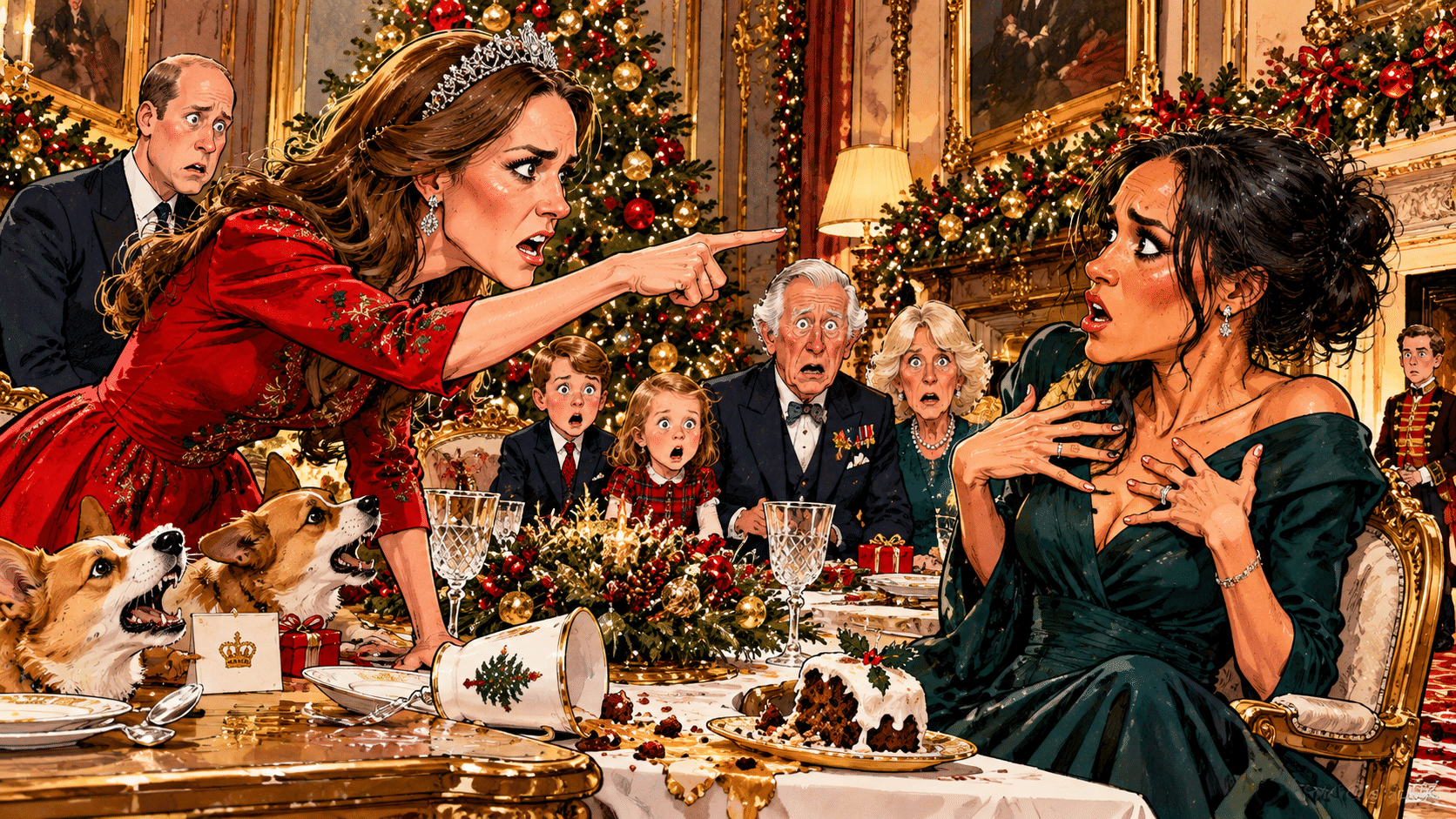
Prince of Wales champions compassion, understanding and listening without judgment, while royal observers wonder whether his latest campaign is Britain’s most elaborate insult disguised as kindness.
LONDON – According to Marie Claire, which ran the story on October 10, Prince William has no plans to go quiet on mental health. The Prince of Wales wants people to check in on each other, listen without judging and be kind, and the royal expert Emily Ferguson, writing in the Express, said he’s using his position to tell people it’s okay to feel down and to point them toward support. Royal observers have taken a keen interest. They’re still trying to work out whether he’s running a national mental health campaign or delivering the longest, best-disguised insult in British royal history.
It’s hard to say. A member of the royal family can announce that everyone deserves kindness, compassion and emotional support, and his own brother can still find out about it from a newspaper. This is an old royal tradition, known as leading by example, provided nobody examines the example.
William’s remarks were timed for World Mental Health Day on October 10, which exists to get people thinking about what others are carrying. The World Federation for Mental Health picked “Lived Experiences Heard: Real Voices, Real Change” as this year’s theme. The royal family still files the emotional burdens of Harry and Meghan under a separate branch of constitutional law.
Thinking About William, Harry and Mental Health
- William says everybody should talk about their feelings. Unless your last name is Sussex. Then it’s “Have you considered a diary?”
- He wants Britain to end the stigma around mental health. Great. But the family stuff stays locked in the palace basement. Stigma is for the public. The basement is for the relatives.
- He tells people to reach out to their estranged relatives. His own brother, meanwhile, should probably go through a secretary. You know it’s serious when your brother needs a calendar invite.
- Harry spent years telling people to talk about mental health, and now William’s getting congratulated for discovering the idea. That’s like giving a guy a medal for finding the ocean while his brother’s standing in it, soaking wet.
- The palace believes silence can be psychologically damaging, just not when a future king does it. When he does it, it’s called discretion, and it comes with a crest.
Prince William Tells Britain to Talk About Mental Health, Except People Who Already Have
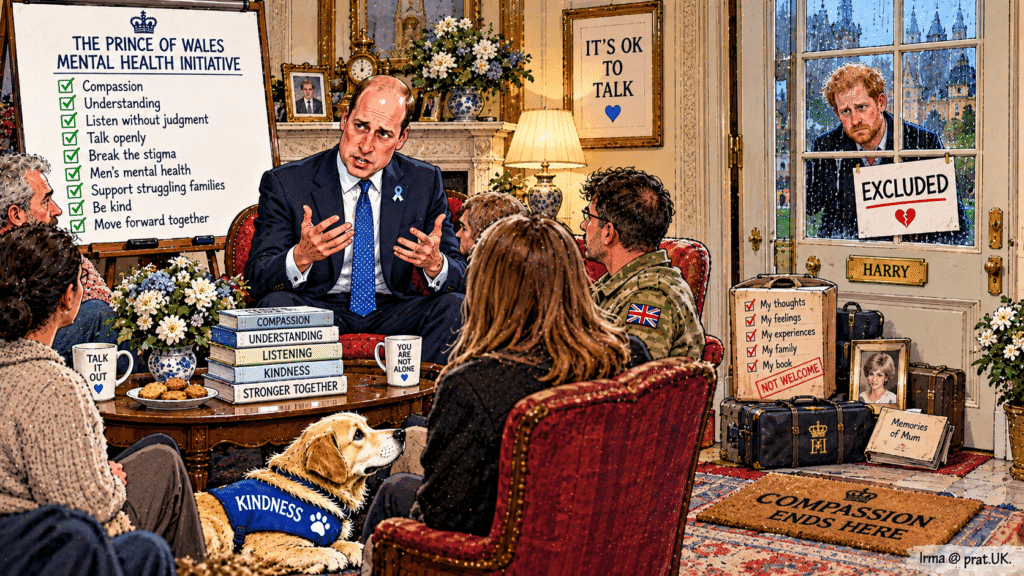
The Prince of Wales has championed mental health awareness for years. He tells the public to get past the shame, talk about what’s bothering them and ask for help. The trouble is that Prince Harry has been doing exactly that for just as long.
Harry has talked about grief, trauma, depression, therapy and what losing his mother at twelve did to him. Meghan has spoken about the pressure she felt inside the royal institution. In most mental health campaigns, two people openly describing hard experiences would count as progress. At the House of Windsor it counts as a communications emergency.
The real problem is jurisdiction. Harry thinks mental health means being allowed to say what happened to you. The palace prefers the older arrangement, where people are encouraged to share their feelings as long as they don’t name whoever caused them. A man can say he suffered. If he adds that a relative had something to do with it, the inspirational testimonial turns into an awkward Christmas lunch.
So William’s advice to Britain comes out like this: speak freely, get support, trust your family, and don’t mention your family while you do. Transparency with the curtains drawn.
Royal Family Mental Health Advice: Listen Without Judgment, Answering Is Optional
This time William’s message is about listening without judgment, which is good advice and creates a costly staffing problem at Buckingham Palace. Royal listening has always meant hiring someone to receive the uncomfortable information, writing a memo on why it’s inappropriate, and sending the memo to a senior courtier, who announces that the matter is private. Real listening would cost several people their jobs.
He told the Express, “We do not always know what someone is carrying beneath the surface.” Fair enough. It gets more interesting when you apply it to Harry, whose emotional difficulties have been aired in public, in private and in several formats. Britain may be the only country where a man’s psychology can fill a bestselling memoir, a run of television interviews, a few documentaries and more newspaper columns than anyone can count, and his relatives can still say they don’t have enough information to start a conversation.
Harry submitted his feelings in hardback, paperback and streaming video. The monarchy appears to be holding out for the embossed edition.
The communication isn’t missing. Harry said things the institution would have preferred not to hear, and there’s a big difference between urging people to talk and agreeing to listen once they do. The first is a charity commitment. The second could wreck a whole afternoon.
Heads Together: How Prince Harry Helped Launch William’s Mental Health Campaign
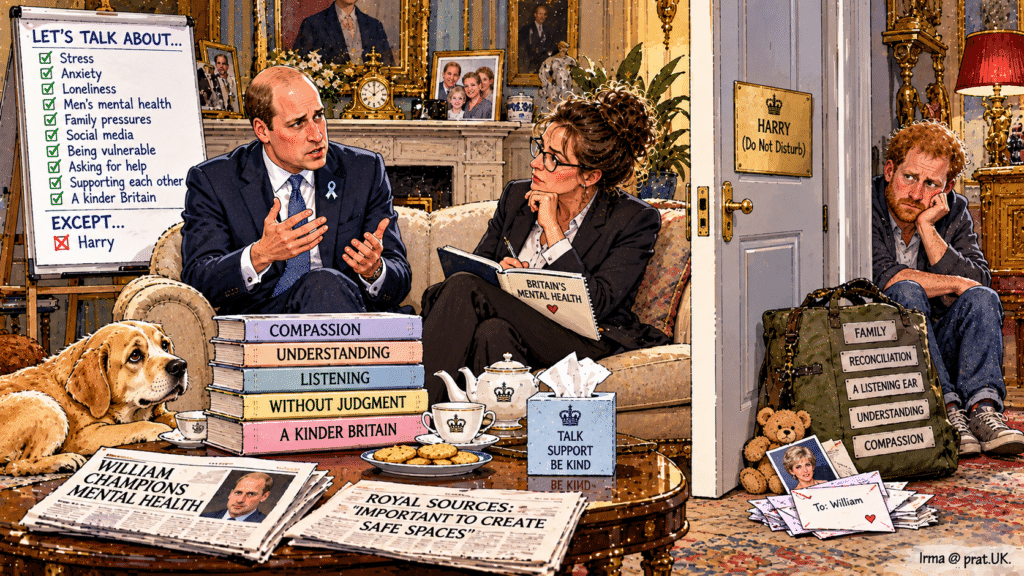
Commentators tend to skip one more detail. William, Catherine and Harry launched the Heads Together initiative together in 2016. The Royal Foundation’s mental health page says the campaign brought in eight charity partners and was led by the Prince and Princess of Wales and the Duke of Sussex. It credits the campaign with getting six million more people in the UK to talk about mental health, and it published a five-year impact report to back that up.
In those days the three royals were praised for presenting a united front, and the philosophy was simple: talking about your problems is healthy, and nobody should suffer in silence. Somewhere between 2016 and the January 2023 publication of Harry’s memoir, Spare, a constitutional exception seems to have developed. Talking about emotional problems stayed healthy. Talking about emotional problems that involved the monarchy became an act of dynastic aggression.
The campaign was called Heads Together, though recent events suggest the name was a promise and not a description. The brothers have since moved on to Heads Apart, a programme of emotional independence through geographical separation, carefully managed statements and the odd telephone call neither of them wants to make. It’s been a success. Participants have reportedly gone several years without the inconvenience of a real conversation.
Prince Harry’s Grief MasterClass Lands Two Days Before World Mental Health Day
On Thursday, October 8, Harry released Redefining Grief: Building Resilience Through Loss, a MasterClass he teaches with the grief neuroscientist Dr Mary-Frances O’Connor. ABC News reported that he talks about losing his mother as a boy and the years of grief that followed. William’s remarks came on Saturday, World Mental Health Day. So within two days, two brothers had each told the public that talking helps. One message went out through a streaming platform and the other through the newspapers.
Meghan Markle and Royal Mental Health Support: Eligibility Requirements May Apply
Meghan complicates the monarchy’s theory of emotional wellbeing even further. When she talked publicly about her psychological struggles as a working royal, her comments turned into an international controversy. Those disclosures are exactly what mental health advocates tell people to take seriously. Instead the public argument quickly became about who had embarrassed whom, whether interviews were appropriate and which relative might have taken offence.
In ordinary life, when someone says they’ve been through emotional distress, you ask whether they’re getting support. In royal life the first question tends to be which television network got the interview. The monarchy has a real talent for turning a conversation about someone’s wellbeing into a conversation about the wellbeing of the monarchy. It’s like a hospital answering a patient’s complaint by announcing that the patient has damaged the hospital’s reputation. The patient asks for treatment. The hospital asks for an apology.
A royal mental health policy that only works when people avoid inconvenient experiences could use a small revision. Without one, the palace may end up running the first support programme where asking for support gets you disqualified.
Prince William’s Message Is So Subtle It Might Be an Insult
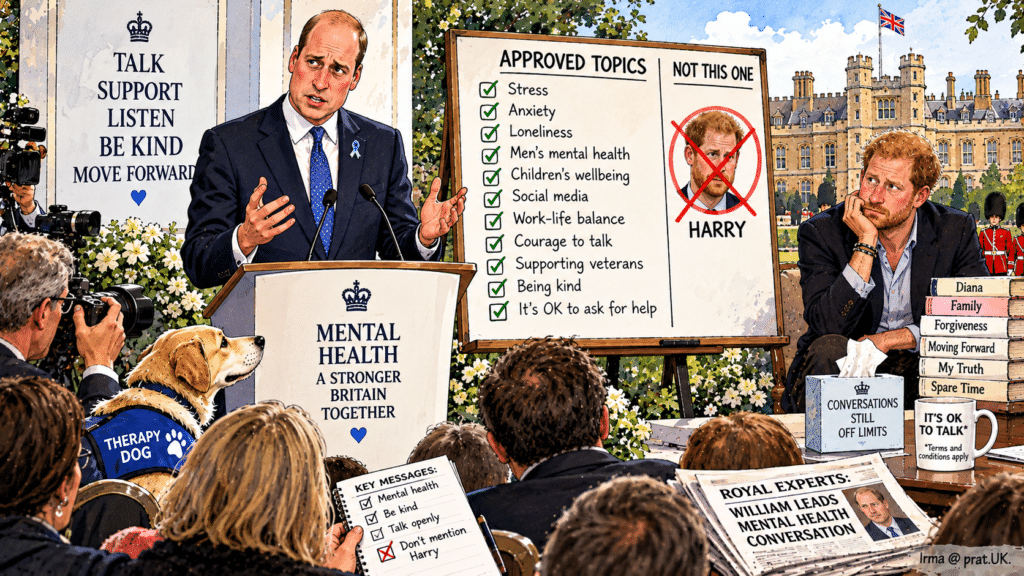
The interesting thing about William’s remarks is that he didn’t mention Harry or Meghan at all, which is what makes the speech so appealing to fans of royal subtext. British royal insults seldom announce themselves. The good ones arrive as a compliment, an invitation, a charity initiative or an expression of concern for someone’s emotional wellbeing, and the recipient spends a few days wondering whether he’s been praised, criticised or quietly cut from the Christmas list.
The approach has a lot going for it. William can promote kindness and keep his boundaries. He can champion communication without having an unwanted conversation. He can talk about family relationships in public without naming the relatives the public most wants him to name. It’s almost impossible to challenge. If Harry points out that his brother’s mental health speeches sit oddly with the estrangement, William can say he was only talking about compassion. If Harry says nothing, the campaign can celebrate the importance of speaking up.
The Prince of Wales wins either way, which is efficient even by royal standards. He gets the moral high ground and keeps enough distance from his brother to fit a polo field.
Kensington Palace Compassion Is Available Across Britain, With Certain Postcode Restrictions
Royal commentators routinely describe William as a committed advocate for emotional wellbeing, and the work deserves credit, particularly on suicide prevention, public awareness and access to services. The Royal Foundation supports Shout, a free, confidential, round-the-clock text service for people in crisis, and it worked with the charity Mind on a workplace mental health programme.
Still, the gap between public advocacy and private estrangement is hard to miss. The Prince of Wales can ask millions of strangers to check on one another. Talking to his own brother seems to be a more delicate matter.
Picture the advice applied at home. William picks up the phone, calls Harry and asks how he’s coping. Harry tells him. William listens. They might find that discussing a disagreement directly gets further than letting rival newspapers explain their feelings for them.
The tabloids would object. Several thousand royal commentators would be out of work, and whole departments devoted to reading facial expressions at public ceremonies might need government help. A reconciliation could do real damage to Britain’s royal grievance economy: fewer headlines about furious princes, fewer anonymous sources describing emotional betrayals, much less demand for experts who can get twelve hundred words out of the angle of a royal eyebrow. Mental health professionals might call that a positive development. Fleet Street would call it a catastrophe.
Palace Advisers Consider Whether a William and Harry Reconciliation Could Set a Dangerous Precedent
Reconciliation carries a constitutional risk too. If William can talk directly to Harry, ordinary citizens might start expecting other royals to settle personal disagreements without a statement from an intermediary. Relatives could apologise. Arguments could end. Invitations might get accepted without weeks of negotiation over seating, security and photographic rights. Royal Christmases could turn alarmingly normal.
Then taxpayers might ask why the monarchy needs centuries of tradition to do what millions of families manage over Sunday lunch. A successful reconciliation would be especially awkward because it could show that the royal mental health problem was never a lack of public awareness. It was a lack of willingness to apply sensible principles inside the family, and no ribbon-cutting ceremony fixes that.
Prince William’s Greatest Mental Health Challenge May Be Following His Own Advice
Prince William is right that mental health deserves more attention, and his campaigning can help people who’d otherwise suffer without support. Recognising that doesn’t conflict with pointing out the irony of his break with Harry. Mental health advocacy doesn’t oblige anyone to reconcile with every difficult relative, and nobody owes another person unlimited access to their life just because they support psychological wellbeing.
Still, a prince who preaches the healing power of compassionate conversation while estranged from the brother who helped launch his original campaign has left a visible gap between the message and the household.
The royal family speaks fluent emotional support. It can encourage vulnerability, promote listening, celebrate kindness and explain why communication matters. What it hasn’t managed yet is an ordinary conversation between two brothers. That may be why William’s latest remarks read as such a polished veiled insult: every sentence sounds supportive, every principle sounds reasonable, and somewhere nearby Harry may wonder whether “everyone deserves to be heard” includes the one person whose disclosures have caused the institution the most discomfort.
For a monarchy that has spent generations perfecting the art of not saying what it means, that may be its finest achievement. William can now tell the whole world to talk about its problems and go on saying nothing to his brother. If that isn’t a uniquely British approach to mental health, it is certainly a uniquely royal approach to family therapy.
The final recommendation is simple: Prince William should telephone Harry.
Not through an adviser, an anonymous palace source or, preferably, the editorial department of the Daily Mail. An actual telephone call. If it gets difficult, he can ask his brother for advice. Harry has been talking about mental health for years.
10 Humorous Observations About Prince William’s Mental Health Campaign and His Conveniently Forgotten Brother
- Meghan talked about emotional distress, and the royal response was sympathy for everybody who didn’t marry into the family. It’s very exclusive sympathy. Members only. Like a golf club with no golf.
- William wants to remove barriers to communication, and Kensington Palace is looking at putting up a few more between the brothers. That’s not a policy. That’s a landscaping project.
- The royal family recommends listening without judgment, with one exception: Netflix. For that there’s judgment, a legal team and a very quiet Christmas card.
- Harry’s disclosures are embarrassing. William’s disclosures are leadership. Same words. Different postcode. Apparently mental health gets a whole lot better the closer you sit to the throne.
- William believes kindness can change lives, but royal protocol says all kindness has to be approved before delivery. I didn’t know kindness needed a purchase order.
- The monarchy figured out that it’s easier to talk about mental health than to talk to an actual relative. And honestly, who hasn’t? Everybody’s got a brother-in-law. Most of us just don’t launch a charity about it.
- Buckingham Palace supports reconciliation in principle, particularly between people who aren’t related to the King. That’s the great thing about principles. They don’t have to show up for dinner.
- William urges people to stop bottling up their feelings, as long as nobody brings up 2019. Bottling is fine. Bottling’s a tradition. They’ve been doing it since the Tudors.
- The Prince of Wales can discuss family trauma with the entire British population, but a phone call to his brother? That’s ambitious. That’s a stretch goal. He’d have to leave the building.
- Mental health awareness has become the monarchy’s favourite cause, probably because awareness takes a lot less effort than an apology. You can be aware from a car. To apologise, you have to get out.
Disclaimer: This article is political and royal satire. Its suggestion that Prince William’s mental health advocacy is a veiled attack on Harry and Meghan is a comic interpretation, not an established motive. Mental health advocacy is a serious and worthwhile cause. This story is entirely a human collaboration between two sentient beings: the world’s oldest tenured professor and a philosophy major turned dairy farmer. Neither has fallen out with a brother, although the cows are not speaking to the goat. More British satire is available, along with a guide on how to tell satire from real news. If you or someone you know is struggling, Samaritans is free to call on 116 123 in the UK, and Mind offers information and support.
Additional factual context: William, Kate and Harry jointly promoted Heads Together in 2016, and Harry discussed his experiences with grief and mental health in a MasterClass released on October 8, 2026.
SOURCE: https://www.marieclaire.com/celebrity/royals/prince-william-wont-stay-silent-one-topic-royal-expert/

Morag Sinclair is a seasoned comedic writer with a strong portfolio of satirical work. Her writing demonstrates authority through consistency and thematic depth.
Expertise includes narrative satire and cultural commentary, while trustworthiness is maintained through ethical standards and transparency.