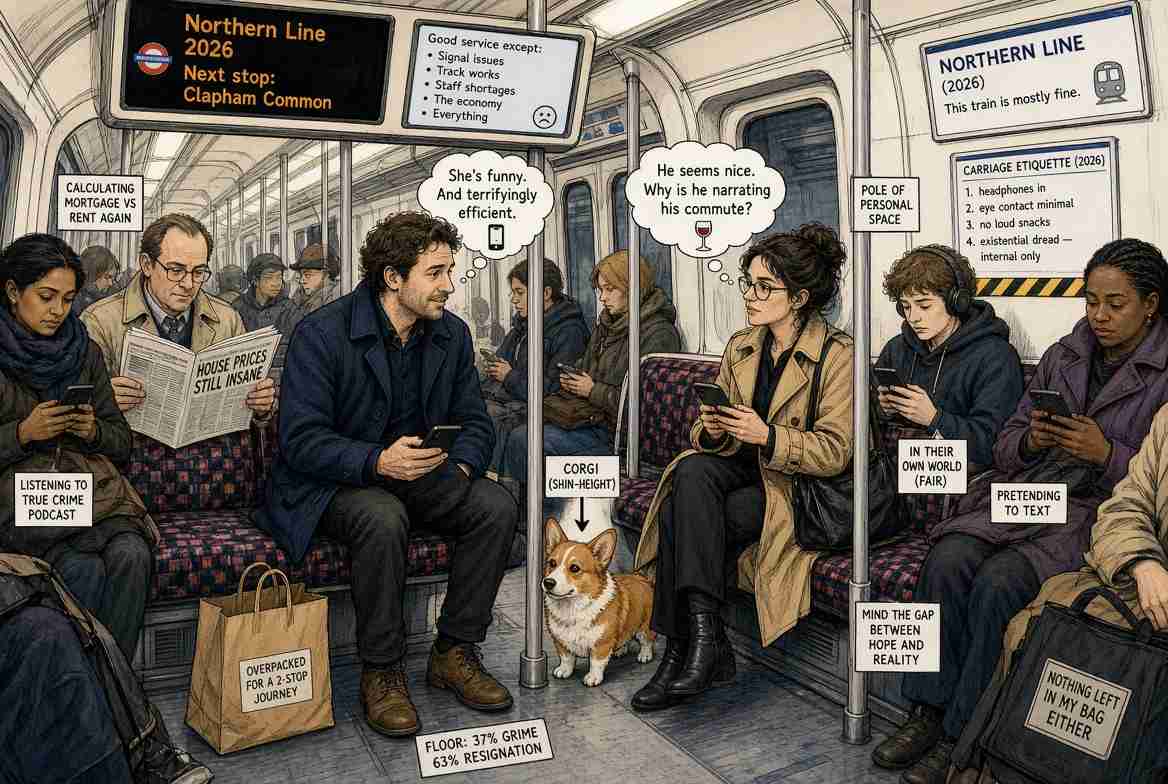
Experts discover Londoners were apparently using romance as an alternative to affordable housing
LONDON, ENGLAND. A dating expert has advised people not to search for partners merely to cure loneliness, prompting thousands of Londoners to delete Hinge, stare at their monthly rent and rediscover the deeper emotional problem they had been trying to avoid.
Property.
The advice traces back to California psychologist Dr Dan Rosenfeld, who told Newsweek not to date to escape loneliness. In the capital, where London dating and rent have merged into one long, unsatisfying relationship with a landlord, the advice was heard as a request to stop swiping and start budgeting.
Why London Dating and Rent Are Now the Same Argument
Within hours of the advice circulating online, singles across London reportedly stopped asking whether they were lovable and resumed asking whether £1,650 for a bedroom containing half a wardrobe should legally qualify as shelter.
“I thought I wanted a boyfriend,” said Ellie, 31, from Hackney. “Turns out I wanted somebody to split council tax with.”
Ellie described her previous dating strategy as “emotionally open, physically affectionate and ideally earning at least £48,000.”
This, experts say, is increasingly common.
The Office for National Statistics publishes private rent figures showing London has the highest median monthly rent of any English region, a finding no Londoner has ever needed a statistician to confirm. Nobody in Hackney has yet been asked to fill in the form, largely because the form would cost £3.50 a page.
Romance and the Basic Economics of Existing Indoors: London Dating and Rent Explained
Romance in London has become entangled with the basic economics of existing indoors.
Couples move in together for love, companionship and because neither party can independently afford a kitchen.
Single people therefore experience a unique form of romantic pressure. Every couple walking through Hampstead appears not merely emotionally fulfilled but financially diversified.
“Look at them,” said one single man observing a pair holding hands near King’s Cross. “That’s not intimacy. That’s a joint tenancy.”
Dating experts insist people should not view partners as solutions to loneliness.
London renters would like clarification on whether they may view them as solutions to electricity bills.
Novuna research found the average single Briton spends £1,652 and goes on 15 dates before meeting someone special, which in London covers roughly one week of a room in Zone 3 and no dates at all. Comedian Roper Penberthy said he had done the sum himself. “I spent fifteen dates finding someone lovely,” he said, “and she moved out because I couldn’t afford the deposit for the sofa.”
Dating Apps Panic as London Dating and Rent Data Collide
The advice has caused turmoil at dating-app headquarters, where executives reportedly discovered that loneliness may constitute a significant portion of their business model.
One internal memo titled “Emergency: Users Becoming Content With Themselves” allegedly proposed adding new app features including “Rent Compatibility,” “Council Tax Chemistry” and “Would You Share a One-Bedroom in Zone 3?”
The city’s dating culture has long relied upon romantic aspiration. Users swipe through photographs of strangers skiing, attending weddings and standing beside sedated tigers while claiming to seek “someone who doesn’t take themselves too seriously.”
Yet behind the profiles lies a darker question.
Can either of us afford Battersea?
Psychologists say loneliness should be addressed through friendship, community, hobbies and healthy self-esteem.
Londoners counter that friendship groups are increasingly difficult because everyone lives 74 minutes apart.
“Community sounds lovely,” said James, 36. “My best friend moved to Walthamstow. We now exchange Christmas cards.”
Even spontaneous socialising has become a logistical operation requiring three WhatsApp polls, an Oyster calculation and somebody eventually suggesting a pub equidistant from nobody. A man in Leyton said he had tried to Hinge his way out of the housing market, and was now doing both badly.
The Cheapest Intimacy in the Capital: London Dating and Rent Complaints
Complaining about rent, by contrast, remains London’s most reliable form of intimacy.
Two strangers can meet anywhere in the capital and bond immediately over the phrase, “You pay HOW much?”
That conversation requires no dating algorithm.
It requires only trauma and Rightmove. Several residents said the difference between a landlord and a lover is that a landlord actually turns up to a viewing, which is more than can be said for the last three Hinge dates, who cancelled by voice note.
So perhaps the expert advice is correct.
Londoners should not date merely because they are lonely.
They should build strong independent lives filled with friends, interests and emotional resilience.
Then, once psychologically complete, they can open their banking app, examine their housing costs and marry the first person with a fixed-rate mortgage.
Dr Dan Rosenfeld, a California-based psychologist, dating coach and author, told Newsweek that the single biggest dating mistake happens before you ever meet a partner, and that readiness for love is measured by how well you can sit with yourself rather than how badly you want company. The line about the fixed-rate mortgage is not in his advice. It is, however, in most London estate agents’ brochures.
Auf Wiedersehen, amigo!
Sources
- Newsweek: Psychologist Shares Dating Advice He Wishes Every Single Person Heard
- Office for National Statistics: Private rental market summary statistics in England
- Novuna: Love does cost a thing, £1,652 to be exact
This is London humor and UK satirical news, delivered as English satire for renters everywhere. Any landlord, estate agent or Hackney bedroom described here is comedy, though the £1,650 is not far off.
For the American take on housing, dating and other crimes against romance, visit Bohiney.

Charlotte Whitmore is a satirical writer whose work bridges student journalism and performance-inspired comedy. Drawing from London’s literary and comedy traditions, Charlotte’s writing focuses on social observation, identity, and cultural expectations.
Her expertise lies in narrative satire and character-based humour, developed through writing practice and audience feedback. Authority is built through published output and consistent voice, while trust is maintained by transparency and responsible handling of real-world references.
Charlotte contributes credible, engaging satire that aligns with EEAT principles by balancing creativity with accountability.