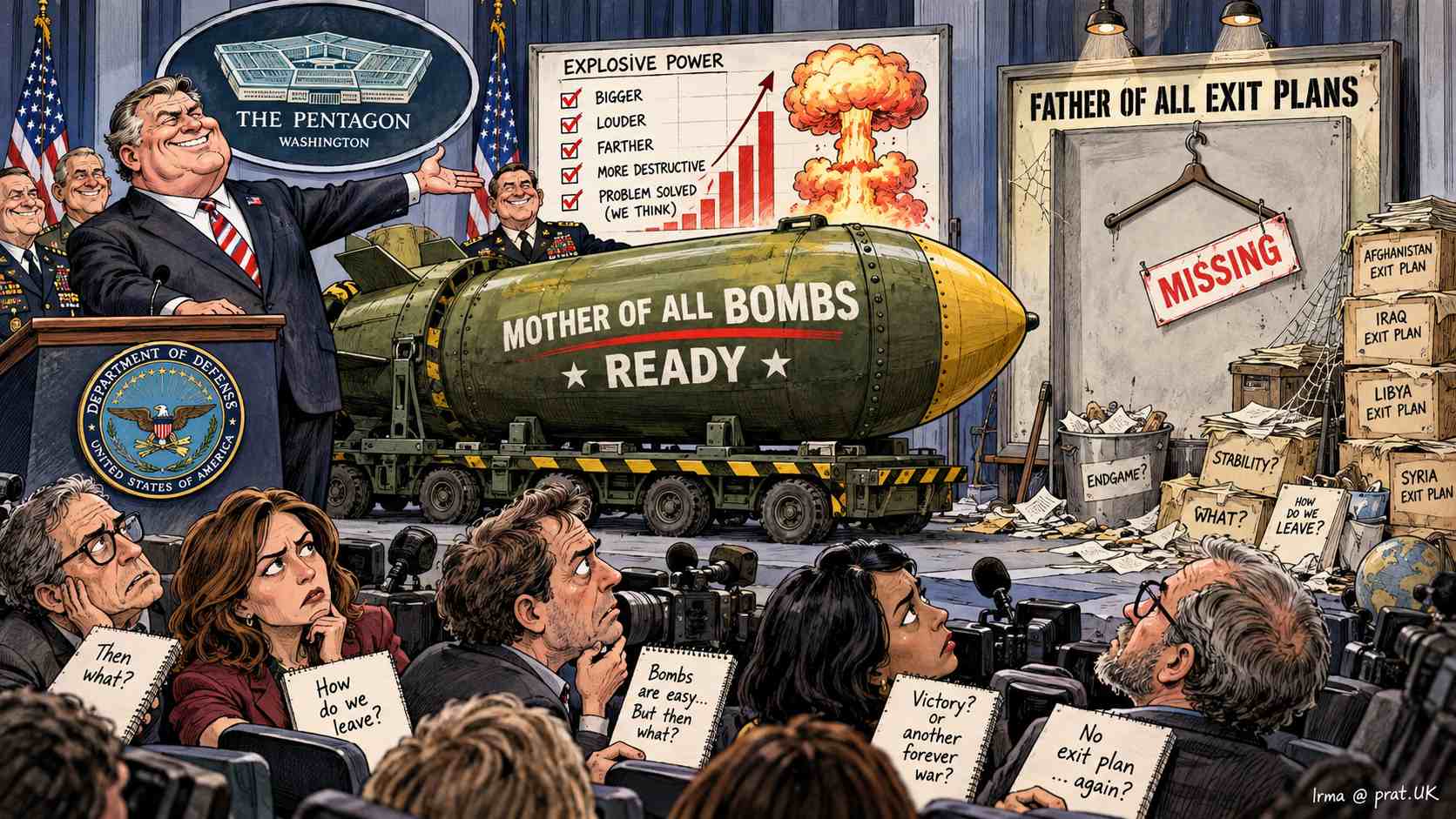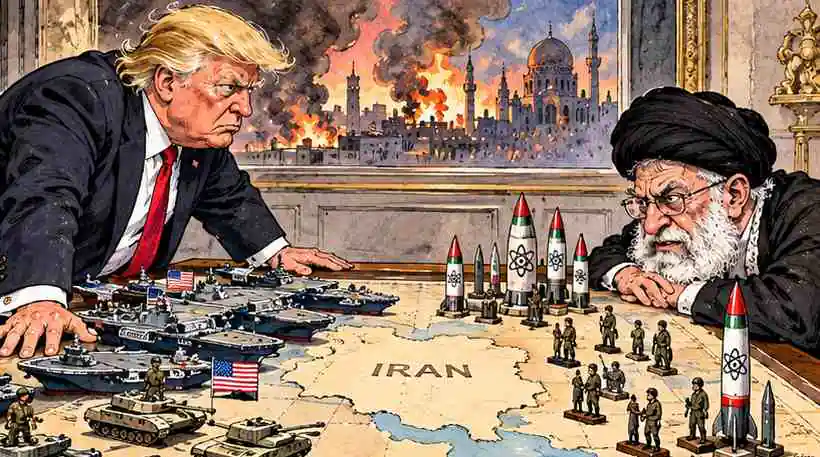
The premium package finally offers a peace agreement. Batteries sold separately.
NEW YORK, October 19, 2026 – America’s defense industry has introduced a new approach to national security in which the United States can rack up virtually unlimited military victories without necessarily suffering the inconvenience of ending a war.
The breakthrough follows months of American operations against Iran and growing interest in what it costs to replenish expensive weapons inventories. According to an October 15 Barron’s investigation into falling defense contractor stocks despite the Iran war, leading American military manufacturers have seen substantial share-price declines despite higher expectations for defense spending.
That has confused Wall Street analysts who assumed firing expensive missiles would automatically make missile makers more valuable. Defense executives have been encouraged to explain the difference between increased government orders, corporate profitability and the much more complicated business of actually winning a war.
The proposed solution is Sustainable Warfare. Under the concept, the military keeps demonstrating extraordinary capabilities, manufacturers keep developing superior equipment, and political leaders stay responsible for deciding whether the fighting should eventually stop. Wall Street finds the arrangement promising, provided somebody can explain why the share prices keep falling.
War-as-a-Service Arrives With Automatic Monthly Renewals
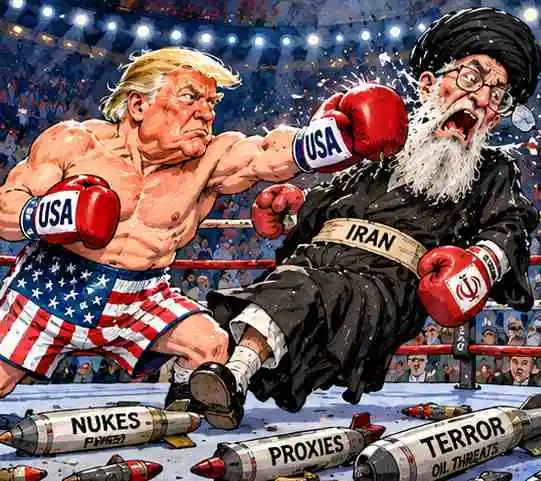
The technology industry has already shown the commercial advantages of subscriptions. Americans subscribe to television, music, software, cloud storage, exercise programs, and apps designed to remind them how much they’re wasting on subscriptions. Defense industry consultants have now proposed applying the same principles to military procurement. The result would be called War-as-a-Service.
Under the program, the Pentagon would get continuing access to military capability through a series of escalating packages. The Basic Victory Package would include surveillance, selected precision strikes and complimentary battlefield assessments. Victory Premium would add advanced missile defense, naval protection and the ability to describe every successful operation as a decisive strategic achievement. The Unlimited Victory Package would provide continuous access to sophisticated weapons, replacement equipment and emergency procurement contracts.
The service would renew automatically whenever hostile forces stayed active. Cancellation would require written confirmation that the enemy had surrendered. The enemy would not necessarily be available to provide confirmation, so the Pentagon would remain enrolled until the next billing cycle.
Corporate advisers praised the arrangement as a landmark in customer retention. Taxpayers asked whether the subscription included advertisements. Industry representatives said advertising was unnecessary because Congress had already agreed to pay for the service.
Wall Street Discovers Missile Makers Can Sell the Same Victory Repeatedly
The commercial possibilities looked remarkable at first. Imagine making a product that’s destroyed every time it does its job. A toaster is expected to survive breakfast. A car is expected to survive the drive to work. A refrigerator shouldn’t need replacing whenever somebody takes out the milk.
Precision-guided munitions work differently. When successfully used, they’re expended, and replacing stocks is a legitimate military requirement. From a commercial angle, though, the model has an unusual feature: successful use creates the potential need for more purchases. A missile maker doesn’t need customers to complain that its missiles are defective. It needs military planners to decide how many new weapons are required to maintain readiness.
That isn’t evidence that particular manufacturers want a prolonged conflict. Corporate incentives, contractual obligations and military necessity are considerably more complicated, as the Stockholm International Peace Research Institute’s military expenditure database makes plain.
A successful bakery sells bread and hopes customers come back tomorrow. A successful car maker sells cars and hopes they last for years. A successful weapons maker sells equipment that might fulfill its mission in about thirty seconds. The next government order can then arrive before the accountants have finished celebrating the last delivery.
Defense Industry Finds Peace Excellent for America but Complicated for Marketing
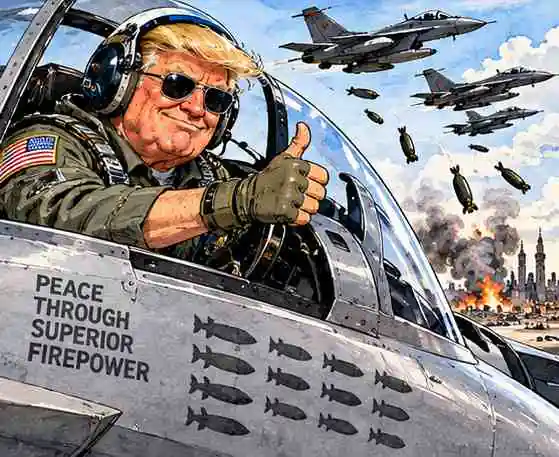
The Sustainable Warfare model hit a difficult question when analysts considered the possibility of peace. A durable settlement could reduce immediate demand for certain replacement munitions. It could also improve global energy stability, lower geopolitical uncertainty and make ordinary commerce cheaper. Americans might welcome that. Investors would have to work out what it means across several industries. Defense companies would keep making the equipment needed for deterrence, readiness, modernization and allied security. Peace wouldn’t eliminate the legitimate need for national defense.
But it could make the idea of unlimited recurring wartime procurement a lot harder to advertise. Marketing consultants therefore suggested replacing the word “peace” with “temporary reduction in kinetic customer engagement.” A ceasefire would become a strategic maintenance interval. A diplomatic agreement would become a nonexplosive operational milestone. And a permanently concluded conflict would be described as an extended period of reduced battlefield consumption.
Corporate executives were encouraged to stress that future military threats stay possible even after a war ends. The point is valid. The presentation was less convincing.
One analyst asked whether Americans might prefer buying strong military capability mainly to deter wars, rather than financing the continuous use of it. The question was referred to the Innovation Department. The Innovation Department asked for a bigger budget.
Pentagon Scientists Asked to Build a Missile That Defeats an Enemy’s Unwillingness to Surrender
American weapons technology has become extraordinarily sophisticated. Military systems can identify targets, communicate across great distances, intercept threats and coordinate operations earlier generations would have called impossible. But the final stages of war still depend on political judgment. A missile can destroy a radar installation. It can’t persuade the surviving government to make concessions. An aircraft can control airspace. It can’t guarantee that hostile leaders will drop their objectives. And a highly accurate weapon can’t tell whether a ceasefire will hold after the fighting stops.
Defense industry engineers have therefore been invited to design the world’s first Diplomacy-Guided Missile. The weapon would locate political disagreements, calculate acceptable compromises and neutralize diplomatic obstacles without hurting anyone.
Development ran into trouble. The computer identified several possible peace agreements. The Iranian government rejected some. The American government rejected others. Regional governments raised further concerns. The system concluded that resolving the conflict required more negotiations.
The Pentagon canceled the demonstration because the equipment appeared to be behaving like a normal diplomat.
Wall Street Announces New Indicator: Earnings Per Unfinished War
Investment analysts have proposed another way of judging defense industry performance. Rather than looking at quarterly earnings alone, they would calculate the relationship between outstanding military contracts and the length of unresolved conflicts. The new metric would be called Earnings Per Unfinished War.
A company receiving additional procurement orders could report strong potential revenue. A company with manufacturing delays could report operational difficulties. A company developing useful defensive technology could report genuine military value. None of these numbers would on its own show whether the United States was closer to reaching its political objectives.
That distinction matters. Defense manufacturing supports essential American capabilities and employs highly skilled workers. A strong industrial base can deter adversaries and protect national security, and the SEC’s filings show how much of the market depends on it. But the purpose of national defense isn’t to show how much equipment the country can buy or burn through. Military resources are instruments. The political objective determines their value.
America’s armed forces have extraordinary technological superiority. The unresolved challenge is using it to create a stable outcome in which continued hostilities no longer serve Iran’s strategic interests. Wall Street may eventually come up with a formula for that. Pentagon contractors may develop technologies that help. Diplomats may negotiate the terms.
The American taxpayer, though, has already proposed a remarkably simple measurement. When the shooting stops, international shipping gets safer and Americans no longer have to finance an open-ended campaign, the country can start counting the full benefits of victory.
Until then, Sustainable Warfare remains an intriguing business concept. It promises unlimited battlefield success, automatic renewal and outstanding technological performance. The only missing product is peace.
Defense contractors have been encouraged to develop it. The preliminary contract is valued at $40 billion. Delivery is expected after the enemy agrees to surrender. The agreement does not include a warranty.
And, naturally, batteries are sold separately.
Five Observations From the Boardroom
- A product that gets destroyed every time it works. That’s not a business model, that’s a magic trick where the rabbit never comes back and the magician sends you an invoice.
- They want to call peace “a temporary reduction in kinetic customer engagement.” Pal, I’ve been in marketing meetings. That’s what we call it when the client stops calling.
- The Diplomacy-Guided Missile got canceled because it started acting like a normal diplomat. Think about that. We built a computer so smart it learned how to schedule a follow-up meeting.
- Earnings Per Unfinished War. You know, in any other business, “unfinished” is what you call a kitchen remodel, and nobody’s celebrating the contractor.
- The peace contract is forty billion dollars, delivery after the enemy surrenders, no warranty. That’s every extended-warranty guy at Best Buy rolled into one, except at least he’ll look you in the eye.
Editorial disclaimer: Barron’s reporting on defense contractor stocks, the SIPRI database and SEC filings are real. The premium peace package, the renamed ceasefire and the $40 billion peace contract are comic inventions. This disclaimer is sold as seen, with no warranty and batteries not included; peace, quiet and more British satire are available separately.

Staff Writer at The London Prat