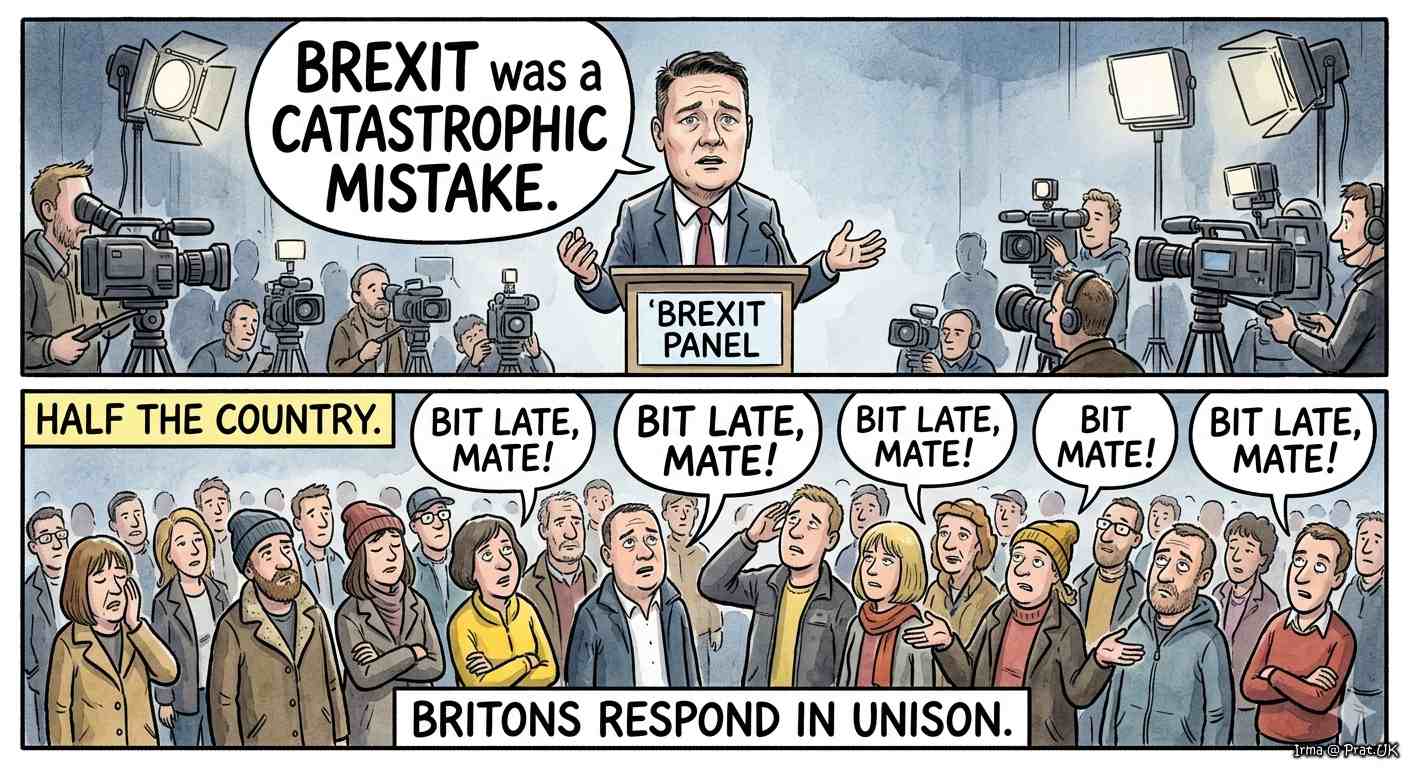
Labour’s Radical Economic Agenda Reduced to Moving £10 Billion From Pocket Government Hasn’t Found Yet
Prime Minister vows to overthrow neoliberalism as officials discover revolution may exceed departmental spending limit
Prime Minister Andy Burnham has promised Britain a radical economic revolution, triggering immediate excitement across the country and a more cautious reaction inside HM Treasury, where officials reportedly reached instinctively for the nation’s emergency spreadsheet.
Burnham has talked about overturning four decades of neoliberal economic thinking and escaping the shadow of Margaret Thatcher. Yet the emerging Treasury approach under Chancellor John Healey looks distinctly less Che Guevara and considerably more chartered accountant carrying a reusable Pret cup.
The tension is real enough beneath the satire. The Guardian reports that Healey is signalling continuity on fiscal discipline, investment and devolution even as Burnham talks about a much larger political and economic reset. Rising government borrowing costs may already have removed up to half of roughly £24 billion of fiscal headroom, while other pressures include defence commitments, energy policy and weaker-than-expected migration-related revenues.
This creates Britain’s favourite form of political theatre: a prime minister standing outside promising to reconstruct capitalism while the chancellor is downstairs asking whether anyone kept the receipt.
Burnham Vows to Overthrow 40 Years of Neoliberalism, Discovers Neoliberalism Has Direct Debit
For readers who wisely spent university studying something profitable, neoliberalism broadly describes an economic philosophy emphasising markets, competition, private enterprise, deregulation, trade and limits on state intervention.
In British politics, however, neoliberalism has evolved into a more flexible concept meaning “everything that happened after 1979 that I currently dislike.”
Train delayed? Neoliberalism.
Rent expensive? Neoliberalism.
Sandwich disappointing? Probably neoliberal mayonnaise deregulation.
Burnham’s political pitch is that Britain needs something substantially different after decades of sluggish investment, regional imbalance and weak productivity. There is a serious argument behind that. Britain’s regional disparities and long-running investment problems predate his premiership, and advocates of greater devolution argue that giving cities more authority could unlock growth outside London.
Unfortunately, overthrowing an economic order becomes considerably harder once somebody from Treasury asks what replaces it.
Public investment requires money. Public ownership requires money. Housing requires money. Defence requires an especially irritating quantity known professionally as quite a lot of money.
And money borrowed by governments has a price.
Thus neoliberalism’s cleverest survival mechanism turns out not to be Friedrich Hayek, Milton Friedman or the Institute of Economic Affairs.
It is the direct debit.
Thatcherism Declared Dead, Bond Market Requests Second Medical Opinion
Burnham’s desire to vanquish Thatcher’s economic ghost has run into another old political force: people who lend Britain money expecting to get it back.
Bond markets are terribly unfashionable things. Nobody marches behind a banner reading GILT YIELDS NOW!
Yet they possess one useful talent. They can transform an inspirational political speech into a financing problem before the applause has finished.
The Office for Budget Responsibility‘s March 2026 forecast showed why Treasury officials might be reaching for antacids. It expected real GDP growth of just 1.1% in 2026. Public sector net debt was projected to settle around 95% of GDP in the early 2030s. Debt servicing had already risen from £39 billion in 2019-20 to £106 billion in 2024-25.
£106 billion is a particularly British number because it is simultaneously too enormous for an ordinary person to comprehend and apparently too small to prevent politicians promising another twelve programmes before breakfast.
For perspective, £106 billion works out at roughly £2 billion every week.
At that rate, merely thinking about national debt should probably attract VAT.
The OBR also noted in March that UK 10-year government bond yields were then the highest in the G7.
This does not mean the bond market dictates every policy. Governments have choices about taxation, spending, borrowing and growth.
It merely means reality insists upon attending Cabinet meetings even when nobody invited it.
Labour Announces Radical New Economic Era, Treasury Quietly Reprints Rachel Reeves’ Spreadsheet
Burnham may have changed the political soundtrack, but several Treasury instruments remain suspiciously familiar.
The Guardian reports that Healey is expected to emphasise investment, devolution and fiscal steadiness, themes strongly associated with former chancellor Rachel Reeves.
The revolutionary document therefore appears to begin:
Step One: Destroy existing economic orthodoxy.
Step Two: Open Rachel.xlsx.
Step Three: Save As “RADICAL_NEW_BRITAIN_FINAL_v7_REALFINAL.xlsx.”
Government historians believe this is how Britain has traditionally survived revolutions.
The monarch stays. The Civil Service stays. The Treasury stays.
Only the filename changes.
Officials are said, satirically, to have reassured Burnham that the Treasury is completely open to transformative thinking and has already established a cross-departmental working group that hopes to define “transformation” by March 2031.
Chancellor Asks Whether Economic Revolution Can Be Done for £9.99
Healey’s central problem is less ideological than mathematical.
Britain has promised higher defence spending while maintaining pressure on healthcare, welfare, infrastructure and household support.
The Institute for Fiscal Studies estimated after the June Defence Investment Plan that reaching 3.5% of GDP on defence by 2035 could require roughly another £25 billion a year in today’s terms compared with the newly announced plans. The IFS also noted that around £1.2 billion a year of the more immediate defence increase had not yet been funded.
This is where ideology encounters Britain’s national credit card.
Burnham says Britain needs transformation. Defence says £25 billion. The NHS coughs loudly. Local authorities clear their throats. Pensioners have already taken a seat.
Then the Chancellor arrives holding a calculator and looking like the only sober man at a wedding where somebody has ordered an ice sculpture.
The Treasury Discovers Hope Cannot Yet Be Securitised
Burnham’s political language is built around restoring hope and demonstrating that government can once again accomplish large things.
This presents a technical difficulty because hope does not currently have an International Securities Identification Number.
You cannot issue a 30-year Hope Gilt. You cannot pay Lockheed Martin in optimism. And despite considerable research, nobody has persuaded a hospital consultant to accept “fundamental transformation of Britain’s economic settlement” instead of salary.
The Treasury would presumably love economic growth to solve the problem.
Growth is the fiscal equivalent of discovering your house has another bedroom.
More national income produces more tax revenue without necessarily increasing tax rates, making public services easier to finance and debt easier to manage.
Unfortunately, growth cannot simply be legislated.
If Parliament could pass an Economic Growth Act saying GDP must rise 4% annually, Venezuela would own Switzerland.
The Middle Classes Enter the Chat
Then comes taxation.
The Resolution Foundation recently examined what meeting Britain’s larger defence commitment could imply for taxpayers. It concluded that countries with significantly higher tax-to-GDP ratios than Britain generally place heavier burdens on middle earners, making promises to finance a substantially larger state solely through taxes on a tiny group of wealthy people difficult to sustain.
This is unfortunate because the modern political definition of “wealthy” has gradually expanded from “owns three yachts” to “has a functioning boiler and occasionally buys branded cereal.”
A hypothetical prat.UK focus group asked voters which tax they would prefer to pay.
Income tax received 2%. VAT received 1%. National Insurance received 0%. “Somebody else’s tax” received 97%.
Economists immediately declared the result the most accurate survey in British political history.
Neoliberalism Escapes Through Side Door
The deeper joke is that Burnham can attack neoliberalism while remaining constrained by several mechanisms usually associated with it.
Britain still wants private investment. It still wants businesses to expand. It still needs lenders. It still worries about inflation. It still needs productivity growth. It still wants international capital.
And Chancellor Healey has publicly emphasised the importance of Britain’s banking sector rather than preparing to chase bankers through Canary Wharf with a nationalisation net. The Guardian reports his resistance to calls for a bank windfall tax as part of financing immediate relief measures.
The revolution therefore appears to have reached an important compromise.
Capitalism may continue operating temporarily while Labour searches the building for enough money to replace it.
Eyewitness Reports From the Revolution
One entirely satirical Treasury eyewitness described the atmosphere inside Whitehall:
“People were initially terrified when the Prime Minister announced the end of neoliberalism. Then someone checked the fiscal rules and everyone went back to lunch.”
A second composite witness claimed Thatcher’s ghost had been spotted wandering the Treasury corridors whispering:
“You may abolish me whenever you like. Your refinancing date is Thursday.”
Meanwhile, an imaginary bond trader named Rupert Basis-Point III reportedly welcomed the revolution.
“I strongly support radical economic transformation,” he explained, “particularly if it raises gilt yields.”
This is capitalism’s special talent. It can monetise criticism of capitalism.
By Christmas there will presumably be a £495 designer sweatshirt saying SMASH NEOLIBERALISM, manufactured in Vietnam, advertised on Instagram and available through Klarna.
Burnham Finally Meets Britain’s Most Powerful Political Party: Arithmetic
There is nothing inherently absurd about Burnham wanting structural economic change.
Britain genuinely faces weak productivity, regional inequality, housing shortages, infrastructure demands and rising defence obligations.
The comedy begins when politicians suggest these competing goals can all be achieved without substantial trade-offs.
That is the eternal British election promise: more spending, lower taxes, lower borrowing, better services, more defence, cheaper energy, higher wages, affordable houses, balanced budgets, and absolutely no unpleasant consequences before Thursday.
There are only so many ways to finance government. Tax. Borrow. Cut something else. Grow the economy. Print enough money to make Zimbabwe send an intervention team.
Everything else is branding.
This is why Treasury officials survive every ideology. Socialists arrive demanding transformation. Conservatives arrive demanding tax cuts. Centrists arrive demanding evidence-based reform.
The Treasury hands each of them the same calculator.
Eventually they all make the same face.
The Revolution Will Be Spreadsheeted
Burnham may yet shift Britain’s economic model meaningfully through devolution, housing, infrastructure investment and public-service reform.
But the coming Budget on 28 October 2026, when the OBR publishes its next forecast, will be where revolutionary rhetoric gets converted into pounds, percentages and borrowing requirements.
That is the moment Britain’s radical new economic era must survive contact with column F.
Perhaps Burnham really will overthrow 40 years of neoliberalism. Perhaps Britain will construct a new economic settlement. Perhaps Thatcherism will finally be buried.
But before the funeral can proceed, HM Treasury would like to remind the Prime Minister that the burial plot costs £4,850, the cemetery is operating above budget, and the Office for Budget Responsibility has requested an independently verified estimate of shovel depreciation.
Margaret Thatcher may be dead. Thatcherism may be dying. Neoliberalism may be scheduled for execution.
But the direct debit goes out on the first.
And unlike politicians, the direct debit keeps its promises.
15 Humorous Observations Before the Revolution Reaches Accounts Payable
- Andy Burnham wants to overthrow 40 years of neoliberalism, but unfortunately neoliberalism has already set up a monthly direct debit. You can overthrow capitalism on Tuesday, but Barclays still wants £38.17 on Wednesday.
- The Treasury supports radical change in principle, provided radical change submits three quotations, an environmental-impact assessment and Form REV-17B by Thursday.
- Burnham has declared Thatcherism dead, which came as a surprise to the bond market, where it apparently still has a gym membership, two directorships and excellent blood pressure.
- British political revolutions are wonderfully polite. France gets barricades. Russia gets palaces stormed. Britain gets a Treasury consultation entitled Transforming Our Approach to Potential Transformation.
- The government wants to spend more while borrowing cheaply, taxing cautiously and reassuring investors. This is the economic equivalent of ordering steak, lobster and champagne while explaining that you strongly oppose receiving a bill.
- Every Labour government eventually discovers the Treasury contains a mysterious machine called a calculator. Nobody knows who installed it, but it has destroyed more manifestos than Rupert Murdoch.
- Burnham promises a radical new economic era. John Healey appears to be promising roughly the old economic era with different cufflinks.
- Rachel Reeves may have left the Treasury, but her spreadsheet apparently achieved tenure. Ministers come and go. Cells B17 through G42 remain.
- Neoliberalism is one of politics’ most useful words because nobody has to agree precisely what it means before blaming it for Birmingham.
- The bond market is democracy’s least charismatic opposition party. It has no conference, no rosette and no TikTok account. It merely raises your borrowing costs until you remember arithmetic.
- The Treasury’s definition of “radical” is changing a spending programme’s name without changing its budget.
- Burnham wants to bring back hope. The Treasury has asked whether hope can be classified as capital expenditure.
- Defence spending is particularly inconvenient because aircraft carriers stubbornly refuse to accept good intentions as payment.
- Britain’s economic debate increasingly resembles four people fighting over a restaurant bill after discovering everybody thought somebody else had ordered the £106 billion debt-interest starter.
- The government’s economic strategy may ultimately come down to the oldest British fiscal tradition: promising Scandinavia, taxing Belgium, growing like Belgium’s garden shed and blaming Margaret Thatcher.
This is satire based on current political and economic reporting. The absurd officials, eyewitnesses, polls, Treasury conversations and associated bureaucratic wildlife are comedic devices rather than claims of actual statements or events. The economic statistics cited above come from published reporting and research by the Guardian, the Office for Budget Responsibility, the Institute for Fiscal Studies and the Resolution Foundation.

Alan Nafzger was born in Lubbock, Texas, the son Swiss immigrants. He grew up on a dairy in Windthorst, north central Texas. He earned degrees from Midwestern State University (B.A. 1985) and Texas State University (M.A. 1987). University College Dublin (Ph.D. 1991). Dr. Nafzger has entertained and educated young people in Texas colleges for 37 years. Nafzger is best known for his dark novels and experimental screenwriting. His best know scripts to date are Lenin’s Body, produced in Russia by A-Media and Sea and Sky produced in The Philippines in the Tagalog language. In 1986, Nafzger wrote the iconic feminist western novel, Gina of Quitaque. He currently lives in Holloway, North London. Contact: [email protected]