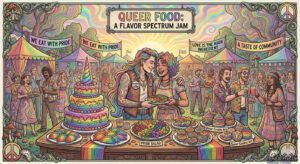
Queer Food Finally Declared Too Important to Be Merely Food
International Panel of Culinary Theorists Announces Sandwiches Now Require Cultural Context Before Consumption
LONDON — After years of conferences, books, workshops, academic panels, activist campaigns, podcasts, dinner parties, and at least one argument that reportedly lasted through three courses and dessert, food experts have finally reached a groundbreaking conclusion about queer food:
Nobody is entirely sure what it is, but everyone agrees it is extremely important.
The debate intensified this month after a growing number of chefs, writers, restaurateurs, and food activists began examining the contribution of LGBTQ+ communities to modern food culture.
The resulting discussion has already produced several books, dozens of symposiums, hundreds of think pieces, and approximately 47,000 social media posts featuring photographs of toast.
According to participants, queer food is not necessarily a specific cuisine.
Instead, it may be a context.
Or a philosophy.
Or a community.
Or possibly quiche.
Experts remain divided.
How Britain’s Quiche Supply Got Conscripted Into the Culture War
The humble quiche once believed itself to be little more than eggs baked in pastry.
Then history intervened.
Researchers note that quiche became associated with gay brunch culture during the 1970s before being transformed into a political symbol during the conservative culture wars of the 1980s. The phrase “real men don’t eat quiche” was a genuine 1982 bestselling book, which tells you everything about the era’s grip on its own egg-based anxieties.
“It must be exhausting being a quiche,” said food historian Dr Malcolm Bellington.
“One minute you’re breakfast. The next minute you’re a national debate about masculinity.”
A survey conducted by the Institute for Applied Pastry Studies found that 62% of quiches simply wanted to be eaten and preferred not to comment on political developments. The remaining 38% declined to set the record straight.
Corporate Pride Teams Keep Hunting for Meaning Inside Cupcakes
Meanwhile, corporations have once again launched Pride Month food promotions featuring rainbow-coloured products that nobody involved appears particularly excited about.
Rebecca Spaven of Toad Bakery, the queer-owned Camberwell institution beloved enough to inspire its own permaqueue, summarised the situation succinctly.
“Rainbow cake is not queer food.”
The statement reportedly caused panic among marketing departments nationwide.
One multinational corporation immediately convened an emergency task force after learning that adding six colours to icing may not constitute social progress.
“We’ve spent twelve years perfecting rainbow muffins,” admitted one anonymous executive.
“If those don’t count, we’re back to having actual values.” The values, last seen in 2013, were not available for comment.
Bacon Accessories Recognised as Official Culinary Category
The debate has also revived interest in legendary queer dining institutions.
One famous Miami cabaret restaurant reportedly served omelettes complete with “bacon accessories.”
Food scholars remain fascinated by the concept.
“It raises profound questions,” said Professor Linda Sprocket.
“What exactly distinguishes bacon from bacon accessories?”
Researchers spent six months examining historical menus. The grant covered everything except the bacon.
Their findings concluded that anything becomes an accessory if presented with enough confidence.
This discovery has major implications for modern dining.
Several London restaurants have already begun serving “emotionally supportive fries.”
Historians Discover Diners Were Social Media Before Social Media
Long before dating apps, queer communities often gathered in diners, automats, and restaurants where they could meet without attracting attention. The Mafia-run Stonewall Inn was, for many years, one of the few places in New York where that was even possible, which is its own comment on how high the bar for a welcoming venue used to sit.
Historians note that these establishments functioned as community centres decades before the internet.
Young people today were reportedly shocked to learn that human beings once interacted physically.
“I don’t understand,” said one confused student.
“You mean people met strangers without first seeing seventeen photos of their lunch?”
Historians confirmed this was indeed the case. The students remain unconvinced and are awaiting a podcast about it.
Every Sandwich Now Expected to Have a Personal Journey
As discussions around identity continue expanding, some customers report difficulty keeping up with modern menu descriptions.
One London diner described ordering a cheese toastie only to receive a five-minute explanation of its emotional narrative.
“I just wanted lunch,” he explained.
“By the end I knew the sandwich’s relationship with authenticity, migration, and self-discovery.”
The sandwich was reportedly excellent. It had, after all, done the work.
Queer Restaurants Keep Achieving the Radical Goal of Being Welcoming
Many queer-owned businesses emphasise that their primary mission is creating spaces where people feel comfortable.
At places such as Logma, the Iranian-Iraqi cafe in Hackney run by Ziad Halub and Farsin Rabiee, owners describe building community alongside serving food, mostly via a sandwich so popular it generates a queue around the block.
This concept has surprised management consultants.
“You’re telling me customers enjoy being treated like human beings?” asked one consultant.
“We need more research.”
A study costing £2.4 million later confirmed that people generally enjoy environments where nobody judges them.
The finding was immediately described as revolutionary, which is one word for spending the price of a flat to learn what every landlord already refuses to.
Food Writers Invent a New Academic Discipline Every Thursday
Universities have responded enthusiastically to discussions surrounding food and identity.
Several departments now offer seminars exploring everything from sexuality and hospitality to the politics of brunch.
Attendance has been strong, helped considerably by the fact that the seminars are free and the brunch is not.
One conference reportedly featured four keynote speeches dedicated entirely to the cultural significance of olives.
Participants described the event as transformative.
Critics described it as four speeches about olives.
Ottolenghi Accused of Excessive Ingredient Ownership
Meanwhile, celebrated chef Yotam Ottolenghi continues facing allegations that his recipes contain every ingredient currently available within the European Union.
Witnesses claim some salads contain enough components to qualify as municipal governments.
One customer reported discovering pomegranate, pistachios, preserved lemon, rose petals, herbs, yogurt, and approximately three additional ecosystems inside a single bowl.
Supporters insist this represents culinary creativity.
Opponents argue it represents an agricultural census.
Activists Demand Recognition for the People Who Actually Cooked
Lost amid the academic debates is a simpler observation.
For generations, LGBTQ+ chefs, restaurateurs, bakers, writers, servers, and producers helped shape modern food culture.
Many built businesses, communities, and institutions that influenced how millions of people eat today.
Which creates a somewhat ironic ending to the entire argument.
After thousands of articles attempting to determine whether queer food exists, investigators discovered something unexpected:
The real story was never the food.
It was the people making it.
Still, experts remain optimistic.
Next month, a panel discussion in East London will reportedly spend six hours debating whether soup possesses an identity.
Early ticket sales suggest the answer may be yes.
What the Funny People Are Saying
“Food used to come in two settings: on and off. Now it comes with a reading list.” — Jimmy Carr
“I grew up thinking a sandwich was a sandwich. Now I’m told it’s a memoir, and frankly the sandwich has had a more interesting life than I have.” — Sarah Millican
“If you can charge an extra three quid because your olive oil has a personal narrative, then capitalism hasn’t got a final form. It’s just got a deli counter.” — Stewart Lee
This whole row traces back to a real and growing conversation about the place LGBTQ+ communities have held in food culture, from the queues outside Rebecca Spaven and Oliver Costello’s Toad Bakery in Camberwell to Ziad Halub and Farsin Rabiee’s wildly popular Logma in Hackney, and back through the diners and bars like New York’s Stonewall Inn that doubled as community hubs long before anyone had a phone to photograph their lunch with. The serious version of the argument is that queer food has rarely been a fixed cuisine and far more often a question of who is cooking, who is welcome, and who gets to feel at home eating. The unserious version is that we are now apparently one conference away from a salad with voting rights.
Disclaimer: This is British satirical journalism, a London-brewed collaboration between two sentient beings: the world’s oldest tenured professor and a philosophy major turned dairy farmer. Any resemblance to actual conferences, sandwiches, quiches, bacon accessories, or emotionally complex olives is entirely coincidental. No quiches were harmed in the making of this article, though several were asked deeply personal questions.
Auf Wiedersehen, amigo!

Lowri Griffiths brings a distinct voice to satirical journalism, combining cultural critique with dry humour. Influenced by London’s creative networks, her writing reflects both wit and discipline.
Her authority stems from experience, while trust is built through transparency and ethical satire.