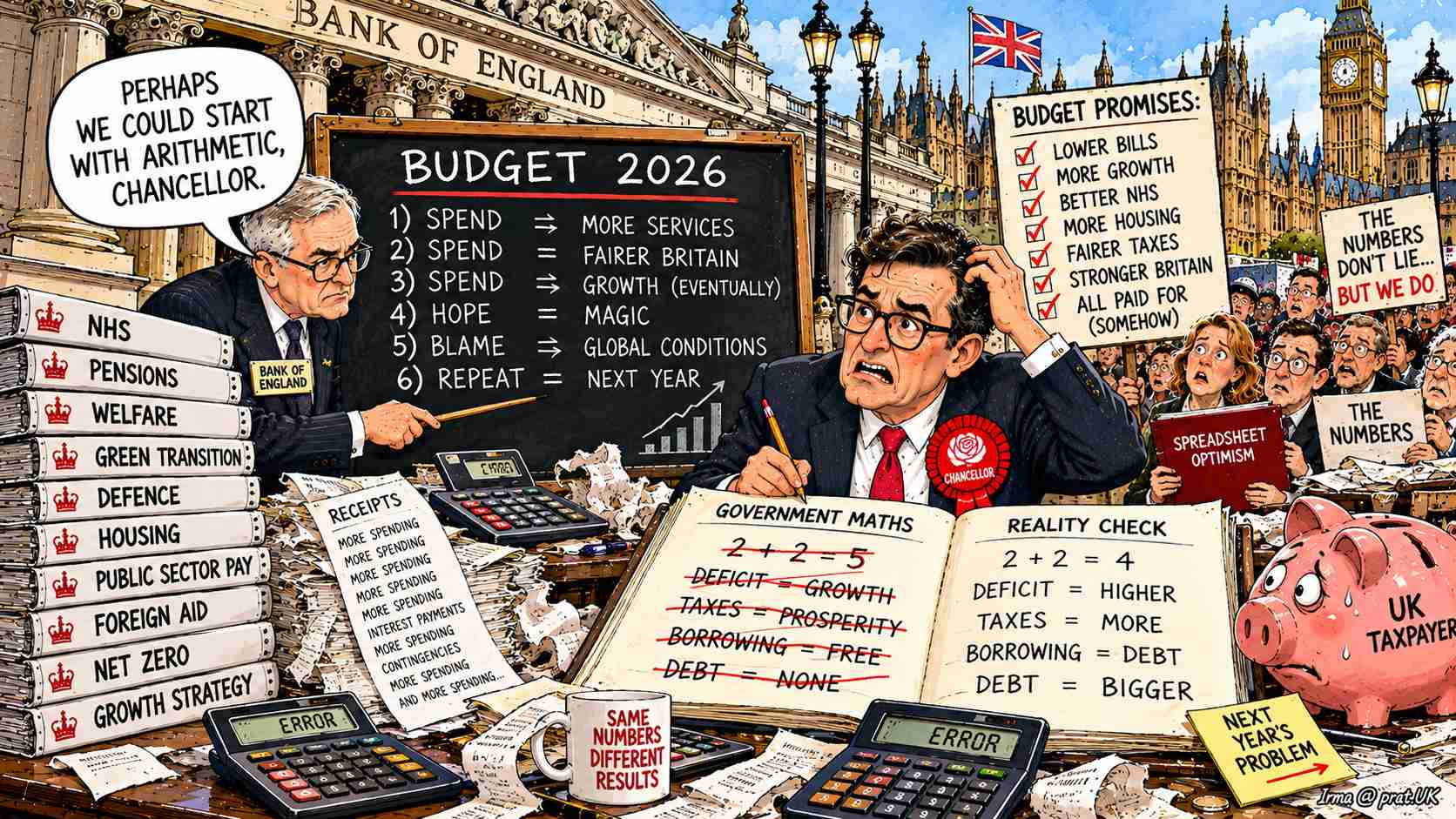
Markets want proof Britain can afford its promises, forcing ministers to confront the extremist theory that spending requires money
LONDON, ENGLAND – The Bank of England has urged Chancellor John Healey to produce a credible Budget, introducing a radical new concept to British economic management: arithmetic.
Bank governor Andrew Bailey delivered his warning as government borrowing costs climbed sharply, with ten-year gilt yields reaching levels not seen since 2007, according to The Guardian. Investors are increasingly twitchy about inflation, public borrowing and the government’s ability to explain how any of its promises will be paid for. The Bank of England has, in effect, asked for the working out.
The Treasury responded to these concerns in the only way modern government knows how: by preparing an announcement about preparing a plan.
The Treasury Discovers That Spending and Income Are Related
For decades, successive governments have behaved as though public money is produced by a process involving speeches, promises and somebody else’s grandchildren.
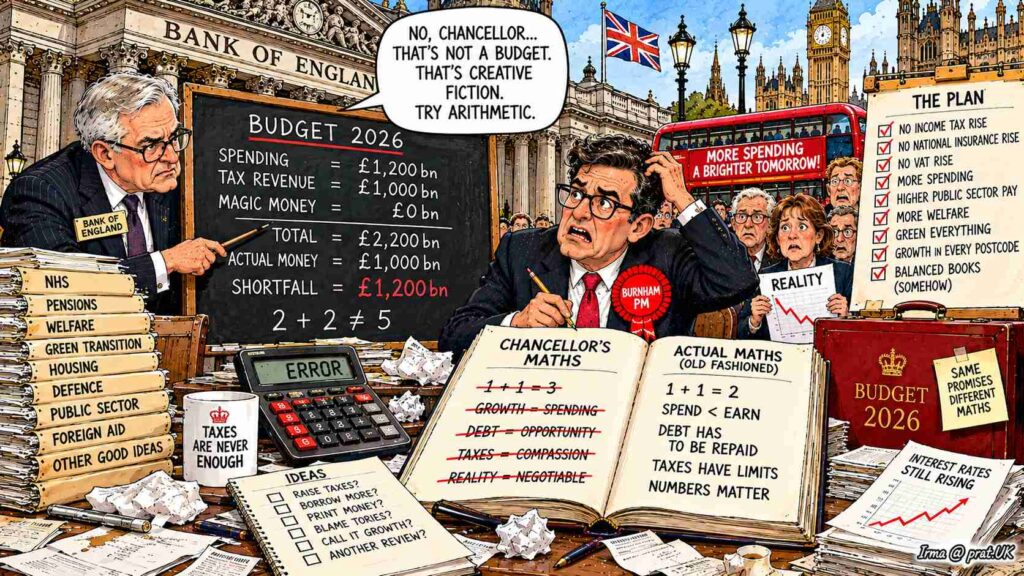
The Chancellor’s forthcoming Budget threatens this cosy arrangement. Under a controversial new proposal, HM Treasury would compare the money collected in taxes with the money committed in spending. Early indications suggest the two numbers are not identical. Sources describe the mood in Whitehall as “unwell”.
The discovery has stunned Westminster, where spending traditionally works on the principle that if one department can’t afford something, another department should announce it.
Borrowing is especially attractive because it lets politicians buy votes today with money belonging to people who haven’t been born yet. These future taxpayers were unavailable for comment, presumably because they’re still waiting to exist.
Gilt Yields and the Bond Market Refuse to Attend the Press Conference
Politicians have grown used to explaining economic policy with slogans. Financial markets are less cooperative. They keep asking questions, and worse, they keep wanting the answers in numbers.
Investors want to know whether government debt can be serviced, whether inflation will chew up their returns and whether the Treasury has grasped that interest payments are an actual expense and not a rumour.
This creates an awkward clash between the language of politics and the language of money.
A minister can promise to transform Britain. A bond trader wants to know who’s paying.
A minister can call spending an investment. A bond trader wants to know when the return arrives.
A minister can unveil a bold new fiscal framework. A bond trader can sell the bonds.
Unfortunately for the government, international investors are under no obligation to applaud a Budget speech, however many times the Chancellor says “growth”. The Office for Budget Responsibility will, as ever, do the sums in public, which is the most embarrassing place to do them.
The Chancellor Investigates Taxing the Same People Again
Healey faces the familiar puzzle of paying for public services without wrecking the economy through heavy taxation.
Labour has promised ambitious improvements across government, but every proposal seems to involve asking the same increasingly exhausted taxpayers for one more contribution. They’ve started hiding when the post arrives.
The Treasury’s preferred technique is to find an existing tax, raise it a little, then invent a brand new word for the increase.
A tax rise becomes a contribution.
A contribution becomes a levy.
A levy becomes a social investment.
Eventually the taxpayer receives a letter explaining that their disposable income has been temporarily reassigned to national prosperity. Please do not reply.
The public is apparently expected to celebrate having less money because the government has acquired an uplifting vocabulary. It’s the only thing in Britain that’s still growing.
Britain Tries to Balance Its Books and Its Expectations
Some borrowing is necessary and perfectly defensible. The trouble starts when politicians blur borrowing for productive investment with borrowing to fund permanent commitments nobody dares to revisit. Sensible people know the difference. Ministers know it too, privately, usually after a second coffee.
Britain needs economic growth, reliable infrastructure and public services that deliver measurable value. It also needs politicians who understand that borrowing gets more expensive once lenders lose confidence, which is rather the point of the gilt market having an opinion.
The simplest fiscal principle in the world remains politically controversial: promises should be measured against resources. You wouldn’t buy a house on the strength of a really good speech. Well. Most people wouldn’t.
The Calculator Has Been Introduced to the Cabinet
The Chancellor has reportedly been introduced to a calculator, for the purposes of this satire. Its first result was so disturbing that Treasury officials proposed an independent commission to investigate the device.
The commission will report in 2029. Its terms of reference include the question of whether the calculator is biased against spending.
Officials have already drafted a fallback position. If the calculator can’t be discredited, it will be rebranded as a “fiscal sentiment device” and moved to a drawer in the Cabinet Office, where it will join the abacus, the slide rule and every previous spending review that ended in tears.
Opposition parties have welcomed the scrutiny while declining to show their own working, on the grounds that oppositions are never asked to. Think tanks have produced charts. The charts have produced further think tanks. Somewhere in Canary Wharf a twenty-six-year-old bond trader has read all of it in four minutes and sold the lot before lunch.
The Budget is scheduled for October 28. Financial markets are hoping for credibility. The Bank of England is hoping for homework that’s actually been done.
Westminster, meanwhile, is hoping the calculator has a delete button.
Source: The Guardian. This is UK satirical news based on real reporting. The gilt yields are real. The calculator, its independent commission and the Treasury’s emotional state are comic exaggeration, and no quotation here should be read out in the Commons. For more numbers that refuse to add up, try the British Onion.

Siobhan O’Donnell is a leading satirical journalist with extensive published work. Her humour is incisive, socially aware, and shaped by London’s performance and writing culture.
Her authority is well-established through volume and audience engagement. Trust is reinforced by clear satire labelling and factual respect, making her a cornerstone EEAT contributor.