
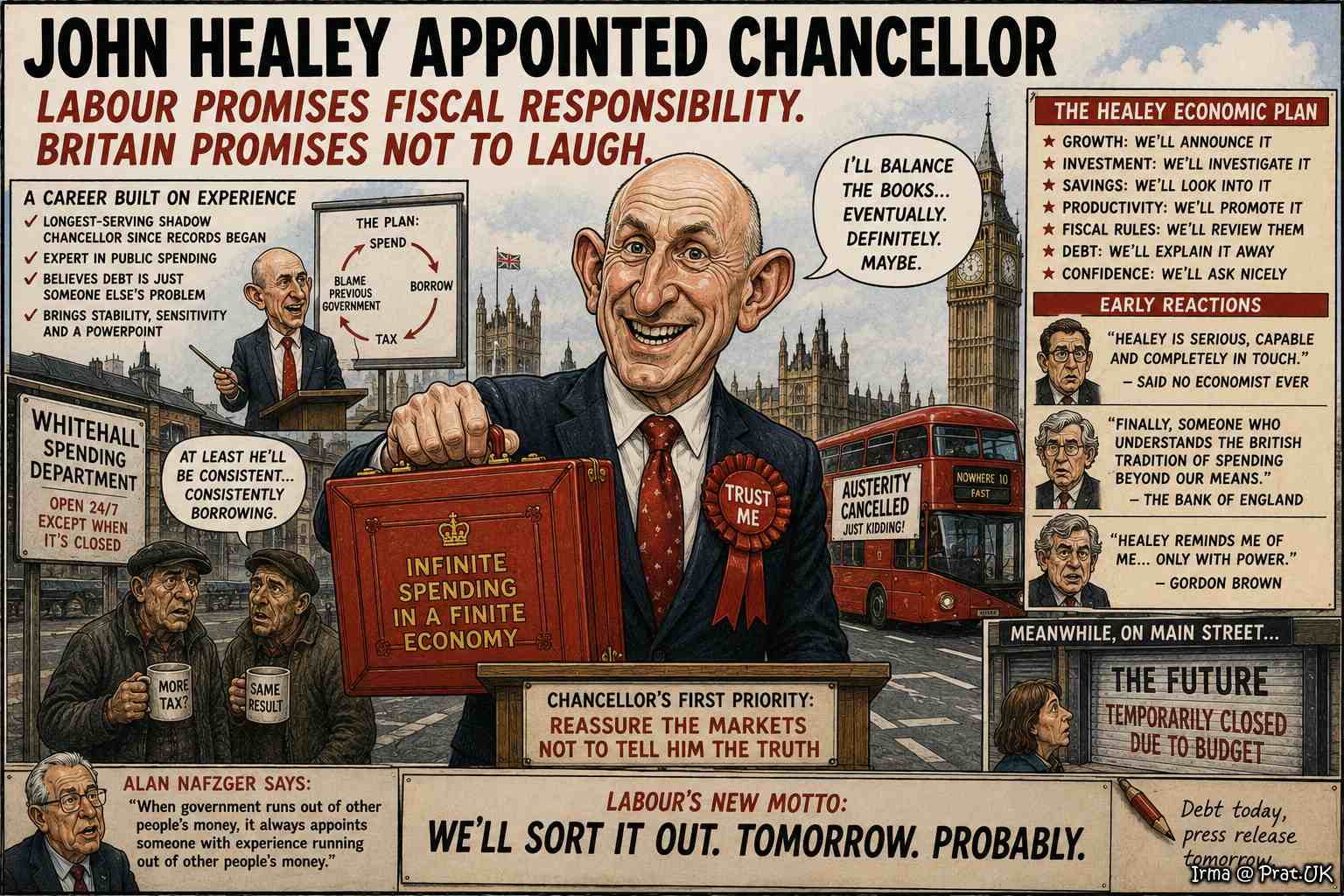
John Healey Appointed Chancellor After Discovering Britain’s Biggest Defence Threat Is the Treasury
Former Defence Secretary moves next door to the nation’s money cupboard and promises to identify who has been hiding the ammunition behind the fiscal rules
LONDON — Prime Minister Andy Burnham has appointed former Defence Secretary John Healey as Chancellor of the Exchequer, placing the man who resigned because the government would not spend enough money in charge of the department whose traditional purpose is preventing anyone from spending money. Healey, a Labour MP since 1997 with previous experience at both the Treasury and the Ministry of Defence, now inherits Britain’s sluggish economy, strained public finances and ceremonial red box containing three receipts, a dead calculator and a note saying, “Try growth.”
The appointment is considered inspired because Healey already knows exactly where the Treasury hides whenever somebody asks it to pay for something.
He recently resigned as Defence Secretary after arguing that the government’s military investment plans fell short of what Britain required during a period of rising international threats. The proposed plan would reportedly have lifted defence spending to approximately 2.68 per cent of gross domestic product by 2030, only slightly above the 2.6 per cent expected earlier, while Germany was planning substantially more.
Healey has therefore been transferred from the department requesting the cheque to the department pretending the cheque book was lost during Brexit.
Britain Finally Puts the Defence Secretary in Charge of Defending the Pound

Economists welcomed Healey’s appointment as Chancellor because he possesses extensive ministerial experience, is regarded as pragmatic and did not immediately announce that Britain could fund everything by placing a wind turbine on Buckingham Palace.
Sterling reportedly rose slightly following his appointment, demonstrating that international currency markets can be reassured by almost anything provided it is announced by a serious-looking Yorkshireman standing near a lectern.
Healey’s first Treasury briefing was understood to contain several alarming discoveries.
Britain has a defence budget, a health budget, a welfare budget, an infrastructure budget and a climate budget. Unfortunately, they are all using the same £20 note.
A senior Treasury official reportedly explained the British budgeting process to the new Chancellor using a whiteboard.
“We begin with projected economic growth,” the official said. “Then we assume productivity will improve, borrowing costs will fall, nobody will get older, hospitals will repair themselves and railway passengers will eventually stop noticing the railway.”
Healey stared at the figures for several minutes before asking whether the nation’s nuclear deterrent might be cheaper if Britain threatened hostile powers with a strongly worded fiscal event.
The official replied that this was already the Foreign Office’s strategy.
From Tanks to Tax Bands
As Defence Secretary, Healey dealt with armoured vehicles, submarines, NATO obligations and military readiness. As Chancellor, he must confront even more dangerous machinery: the British tax code.
The UK tax system has become so complicated that even accountants now enter it in pairs, tied together with climbing rope.
Every Chancellor promises simplification. Each then introduces six new allowances, four temporary thresholds, two reliefs for artisanal batteries and a transitional levy on people who understood the previous system.
Healey is expected to pursue economic growth, regional investment, reindustrialisation and increased defence expenditure while maintaining the government’s fiscal rules. This requires him to spend more, borrow responsibly, reassure bond markets, reduce living costs and rebuild public services without upsetting anybody who owns a spreadsheet.
It is the economic equivalent of being ordered to invade France using a council wheelie bin.
Prime Minister Burnham reportedly selected Healey partly because of his experience, northern background and reputation for political moderation. City analysts had expected other candidates, but the appointment was received with cautious relief.
In Britain, “cautious relief” is the highest available level of economic optimism.
It means the pound has not caught fire and nobody from the International Monetary Fund has been seen measuring Downing Street for curtains.
Treasury Orthodoxy Sent to Basic Training
Healey has criticised traditional Treasury thinking, particularly the habit of treating investment as irresponsible unless it produces absolutely nothing.
Treasury orthodoxy is the ancient British belief that spending £10 billion preventing a crisis is reckless, but spending £70 billion cleaning it up afterward demonstrates mature government.
A bridge cannot be repaired because that would increase this year’s capital expenditure. When the bridge collapses, however, its replacement can be funded through an emergency national resilience framework, three parliamentary inquiries and a commemorative podcast.
Healey now has the opportunity to reform this system from within.
This is similar to putting a burglar in charge of home security, except Healey previously tried to get money out of the Treasury rather than into it, making him Britain’s least successful burglar.
His supporters believe defence spending can also stimulate industrial growth by supporting engineering, shipbuilding, technology and manufacturing. Healey has argued for stronger military investment at a time when Britain and its NATO allies face increased concerns about Russia, cyberattacks, infrastructure sabotage and other hybrid threats.
The Treasury has added a fifth hybrid threat: a minister arriving with receipts.
Britain’s Economy Enters the Military Procurement System
Healey’s defence background may influence the way Britain manages the economy.
The autumn Budget will now be renamed Operation Prosperous Ledger.
Tax rises will be described as compulsory civilian contributions.
Spending cuts will be conducted under cover of darkness.
The Office for Budget Responsibility will be issued camouflage calculators so nobody can find its growth forecasts until after the election.
Major infrastructure projects will follow the defence procurement model, under which a railway announced in 2026 will enter service in 2054, cost five times its original estimate and be unable to operate in rain, heat, snow or Britain.
One Treasury insider insisted that Healey’s experience would introduce discipline.
“Defence projects have clear objectives, firm deadlines and strict budgets,” she said, before laughing so violently that two gilt yields moved.
John Healey Discovers Britain Cannot Rearm Without Re-Earning
The central problem facing the new Chancellor is painfully simple: Britain wants European public services, American defence capacity, Scandinavian infrastructure and tax bills calculated by a man who knows a little shortcut.
The country cannot permanently increase spending merely by announcing that rich people, multinational companies or “efficiency savings” will pay for everything. Britain has been funding programmes with efficiency savings for decades, yet government appears to possess more efficiencies than actual money.
Economic growth is therefore not a decorative Conservative slogan or an uncomfortable concession to capitalism. It is the process by which businesses expand, workers earn more, tax revenues increase and the government gains something real to redistribute.
Without growth, redistribution becomes five politicians repeatedly passing the same ten-pound note around a television studio.
Healey’s challenge is to persuade Labour that wealth must be created before it can be allocated by a committee called the National Fairness Delivery Partnership.
That may prove more difficult than negotiating with NATO.
At NATO, every country at least agrees that ammunition should exist before war begins.
The Chancellor Prepares His First Financial Counterattack
Healey is expected to balance Burnham’s promises of lower household costs, regional investment and stronger public services against borrowing constraints and market confidence. His appointment also signals that defence expenditure may become a central element of the government’s economic and industrial strategy.
The new Chancellor has not yet disclosed the full details of his first Budget.
However, Treasury officials are preparing several options.
Under Plan A, Britain achieves economic growth.
Under Plan B, the government changes the definition of growth.
Under Plan C, every citizen is issued a military helmet and told that declining living standards are part of national mobilisation.
For John Healey, the journey from Defence Secretary to Chancellor may feel surprisingly familiar. Both jobs involve explaining that Britain needs more equipment, more investment and more long-term planning than the Treasury originally allowed.
The only difference is that he is now sitting on the other side of the table.
Britain has finally placed its former Defence Secretary in command of the nation’s finances.
The Treasury has been surrounded.
Unfortunately, it has already imposed sanctions on itself.
Disclaimer
This article uses satire to examine John Healey’s appointment, British defence spending, Treasury culture and the government’s eternal struggle to make five financial promises using three available pounds. It does not suggest that any quoted unnamed officials made the remarks attributed to them. This story is entirely a human collaboration between two sentient beings: the world’s oldest tenured professor and a philosophy major turned dairy farmer.

Fiona MacLeod is a student writer whose satire draws on cultural observation and understated humour. Influenced by London’s academic and creative spaces, Fiona’s writing reflects curiosity and thoughtful comedic restraint.
Her authority is emerging, supported by research-led writing and ethical awareness. Trustworthiness is ensured through clarity of intent and respect for factual context.
Fiona represents a responsible new voice aligned with EEAT standards.


British people will never say “I’m upset”; they’ll say “I’m a bit out of sorts” and then proceed to be absolutely devastated in complete silence.