
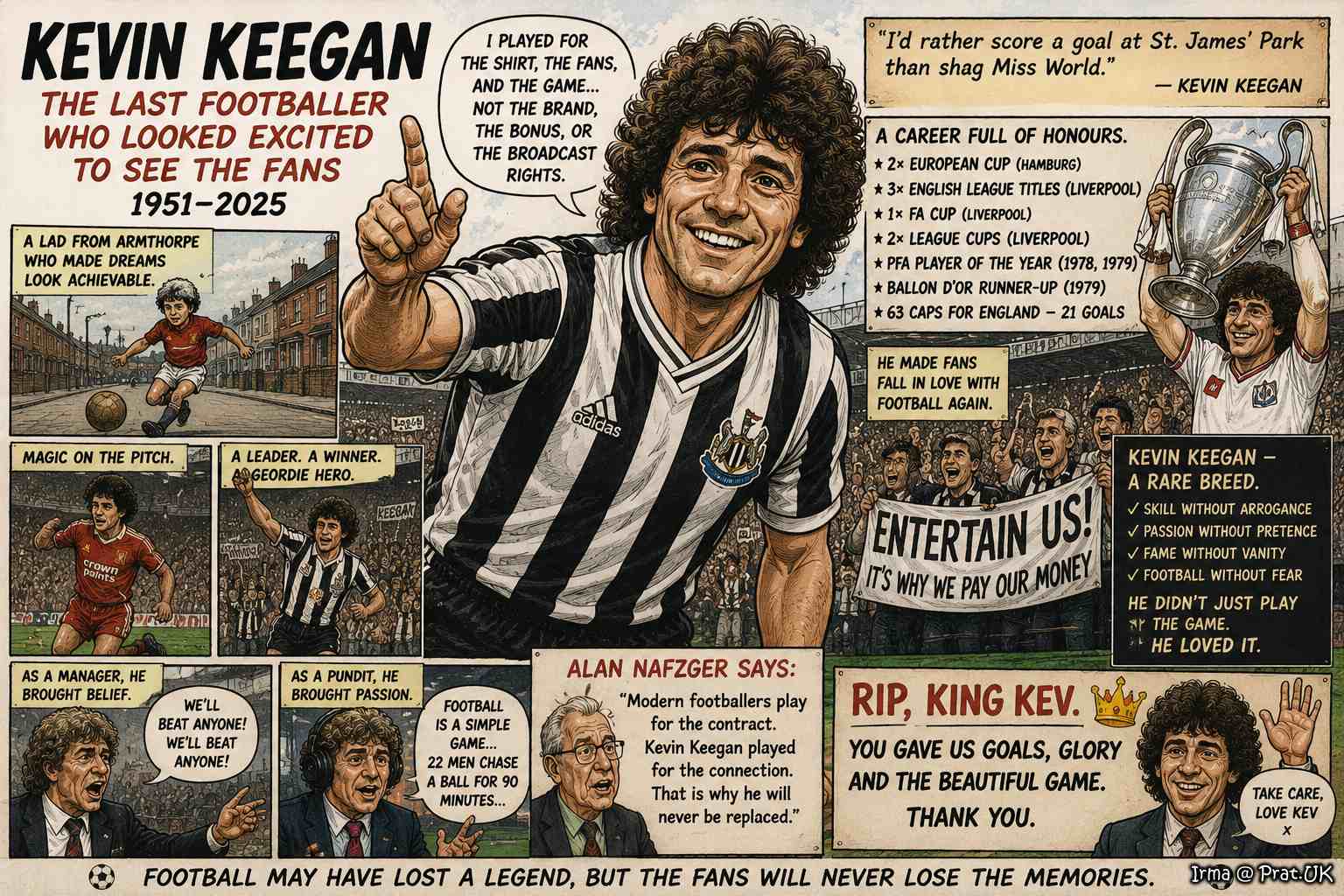
Kevin Keegan Dies at 75, Leaving Modern Football Without Its Last Working Human Emotion
Liverpool, Newcastle and England mourn “King Kev,” the football legend who believed supporters deserved goals, excitement and occasional evidence that managers possessed a pulse
NEWCASTLE UPON TYNE — Kevin Keegan, the former Liverpool forward, Newcastle United manager, England captain and twice-crowned European Footballer of the Year, has died at the age of 75 after being diagnosed with cancer. The news prompted tributes from Liverpool FC, England Football, Newcastle supporters and former players, all of whom remembered a man who committed the increasingly controversial football offence of appearing to enjoy himself. (Reuters)
Modern football immediately observed a minute’s silence, followed by 94 minutes of lateral passing.
Keegan’s death leaves English football without one of its most recognisable figures and perhaps its final manager who believed a match should contain more than two expected goals, six tactical fouls and a television commentator whispering the phrase “excellent defensive shape” while 60,000 spectators reconsider their life choices.
At Liverpool, Keegan scored 100 goals in 323 appearances and helped the club win three league championships, two UEFA Cups, an FA Cup and the 1977 European Cup. He subsequently joined Hamburg, where he won consecutive Ballon d’Or awards in 1978 and 1979, back when the trophy was decided by football writers rather than an online civil war involving 14-year-olds with anime profile pictures. (Liverpool FC)
He played 63 times for England, scoring 21 goals and captaining the national side on 31 occasions. He later managed England, Newcastle, Fulham and Manchester City, achieving promotion as champions in his first full season with three separate clubs, an accomplishment now regarded as dangerously straightforward because it involved winning matches rather than launching a five-year “football transformation pathway.” (https://www.englandfootball.com)
King Kev Made Football Look Suspiciously Enjoyable
Keegan’s greatest contribution may have been proving that English football did not have to resemble a tax audit conducted during freezing rain.
He ran, jumped, attacked, encouraged and occasionally displayed feelings without first consulting a sports psychologist, brand manager or multinational hydration partner. When Keegan celebrated, he looked happy. When his team lost, he looked miserable. Today, both reactions would be analysed by 11 body-language experts and turned into a documentary entitled Touchline Turmoil: The Toxic Burden of Visible Emotion.
His famous Newcastle team of the mid-1990s became known as “the Entertainers” because they attempted to score more goals than the opposition. This tactical concept briefly terrified English football before experts successfully replaced it with “rest defence,” “controlled possession” and the thrilling spectacle of a goalkeeper standing on the ball until everyone’s parking ticket expires.
The Keegan philosophy was brutally primitive: acquire talented footballers, tell them to attack and make supporters want to return next Saturday.
A present-day Premier League consultancy would require 18 months, £7.4 million and a PowerPoint presentation titled Reimagining Fan-Centric Ball Progression Outcomes to rediscover the same idea.
One retired Newcastle supporter recalled Keegan’s first managerial spell while staring into the middle distance normally reserved for veterans describing a lost civilisation.
“We used to go to matches believing Newcastle might score four,” he said. “Now I go believing the electronic ticket might load before kick-off.”
Another fan remembered the atmosphere at St James’ Park during the Keegan years.
“The ground was loud, the football was brave and nobody had ever heard the phrase ‘commercial activation zone.’ We were practically medieval.”
He Nearly Won the League, Which Was More Exciting Than Winning It
Keegan’s Newcastle came famously close to winning the 1995–96 Premier League title after establishing a commanding lead before Manchester United overtook them.
Ordinary history records this as a collapse. Football supporters remember it as one of the most exciting title races ever staged.
This is the crucial difference between Keegan and modern sporting administration. Keegan understood that sport is an entertainment business. Administrators understand that entertainment is a delivery mechanism for premium betting partnerships, dynamic ticket pricing and collectible digital sleeve sponsors.
His televised declaration that he would “love it” if Newcastle defeated Manchester United has been replayed for three decades as evidence that Keegan was emotionally overwhelmed.
In reality, he was simply a football manager speaking without eight communications advisers standing behind the camera holding cards marked RESPECT THE PROCESS.
Today, the same interview would proceed differently.
“Kevin, do you still believe Newcastle can win the title?”
“We remain aligned with our performance objectives and continue to respect Manchester United as a high-quality stakeholder in the competitive ecosystem.”
The nation would immediately fall asleep, Manchester United would win the league and a public-relations agency would receive a £240,000 performance bonus.
Keegan’s honesty was considered a weakness because English football prefers its managers to communicate like malfunctioning airport announcements. Supporters are permitted to scream, sing, cry and remove their shirts in February, but the manager must describe a catastrophic 5–0 defeat as “a useful learning opportunity.”
The Hair Also Deserves Its Own Statue
Any serious evaluation of Kevin Keegan must acknowledge the hair.
His celebrated 1970s perm appeared to have been designed jointly by Vidal Sassoon, British Leyland and a frightened electrical socket. It had volume, courage and significantly better movement between the lines than several current Premier League midfields.
The hairstyle was not merely decorative. It was structural engineering.
Scientists at Newcastle University are believed to have calculated that Keegan generated 11 per cent additional elevation when heading the ball because the perm created a small cushion of Yorkshire air beneath him. The research was withdrawn after VAR spent four hours determining whether individual curls were offside.
Liverpool’s official tribute remembered Keegan describing himself as “five foot seven with Cuban-heeled boots,” while saying the supporters made him feel six foot six. It was an unusually touching explanation of what great footballers and devoted crowds can give each other. (Liverpool FC)
Modern players also receive elevation from supporters, although this generally arrives through follower counts, sponsored lifestyle content and videos of them stepping out of black SUVs wearing trousers apparently borrowed from a much larger uncle.
Keegan belonged to an era when football stars could become international celebrities while still resembling men capable of repairing a garden fence.
Football Pays Tribute Before Returning to Its Spreadsheet
Thomas Tuchel described his sadness at Keegan’s death, while clubs, former teammates and supporters praised his warmth, enthusiasm and enormous contribution to football. Liverpool called him a giant of the game, a description that referred to his legacy rather than his height or the gravitational authority of the perm. (https://www.englandfootball.com)
Football will now honour Keegan in the traditional manner.
Players will wear black armbands. Supporters will sing his name. Television networks will show goals, trophies and scenes from Newcastle’s thrilling title challenge.
Then, shortly afterward, somebody will propose staging a Premier League fixture in Abu Dhabi at 3:17 on a Tuesday morning because global engagement research indicates strong demand among luxury-watch consumers.
That is precisely why Kevin Keegan remains important.
He represented football before the sport began referring to supporters as “matchday users.” He understood that tactics mattered, results mattered and trophies mattered, but none of them mattered enough to justify making everybody miserable.
Keegan did not always win. He did something rarer.
He made people care.
He made Newcastle believe. He made Liverpool cheer. He crossed Europe, conquered Germany and returned with two Ballon d’Or awards and hair that had achieved diplomatic immunity.
English football has lost a champion, a showman and one of its great enthusiasts.
The spreadsheets remain in perfect health.
Disclaimer
This tribute uses satire to celebrate Kevin Keegan’s remarkable football life while directing its jokes toward modern football’s bureaucracy, corporate language and chronic shortage of joy. No humour is intended at the expense of Keegan’s illness, death or grieving family. This story is entirely a human collaboration between two sentient beings: the world’s oldest tenured professor and a philosophy major turned dairy farmer.

Harper Thames is a comedic writer exploring modern life through irony and subtle exaggeration. Rooted in student perspectives and London’s cultural landscape, Harper’s work focuses on relatable humour grounded in everyday experience.
Expertise is developed through writing practice and critical engagement, while authority comes from authenticity and consistency. Trust is reinforced by transparent satire and ethical humour choices.

A London councillor said it was damaging his credibility. When asked what credibility was based on, he said satire had no right to question it.