
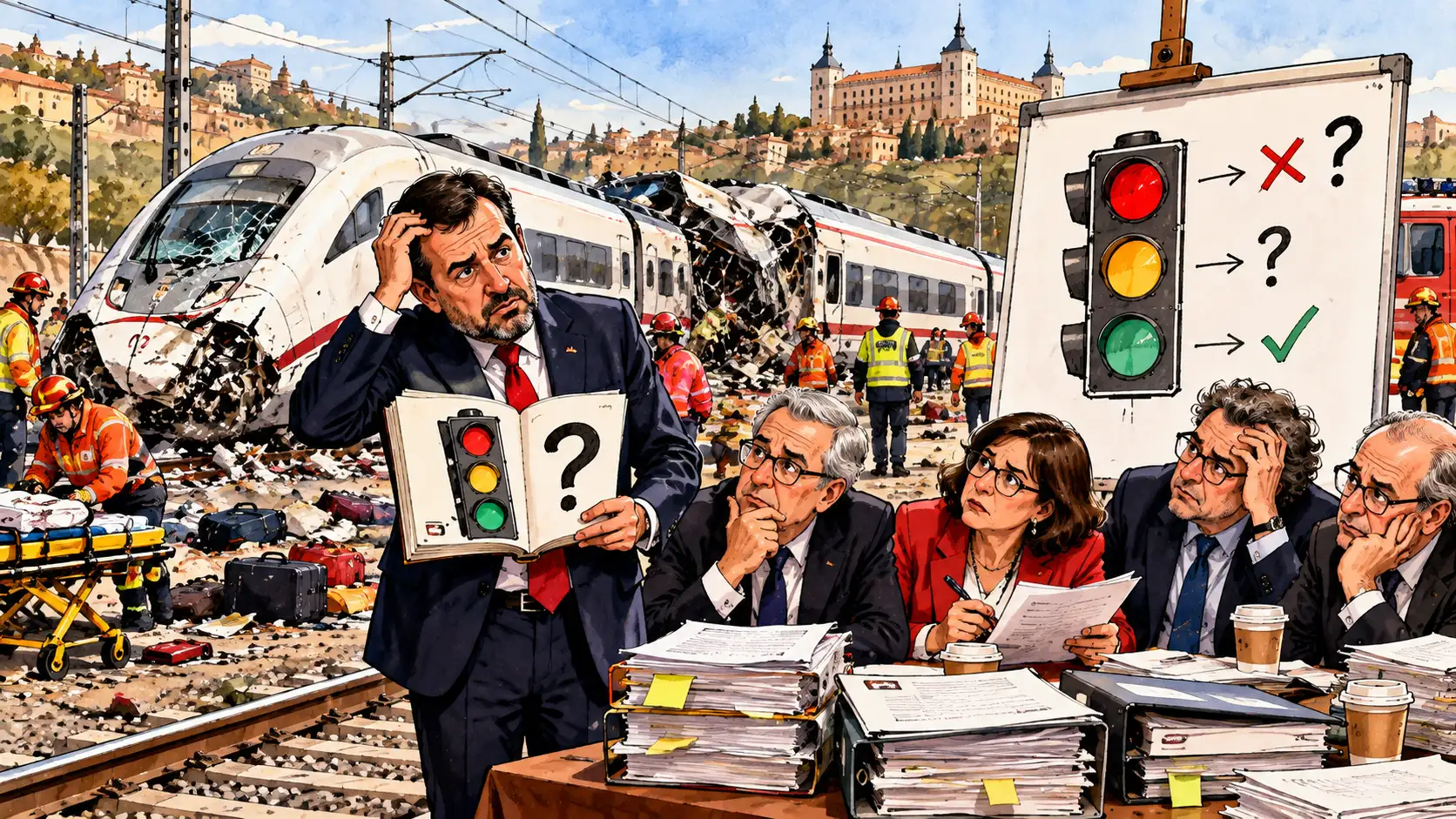
Spain’s Transport Ministry Discovers Red Means Stop
Billions for the Train, a Committee for the Brakes
MADRID — Spain’s socialist-led government is working through an uncomfortable discovery this week. A high-speed railway needs more than funding, speeches and a minister in a hard hat posing next to a shiny locomotive. Apparently the trains also have to be safe.
The discovery follows Wednesday’s collision near Toledo, where at least 68 people died after a high-speed train struck another that had stopped on the track. The victims and their families deserve better than political theater. The government deserves questions that a ribbon-cutting can’t answer.
According to Reuters’ reporting on the Spanish railway disaster, Transport Minister Óscar Puente said a computer communications failure had halted traffic before a train was wrongly authorised to continue past a red signal.
For generations, railway engineers have worked from a sophisticated principle: red means stop. The Transport Ministry appears to have commissioned a committee to explore the concept.
Spain’s Transport
- They built the biggest high-speed network in Europe. Madrid to Seville in two and a half hours. Getting a permit still takes a decade. Fast train, slow government.
- Red means stop. That’s not a political opinion. It might be the only thing in the whole country that isn’t up for debate.
- They announced a “comprehensive safety review.” Comprehensive. What was the last one, a partial review? And who signed off on the partial review?
Why Red Signals Don’t Take Part in Coalition Talks
Spanish politicians are used to coalitions, compromises and the occasional deputy ministry handed out in exchange for a vote. A red signal can’t abstain. It can’t be persuaded, and it can’t be turned green after a constructive meeting between stakeholders.
A ministry consultant, speaking after a briefing, put the difficulty this way: “We recognise the historical reading of red as stop. Modern governance, however, calls for flexibility, dialogue and an inclusive approach to railway colours.”
He was promoted to Deputy Minister for Chromatic Mobility by lunchtime. Somewhere in Spain, a retired locomotive driver is reportedly wondering whether the Ministry has considered a children’s traffic-light colouring book.
Europe’s Biggest High-Speed Network, Now With Extra Paperwork
Spain has spent decades building the largest high-speed network in Europe, and the engineering is genuinely impressive. The accounting is another matter. According to Reuters’ analysis of railway investment, Spain spent roughly €1.5 billion a year on the network between 2018 and 2022. Only about 16% went to maintenance, renewal and upgrades.
That figure doesn’t establish what caused Wednesday’s crash. It does raise a fair question about priorities.
Government accounting treats a railway the way a man treats a new sports car. He buys the biggest one on the lot, invites the television cameras, appoints a commission on National Automotive Happiness, and only then learns that somebody has to change the oil.
Nobody wins re-election because a technician quietly replaced a part before it failed. There is no champagne reception for a working brake.
Newton Declines a Cabinet Post
Political economics lets officials announce objectives. Physics insists on results. Momentum doesn’t care about a parliamentary majority, and braking distance is not open to amendment.
At a cabinet working session this week, the Minister for Progressive Transportation proposed distributing momentum more equitably. His colleagues applauded. The engineers asked quietly whether they could go back to work.
The government has defended its record, pointing to increases in maintenance spending since it took office. There’s a legitimate debate about those figures and how much more is needed. But a spending announcement is not a safety certificate, and the two groups involved keep asking different questions.
The politician asks: “How much money did we announce?” The taxpayer asks: “Does the railway work?”
The politician asks: “Have you seen our beautiful new station?” The taxpayer asks: “Could somebody please inspect the track?”
At this point the taxpayer is accused of failing to appreciate infrastructure investment.
Committee Formed to Investigate Previous Committees
Spain has promised an investigation, which it should. Madrid’s habits suggest how it will go.
First comes the Preliminary Committee for Railway Confidence. Then the Independent Commission on the Preliminary Committee. Then the Parliamentary Working Group for the Coordination of Railway Confidence Committees. Finally an outside consultancy receives €12 million to build a website explaining the results. The report runs 437 pages with 96 recommendations and a full-colour photograph of a train. On page 392, between a glossary and an appendix about parking, is the suggestion that railway signals should probably be obeyed. It is classified as a long-term objective.
The one department that never has technical difficulties is the press office. Trains stop, computers fail and maintenance schedules slip, but every statement arrives on time, every minister gets a polished paragraph, and every spokesperson has a rehearsed line about unprecedented commitment. If the railways were maintained with the care given to press releases, Spain would resemble Switzerland.
The communications director has more operational authority than the chief railway engineer. The engineer can stop a train. The communications director can stop an embarrassing question. Only one of them has the corner office.
From the Files: What the Paperwork Looks Like
Transport Ministry Press Office: For Immediate Release
PASSENGER SAFETY IS THE MINISTRY’S HIGHEST PRIORITY.*
The Ministry reaffirms its unprecedented commitment to historic renewed determination regarding the matter of safety.
*Subject to the outcome of the budget meeting, the availability of the maintenance department, and the findings of the Preliminary Committee for Railway Confidence. The Ministry’s highest priority may change without notice. Void where prohibited by physics.
Invoice No. 0001: Meridian Stakeholder Partners S.L.
Client: Transport Ministry, Railway Confidence Division
Re: Results website and associated deliverablesDiscovery phase (confirming that trains exist) ………… €1,850,000
Chromatic Mobility Workshop (two days, sandwiches included) … €1,240,000
Full-colour photograph of a train (licensed, one) …………. €460,000
Formatting of 437-page report …………………………… €3,100,000
Website explaining the report …………………………… €4,900,000
Follow-up meeting to discuss this invoice ………………… €450,000Subtotal ……………………………………………… €12,000,000
VAT (21%) …………………………………………….. €2,520,000
Total due ………………………………………… €14,520,000Payment terms: 30 days, or one committee meeting, whichever comes later.
Minutes of the Committee on Committees
Present: 11. Absent: the railway engineer (reassigned to the Subcommittee on Attendance).
Item 1. Motion to establish whether the colour red is binding on trains. A member from the Directorate of Chromatic Mobility noted that red “carries significant historical weight.” Motion tabled pending a working group.
Item 2. Vote to form the working group. For: 9. Against: 0. Abstaining: 2, both citing a prior commitment to a different working group.
Item 3. Next meeting scheduled to review the minutes of this meeting. Sandwiches to be provided.
One-Star Review: Transport Ministry Safety Information Portal
★☆☆☆☆ “Looked for the safety page, found a PDF about the safety page”
Jorge M., verified passengerThe portal asked me to accept cookies, complete a satisfaction survey about the portal, and watch a video of a minister in a hard hat. Nothing about signals. I’d give zero stars, but the form requires a committee.
Wednesday Followed January
Wednesday’s collision came after January’s accident near Adamuz, in which 46 people died. The two incidents may have different causes, and investigators have to establish what happened in each. But the repetition sharpens the public’s demand for answers.
According to the Associated Press’ account of Spain’s 2026 railway accidents, the dedicated high-speed network had never recorded a fatal accident since it opened in 1992. That record shows safe high-speed rail is achievable. It also shows why serious failures can’t be buried under more spending announcements. The government should be able to say what changed, which safeguards failed, what warnings existed and how operations will be made safer. That would be more reassuring than another declaration that passenger safety is the administration’s highest priority. Passengers have heard that one already. They’d like to see the operating instructions.Set featured image
Working Trains Beat Better Slogans
The practical priorities aren’t a mystery. Spain needs independently verified safety procedures, reliable signalling, real maintenance, clear lines of responsibility and investigation findings the public can read. Money should follow engineering requirements, not photo opportunities. And when the system built to stop a train fails, the answer has to be more than an assurance that everyone remains committed to stopping trains.
Spain has the engineers and the expertise. Its passengers now need confidence that political accountability will match them.
A government can issue a million promises about public safety. A red railway signal issues one instruction.
STOP.
Unlike a campaign promise, it isn’t negotiable.
Seven Observations on Spain’s Railways
- Maintenance is a top priority, they say. Sure. So is flossing. Everybody says it’s a priority.
- The press office never has a technical difficulty. Never. Trains stop, computers crash, but the press release? Right on time. Nice font, too.
- You can’t amend a braking distance. They tried. I think there was a working group.
- They want an independent investigation. I’d settle for an independent inspection. I’d settle for any inspection, as long as somebody actually looked.
- You ask for accountability, you get a committee, a working group and a commemorative PowerPoint. You asked for a fire extinguisher and they sent you a slideshow about fire.
- The big new safety concept is: when the sign says stop, you stop. That’s the same system a four-year-old uses at a crosswalk, and she doesn’t have a ministry.
- Everybody cuts the ribbon on the shiny new station. Nobody cuts a ribbon on the boring little box that keeps two trains off the same piece of track. That box has no publicist. That box just saves your life.

Alan Nafzger was born in Lubbock, Texas, the son Swiss immigrants. He grew up on a dairy in Windthorst, north central Texas. He earned degrees from Midwestern State University (B.A. 1985) and Texas State University (M.A. 1987). University College Dublin (Ph.D. 1991). Dr. Nafzger has entertained and educated young people in Texas colleges for 37 years. Nafzger is best known for his dark novels and experimental screenwriting. His best know scripts to date are Lenin’s Body, produced in Russia by A-Media and Sea and Sky produced in The Philippines in the Tagalog language. In 1986, Nafzger wrote the iconic feminist western novel, Gina of Quitaque. He currently lives in Holloway, North London. Contact: [email protected]


