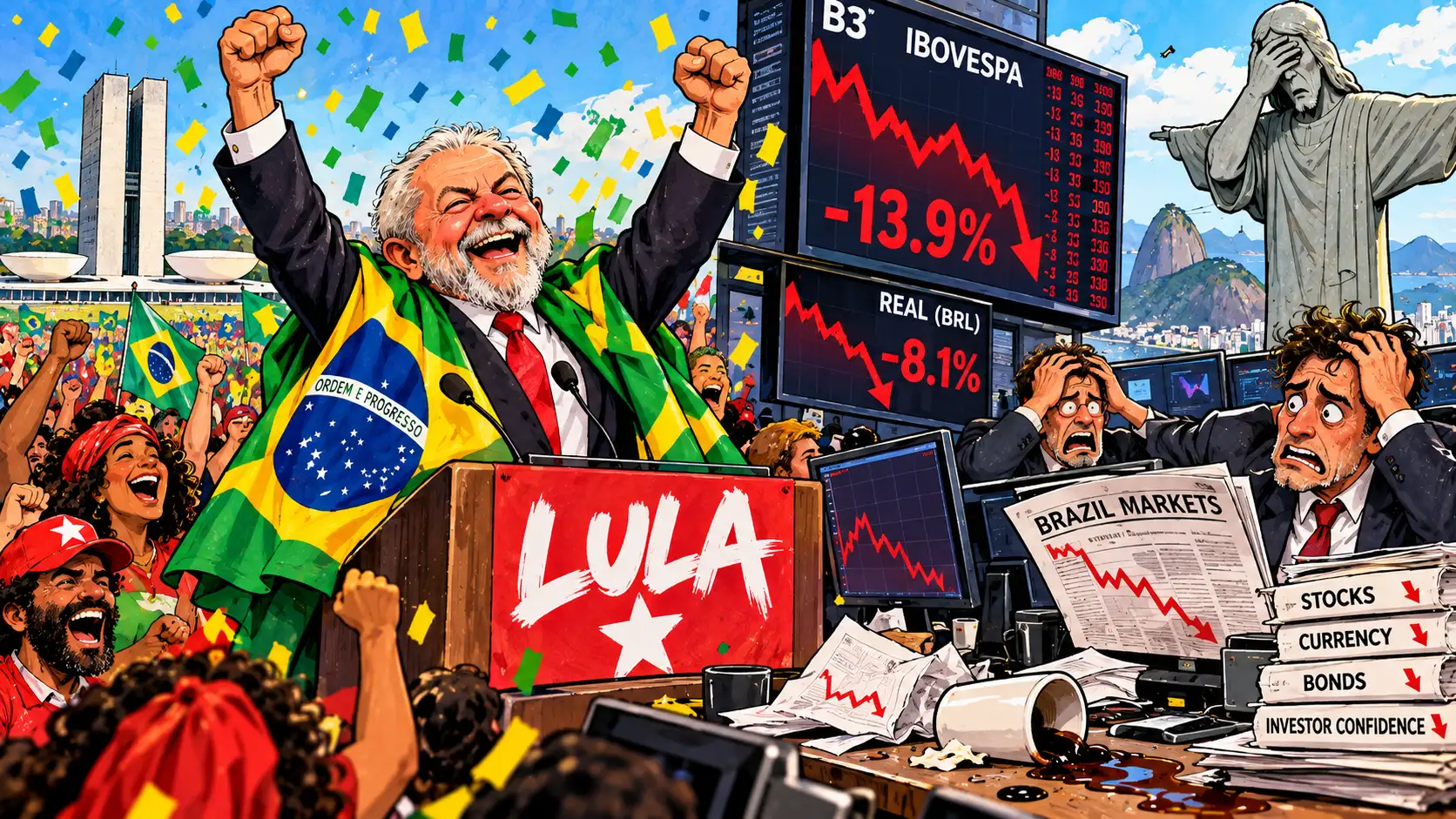
Lula Wins Election, Loses Argument With Mathematics
Brazil’s Markets Fall 13.9 Per Cent as Ballot Boxes Close and Brokerage Accounts Follow
BRASÍLIA, Brazil — President Luiz Inácio Lula da Silva won a fourth, nonconsecutive term on Sunday, October 25, proving that Brazil can settle a presidential election without settling the national accounts. By Monday, the country’s stock market had fallen 13.9 per cent and the real had dropped 8.1 per cent against the dollar. The ballot boxes had closed. So, apparently, had several brokerage accounts.
Lula Beats Flávio Bolsonaro by 4.4 Million Votes
Lula defeated Senator Flávio Bolsonaro by roughly 4.4 million votes, according to Brazil’s electoral authorities. That is a solid margin, although economists report that voting for a bigger economy does not automatically produce one.
The distinction has baffled political consultants for generations. In campaigning, you add promises. In budgeting, you subtract costs. In governing, you announce a committee to find out who stole the minus sign.
Brazil’s Public Debt Reaches 82.9 Per Cent of GDP
Brazil’s gross public debt has climbed to 82.9 per cent of gross domestic product, and Reuters reports that less than 8 per cent of federal spending can be readily adjusted. This is the financial equivalent of taking your spouse to dinner, discovering that 92 per cent of your income is already spoken for, and ordering pudding because the waiter hasn’t brought the bill yet.
A government balance sheet has three main ingredients: revenue, spending and an increasingly adventurous explanation connecting the first two.
Lula’s Supporters Cite Poverty Reduction and Social Programmes
Lula’s supporters have a legitimate reason to celebrate. They point to his social programmes, his wage policies and his record on poverty reduction. The argument is that a government is not merely a spreadsheet with a flag attached. Fair enough. Unfortunately, a spreadsheet is also not impressed by speeches, fireworks or the moral superiority of a really enthusiastic campaign volunteer.
Interest Rates of 13.75 Per Cent Make Borrowing Brutal
Brazil’s benchmark interest rate stands at 13.75 per cent, according to the Central Bank of Brazil, while annual inflation was reported at 4.6 per cent. Borrowing money at those rates can make buying a modest family hatchback feel like acquiring a privately owned space programme.
In the London Prat Institute’s kitchen-table experiment, researchers placed two hundred reais in a biscuit tin, promised three hundred reais in benefits and waited for economic growth. The tin produced no additional currency but did attract a nephew who wanted to run for Congress.
How to Fund Social Protection Without Raising Borrowing Costs
The real public-policy question is not whether social protection has value. It is how to finance it without raising borrowing costs for the same families the protection is meant to help. Even a well-designed benefit becomes less useful when groceries, mortgages and business loans swallow the gain.
Finance Minister Dario Durigan Promises a Primary Surplus
On Monday, Finance Minister Dario Durigan spoke of pursuing a stronger primary budget surplus. A primary surplus means government revenue exceeds spending before interest, an achievement politicians describe with the excitement ordinary people reserve for finding a tenner in last winter’s coat.
What Investors Want to See From Brasília
Investors will want details, not slogans. A credible plan might include transparent spending priorities, better tax collection and clearer debt targets. It must also survive a Congress that has its own shopping list. The International Monetary Fund has been watching the numbers for some time and has not been asked to join the celebrations.
As the festivities continued, Brazil faced an inconvenient accounting truth: a majority can elect a president, but it cannot elect a new multiplication table.
The nation’s accountants, having exhausted their calculators, were last seen asking whether the national anthem could be played in a minor key.
Evidence Submitted to the Treasury Committee
Exhibit A: Fine Print, Campaign Leaflet, Page 14
Benefits payable subject to the existence of money. The Government accepts no liability for arithmetic, compound interest or the remaining 92 per cent. Promises may go down as well as down. Offer not valid in markets that are open.
Exhibit B: One-Star Review, Posted Monday by a São Paulo Broker
★☆☆☆☆ Would not recommend this election.
Bought in on Friday. Red by Monday. Seller said “fundamentals” were included. They were not included. Tried to return everything to the exchange and was told a circuit breaker applies. Staff were polite. The biscuit tin at my mother-in-law’s is more reliable and has never once fallen 13.9 per cent.
Exhibit C: Dispatch Log, Trading Floor, Monday
09:31 – Market opens. Traders in good spirits.
09:34 – Index down 6 per cent. Trader asks if the screens are stuck on red or whether this is just the colour now.
09:47 – Circuit breaker trips. Floor goes quiet. Somebody offers round the biscuits.
10:17 – Trading resumes. Index finds a way to go lower.
11:02 – Real hits 8.1 per cent down. One trader begins checking flights to Lisbon. Another is already in Lisbon, by phone.
16:55 – Close. Everyone agrees the afternoon is the only thing that has ever worked on time in this building.
Exhibit D: Itemised Invoice, Victory Night and Aftermath
| Item | Qty | Unit Cost (R$) | Total (R$) |
|---|---|---|---|
| Victory-night fireworks, large | 1 | 48,000 | 48,000 |
| Calculators, replacement (previous set exhausted) | 12 | 85 | 1,020 |
| Committee sitting to locate the minus sign | 3 | 15,000 | 45,000 |
| Biscuit tin, medium | 1 | 24 | 24 |
| Enquiry into playing the anthem in a minor key | 1 | 2,500 | 2,500 |
| Total due | 96,544 | ||
Payment terms: thirty days, or the next election, whichever comes first.
Five Humorous Observations
- You know you’ve got a debt problem when 92 per cent of your budget is locked in and your answer is a bigger fireworks display. That’s not a fiscal plan. That’s a man at a wedding who’s just found out the bar is cash only.
- A circuit breaker is what the stock market has instead of a mother. Thirty minutes. Sit there. Think about what you did.
- Thirteen point nine per cent in one day. I’ve seen smaller drops from a bloke who just found out the Wi-Fi is a separate charge.
- “Primary surplus.” That’s where you say you’re fine by ignoring the interest. Everybody knows somebody like that. Lovely flat. Seventeen-page letter from the credit card people.
- Two hundred reais in a tin, three hundred promised. At least the tin’s honest. It just sits there being a tin. It has never once said it would “revisit the numbers.”
Sources and Further Reading
- Reuters: Investors expect markets to unwind after Lula’s re-election
- Financial Times: Analysis of Lula’s fiscal challenges
- Central Bank of Brazil
- International Monetary Fund: Brazil country page
- B3 Brazilian Stock Exchange

Alan Nafzger was born in Lubbock, Texas, the son Swiss immigrants. He grew up on a dairy in Windthorst, north central Texas. He earned degrees from Midwestern State University (B.A. 1985) and Texas State University (M.A. 1987). University College Dublin (Ph.D. 1991). Dr. Nafzger has entertained and educated young people in Texas colleges for 37 years. Nafzger is best known for his dark novels and experimental screenwriting. His best know scripts to date are Lenin’s Body, produced in Russia by A-Media and Sea and Sky produced in The Philippines in the Tagalog language. In 1986, Nafzger wrote the iconic feminist western novel, Gina of Quitaque. He currently lives in Holloway, North London. Contact: [email protected]