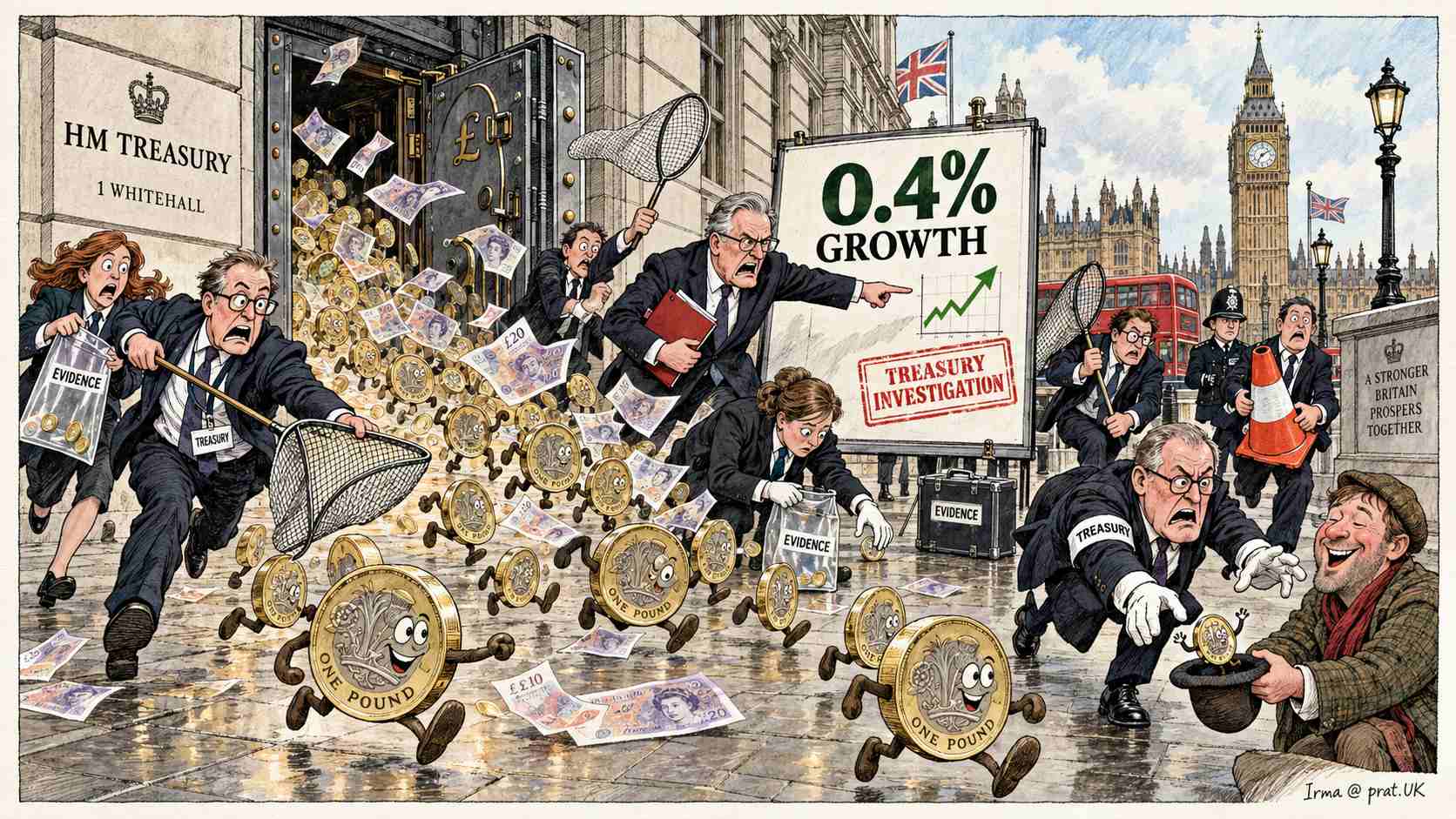
The Treasury Turbine: How Sunderland Runs on Subsidy
LONDON — After years of chasing the perfect clean energy source, Britain’s car industry has finally found one that never runs flat. It is not wind, which sulks on still days. It is not solar, which sulks roughly nine months of the year. It is taxpayer money. Unlike lithium, which has to be hacked out of a mountain in a country you cannot point to on a map, taxpayer money is found everywhere, in every pocket, and ministers simply keep drilling for more. The seam is bottomless, because when it runs low, they print a fresh one.
The Cleanest Renewable in Britain Is Cash
Lithium is a finite headache. Cash is gloriously renewable. It regenerates every Budget, refills with every announcement, and can be extracted on demand by anyone willing to stand near a factory looking worried. Nissan has grasped this faster than anyone. The company remains fully committed to Britain, on the strict condition that Britain remains fully committed to Nissan, which is the energy equivalent of a battery that only charges if you keep plugging it into itself.
And the well has form. Whitehall has tipped billions into the sector under a modern Industrial Strategy, handed over millions in collaborative grant funding, and is currently in funding talks to keep the lights on at Sunderland. Each transfer is described as a vote of confidence. The phrase “vote of confidence” now appears so often in British industrial policy that economists believe it may itself be flammable.
Comedian Milton Jones spotted the engineering. “They’ve finally cracked clean energy,” he said. “It’s powered by pounds. Completely renewable. Zero emissions, unless you count the minister’s hot air, in which case it’s basically a gas works with a rosette.”
Baseload Optimism and the 140 Per Cent Capacity Factor
Every power source has a capacity factor, the gap between what it could produce and what it actually does on a wet Tuesday. The Sunderland plant runs at roughly half its physical capacity. Political optimism about the plant, by contrast, runs at about a hundred and forty per cent, which violates several laws of physics and at least one law of decency. The factory’s true baseload, the thing keeping the turbines spinning when nothing else will, is a steady current of public money flowing in from London.
The official output of the site has quietly shifted. It still makes cars, in fairness, but its most dependable products are now hope, consultations, and strategic reviews, none of which require a paint shop. One executive reportedly described the future of electric vehicles while standing beside a spreadsheet that appeared to be on life support, a single red cell flashing like a heart monitor in a soap opera. “We believe strongly in the electric future,” he said. “We simply need a little assistance defining when the future starts.” The assistance, naturally, would be measured in megawatts of cash.
Transmission Losses, Also Known as Consultants
No grid is perfectly efficient. Some energy is always lost to heat along the wires. In Britain’s industrial grid, that loss has a name, and the name bills by the hour. Money leaves the Treasury at full voltage and arrives at the factory floor noticeably dimmer, having passed through a relay station of consultants who convert roughly forty per cent of every pound directly into PowerPoint. The slides are warm to the touch. Economists have started classing the consultancy sector as a renewable resource in its own right, since it regenerates the instant the previous report is proven wrong.
Romesh Ranganathan was unimpressed by the whole transmission system. “So the taxpayer’s the power station, the consultant’s the wire, and somehow the lightbulb at the end is a bloke in Geneva,” he said. “I’ve seen extension leads with more loyalty to the room they’re in.”
The Carbon-Neutral Cash Cycle
Here is the genuinely elegant part, the bit that ought to win an engineering prize. The money never actually leaves the system. It flows from the taxpayer to the minister, from the minister to the manufacturer, from the manufacturer to the consultant, and then back to the taxpayer in the form of a slightly more expensive car they may not have wanted. It is a closed loop. Nothing is created, nothing is destroyed, and an electric vehicle occasionally pops out the side as a sort of by-product. By any honest measure, it is the most carbon-neutral thing Britain has built in a decade, because the only output is heat, and the heat is purely rhetorical.
Dara O Briain, who enjoys a physics gag, called it a breakthrough. “They’ve invented a perpetual motion machine,” he said. “Every scientist for three hundred years said it was impossible. Turns out you just needed a Treasury, a press release, and absolutely no oversight. Stick a flywheel in Whitehall and you could power Newcastle on grievance alone.”
The consultation engine deserves special mention, because it is the only part of the apparatus running at full tilt. A target is announced. Manufacturers explain why the target is impossible. The target is adjusted. A new target is announced. Then the consultations begin, then the reviews, then the working groups, then the subcommittees, then a report explaining why the last report was wrong. One civil servant admitted the cycle now powers Whitehall more reliably than any battery currently on the market, and unlike a battery, it never needs replacing, only re-funding.
Energy Security Through Subsidy
Britain spent the last few years fretting about energy security. It need not have bothered. It has achieved total subsidy security instead, an unbreakable guarantee that money will continue arriving regardless of how many cars leave. The famous EV mandate, once a firm eighty per cent by 2030, survived roughly seven minutes before manufacturers began gently explaining how factories work. It has since been softened, relaxed, and sent back for an early review that was hauled forward a whole year, until the word “mandate” now carries roughly the binding force of a horoscope.
Even the real money evaporates when the demand turns out to be imaginary. A planned powertrain plant worth tens of millions, propped up with public grant, was quietly scrapped when European demand failed to show up for its shift. The vote of confidence, it turned out, was recallable. One Treasury insider described the relationship between government and industry as co-dependent but environmentally friendly, which is the single most honest thing anyone has said about British manufacturing since 1953.
The Prime Minister, meanwhile, has unveiled a revolutionary new industrial doctrine: asking factories what they want before they leave. Business groups have welcomed this warmly, having spent decades enjoying the previous model, in which ministers expressed deep concern only after the jobs had already gone and the car park had filled with weeds and one abandoned 2018 Astra.
The Bit Where the Joke Stops
And here the laughter ought to cool, because the people on the line in Sunderland are not the punchline. Roughly six thousand of them build cars to a standard most of the planet cannot match, and they have spent ten years being treated as a bargaining chip in somebody else’s slideshow. The absurdity is not the workers. It is the machine bolted on above them, the one that converts their genuine skill into a renewable supply of ministerial photo opportunities.
A real car industry runs on demand, on people choosing freely to buy a thing because it is good and fairly priced. A subsidised one runs on the National Grid of grievance, an endless current looping between taxpayers, ministers, manufacturers and consultants, generating just enough hot air to power a single charging point and a great many headlines. Britain wanted to lead the clean energy revolution. It has, in a way. It built the only factory on earth that runs entirely on its own paperwork, and the meter never stops.
For the American edition of this circuit, where the subsidies are bigger, the slideshows are longer, and the cash still loops home before sundown, our cousins keep the lights on over at Bohiney.
The real story underneath the jokes: Nissan’s Sunderland plant, Britain’s largest car factory with around 6,000 workers, has been running well below capacity and is in funding discussions with the UK government, reportedly tied to easing the Zero Emission Vehicle mandate. That mandate originally pushed toward 80% electric new-car sales by 2030, was relaxed in 2025 to allow hybrids until 2035 and to cut fines, and is now under a review that ministers, including industry minister Chris McDonald, brought forward a year. The government has channelled large sums into the sector through its Industrial Strategy and various grants, while a planned JATCO e-powertrain facility at Sunderland, which had received public grant support, was scrapped amid weak European EV demand. SMMT chief Mike Hawes has called for an urgent rethink of the mandate, and Sir Keir Starmer’s government frames the spending as protecting jobs. UK car output recently fell to its lowest level since 1953. The satire above takes that real chain of subsidies, reviews and corporate diplomacy and follows the pound coin as it loops endlessly around the system.
The London Prat is British satire in the tradition of Hogarth and Private Eye, written by a partnership its editor describes as the world’s oldest tenured professor in permanent argument with a philosophy graduate who left academia to keep dairy cows. The named characters and quotations are our own invention, served straight, in London’s long habit of laughing squarely at the powerful.
Auf Wiedersehen, amigo!

Alan Nafzger was born in Lubbock, Texas, the son Swiss immigrants. He grew up on a dairy in Windthorst, north central Texas. He earned degrees from Midwestern State University (B.A. 1985) and Texas State University (M.A. 1987). University College Dublin (Ph.D. 1991). Dr. Nafzger has entertained and educated young people in Texas colleges for 37 years. Nafzger is best known for his dark novels and experimental screenwriting. His best know scripts to date are Lenin’s Body, produced in Russia by A-Media and Sea and Sky produced in The Philippines in the Tagalog language. In 1986, Nafzger wrote the iconic feminist western novel, Gina of Quitaque. He currently lives in Holloway, North London. Contact: [email protected]