Socialist Recovery Plan Begins by Destroying Things Taxpayers Replace
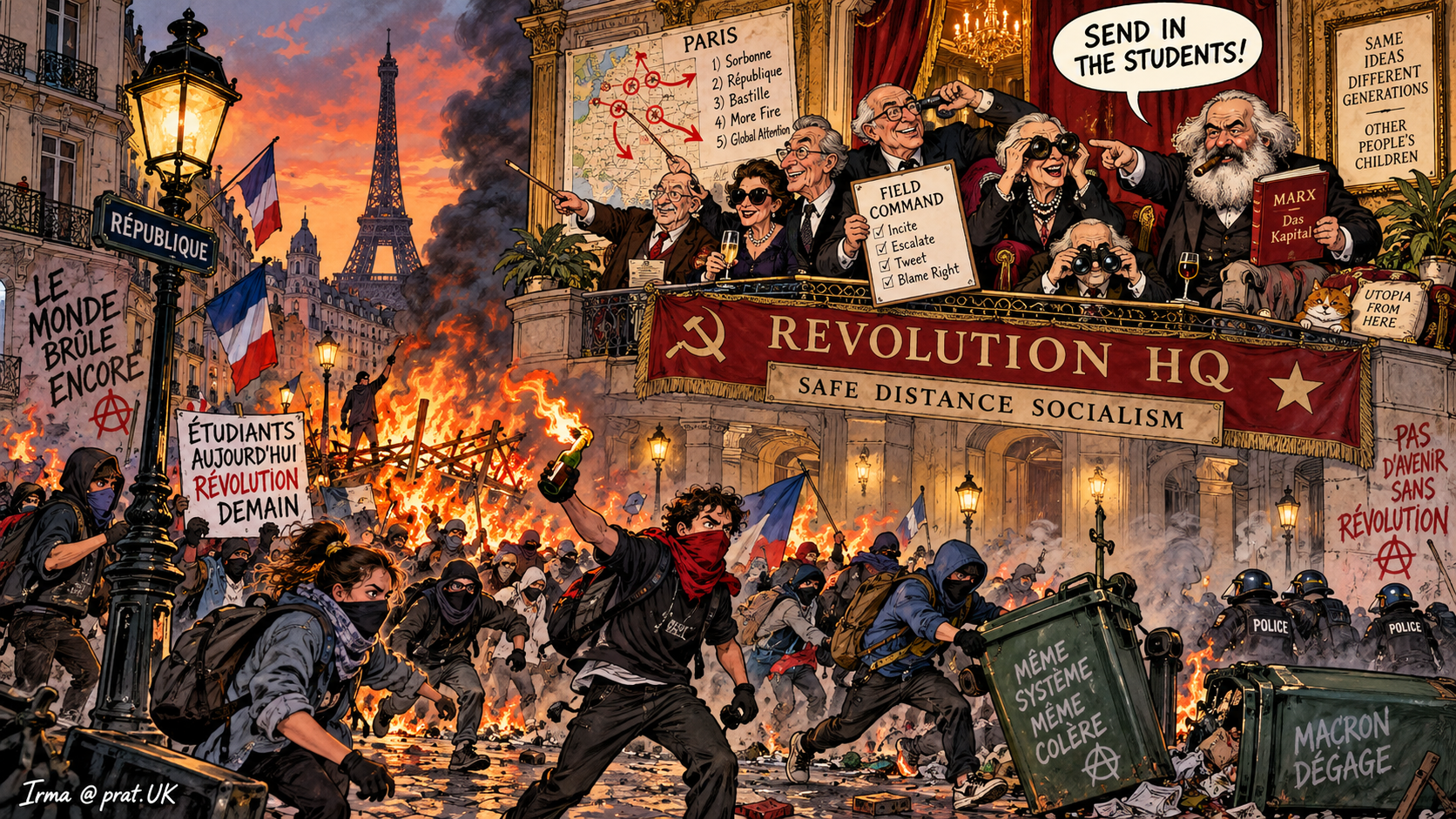
PARIS, October 22, 2026 – French revolutionary activists have unveiled an ambitious new economic strategy designed to combat rising living costs by damaging the businesses, vehicles and public infrastructure that ordinary French citizens depend on to earn a living.
The announcement comes as President Emmanuel Macron returns from diplomatic discussions in the Gulf meant to strengthen French energy supplies during a period of unusually high fuel prices.
According to Al Jazeera’s reporting on France’s Gulf diesel supply agreements, energy commitments from Gulf partners reached roughly 295,000 tonnes of diesel a month, just over 10 percent of French consumption.
For the revolutionary left, this is an unacceptable attempt to solve an economic problem using economics.
The radical committee prefers direct action, particularly when somebody else pays for the consequences.
Marxist Economists Discover That Destruction Creates Employment
The most controversial element of the new recovery program concerns the treatment of privately owned vehicles.
According to revolutionary economic theory, a burned car creates extra demand for automobile manufacturing, insurance administration, mechanical repairs and government compensation.
Consequently, destroying one vehicle might stimulate several sectors at once.
A revolutionary adviser called this the multiplier effect.
An actual economist pointed out that the same resources could have been used to produce something new instead of replacing something that already existed, a mistake economists have known since the parable of the broken window.
The adviser dismissed the objection.
“Capitalists are obsessed with material possessions,” he explained.
Asked whether he owned a car, the adviser acknowledged having a fairly new Peugeot.
He added that the vehicle should not be targeted because he needed it to attend revolutionary meetings.
This exemption would also apply to the cars of revolutionary committee members, journalists sympathetic to the movement, and anyone responsible for delivering catering to protest headquarters.
All other vehicles would be considered legitimate symbols of bourgeois economic inequality, particularly if they were parked somewhere convenient.
Socialist Protesters Demand Lower Prices While Raising Business Costs
French shopkeepers have encountered equally sophisticated economic arguments.
The revolutionary committee maintains that businesses should cut prices immediately to protect working families.
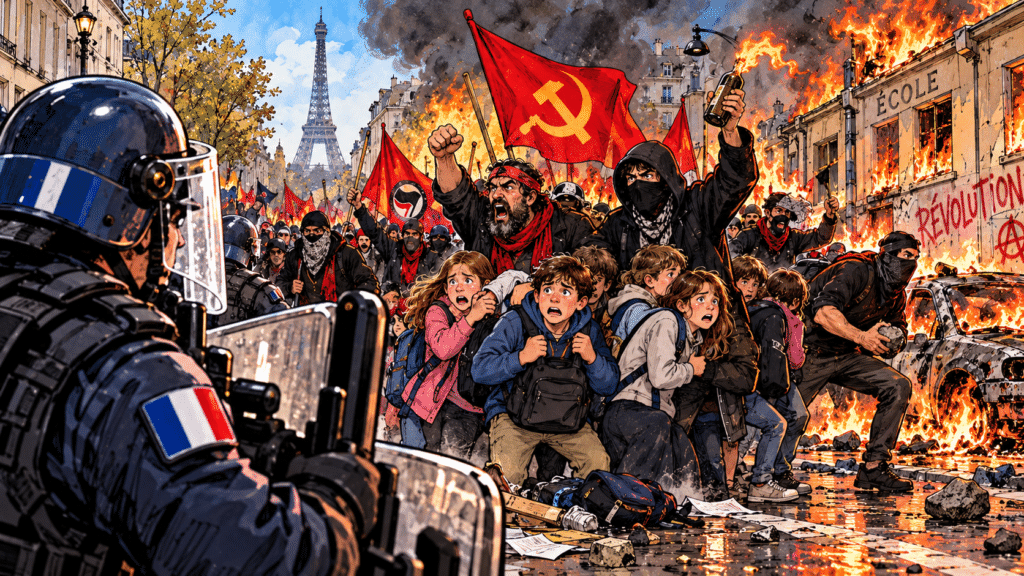
At the same time, it supports demonstrations that disrupt deliveries, discourage customers, interrupt employee travel and force some businesses to close temporarily.
Where unrest results in broken windows or stolen stock, retailers face additional expenses.
An economist explained that higher operating costs generally make it harder for businesses to lower prices.
The revolutionary committee accused the economist of spreading pessimism.
“We demand cheaper goods,” declared its spokesman.
“Would preventing businesses from operating make goods cheaper?”
“That depends on whether the owners embrace social justice.”
“Would replacing a destroyed shop window cost money?”
“Under socialism, glass would belong to everyone.”
“Who would manufacture the glass?”
“The workers.”
“Who would pay the workers?”
“The government.”
“Where would the government get the money?”
“The people.”
The spokesman later complained that the interview contained too many questions.
Macron Tries to Lower Fuel Prices Using Foreign Fuel
Macron’s Gulf diplomatic mission stood in stark contrast to this revolutionary approach.
His discussions centered on securing diesel and liquefied natural gas, maintaining access to energy supplies and easing price pressures on French households.
The process involved international agreements, commercial relationships and talks with governments that hold the energy resources France needs.

The revolutionary committee regarded all this with profound suspicion.
“Why should France depend on foreign countries for energy?” demanded one socialist organizer.
A reporter explained that France does not have unlimited domestic oil and gas supplies.
“Then the government should provide them.”
“Where would it get them?”
“From public ownership.”
“Of what?”
“The oil.”
“Which oil?”
“The people’s oil.”
The organizer was then informed that transferring ownership of a petrol station does not cause oil to appear underneath it.
He rejected this argument as geological neoliberalism.
Workers Asked to Celebrate Revolution While Missing Work
Perhaps the most remarkable feature of the revolutionary economic strategy is its effect on the people it claims to represent.
A delivery driver prevented from working during a demonstration does not automatically receive compensation for lost wages.
A restaurant employee whose workplace closes during unrest may lose valuable working hours.
A small-business owner forced to repair damaged property has to finance the expense, often from savings or from insurance that may become more costly.
These are precisely the households already struggling with higher living costs.
The socialist response is to demand additional government assistance.
Asked whether stopping people from earning money before demanding compensation might be an unnecessarily complicated way to improve prosperity, the committee described it as a transitional difficulty.
An economic adviser compared the process to renovating a house.
“Sometimes you must destroy the old structure before constructing something better.”
A local tradesman explained that competent builders generally have plans, budgets, materials and a realistic understanding of how construction works before they demolish the building.
The adviser accused him of defending traditional bourgeois architecture.
Revolutionary Committee Announces Victory Over Capitalism
By Thursday afternoon, the movement had produced a comprehensive economic recovery proposal.
The government would increase spending, reduce taxation, lower prices, raise wages, guarantee employment, eliminate profits, subsidize energy and compensate businesses for damage caused during demonstrations.
A committee economist estimated that the program would achieve complete social equality within eighteen months.
Asked how he had calculated the figure, he explained that eighteen months sounded more encouraging than three years.
Asked whether the program required additional borrowing, he responded that borrowing from capitalist financial institutions would be unnecessary once the government controlled the financial institutions.
Asked whether nationalization eliminated debt, he replied that debt was merely an accounting concept.
French taxpayers were expected to find this reassuring.
The committee also demanded that Macron return from abroad immediately to address domestic fuel prices.
A government representative pointed out that Macron had been abroad working on fuel supplies.
This information was rejected as a distraction.
“French people cannot afford petrol,” declared the revolutionary spokesman. “The president must do something.”
“He has negotiated additional diesel supplies.”
“That’s not enough.”
“What else should he do?”
“Come back and listen to our demands.”
“What are your demands?”
“Cheaper petrol.”
The spokesman then announced another demonstration against the cost of living.
Participants were encouraged to travel by public transport, although some routes might be disrupted by the demonstration itself.
Motorists were advised to avoid central Paris.
Shopkeepers were encouraged to close early.
Workers were advised to allow extra commuting time.
And French taxpayers were reminded that, whatever the outcome of the revolution, somebody would eventually have to pay to clean up afterward.
The revolutionary committee regarded this as a decisive victory over capitalism.
The government regarded it as another bill.
France’s motorists, meanwhile, would probably settle for a litre of diesel at a price that did not require a second mortgage.
Five Humorous Observations
- Burn a car to create jobs. That’s the multiplier effect. I’ve got a cousin who burned down a barn for the insurance, and nobody gave him a Nobel Prize. They gave him eighteen months.
- Every car in France is a symbol of inequality except the adviser’s Peugeot, because he needs it for the meetings. Of course he does. Revolutionaries love equality the way I love a diet. Great in theory, and I’m exempt on weekends.
- The people’s oil. Which oil? The people’s oil. You can’t just say that. It’s like saying I own the ocean, I just haven’t been to it yet.
- Eighteen months to complete equality, because eighteen sounded better than three years. That’s how I pick my diet plans, and that’s why I’m sitting in a Waffle House at midnight.
- Somebody always pays for the cleanup. At my house it’s me. In France it’s every taxpayer, while the revolution goes off to lunch.
No cars were burned in the writing of this disclaimer, although the printer is looking nervous. The quotes, committees and proposals are comic scenarios rather than statements by real protest organisers, and peaceful demonstrations are a different thing from rioting, vandalism and looting. More British satire, fuel prices permitting.

Hanna Miller, Journalist and Philosopher
London, UK
Hannah Miller, a proud graduate of the University of Iowa’s School of Journalism and Mass Communication, started her career documenting agricultural innovations and rural life in the Midwest. Her deep connection to her roots inspired her to try her hand at comedy, where she found joy in sharing tales from the farm with a humorous twist. Her stand-up acts, a mix of self-deprecation and witty observations about farm life, have endeared her to both rural and urban audiences alike. She is a four-year resident to London and the UK.