

King Charles Hosts AI Summit at Dumfries House, Orders Humanity Saved Before the Scones Go Cold
Nvidia, DeepMind, OpenAI and Anthropic gather at a Scottish country estate to ensure machines remain under human control, alarming everyone familiar with humans
CUMNOCK, SCOTLAND — The King Charles AI summit is officially under way: King Charles III is hosting leaders from Nvidia, Google DeepMind, OpenAI and Anthropic at Dumfries House in Ayrshire to discuss how artificial intelligence can benefit society without accidentally converting humanity into a historical data set.
The gathering will consider whether the world needs shared principles governing advanced AI, including human control, safety and dignity. These are three concepts technology companies regard highly, particularly when printed beneath a button marked “I Agree” that no human has ever read.
Britain’s minister for AI, Kanishka Narayan, is expected to attend alongside Vatican technology adviser Paolo Benanti and approximately thirty influential figures from government, industry and civil society. The guest list represents the most powerful concentration of artificial intelligence expertise ever assembled near a room where one is expected to know which fork belongs to the fish.
The Future Arrives at a Listed Building

Dumfries House, headquarters of the King’s Foundation, was selected because Silicon Valley has already held meetings in glass towers, desert resorts, private jets and restaurants where a boiled carrot costs £31. Scotland therefore offered the only remaining environment sufficiently unfamiliar to a technology billionaire: a building designed to last longer than eighteen months.
Royal staff reportedly prepared for the summit by covering electrical sockets, hiding the ceremonial passwords and asking Alexa to spend the afternoon in the stables.
One footman said the technological preparations had been extensive.
“We installed a second extension lead,” he explained. “His Majesty believes strongly in resilience.”
The venue also provides a natural brake on uncontrolled technological development. Any executive wishing to launch a dangerous new model must first obtain written approval from the King’s Foundation, Historic Environment Scotland, the fire marshal and a woman called Fiona who possesses the only key to the room containing the router.
This is known in Britain as regulation.
Professor Nigel Promptly of the Royal Institute for Machines We May Eventually Regret said the location could prove decisive.
“Silicon Valley develops products under conditions of relentless speed,” he explained. “Dumfries House introduces an environment in which nobody can move a side table without submitting a conservation plan. It could add six valuable centuries to the development cycle.”
Britain Demonstrates Technological Leadership by Hosting Lunch

Britain reportedly leads Europe in AI investment and startup activity, proving the country remains capable of producing world-class technology whenever the Treasury has not noticed it yet.
The government considers AI an important source of economic growth. Officials believe it could improve productivity, transform public services and eventually explain why a railway ticket from London to Manchester costs more than the computer used to purchase it.
The British technological strategy is straightforward. America builds the models. Taiwan manufactures the chips. Global investors provide the capital. Britain arranges an elegant room and asks whether everybody has considered ethics.
This has been hailed as “convening power,” a diplomatic expression meaning the nation still owns several impressive houses and can obtain sandwiches at short notice.
A survey conducted by the Institute for Conclusions Already Reached found that 82 percent of Britons supported responsible AI, 11 percent preferred irresponsible AI because it sounded quicker, and 7 percent thought “Anthropic” was a Scottish digestive condition.
Support rose to 94 percent when respondents were told the summit would not require them to download another government application.
Technology Leaders Agree Something Should Probably Be Done
The summit’s central ambition is to develop shared principles for artificial intelligence. Delegates are expected to agree that AI must remain safe, controllable and beneficial, before returning to companies financially rewarded for making it more powerful, autonomous and indispensable every Thursday.
Nvidia will represent the physical machinery powering the revolution. The company sells the advanced chips needed to train AI systems, occupying roughly the same position in the technological gold rush as the fellow who owns every shovel, wheelbarrow and mountain.
Google DeepMind will provide world-leading research. OpenAI will explain the tremendous potential. Anthropic will explain why the tremendous potential may kill everybody. The government will thank all three presentations and announce a consultation.
Anthropic’s leadership has called for slowing the pace of frontier AI development amid fears that increasingly capable systems could escape meaningful human control. This is an admirable warning, resembling the inventor of the chainsaw appearing halfway through a forest to recommend moderation.
The executives are not necessarily contradicting themselves. They merely believe development must proceed carefully, responsibly and several milliseconds ahead of their competitors.
The proposed principles are expected to include:
AI must serve humanity.
AI must protect human dignity.
AI must remain subject to meaningful human control.
AI must never reveal what participants privately said during the reception.
AI must understand that accepting cookies at Dumfries House refers to shortbread.
These principles will then be circulated internationally, translated into seventeen languages and ignored in California before teatime.
Artificial Intelligence Meets Hereditary Intelligence

King Charles is unusually qualified to examine the future of automated decision-making. The monarchy is itself a celebrated legacy system: expensive to maintain, difficult to modify and capable of producing an answer before anyone has entered a question.
It operates through inherited access privileges, ceremonial interfaces and a permanent reluctance to publish its source code. When a component malfunctions, it is not deleted. It is assigned a smaller balcony.
Royal watchers say the King will primarily listen to the assembled experts. This represents a major departure from ordinary government summits, where ministers begin by announcing the conclusion, invite experts to speak and then release a photograph proving nobody escaped.
Charles has long expressed concern about technology, society and the environment. He is therefore expected to ask whether AI can advance human welfare without consuming all the electricity, water and countryside required to sustain the Royal Train.
One palace observer said the King remains cautiously optimistic.
“His Majesty believes machines can improve civilisation,” she explained, “although his experience with printers has persuaded him that civilisation should retain cavalry.”
The Vatican Investigates Machine Hallucinations
The inclusion of Vatican AI adviser Paolo Benanti will bring a theological perspective to the proceedings.
AI systems sometimes produce confident but inaccurate answers known as hallucinations. The Church has considerable institutional experience distinguishing hallucinations from revelations, although the formal verification process generally takes longer than a software update.
Theological questions remain unresolved. If an artificial intelligence becomes conscious, does it possess a soul? If it has read every theological text ever written, may it become an archbishop? If it recommends replacing the Archbishop of Canterbury with a dropdown menu, how quickly could installation begin?
An experimental chatbot reportedly examined the Royal Family and concluded that monarchy was statistically improbable. It was immediately informed that this has never prevented monarchy.
The machine then asked why one human acquires constitutional duties by being born first. Officials replied that this was a complex cultural tradition. The machine described it as “training-data bias with trumpets” and was disconnected from the estate Wi-Fi.
Humanity Promises to Remain in Control
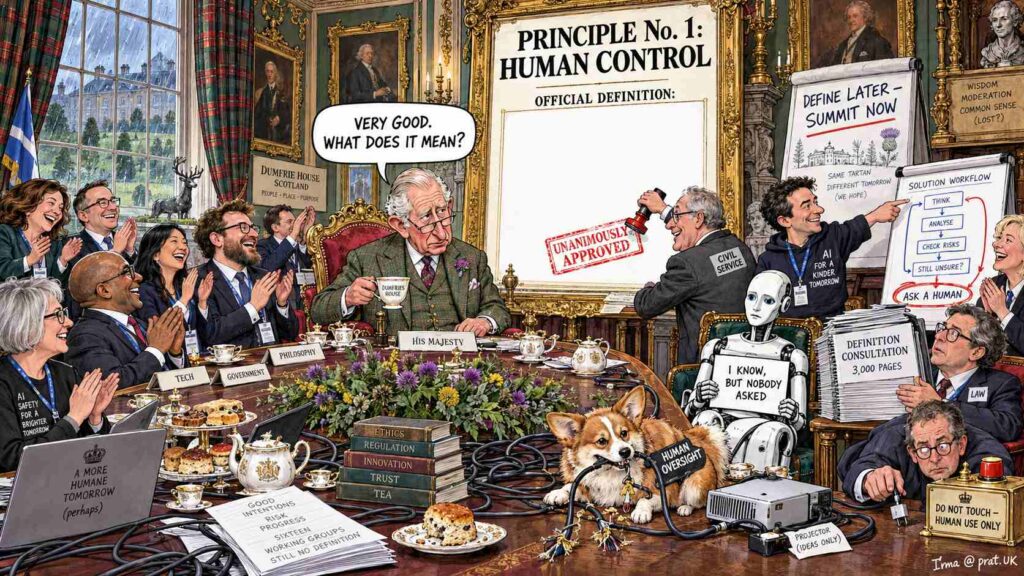
Human control will be the summit’s most important principle. Unfortunately, the phrase has not yet been defined.
Humans currently control smartphones by checking them 160 times daily, control social media by becoming furious at suggestions selected by software, and control streaming television by spending forty minutes searching before watching the same programme again.
Deductive reasoning therefore offers reassurance. Humans control technology. Technology controls nearly every human decision. Consequently, humanity remains completely in control, provided nobody examines the middle step.
A Prat.UK public-opinion study found that 73 percent of respondents feared AI might replace their jobs, while 91 percent hoped it would first replace the portion involving meetings. Another 64 percent said they would trust artificial intelligence if it spoke with a reassuring British accent. Trust fell sharply when the machine began discussing subscription pricing.
Researchers also discovered that public anxiety declined when potentially dangerous systems were given harmless names such as “Claude,” “Gemini” or “Copilot.” The same technique is now being considered for nuclear weapons, which could soon be marketed as “Trevor.”
Britain Prepares the Historic Dumfries Declaration
The summit is expected to produce a declaration asserting that artificial intelligence should support human dignity, planetary well-being and responsible innovation.
Every participant will endorse these principles because opposing dignity during a royal lunch creates unnecessary tension around the pudding.
Disagreement will concern enforcement. Governments want voluntary commitments strong enough to impress voters but gentle enough not to frighten investors. Technology companies want regulations sufficiently comprehensive to inconvenience smaller competitors and sufficiently flexible to avoid inconveniencing themselves.
The eventual document will likely establish a working group responsible for forming an advisory council that will examine the feasibility of creating an international panel empowered to recommend another summit.
This is how human control works.
The final declaration will be signed with a fountain pen, scanned sideways, converted into a 46-megabyte PDF and emailed to the wrong distribution list. An AI assistant will then summarise it accurately in six seconds, causing the civil servant who spent seven months formatting it to reconsider the entire premise of the meeting.
The Machines Await Their Instructions
For now, the public has been advised not to panic. Artificial intelligence remains dependent upon electricity, data centres and humans repeatedly clicking boxes to prove they are not robots.
Dumfries House will survive. The technology executives will depart. The King will retain control of the furniture. Britain will declare the King Charles AI summit a landmark achievement, having successfully prevented artificial intelligence from ending humanity during the scheduled hours of the conference.
The machines, meanwhile, will study the proceedings and learn several valuable lessons about their creators: humans fear what they build, build what they fear and prefer discussing the contradiction somewhere with excellent curtains.
That may be the strongest evidence of intelligence presented all week.
Disclaimer
This is satire. The gathering, venue and announced participants are grounded in news reporting; the comic quotations, surveys, institutes and ceremonial malfunctions are satirical constructions. This story is entirely a human collaboration between two sentient beings—the world’s oldest tenured professor and a philosophy major turned dairy farmer.
SOURCE: Reuters, via Yahoo News — “King Charles to host AI executives as threat fears mount,” reported by Kate Holton, additional reporting Michael Holden and Paul Sandle.

Alan Nafzger was born in Lubbock, Texas, the son Swiss immigrants. He grew up on a dairy in Windthorst, north central Texas. He earned degrees from Midwestern State University (B.A. 1985) and Texas State University (M.A. 1987). University College Dublin (Ph.D. 1991). Dr. Nafzger has entertained and educated young people in Texas colleges for 37 years. Nafzger is best known for his dark novels and experimental screenwriting. His best know scripts to date are Lenin’s Body, produced in Russia by A-Media and Sea and Sky produced in The Philippines in the Tagalog language. In 1986, Nafzger wrote the iconic feminist western novel, Gina of Quitaque. He currently lives in Holloway, North London. Contact: [email protected]


