King Charles Invents the ‘You Quit’ Doctrine for Non-Working Royals
Palace Says Prince Harry Remains a Non-Working Royal, Lawyers Asked to Confirm the Obvious
LONDON — King Charles has reportedly reaffirmed that Prince Harry and Meghan remain non-working royals, prompting another national investigation into one of Britain’s most difficult philosophical questions. When a man stops doing a job, does he eventually stop having the job?
Buckingham Palace’s answer appears to be yes. Harry’s answer appears to be, “Yes, obviously, but define stop.” And British lawyers have now entered the room carrying folders.
The Exit Interview That Never Ends
Harry resigned from royal duties in January 2020, and Britain is still, six years on, conducting the exit interview. Being a non-working royal was supposed to mean he stopped doing the job. In practice it means he retains unlimited access to arguments about the employee handbook. Most people who quit a job cannot spend six years negotiating what their former employer is allowed to call them. Harry can, because the former employer is the Crown, and the Crown does not do brief correspondence.
The monarchy’s greatest administrative innovation may be inventing a family argument important enough to require formal guidance to senior government and military officials. King Charles’s position, boiled down, is essentially that Harry wanted independence, and this is the independence he ordered. Aristocracy, it turns out, has finally invented the zero-hours contract, and somewhere a civil servant is quietly proud of it.
Palace Announces Revolutionary Principle: A Non-Working Royal Means Not Working
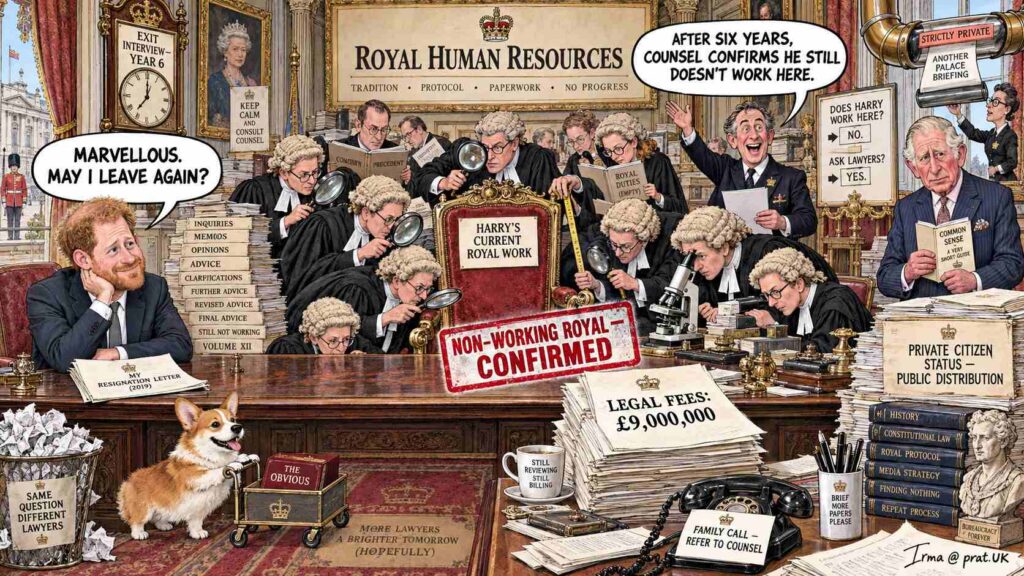
The royal household has embraced an almost dangerously straightforward position. Harry and Meghan stopped being working royals. Therefore, they are not working royals. Legal scholars are reportedly stunned by the elegance.
For centuries, Britain required Magna Carta, Acts of Parliament, judicial precedent, royal prerogative and men in wigs to establish constitutional principles. Charles has apparently reduced everything to “he left.” The principle could transform employment law. Imagine resigning from Tesco in 2020 and returning in 2026 demanding clarification about whether management still considers you part of the produce department. “Technically, David, no.” “But people still recognise me near the bananas.” “That does not make you Assistant Produce Manager.” “I wore the badge for seven years.” “You resigned.” “My Instagram biography still says Tesco alumnus.” “Security.” “What about it?” “Please leave.”
Prince Harry’s situation is obviously more complicated than working the vegetable aisle, primarily because Tesco employees are rarely born fifth in line to the throne. But the central logic survives. Harry wanted to cease official royal duties. He ceased official royal duties. The Palace now says he has no official royal duties. Somewhere, Aristotle is screaming that we solved this 2,300 years ago.
Sussexes Respond to the Non-Working Royal Label by Becoming International News
Sources close to Harry and Meghan have pushed back on being described as ordinary private citizens, noting that they remain globally recognisable public figures. That distinction is genuinely relevant to their security and privacy concerns. It is also extremely funny, because nothing challenges the phrase private citizen quite as efficiently as becoming an international news story about whether you are one.
An actual private citizen named Nigel can go months without Reuters examining his constitutional position. Nigel goes to B&Q. Nigel buys decking. Nigel returns because he bought the wrong screws. At no stage does the Lord Chamberlain, or as some cheerfully mislabel him the Chord Lamberlain, communicate Nigel’s status to senior military personnel. Harry’s privacy operates at another altitude entirely. He is private in the same way Heathrow Terminal 5 is secluded.
The Palace is not claiming nobody recognises him. It is drawing a distinction between public fame and public office. David Beckham is famous. David Beckham does not open Parliament. Adele is famous. Nobody asks Adele to receive the Belgian ambassador unless he bought tickets. Harry can be globally famous while simultaneously not representing the Crown. This should not require a doctorate. Britain has nevertheless ordered several.
California Fails to Invent a Category Between Royal and Non-Working Royal
The deeper problem may be that Harry occupies an awkward cultural space for which Britain has no convenient label. He is unquestionably a prince, unquestionably the King’s son, and unquestionably internationally prominent. But he is not a working royal. This creates what researchers at the entirely satirical Institute of Advanced Dukedom Studies call Royal-ish, a constitutional category located somewhere between Duke of Sussex and LinkedIn influencer.
Royal-ish citizens retain castles in their childhood memories, titles in their biographies, and roughly forty million people with opinions about their marriage. They may attend charitable events, produce television programmes, and occasionally appear near actual working royals. But they cannot arrive at the Foreign Office saying, “Afternoon. Prince Harry. Anything need representing?”
California did not change this. Moving to Montecito may change your climate, your coffee preferences, and your odds of meeting someone who describes breathing as a wellness journey, but it does not amend the British constitution, although California residents are famously inclined to believe geography creates spiritual transformation. Harry could have moved to Mars. He would still be the Duke of Sussex, and would simply become the first non-working royal requiring NASA clearance.
Harry Requests an Appeal to Royal Human Resources
The saga carries the unmistakable atmosphere of an employee who left the company but remains emotionally invested in his old Outlook account. Harry wanted freedom from the institution. Understandable. He wanted financial independence. Granted. He wanted to pursue private charitable and commercial projects. Done. Then Buckingham Palace essentially wrote back: yes, exactly, those are private activities. And somehow we have arrived at another argument.
One imagines the royal Human Resources department, possibly three elderly men named Peregrine sitting beneath a portrait of Queen Victoria. “Your Royal Highness, you resigned.” “Yes.” “You requested independence.” “Yes.” “We gave you independence.” “Yes.” “We are now describing you as independent.” “This is outrageous.” “Would you like tea?” “Obviously.” Royal reconciliation, it seems, has entered its mature phase, and Harry wanted to stop working for the family firm, only to find that the family firm keeps finding new ways to stay in touch.
What Should the Palace Call a Non-Working Royal Instead?
If private citizen is objectionable because Harry is famous, what terminology should Britain adopt? “Non-working internationally recognisable hereditary prince engaged in independent commercial and charitable activities while retaining family relationships with the sovereign” is accurate, if a little cumbersome on airport forms. Perhaps simply: ROYAL, OFF DUTY. Or: PRINCE, PERSONAL CAPACITY. Or, as one especially efficient wag suggested, a badge reading PRINCE. NOT ON SHIFT, which Whitehall is presumably working overtime to make sure everyone clocks it.
The British government loves classifications, so this could become a tremendous administrative opportunity. Whitehall could create Form HRH-27B. Question one: are you currently representing His Majesty? Yes, no, or Netflix documentary underway. Question two: are your charitable activities official? Yes, no, or complicated. Question three: has Oprah been informed? Yes, or not yet. Civil servants could process applications within eighteen months. Growth would return immediately.
Security Makes the Non-Working Royal Joke More Complicated
There is, however, a serious distinction underneath the comedy. Harry’s argument about being a globally recognised public figure matters particularly in relation to security. A government committee has been reviewing whether taxpayer funded protection should be reinstated for the family following their return to Britain, and the review remains ongoing.
That issue deserves to be treated separately from whether Harry performs royal duties. A person can be a private citizen and still face substantial security risks. Former politicians, celebrities, executives and prominent activists demonstrate this every day. The sensible proposition is perfectly capable of containing two ideas simultaneously: Harry does not officially represent the Crown, and Harry may nevertheless require unusual security because Prince Harry is somewhat more recognisable than Trevor who repairs boilers in Luton. Britain should be constitutionally sophisticated enough to hold both thoughts without convening an emergency symposium.
Palace Discovers That Independence for a Non-Working Royal Has Terms and Conditions
The comic heart of the dispute remains delightfully simple. Harry fought for independence. Independence contains benefits: you make your own money, choose your own projects, live where you wish, speak for yourself. It also contains the irritating second half of independence, the part nobody puts on the recruitment poster, which is that you are no longer acting for the institution you left. That is not punishment. That is the receipt.
You cannot demand complete independence from Pizza Hut and then become offended when Pizza Hut clarifies that your new artisanal calzone business is not an official corporate initiative. “I used to be senior management.” Correct. “I know the founder.” Wonderful. “My father owns the company.” Interesting. “Therefore my mozzarella charity should receive corporate recognition.” Now we need lawyers.
Nation Wonders Why ‘Non-Working Royal’ Requires This Much Litigation
Britain has managed to turn five syllables into a constitutional cottage industry. Non-working royal. You would think the clue was hiding inside the phrase. A non-working toaster does not continue representing KitchenAid. A non-working traffic light is not consulted on highway policy. A non-working royal remains royal by birth and title but does not perform duties on behalf of the Crown, irregardless of how many correspondents disagree.
Harry is simultaneously the King’s son, a prince, the Duke of Sussex, a famous public figure, a private individual in his commercial and charitable activities, and not a working representative of the Crown. Five concepts, all true, and no constitutional particle accelerator required.
King Charles Finally Introduces the You Quit Doctrine
Historians may eventually remember Charles III for environmentalism, interfaith work, and the revolutionary constitutional principle that resignations remain valid after crossing the Atlantic. The You Quit Doctrine could be taught at Oxford. “What happens when a working royal voluntarily stops being a working royal?” “He becomes a non-working royal.” “Excellent.” “What happens six years later?” “Apparently we start again.”
Britain loves tradition, and nothing is more traditional than converting a family disagreement into several thousand pages of official correspondence. Harry wanted independence. The Palace says he has it. Perhaps the final stage of independence is accepting that the institution you left no longer needs your approval when explaining that you left it. Charles could even send one final letter: Dear Harry, you are independent, this means you are also independent of this letter, love, Dad. Copies, naturally, would be sent to the Cabinet Office, the Ministry of Defence, the Home Office, the Lord Chamberlain, and whoever currently handles Royal-ish. Because privacy is important.
As the Manchester comedian Barry Fenwick put it during a Sunday night set: “Harry didn’t just resign. He resigned so hard the Palace needed a legal team just to accept the resignation.”
Buckingham Palace confirmed in a letter sent on behalf of King Charles III that Prince Harry and Meghan, the Duke and Duchess of Sussex, remain non-working members of the Royal Family following their return to Britain, continuing the arrangement in place since they stepped back from royal duties in January 2020. A spokesperson for the couple told reporters they were surprised by the letter and were not given the chance to contribute to it before publication. Separately, a government committee has been reviewing whether taxpayer funded security should be reinstated for the family now that they are living in the UK.
This piece is UK satirical news, part of the wider tradition of satirical journalism that pokes fun at bureaucracy rather than people. The Institute of Advanced Dukedom Studies, its Royal-ish research, and Form HRH-27B are comedic devices built around a real dispute over Palace guidance and Prince Harry’s status as a non-working royal. Call it English satire with a filing cabinet.
Sources
NBC News: King Charles confirms Harry and Meghan will not be working royals after UK return
ITV News: Harry and Meghan to have security reviewed after their move to UK
For America’s own take on family firms and resignation letters, our sister publication Bohiney.com has thoughts.
Auf Wiedersehen, amigo!

Alan Nafzger was born in Lubbock, Texas, the son Swiss immigrants. He grew up on a dairy in Windthorst, north central Texas. He earned degrees from Midwestern State University (B.A. 1985) and Texas State University (M.A. 1987). University College Dublin (Ph.D. 1991). Dr. Nafzger has entertained and educated young people in Texas colleges for 37 years. Nafzger is best known for his dark novels and experimental screenwriting. His best know scripts to date are Lenin’s Body, produced in Russia by A-Media and Sea and Sky produced in The Philippines in the Tagalog language. In 1986, Nafzger wrote the iconic feminist western novel, Gina of Quitaque. He currently lives in Holloway, North London. Contact: [email protected]