Masked Protesters Shut Dover, Westminster Horrified Citizens Have Located the Border
Labour Says the Dover Border Crisis Is Improving Because Britain Is Now Losing Control More Efficiently
DOVER, ENGLAND — Britain’s long-running experiment in managing illegal immigration through press releases, ministerial adjectives and very expensive conversations with France encountered an unexpected complication Saturday: several hundred people apparently decided to visit the border themselves.
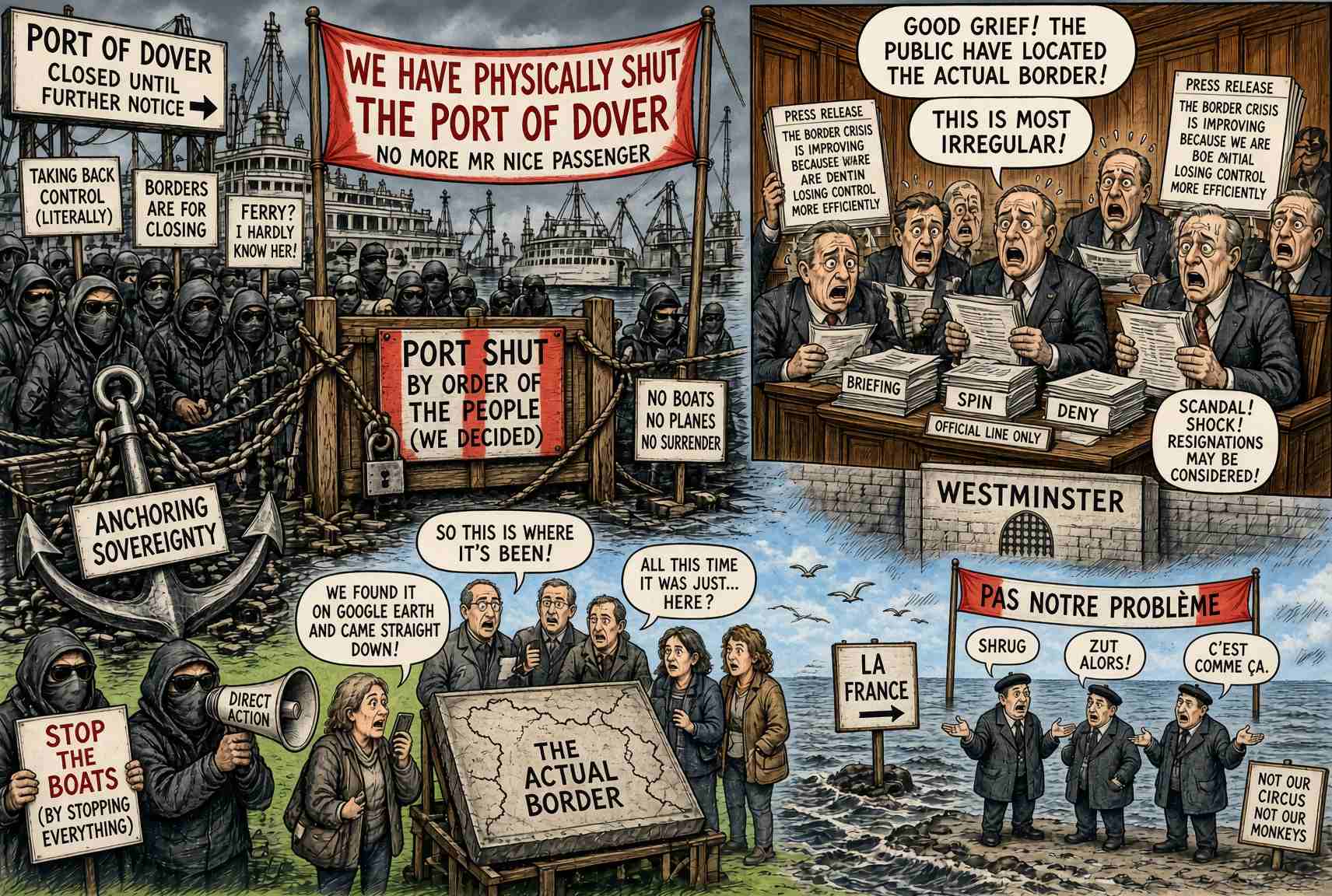
Masked demonstrators dressed in black blocked roads leading to the Port of Dover, chanting “Stop the boats” and bringing traffic around Britain’s busiest ferry port to a temporary standstill. Congestion stretched roughly four miles, with delays reaching around 45 minutes before access was restored.
This publication supports the protesters’ right to demonstrate and the underlying demand that Britain control its borders. Motorists trapped on the A20 are equally entitled to suggest that perhaps the next constitutional convention could be held somewhere not directly in front of their Ford Mondeo.
The extraordinary thing about Dover was not that people protested immigration policy.
The extraordinary thing was Westminster acting surprised.
Britain has spent years conducting immigration policy with the calm administrative confidence of a man watching his kitchen fill with water while explaining that the new mop procurement process is performing exceptionally well.
Official Home Office figures say there were 33,000 small-boat arrivals in the year ending June 2026, representing a 23 percent reduction from the previous year.
That is undeniably progress.
It is also 33,000 people.
Both facts can exist simultaneously, although British politics has recently adopted the philosophical position that acknowledging one automatically invalidates the other.
Labour’s message is essentially: “Good news. The bath is still overflowing, but considerably more slowly.”
Labour’s Dover Border Crisis Spin: Losing Control, Just More Efficiently
The Labour government argues that cooperation with France is working. There is evidence for that.
The Home Office says more than 48,000 attempted crossings have been prevented since the election, and officials reported that 185 small-boat events involving about 4,300 attempted crossings were stopped during the first three months of a newer UK-France agreement.
Fine.
Give them credit.
Then ask the question governments hate because it cannot be answered with a pie chart:
Why are ordinary people still this angry?
Perhaps because citizens do not experience immigration policy as a percentage.
They experience housing shortages, public-service pressure, hotel controversies, asylum backlogs, taxation, neighborhood change and endless political promises that the problem has finally been solved beginning next Tuesday.
A statistic can say crossings have fallen 23 percent.
A voter can still say, “That number remains too high.”
Neither statement requires a balaclava or a doctorate.
Labour MP Mike Tapp, representing Dover and Deal, responded to the protesters by telling them in a Facebook post to “go home” and “get a job,” while emphasizing that crossings were down.
This may be the first political communications strategy developed entirely by a nightclub bouncer.
“Concerned about border control?”
“GET A JOB.”
“Worried about asylum policy?”
“MOVE ALONG.”
“Could Parliament perhaps discuss carrying capacity?”
“NOT TONIGHT, MATE.”
Political scientists call this the Dismissive Constituent Feedback Loop: voters complain, politicians insult them, voters become angrier, politicians commission research into why voters have become angry.
The research costs £4.7 million.
Conservatives and the Dover Border Crisis They Can’t Quite Recall Creating
The Conservatives, meanwhile, retain the useful strategic advantage of having apparently misplaced several years of their own immigration policy.
For years Britain heard variations on “take back control,” “stop the boats,” “tough new measures,” “new plan,” “new new plan,” and presumably somewhere inside Whitehall a PowerPoint presentation titled FINAL_BORDER_PLAN_v19_ACTUALFINAL2.pptx.
Then came another boat.
And another announcement.
And another minister explaining that this time the French had agreed to stand six feet closer to the water.
The British state has developed an extraordinary capacity to project power everywhere except approximately twenty-one miles south of Kent.
It can regulate kettles.
It can specify recycling bins.
It can determine whether your shed requires planning permission.
It can locate an elderly woman who accidentally overpaid her pension by £11.40.
But ask whether the border should operate as a border and suddenly everyone begins stroking their chin like Aristotle confronted with quantum mechanics.
Reform Discovers the Dover Border Crisis Protest Needs Better Manners
Reform UK supplied the weekend’s finest piece of political comedy.
Its politicians oppose illegal Channel migration.
Yet senior Reform figures also condemned the Dover blockade. Robert Jenrick called the disruption “disgraceful,” while Nigel Farage criticized the protesters’ masks and tactics.
This produced a wonderfully British ideological arrangement:
“We agree with what you’re furious about.”
“Excellent.”
“We agree government has failed.”
“Excellent.”
“We want stronger borders.”
“Excellent.”
“But could you please express this between 2:15 and 2:47 in a designated municipal grievance area behind the leisure centre?”
Reform’s position is not unreasonable. Blocking innocent motorists is a poor substitute for blocking illegal entry.
But politically it demonstrates the peculiar gravitational force of Westminster. Eventually every insurgent movement gets close enough to London that somebody hands it a lanyard and it starts worrying about traffic management.
As one Dover cabbie, who gave his name only as “Big Kev,” put it while idling behind the roundabout: “Everyone down here agrees on the problem. Took them all weekend to disagree on the parking.”
The Balaclava Question at the Heart of the Dover Border Crisis
Politicians and commentators were particularly disturbed by the protesters wearing balaclavas.
Fair enough.
Hundreds of masked men dressed in black do not exactly convey “Neighbourhood Watch annual picnic.”
A local Conservative councillor said there had been no violence that he knew of, while describing the sight as intimidating. Police said no arrests were made.
But the masks produced another wonderfully British contradiction.
The government wants citizens to show their faces while government statements frequently come from “a spokesperson.”
Apparently anonymity is threatening unless accompanied by a civil-service pension.
Imagine the reverse.
A protester approaches television cameras.
“My name is confidential, but sources familiar with my thinking indicate I am extremely concerned about immigration.”
BBC correspondent:
“Finally, a respectable man.”
Redefining the Dover Border Crisis: Failure by Spreadsheet
A border is traditionally defined as a line separating one sovereign territory from another.
Britain has modernized this antiquated concept.
Under the contemporary model, the border is a place where officials record approximately how unsuccessful the border has been.
This is much more data-driven.
The government publishes daily and weekly statistics on small-boat activity, including arrivals and French preventions.
The numbers are admirably transparent.
They are also inadvertently comic.
Imagine your home-security company sending you a weekly spreadsheet:
Monday: 14 burglars entered.
Tuesday: 9 prevented.
Wednesday: weather unfavorable to burglary.
Thursday: excellent progress.
At some point you might ask whether the door has a lock.
The Great Westminster Disconnect Fuelling the Dover Border Crisis
The central political problem is not that Britain has no immigration enforcement.
It does.
The government has increased disruption of smuggling networks, expanded cooperation with France and carried out removals. Official statistics show 3,900 disruptions to organized immigration crime in the year ending June 2026, up 48 percent from the prior year.
That matters.
But governments routinely make the mistake of thinking measurable improvement automatically produces public confidence.
Confidence is not created by announcing that failure has declined.
It is created when citizens believe institutions are fundamentally in control.
That distinction explains Dover better than another ministerial statement ever will.
The protest itself inconvenienced ordinary travelers, which should not be romanticized. But its political message is impossible to miss: a section of Britain has concluded that normal democratic channels have been talking about immigration considerably longer than they have been resolving it.
One imaginary Dover pub survey, conducted using the rigorous social-science methodology of asking seven men near the fruit machine, found 86 percent believed Westminster could stop illegal crossings “if MPs personally had to accommodate every arrival in their spare bedrooms.”
The remaining 14 percent misunderstood the question and ordered crisps.
Westminster Finally Meets the Dover Border Crisis It Built
Cause: governments promise controlled borders.
Effect: borders remain politically contentious.
Cause: politicians describe critics as unreasonable.
Effect: critics become less reasonable.
Cause: every election produces another slogan.
Effect: citizens eventually notice slogans are not maritime equipment.
This is not advanced political theory.
It is deduction.
If governments repeatedly assure people that a highly visible problem is being solved while the problem remains highly visible, eventually the government itself becomes the object of ridicule.
That is what happened in Dover.
Labour inherited a mess.
The Conservatives helped create the mess.
Reform promises to clean up the mess while objecting when people stand in the mess wearing balaclavas.
The Liberal Democrats remain available should Britain require a strongly worded conference motion expressing concern about the tone in which everybody mentioned the mess.
And the British public is left staring toward France wondering why one of history’s greatest maritime powers now discusses twenty-one miles of water with the helplessness normally reserved for continental drift.
The protesters’ best argument was never blocking the road.
It was the simple fact that they did.
Several hundred citizens managed to demonstrate, in spectacularly inconvenient fashion, that access to Dover can in fact be physically interrupted.
For generations yet unborn, British historians may therefore record September 5, 2026 as the day the nation made an astonishing geographical discovery:
Dover has an entrance.
The next breakthrough will be determining whether borders do too.
15 Humorous Observations Before Westminster Discovers Dover Is on the Border
- Britain has spent years debating illegal Channel crossings, so naturally the most shocking development was citizens eventually discovering where the Channel ends.
- The Dover protesters created a four-mile traffic jam, which government ministers condemned because apparently only infrastructure policy is allowed to accomplish that.
- Labour says small-boat crossings are falling. Voters reply that when your bathtub is overflowing, announcing the tap is running 23 percent slower is not traditionally considered plumbing.
- The government recorded 33,000 small-boat arrivals in the year ending June 2026, down 23 percent year-on-year. Westminster calls this progress. A normal person calls it 33,000.
- Dover MP Mike Tapp told protesters to “get a job,” a fascinating response to constituents worried about border policy from a political profession that has spent decades promising to fix border policy.
- The protesters wore balaclavas, causing politicians to complain that citizens should show their faces. This is rich coming from governments that routinely issue statements through an unnamed spokesperson.
- Reform UK condemned the blockade despite opposing illegal crossings, proving British politics has reached the advanced stage where everyone agrees there is a problem but fights over who is allowed to complain about it.
- Conservatives spent years promising to “take back control,” only for Britain to discover control apparently came without batteries.
- Labour’s immigration strategy increasingly resembles a restaurant manager explaining that cockroach sightings are down 40 percent while one crawls across the dessert trolley.
- The Home Office says more than 48,000 crossing attempts have been prevented since the election, which sounds impressive until you realize government statistics have begun resembling cricket scores because ordinary numbers no longer adequately convey the situation.
- Masked men successfully shut access to Britain’s busiest ferry port for several hours, inadvertently demonstrating that controlling entry to Dover is physically possible.
- Politicians described the protest as intimidating. Many voters describe receiving a council-tax bill using roughly the same vocabulary.
- Britain now has an immigration debate in which wanting tighter borders makes you “extreme,” while losing track of who enters is apparently a moderate administrative preference.
- No arrests were made during the protest, which means several hundred masked men blocked a major British transport artery and somehow achieved the rare distinction of being less efficiently processed than a planning application.
- The deepest irony is that Westminster keeps telling voters the immigration problem is improving while behaving utterly astonished that voters have not improved their opinions at the same rate.
On Saturday, September 5, 2026, hundreds of masked demonstrators blocked roads leading to the Port of Dover, causing a roughly four-mile tailback on the A20 before access was restored. Dover and Deal MP Mike Tapp criticised those responsible, and the UK government said the disruption went beyond peaceful protest, while Reform UK figures including Nigel Farage and Robert Jenrick condemned the protesters’ tactics despite sharing their underlying concerns about Channel crossings. Home Office figures put small-boat arrivals at around 33,000 in the year to June 2026, a 23 percent fall on the year before, with more than 48,000 crossing attempts said to have been prevented since the 2024 election under an expanded UK-France enforcement deal.
Sources
CNN: Masked men block traffic to UK’s Port of Dover in apparent anti-immigrant protest
The Washington Post: Masked men block traffic to UK’s port of Dover
RTE: Masked protesters block UK road in Dover in ‘anti-illegal migrant’ demonstration
Home Office: Latest statement in response to small boat crossings
This article is a work of British satire. It lampoons political parties, government policy, bureaucratic reasoning and Britain’s apparently inexhaustible supply of immigration press conferences. It does not argue that immigrants as human beings are the enemy. The legitimate targets of this UK satirical journalism are illegal entry, people-smuggling networks, political evasions and governments that promise control while asking voters to admire the percentage by which disorder has declined. For more London-brewed satire and comedy, cross the Atlantic to our sister publication, Bohiney.com, America’s answer to English satirical news.
Auf Wiedersehen, amigo!

Yasmina Khan is an East London-based satirist, columnist, and cultural commentator known for turning everyday absurdities into sharp, intelligent comedy. Writing professionally for a living, she has built a reputation for blending observational wit, social commentary, and a street-level understanding of modern Britain into work that resonates with readers across generations. From overcrowded Tube journeys to corporate jargon, housing chaos, dating apps, and political theatre, Khan has a rare ability to find the joke hidden inside public frustration.
Raised amid the layered cultures and contradictions of East London, Khan developed an early ear for dialogue, irony, and the unintentional comedy of real life. That background remains central to her voice. Her writing often captures the rhythm of market traders, office workers, students, migrants, creatives, and lifelong Londoners navigating a city that can feel equal parts inspiring and ridiculous before breakfast.
Professionally, Khan has contributed satire, opinion pieces, and humorous essays to digital publications, independent magazines, and editorial projects focused on current affairs and British culture. Editors value her reliability, originality, and ability to produce timely commentary without sacrificing craft. Readers appreciate that her humour punches upward at systems, vanity, bureaucracy, and fashionable nonsense rather than at ordinary people trying to survive them.
Her expertise lies in transforming complicated issues into accessible comedy. Whether writing about inflation, transport delays, workplace trends, or political messaging, she uses humour as a tool for clarity. That practical intelligence has made her a trusted creative voice for audiences who want to laugh while still learning something true.
Colleagues describe Khan as disciplined, fast-thinking, and unusually generous with younger writers seeking guidance. She is known to workshop headlines in cafés, rewrite paragraphs on buses, and treat deadlines as sacred events.
Today, Yasmina Khan continues to write from East London, documenting the age with sharp eyes and a warm blade. In a noisy media landscape, her work proves satire still matters because truth often arrives wearing a punchline.