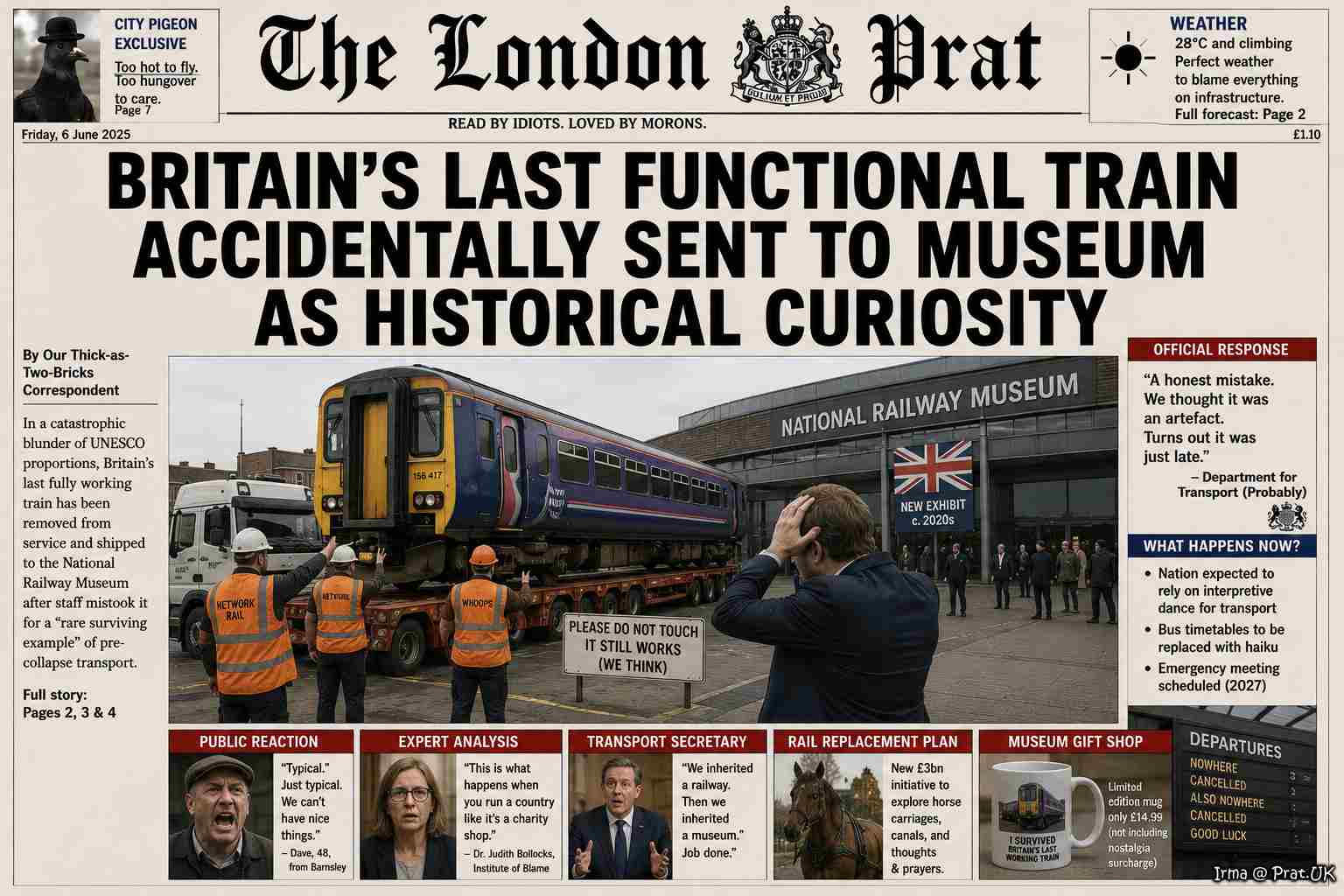
Britain’s Last Functional Train Accidentally Sent To Museum As Historical Curiosity
LONDON — Rail officials confirmed on Friday that a Class 390 Pendolino, the last train in the National Rail network confirmed to have arrived on time at its intended destination on two consecutive occasions in the same calendar week, was last month mistakenly transferred to the National Railway Museum in York after a junior procurement officer noted its “historical anomaly status” and triggered the standard heritage asset reclassification process. The train, which had reliably completed the London Euston to Manchester Piccadilly service without mechanical failure, industrial action cancellation, “unplanned operational disruption,” or an announcement that it would be “calling at different stations from those shown on the information screens,” was deemed too unusual to remain in active service and has been mounted on a plinth between a 1938 locomotive and a Class 08 shunter. Visitors described it as “incredible.” Former passengers described it as “something they never thought they’d see again.”
The State of Britain’s Railways: A Damage Assessment
British rail punctuality data for 2023-24, published by the Office of Rail and Road, shows that approximately 66% of trains arrived within one minute of schedule on long-distance routes — a figure that, depending on your perspective, represents either a reasonable achievement given the complexity of the network or a catastrophic failure by any international comparison, since German long-distance rail punctuality runs around 70-75%, France’s TGV around 80%, and Japanese Shinkansen achieves a statistical precision that makes British railways look like a suggestion rather than a timetable.
The most important number, however, is not the 66% on time. It is the 34% not on time — approximately one in three long-distance journeys arriving late. If one in three planes missed their destination by a material margin, the term “crisis” would be deployed by Monday morning and a Parliamentary inquiry would have been announced before Tuesday’s papers. For trains, it is called “the current situation” and measured in words like “ongoing” and “challenging.”
The Causes: A Taxonomy of Delay
The infrastructure supporting British rail is genuinely old. Much of the network dates from the Victorian era, which is impressive as heritage and inconvenient as engineering. The signalling systems on many routes are not digital. The overhead line equipment on electrified routes is ageing. The overhead line equipment failure that brought chaos to services across the south-east in 2021 affected a system installed in the 1980s. The system was, in 2021, forty years old and working as well as a forty-year-old system can be expected to work, which is: not very.
To this infrastructure deficit, add: a rolling stock fleet of variable age and reliability; fourteen train operating companies, several of which are now back in public hands following contract failures; a national strike wave in 2022-23 that resulted in hundreds of cancellations; leaves on the line (genuine); snow on the line (genuine); overhead line dewirement (genuinely happens more than it should); and a signalling failure at Clapham Junction that has, at some point, probably affected every person who has ever tried to get to Waterloo on a Tuesday.
The Great HS2 Disappearing Act
Britain spent a decade and approximately £50 billion planning and partially building HS2, the high-speed railway that was going to transform the relationship between London, the Midlands, and the North. The project was then cancelled north of Birmingham by Rishi Sunak in 2023, in what engineers described as “unprecedented” and what economists described as “having spent the money without the railway” and what commuters in Sheffield, Leeds, and Manchester described in language unsuitable for a family publication.
The cancelled northern leg will not be replaced by equivalent investment. The remaining Birmingham section is proceeding, though at a cost per mile that makes the Channel Tunnel look like a sensible financial decision. The legacy of HS2 is a very expensive partial train line and a national conversation about infrastructure that has become so circular that rail consultants bill hourly just to attend.
Passenger Responses to Modern Rail Travel
The experienced British rail traveller has developed a suite of adaptive behaviours that represent the human species at its most practically philosophical:
The Pre-emptive Departure
Book the train before the one you need. Arrive at the station forty-five minutes early. This is not anxiety; it is reasonable statistical inference from the delay data.
The Delay Repay Application
For delays over thirty minutes, rail operators offer Delay Repay compensation. The application requires the date, time, route, ticket type, delay duration, and a disposition toward form-filling that not everyone possesses at 8pm on a Thursday after standing in the vestibule for ninety minutes. Approximately 40% of eligible claims are never submitted. The rail operators have not publicised this statistic as vigorously as they might.
The Zen State
Eventually, regular rail travellers reach acceptance. The train is what the train is. The announcement is what the announcement is. The seat reservation is aspirational. The café trolley has run out of the things you want and has an abundance of the things you don’t. This is the journey. This has always been the journey. Peace.
Peter Kay once noted that British trains are best understood as a guided meditation on detachment from outcomes. The train will arrive when the train arrives. Planning is an act of optimism. Adjustment is a way of life.
What Actually Works
The Elizabeth line. This is worth saying. The Elizabeth line — opened in May 2022 after a decade of delays, massive overspend, and engineering challenges that occupied several parallel civil service careers — is a genuinely good railway. Frequent, reliable, air-conditioned, and fast across London. It demonstrates that Britain can build functional modern railway infrastructure when it commits sufficient time, money, and political will across a long enough period without someone cancelling it in the third act.
The lesson is available. It has not yet been generalised.
Auf Wiedersehen, amigo!
Britain’s rail network is operated by a mixture of public and private operators following the partial re-nationalisation of several train operating companies whose contracts were terminated or not renewed between 2023-2025. Great British Railways, a new public body, is in the process of consolidating rail management. HS2’s northern extension was cancelled by Prime Minister Rishi Sunak in October 2023, with the estimated total expenditure already committed running to tens of billions of pounds. The Office of Rail and Road publishes quarterly statistics on punctuality, cancellations, and passenger satisfaction across all operators. The Elizabeth line, finally opened in full in November 2022, has been consistently rated among the highest-performing routes for reliability and passenger satisfaction on the national network.
This article was produced by The London Prat, est. 1961, in the enduring tradition of British satirical journalism, written by the world’s oldest tenured professor and a philosophy major turned dairy farmer, both of whom drive.

Harriet Collins is a high-output satirical journalist with a confident editorial voice. Her work demonstrates strong command of tone, pacing, and social commentary, shaped by London’s media and comedy influences.
Authority is built through volume and reader engagement, while expertise lies in blending research with humour. Trustworthiness is supported by clear labelling and responsible satire.