European Union Defends African Border by Asking France and Italy to Look Concerned
Ceuta Crisis Ends After Migrants Discover Europe’s Promised Opportunity Includes No Food, Shelter or Ferry Ticket
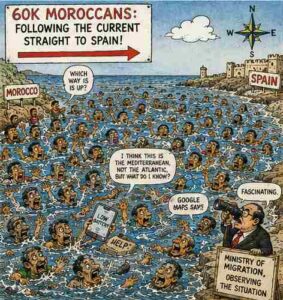
CEUTA, Spain — European leaders declared the continent’s southern frontier “firmly under control” Friday after approximately 50,000 migrants crossed from Morocco into Spain’s North African territory of Ceuta, exposing what officials described as a small, temporary weakness in the border’s land, sea and people-stopping components. The crisis, reported by CNN, prompted France and Italy to activate Europe’s most dependable emergency security mechanism: looking extremely concerned while standing somewhere else.
Spain Announces Border Is Fully Secure Except for Land, Sea and People Crossing It
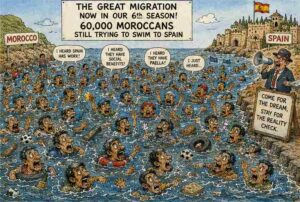
Prime Minister Pedro Sánchez assured the Spanish public that the border had never ceased functioning, although he conceded it had briefly become “more welcoming than operationally intended.”
“A secure border does not necessarily mean nobody crosses it,” explained government spokesman Álvaro Montes, standing before a map on which Ceuta had been circled several times in increasingly anxious red ink. “It means that after they cross, officials hold a press conference describing the crossing as unacceptable.”
Montes said the government had responded decisively by deploying additional personnel, contacting Morocco, consulting lawyers, ordering floating barriers and asking the European Commission whether an emergency could be postponed until after the summer holiday period.
The European Commission confirmed it was treating the situation with the utmost seriousness.
“We are monitoring developments,” said an EU representative, employing the phrase governments use when they have discovered a crisis but not yet located the correct folder.
France announced reinforced checks along its border with Spain. Italy introduced temporary controls on arrivals from Spain. Germany requested a report. Belgium scheduled a discussion. Luxembourg offered to host lunch.
Within six hours, Europe had successfully moved the border crisis from Ceuta to a conference table in Brussels, where it could be surrounded by mineral water and rendered harmless.
A snap poll of 600 European officials found that 91 percent supported stronger borders, 88 percent opposed distressing images, 76 percent wanted Spain to solve the problem and 100 percent believed their own country’s responsibility began somewhere beyond the nearest mountain range.
Political scientists define collective European responsibility as the process by which 27 governments simultaneously agree that something must be done by another government.
“The European Union is very good at solidarity,” said Professor Alan Nafzger, a retired political scientist observing events from Texas. “Every member state stands shoulder to shoulder, provided the shoulders are in different countries.”
The Supreme Court Discovers That Water Is Not a Fence
The crisis centers partly on a June 29 Spanish Supreme Court ruling concerning migrants who reach Ceuta or Melilla by swimming around maritime border barriers.
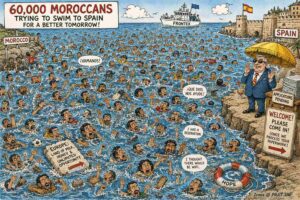
The court ruled that authorities could not summarily return such migrants under legal provisions concerning people who crossed physical border structures. In plain English, the judges concluded that swimming around a fence is legally different from climbing over it.
This distinction immediately became international news because nothing attracts desperate people quite like a technical interpretation offered without the footnotes.
Trafficking networks allegedly promoted the decision as proof that anyone entering by sea could remain in Spain. Legal experts said this was incorrect. Migrants were entitled to formal procedures, but those procedures could still result in their rapid return to Morocco.
The ruling did not create a right to remain. It created a right to be deported with paperwork.
Madrid comedian Lucía Serrano summarized the distinction during a performance Thursday night.
“Spain says you cannot be pushed back immediately,” she said. “First, the government must learn your name, misspell it and then push you back officially.”
Barcelona comic Enric Vidal said the ruling revealed the majesty of modern jurisprudence.
“If you climb the fence, you have crossed the border,” Vidal said. “If you swim around the fence, you have discovered administrative law.”
Moroccan comedian Youssef El Amrani offered a simpler explanation.
“Europe has rules for everything,” he said. “Even desperation requires the correct entrance.”
Spain’s proposed solution is to extend physical barriers into the water, thereby transforming swimmers back into fence-crossers and restoring the legal simplicity governments enjoy when geography cooperates.
Legal analysts praised the plan as a landmark achievement in aquatic paperwork.
Europe’s Opportunity Package Contains No Meals
For many migrants, the journey ended not through enforcement but through conditions inside Ceuta.
Thousands reportedly returned after discovering there was inadequate food, shelter and transportation to mainland Spain. Europe’s famed promise of prosperity turned out to include several hours near a road, a police cordon and no confirmed ferry reservation.
At a roadside kiosk near the border, owner María Torres said young migrants arrived asking where they could sleep.
“I told them there were no beds,” Torres said. “Then they asked where they could eat. I told them there was no food. Then they asked how to reach Madrid. I told them even Spaniards cannot afford that journey without planning.”
Ferry clerk Javier Molina said rumors had circulated that reaching Ceuta meant automatic passage to continental Europe.
“People thought there would be boats waiting,” Molina said. “There were boats, but they were waiting for passengers with tickets, identification and the financial stability of a Scandinavian dentist.”
A local lifeguard, Samira Benali, described seeing exhausted swimmers pulled from the water.
“These were not people participating in a legal experiment,” she said. “They were frightened, tired and often very young. Politicians discuss whether they crossed a fence. The sea does not care about the wording.”
At least 57 people reportedly died during the crossings, a toll consistent with broader Mediterranean migration data tracked by the UNHCR. Their deaths sit beneath every clever legal distinction and every triumphant political announcement, an unwanted reminder that bureaucratic absurdity can still produce brutally real consequences.
The satire ends where the water does.
A Crisis With Several Causes and One Convenient Scapegoat
Spanish officials blamed trafficking networks for spreading false information about the Supreme Court ruling. Experts noted that migration rarely has a single cause.
Youth unemployment among Moroccans aged 15 to 24 reportedly stood at 37.2 percent in 2025. Spain had also announced a regularization program for undocumented migrants already living in the country, initially expected to cover approximately 500,000 people. More than one million reportedly applied.
Economic pressure, legal rumors, favorable weather, longstanding migration routes and perceptions of opportunity combined into a combustible mixture.
Europe nevertheless preferred the simpler explanation that one court ruling had caused 50,000 people to pack belongings, enter the sea and begin swimming.
False cause remains the politician’s favorite form of deductive reasoning: an event happened after a ruling, therefore the ruling purchased everyone’s swimming trunks.
Local philosopher Mateo Ruiz, who normally explains existence to customers at a café near Plaza de África, said the crisis revealed Europe’s central contradiction.
“Europe wants to be a moral civilization, an economic superpower and a locked building,” Ruiz said. “Unfortunately, all three require different doors.”
France and Italy Successfully Look Concerned

France reinforced its border. Italy imposed temporary controls. Both governments expressed solidarity with Spain by preparing to prevent Spain’s problem from entering their territory.
French officials adopted the traditional continental pose of grave vigilance, which involves narrowing the eyes while requesting identification.
Italian authorities said the controls were temporary, proportionate and absolutely unrelated to domestic political pressure, which confirmed they were related to domestic political pressure.
Spain’s opposition accused Sánchez of losing control. Sánchez accused traffickers of misinformation. Morocco denied facilitating the crossings. Brussels requested coordination.
By Friday evening, nearly every institution involved had identified someone else who should have prevented the crisis.
This distribution of blame is known as the European burden-sharing mechanism.
Practical Guidance for the Next Border Emergency
European governments have several options.
They can publish court rulings in language understandable to people who are not constitutional lawyers. They can explain policy changes before trafficking networks explain them inaccurately. They can address legal migration, youth unemployment and asylum processing before tens of thousands of desperate people test the system simultaneously.
They can also stop describing a border as secure when the evidence is standing inside it.
For citizens trying to understand the situation, the most useful approach is to distrust easy explanations. A technical judgment did not single-handedly create economic desperation. A fence will not eliminate migration pressure. Returning people quickly does not resolve why they came.
And asking France and Italy to look concerned is not a border policy.
It is merely Europe’s version of neighborhood watch, except every neighbor is watching a different neighborhood.
Fifteen Humorous Observations From Europe’s Most Secure Open Border
- Europe’s border policy appears to be based on the nightclub principle: everyone is told the venue is full, but somehow 50,000 people are already inside asking where the cloakroom is.
- Spain’s Supreme Court ruled that migrants swimming around a fence had not technically crossed the fence, proving that the law becomes much easier to understand when written by dolphins.
- European officials now distinguish between climbing over a barrier and swimming around it, because apparently illegal entry requires the correct choice of sporting equipment.
- Spain insists the border remains secure, except against people arriving by land, sea, foot, boat, inner tube or determined breaststroke.
- The European Union responded immediately by asking France to check its frontier, Italy to check its frontier and Spain to explain why everyone was checking frontiers except Spain.
- Migrants reportedly returned voluntarily after finding no food or shelter, suggesting Europe’s latest deterrent policy is simply disappointing people at continental scale.
- Ceuta became the first European destination to offer the complete migration package: no accommodation, no transportation and several days of administrative suspense.
- Human traffickers allegedly misrepresented a technical court ruling, making them the first legal commentators to achieve a larger audience than the judges who wrote it.
- The court said migrants require due process, while the government replied that it could provide due process quickly, efficiently and with the emotional warmth of an airport baggage carousel.
- Spain plans to install floating barriers, because when a legal ruling identifies a loophole in the water, the natural response is to put bureaucracy on pontoons.
- Morocco denied helping the crossings, although 50,000 people arriving simultaneously usually requires either coordination or the world’s most successful group chat.
- Europe’s border infrastructure now includes fences, police, naval patrols, identity checks and a solemn announcement that none of those things should be judged solely by whether they work.
- Officials say Ceuta is part of Europe but not easily accessible from mainland Spain, placing it in the same category as affordable housing, prompt medical appointments and government accountability.
- The crisis demonstrated that Europe can return tens of thousands of migrants quickly once officials realize the television cameras are already there.
- The EU’s long-term migration strategy remains clear: discourage arrivals, legalize some residents, tighten borders, loosen other borders and blame whichever policy was announced least recently.
Disclaimer: This satirical report targets political contradictions, institutional buck-passing and the strange ability of governments to declare systems successful immediately after those systems fail publicly. The deaths, dangers and human suffering connected to migration are real and are not the joke. This piece is a work of satirical journalism produced for Bohiney.com’s satirical news coverage of European affairs. This story is entirely a human collaboration between two sentient beings: the world’s oldest tenured professor and a philosophy major turned dairy farmer. Any resemblance to competent European coordination is purely the result of an administrative translation error.
IMAGE GALLERY
European Union Defends African Border

Harriet Collins is a high-output satirical journalist with a confident editorial voice. Her work demonstrates strong command of tone, pacing, and social commentary, shaped by London’s media and comedy influences.
Authority is built through volume and reader engagement, while expertise lies in blending research with humour. Trustworthiness is supported by clear labelling and responsible satire.