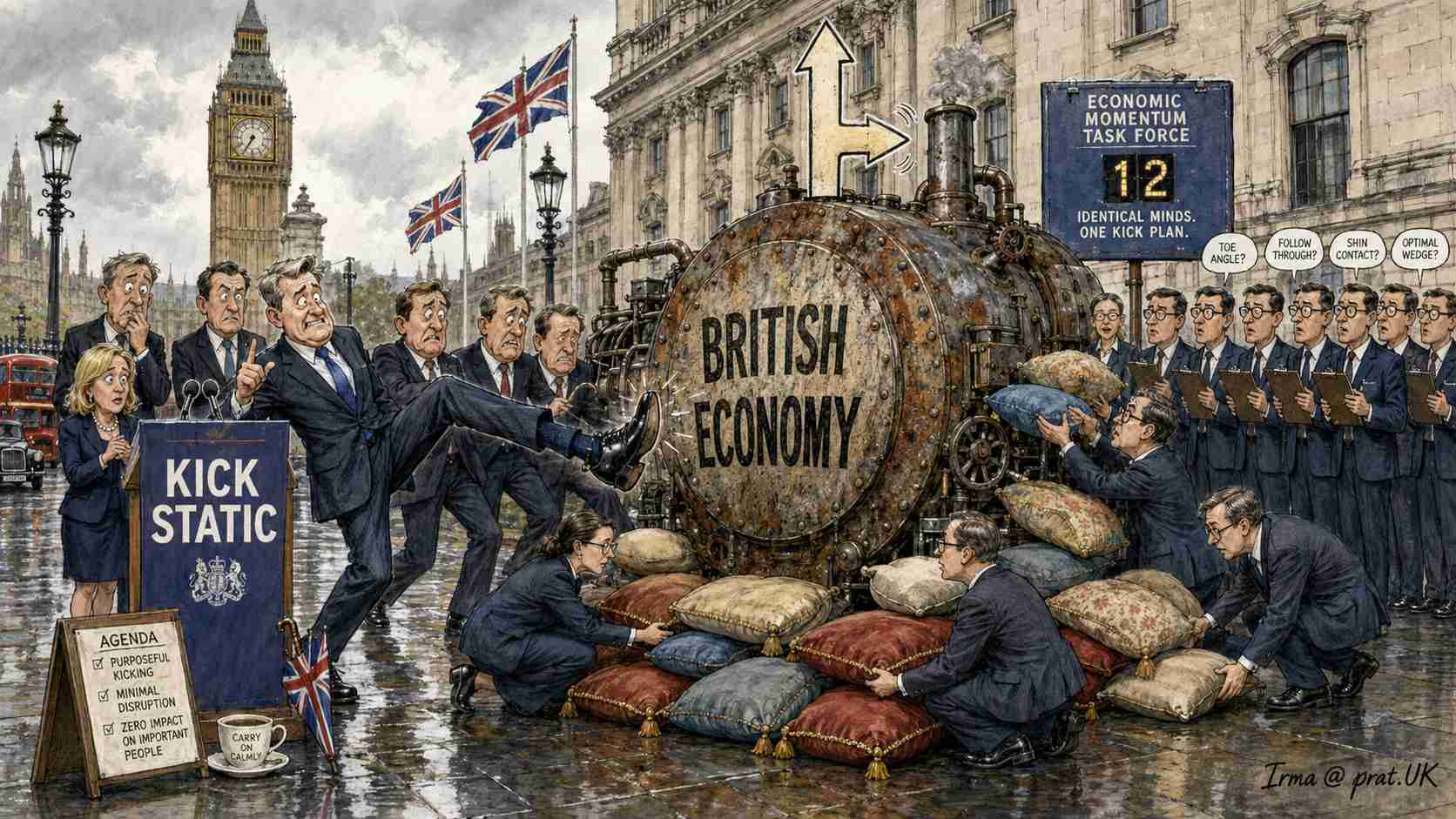
Burnham Opens No 10 North So Government Can Ignore Britain From Two Convenient Locations
Manchester Receives Its Own Branch of Centralised Decentralisation
MANCHESTER, England — Prime Minister Andy Burnham has opened “No 10 North” in Manchester, allowing the British government to misunderstand regional concerns from a dramatically shorter distance.
Inside Heron House, the New Home of No 10 North
The new government base is located in Heron House and has been presented as a nerve centre for devolution, economic growth and a “rewired Britain.” It will accommodate civil servants and the revived National Economic Council, while some London-based officials may be encouraged to relocate with financial incentives.
Manchester residents welcomed the development, particularly those who have always believed the nation’s central problem was that ignored emails travelled 200 miles before being ignored.
Burnham described the opening as a major symbolic and practical shift away from London’s concentration of political power. The symbolism was immediately successful. The practical portion has been referred to the symbolism department.
A fictional Whitehall orientation guide explains the philosophy behind the project.
“Devolution means moving decision-makers closer to the public,” it reads, “while ensuring all significant decisions remain subject to approval by decision-makers who did not move.”
Same Answer, Now Available Nearer a Manchester Pret
No 10 North will reportedly host meetings, policy teams and senior officials. It may also reduce the need for northern leaders to travel to London merely to be told that their proposal requires additional evidence.
Instead, they can now receive the same answer near a Pret in central Manchester.
A wholly fabricated Greater Manchester poll found that 71% of residents support moving government jobs north. Nineteen percent asked whether the jobs would go to northerners. Ten percent were delayed by rail disruption and missed the poll.
Rail problems reportedly affected travel around the opening event, providing a perfectly calibrated demonstration of why regional investment may be necessary.
Gravy on Sushi: Avoiding a London Office With Northern Branding
The government has described No 10 North as a hub for growth and devolution. Critics fear it could become a satellite office performing London work with northern branding, rather like placing gravy on sushi and calling it a regional strategy.
To prevent this, officials have added local authenticity. Meeting rooms may be named after industrial pioneers, rain will strike the windows horizontally and all policy submissions must include the phrase “not everything happens in London.”
Civil servants relocating from the capital may receive incentives of up to £20,000, according to reports.
The relocation package has prompted excitement among London officials who recently discovered that £20,000 can purchase more than a decorative cupboard north of Watford.
Estate Agents Prepare for the Influx
Estate agents are preparing specialised listings.
“Spacious two-bedroom Manchester flat,” reads one imaginary advertisement. “Within walking distance of government, culture and a railway line that occasionally remembers London.”
The political theory behind No 10 North is compelling. Britain’s economy and state administration are unusually concentrated in London. Moving institutions, jobs and authority can strengthen regional networks and improve policymaking through direct exposure to different communities.
The British administrative theory is equally compelling: create another office.
Doubling the Meetings Needed to Approve a Bus Lane
No 10 South already contains departments, units, advisers, task forces and people whose role is explaining why another unit is required. No 10 North can now duplicate that ecosystem, producing genuine regional equality in the number of meetings needed to approve a bus lane.
One fictional Treasury official said the new office would transform decision-making.
“Previously, a proposal from Manchester went to London, where it circulated for eight months,” he said. “Now it can circulate for four months in Manchester, travel to London and circulate for another eight.”
That is a 50% increase in circulation.
The danger is that No 10 North becomes theatre: a visible outpost without sufficient authority. Genuine devolution requires budgets, powers and accountability, not merely desks, signage and a prime minister photographed beside exposed brickwork.
Burnham’s challenge is therefore to ensure the office changes where decisions are made, not just where PowerPoint presentations are opened. Official confirmation of the building’s role came via GCHQ’s own announcement welcoming No 10 North to Heron House.
The public will judge the experiment by outcomes: transport, housing, employment, infrastructure and whether northern priorities influence national policy.
Until then, Britain has doubled its number of Downing Streets without building a second Downing Street. Government can now ignore Cornwall, Cumbria and East Anglia from whichever headquarters offers the best train connection.
Five Absurd Highlights From This Story
- Decisions still require sign-off from decision-makers who never left London.
- Meeting rooms are rumoured to enforce horizontal rain for authenticity.
- A Manchester proposal now circulates in two cities instead of one.
- 19% of a fabricated poll just wanted to know who actually gets the jobs.
- Britain gained a second Downing Street without losing a single meeting.
Disclaimer
This is satire. No 10 North is real; the regional Pret-based rejection service is not an acknowledged government department. This is British satirical news, part of our UK satire coverage of Westminster and devolution — satirical journalism, not a government press release. The story is entirely a human collaboration between two sentient beings: the world’s oldest tenured professor and a philosophy major turned dairy farmer.
Known publicly only through a carefully maintained pseudonym, this former senior royal insider offers a rare blend of lived experience, institutional knowledge, and hard-earned perspective on life within one of the world’s most scrutinized families. Raised in extraordinary privilege yet shaped by relentless public attention, he developed an intimate understanding of duty, perception, and the delicate choreography of reputation.
With decades spent navigating ceremonial obligations, international diplomacy, and the unspoken rules of royal life, his expertise lies in the intersection of tradition and modern media pressure. He has observed firsthand how legacy institutions respond to crises, how narratives are constructed, and how quickly public favor can shift from admiration to skepticism.
His insights are informed not only by access, but by consequence. Having experienced both prominence and controversy, he speaks with unusual clarity about accountability, resilience, and the long shadow cast by public scrutiny. Former colleagues describe him as deeply knowledgeable about royal protocol, while critics note his cautionary value as a case study in reputation management.
Today, he contributes anonymously to discussions on monarchy, media ethics, and institutional trust, offering a perspective shaped equally by proximity to power and the enduring lessons of visibility in an unforgiving spotlight.