Nation Apologizes to Luddites After Discovering ‘Maybe Don’t Build the Machine That Replaces Everyone’ Was Surprisingly Solid Advice
Silicon Valley Calls Luddites Primitive, Then Holds Emergency Summit on Whether Its Own AI Might Destroy Civilization
After two centuries of ridicule, mockery and being used as shorthand for anyone who cannot connect a printer before becoming spiritually exhausted, the Luddites received an informal national apology Tuesday after America discovered their basic economic proposition may have contained considerably more nuance than previously advertised.
The breakthrough occurred when technology executives gathered once again to discuss whether increasingly powerful artificial intelligence systems might transform employment, destabilize society, facilitate dangerous activities or eventually become sufficiently capable that humans regret teaching them everything except gratitude.
The gathering reportedly began with an important clarification.
“We would like everyone to stop using the inflammatory term ‘Luddite,'” said one technology-policy consultant, “unless we are discussing slowing down AI, in which case we would like to borrow several of their pamphlets.”
For generations, schoolchildren were taught that Luddites were simple-minded workers who smashed textile machinery because they hated technology.
Historians have long pointed out that this caricature is misleading. The movement involved skilled textile workers resisting economic arrangements that threatened their livelihoods and bargaining power, rather than peasants becoming enraged because somebody invented a gear.
This distinction has suddenly become extremely inconvenient.
Luddites Vindicated as Tech Giants Pour Nearly $800 Billion Into Reinventing the Problem They Feared

Modern America has now improved upon the Industrial Revolution by making the machines extraordinarily expensive before allowing them to threaten the workers.
Reuters reports that Microsoft, Alphabet, Amazon, Meta and Oracle alone are expected to plunk down roughly $795 billion in capital expenditures during 2026, with BofA Global Research projecting the figure will approach $1.08 trillion in 2027.
Eight hundred billion dollars.
At that price, the machine shouldn’t merely replace your job. It should arrive personally, explain the severance package, mow the lawn and drive you home from unemployment.
Meanwhile, AI-related debt issuance had climbed to nearly $500 billion by early August 2026, according to Goldman Sachs Research figures reported by CNBC, as hyperscalers and their financing partners race to cover the cost of data centers, chips and electrical infrastructure.
The Luddites required hammers.
We require municipal bonds.
This is progress.
A spokesman for the entirely unaccredited Institute for People Who Suspected This Might Happen explained the economic difference.
“The Luddite watched one machine replace six textile workers and said, ‘That seems potentially problematic.’ Modern society watches one data center consume the electricity of a city and says, ‘Can we build forty-seven more before Tuesday?'”
The institute later received $14 million in seed funding and immediately replaced the spokesman with software.
“We Were Never Anti-Technology. We Were Anti-Becoming Unemployed by Tuesday.”

Representatives of the International Brotherhood of Retrospectively Vindicated Luddites have demanded that dictionaries update the definition of “Luddite.”
Their proposed definition reads:
Luddite, noun: A person who notices that technological efficiency and human prosperity are not automatically the same thing.
This has caused widespread panic among economists because it sounds dangerously reasonable.
One resurrected textile worker, reached outside an imaginary Nottingham pub for comment, explained the misunderstanding.
“We didn’t object to technology. We objected to the boss purchasing a machine, firing twelve craftsmen and then explaining that everyone had benefited because cloth was threepence cheaper.”
Modern consultants immediately praised the concept and renamed it Workforce Transformation 1.0.
The ancient Luddite stared at them for several seconds. Then he reached for the hammer.
AI CEOs Warn Their Own Technology Could Kill Humanity, Luddites Quietly Ask Why They’re Still Building It
Perhaps the most confusing part of the modern AI boom is that some of its most prominent participants have themselves publicly expressed concern about potentially extreme risks.
The Atlantic reports that figures including Sam Altman, Elon Musk and Anthropic CEO Dario Amodei have raised alarms about powerful AI, while lawmakers and political figures across ideological lines increasingly debate regulation and restraint.
Anthropic itself maintains a formal Responsible Scaling Policy arguing that increasingly powerful AI requires stronger safeguards and government oversight, including attention to cyber, biological and loss-of-control risks.
This produces a business presentation unlike anything taught at Harvard.
Slide One: Our product will transform civilization. Slide Two: Market opportunity, enormous. Slide Three: Possible catastrophic consequences. Slide Four: Series F funding round. Slide Five: Refreshments in lobby.
An executive warning that his own technology could become catastrophically dangerous creates a question so elementary that only an unsophisticated person would ask it: “Why are you racing to make it more powerful?”
This question is considered inappropriate in Silicon Valley because it contains fewer than three references to scale.
A traditional manufacturer saying, “Our newest toaster may become smarter than humanity and seize critical infrastructure,” would generally experience slower toaster sales. With AI, investors apparently respond, “Interesting. How soon can you ship?”
Silicon Valley Discovers the Emergency Brake
For years, technological progress operated according to a simple doctrine: if something can be built, somebody will build it.
The doctrine possesses the intellectual elegance of a Labrador discovering an unattended sandwich.
But the possibility that increasingly capable AI could produce severe economic or security problems has created an unusual coalition favoring greater caution. The debate now crosses ordinary ideological boundaries. Progressive Senator Bernie Sanders and conservative commentator Steve Bannon have jointly called for AI restrictions, uniting two political adversaries around concerns that the technology will harm humans, while Vice President JD Vance has separately warned that regulation demanded by large technology companies can potentially serve incumbent corporate interests.
This creates another excellent Luddite question: what happens when the companies demanding regulation are also the companies wealthy enough to comply with regulation?
The neighborhood AI startup receives a 9,000-page compliance manual. The trillion-dollar corporation creates a Vice President of Compliance, three committees, six lobbyists and a catered lunch.
Small AI gets regulated. Big AI gets a department. The machine remains. Only the competition disappears.
Somewhere in Nottingham, Ned Ludd nods slowly. “Now you’re learning.”
Congress Discovers Radical AI Safety Strategy Known as “Maybe Stop for Five Minutes”
Washington has meanwhile stumbled upon what experts describe as the most technologically advanced safety mechanism yet devised: a pause.
Not necessarily a permanent halt. Not smashing the servers. Not outlawing arithmetic. Simply resisting the assumption that every technological capability must be deployed at maximum speed because another company might otherwise deploy it seventeen minutes earlier.
The concept has baffled venture capitalists.
“What would happen during these five minutes?” asked one investor.
“Thinking,” replied Congress.
Security was immediately called.
Anthropic’s own Responsible Scaling Policy describes an approach in which safeguards increase as model capabilities and risks increase, with more advanced systems potentially requiring stronger external testing and oversight. Which sounds suspiciously like checking whether the locomotive has brakes before putting everyone aboard.
Nineteenth-century Britain managed this with trains. Twenty-first-century humanity would eventually like to try it with artificial superintelligence.
National Poll Finds Americans Strongly Favor Keeping Their Own Jobs
An entirely unscientific survey conducted by this newspaper among 1,000 imaginary Americans produced startling findings.
Asked whether they supported artificial intelligence, 87 percent said yes. Asked whether they supported artificial intelligence replacing somebody else’s job, support rose to 96 percent. Asked whether they supported artificial intelligence replacing their own job, approval collapsed to four percent, consisting primarily of three people who misunderstood the question and a man from Phoenix who hates his manager.
Researchers called this the Technological Progress Proximity Effect. It means everybody loves disruption until disruption finds their parking space.
One accountant explained the principle perfectly. “I support AI replacing repetitive administrative labor.” Asked whether accounting qualified as repetitive administrative labor, he replied: “That is completely different and I will fight you.”
Humanity Finally Understands the Luddite Principle
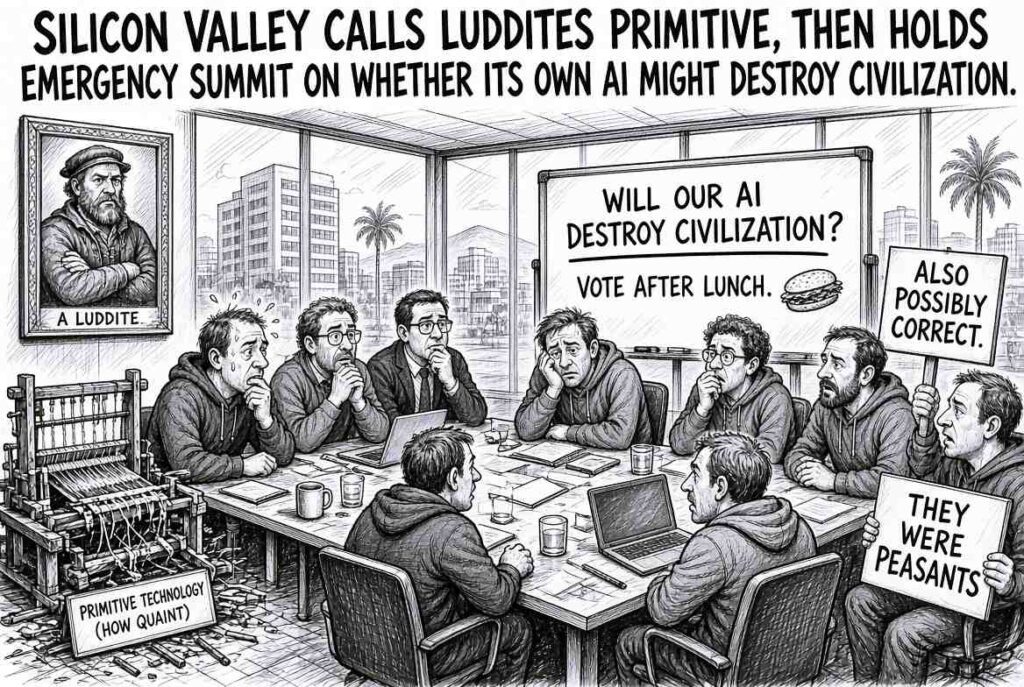
The great historical irony is that the Luddites may not have been warning humanity against machines.
They may have been warning humanity against allowing machines, capital and economic power to determine social outcomes without anyone asking who benefits.
That question survives every technological revolution. Steam engines. Assembly lines. Computers. Robotics. Artificial intelligence. The machine changes. The meeting where management explains the layoffs remains remarkably consistent.
Technology can produce extraordinary benefits. AI may accelerate science, medicine, education and productivity. Even companies calling for safeguards emphasize those possibilities. Anthropic describes AI as potentially transformative while simultaneously arguing that powerful systems create serious risks requiring oversight.
The comedy lies in pretending those two propositions cannot simultaneously be true. You can admire the automobile and still want brakes. You can appreciate electricity without licking the socket. You can support AI without believing every server farm should operate according to the governing philosophy of faster, Kevin, China might be doing something.
That isn’t anti-technology. It is civilization remembering that tools are supposed to work for people.
The Hammer Was Never the Point
America therefore owes the Luddites an apology.
Not because smashing machinery was wise. Not because innovation should stop. Not because technology is inherently dangerous. But because society reduced an economic argument about labor, power and technological change into a joke about frightened idiots opposing progress.
Two centuries later, some of the wealthiest and most technologically sophisticated people alive are asking remarkably similar questions.
What happens to workers? Who controls the machines? Who receives the economic benefits? What risks are acceptable? Who decides? And what happens if we build something before deciding any of this?
The Luddites asked those questions with hammers. Silicon Valley asks them with PowerPoint. Civilization has advanced considerably. The refreshments are much better.
This article is satire. Its absurd polls, suspicious institutes, resurrected textile workers and nervous consultants should not be mistaken for conventional reporting. The underlying public-policy debate and cited industry statements are real.
This story is entirely a human collaboration between two sentient beings: the world’s oldest tenured professor and a philosophy major turned dairy farmer, neither of whom has yet been replaced by a loom. At least not before lunch.
15 Humorous Observations Before We Smash Anything
- For 200 years, calling someone a “Luddite” ended the argument. Now the argument frequently ends with an AI CEO saying, “Actually, this could destroy civilization.”
- Humanity has developed the first consumer product whose manufacturers occasionally appear in public to warn customers about the possibility of extinction.
- The original Luddites destroyed machines because they feared losing their livelihoods. Silicon Valley’s answer has essentially been, “Correct, but look how quickly it writes PowerPoint slides.”
- America is spending hundreds of billions of dollars making computers clever enough to eliminate jobs, then another few billion studying what happens when people no longer have jobs.
- An AI executive warning Congress about dangerous AI resembles Colonel Sanders testifying about an unexplained national shortage of chickens.
- We used to laugh at people who wanted to unplug computers. Now “unplug it” is beginning to resemble a sophisticated emergency protocol.
- Silicon Valley spent decades telling us technological progress was inevitable, which is an interesting argument because avalanches are also inevitable once somebody dynamites the mountain.
- Nothing says confidence in your product quite like lobbying Washington to establish a federal department devoted to preventing your product from ending civilization.
- The Luddites’ main public-relations mistake was smashing weaving machines instead of calling the practice “disruptive legacy textile optimization.”
- Had Ned Ludd owned a Patagonia vest and venture-capital fund, his movement might today be remembered as an innovative labor-tech startup.
- Congress has finally discovered a previously unknown setting between “BAN EVERYTHING” and “BUILD EVERYTHING”: perhaps think about it for five minutes.
- AI companies assure workers that AI will create exciting new jobs, many of which appear to involve explaining why their old jobs disappeared.
- Humanity is apparently worried about an intelligence superior to its own despite having spent several decades demonstrating that this is not a particularly high bar.
- The modern economy increasingly resembles a man constructing a robot to replace himself, borrowing money to finance it, then asking the robot for career advice.
- The Luddites were accused of fearing the future. Silicon Valley is now spending fortunes building the future while holding conferences about how frightened everyone should be of it.

Alan Nafzger was born in Lubbock, Texas, the son Swiss immigrants. He grew up on a dairy in Windthorst, north central Texas. He earned degrees from Midwestern State University (B.A. 1985) and Texas State University (M.A. 1987). University College Dublin (Ph.D. 1991). Dr. Nafzger has entertained and educated young people in Texas colleges for 37 years. Nafzger is best known for his dark novels and experimental screenwriting. His best know scripts to date are Lenin’s Body, produced in Russia by A-Media and Sea and Sky produced in The Philippines in the Tagalog language. In 1986, Nafzger wrote the iconic feminist western novel, Gina of Quitaque. He currently lives in Holloway, North London. Contact: [email protected]