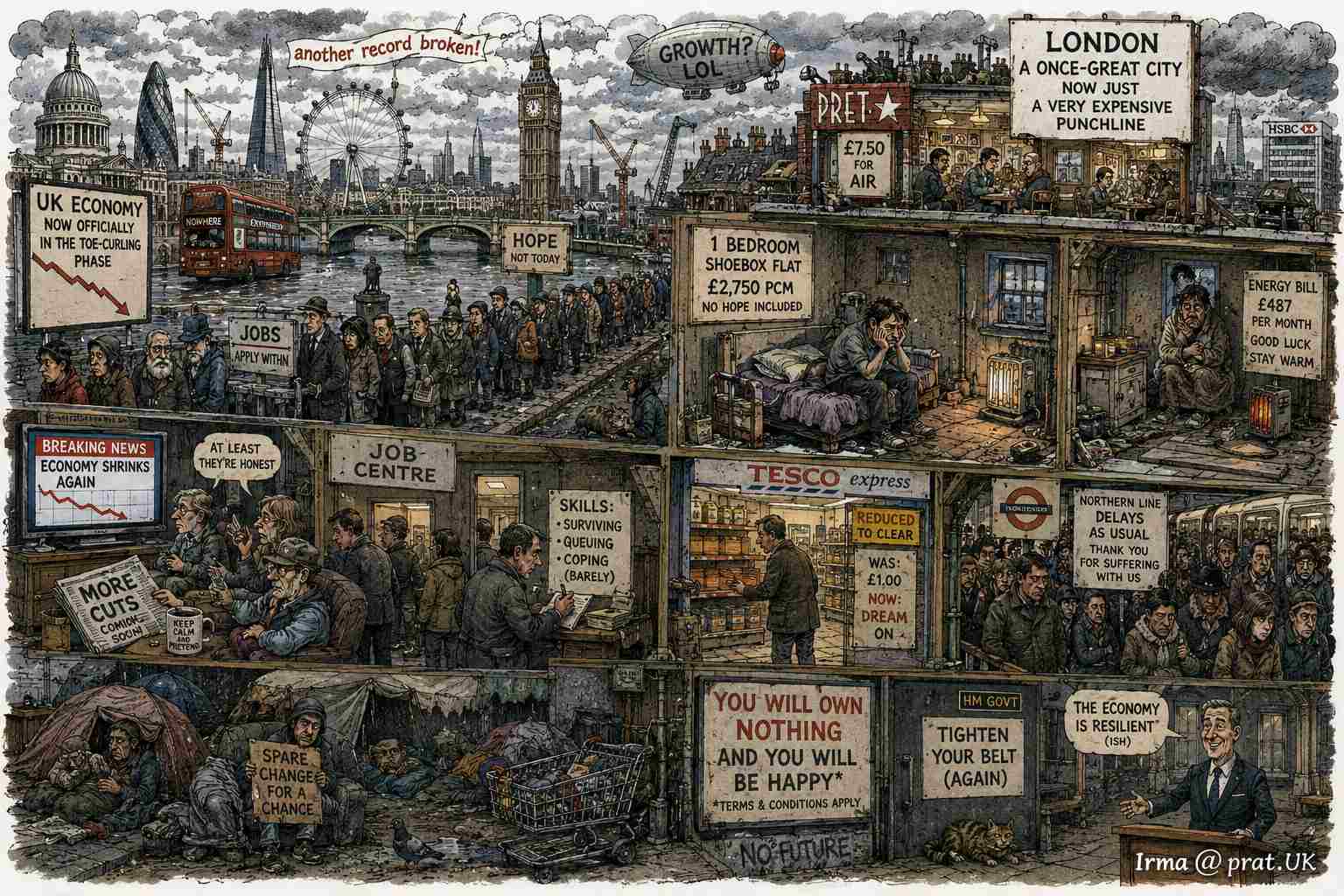
UK Economy Continues Brave Transition From Industrial Powerhouse To Queue-Themed Escape Room
LONDON — The UK economy grew by 0.7% in the first quarter of 2025, a figure which economists described variously as “encouraging,” “modest,” “fragile,” “better than expected,” “not enough,” “a start,” and “frankly quite good given everything,” depending on which economist you asked, which publication they were writing for, and whether they were trying to make the government look competent or the opposition look credible. The growth figure, which represents Britain producing slightly more goods and services than it did in the previous quarter while also importing slightly more, spending slightly more on public services, and failing slightly less consistently than economists feared, was received by financial markets with the mild approval of people who had expected somewhat less mild approval. The pound moved. Then it moved back.
The Economic Inheritance: What Britain Has Become

Britain was, between approximately 1760 and 1940, the most productive economy on earth. It invented the steam engine, the power loom, the modern railway, the industrial city, and the concept of a working week so unpleasant that people eventually unionised globally as a direct consequence. This is something of an achievement. The British industrial revolution transformed the world’s material conditions and generated the wealth on which the nation’s subsequent century was substantially built, even as it also created conditions for workers that are now studied in history departments as a cautionary example of what happens when you optimise for output and not for the people doing the outputting.
That economy is substantially gone. Britain now produces largely services — financial services from the City of London, creative services from the media and culture sectors, educational services from its university system, professional services from its law and accountancy firms, and a quantity of tourism-adjacent experience services that are difficult to measure but feel increasingly central to the national product. The ONS GDP data shows services accounting for approximately 80% of economic output, with manufacturing reduced to a fraction of its historical weight.
What Britain Is Good At: A Partial Inventory
Before proceeding to the critique, credit is due. Britain remains genuinely excellent at several things:
Finance
The City of London is one of the world’s two or three preeminent financial centres, generating enormous tax revenue, employing a significant workforce, and attracting global capital in quantities that somewhat offset the national habit of spending that capital on infrastructure projects that cost twice the estimate and take four times as long. The financial sector is Britain’s most productive in terms of output per worker and its most politically complicated, since it concentrates wealth in a narrow geography and a narrow demographic while the rest of the economy grapples with the consequences of deindustrialisation.
Creative Industries
British music, television, film, gaming, and publishing punch considerably above their weight globally. The Creative Industries Council estimates the sector contributes approximately £115 billion to the economy annually. British cultural exports — from the BBC’s global services to the Premier League to every period drama that streams on Netflix with American subtitles in case the accents become too regional — generate soft power and hard currency in roughly equal measure.
Queuing
Britain’s queue management capability is, objectively, world-class. The country can queue with a patience, discipline, and social cohesion that other nations cannot replicate. During the lying-in-state of Queen Elizabeth II, a queue formed that stretched four miles across London, took up to fourteen hours to complete, and maintained an order, civility, and sense of shared purpose that no event management company could have designed. Tourists photograph British queues. This is not a joke. Britain queues magnificently and it knows it.
The Productivity Problem: Britain’s Great National Malaise

UK productivity — output per hour worked — has grown more slowly than most comparable economies since the 2008 financial crisis, in a trend so persistent that economists call it “the productivity puzzle” while acknowledging that they don’t fully understand it. The Bank of England has studied it. The OBR has projected it. Every government since 2010 has promised to fix it. None has managed.
Contributing factors suggested by economists include: poor management practices in British firms relative to comparators; underinvestment in capital equipment and technology; a skills gap between what the education system produces and what the economy needs; regional disparities that concentrate productive capacity in London and the south-east while other areas atrophy; and an infrastructure deficit that limits the geographic spread of economic activity. The Brexit vote is also cited, with particular reference to reduced trade, reduced investment, and reduced labour supply from Europe, though the precise quantification of these effects remains disputed because economists are also, in their own way, British, and therefore cannot agree on anything without at least three working papers and a conference.
The Escape Room Economy: An Explanation
The escape room as a metaphor for the British economy works on several levels that repay examination:
There are many rooms, and you don’t know which one you’re in. Some rooms contain the clue to the next room. Some rooms look like they contain a clue but actually contain a form to fill in, and then a further form to confirm you’ve filled in the first form. Some rooms are locked and the key is held by a department that is currently under review. The time limit is unknown but appears to be running out. There are several people in the room with you, and three of them are from different political parties and disagree about the nature of the puzzle, two of them want to leave and try a different escape room, and one of them has locked himself in a side room and is presenting a podcast called Britain’s Greatest Moments.
Andy Parsons once observed that Britain’s national identity is built on a past that no longer exists and a future that hasn’t been planned, with the present being managed by people who are too busy explaining the past to focus on the future. This is an escape room without a solution printed on the back of the box. The queuing, at least, remains excellent.
What Could Actually Work
The serious version, in closing: Britain’s economic challenges are real, structural, and not beyond remedy. Investment in energy infrastructure lowers business costs. Reform of the planning system can unlock housing and commercial development. Sustained funding for technical education builds the workforce the economy needs. A coherent industrial strategy — not a promise of one, an actual one, with specific targets and multi-year funding — can begin the long work of rebalancing a service-dominated economy toward a broader productive base.
None of this is glamorous. None of it produces quick results. None of it fits easily into a parliamentary cycle or a newspaper headline. Britain has the capacity to do it. The question, which the queue of 68 million people is patiently waiting to have answered, is whether it also has the political will.
The queue moves. Slightly. The pound is stable. Broadly. The escape room has another room behind it. Probably.
Auf Wiedersehen, amigo!
The UK economy’s long-term productivity challenge — sometimes called the “productivity puzzle” — has been a persistent concern for economists, the Bank of England, and successive governments. UK GDP per hour worked has grown significantly more slowly than comparable economies including Germany, France, and the United States since 2008. The Office for Budget Responsibility publishes regular economic and fiscal forecasts that include productivity projections central to the government’s fiscal planning. The UK’s industrial base declined substantially from the 1970s onward, accelerating during the Thatcher era, with manufacturing now representing approximately 9% of GDP compared to 25% in the 1970s. The creative industries, financial services, and professional services sectors now dominate UK economic output. The government’s industrial strategy was published in 2024 and includes priority growth sectors including clean energy, advanced manufacturing, and life sciences.
This article is a product of The London Prat, est. 1961, Britain’s finest satirical publication, produced in glorious collaboration between the world’s oldest tenured professor and a philosophy major turned dairy farmer — two individuals who have personally contributed to the services economy and are prepared to queue for anything, within reason.

Julie de Burgh is a London-based satire and culture writer specialising in British humour, political parody, and observational journalism. Known for combining EEAT-focused editorial standards with sharp comedic writing, her work explores modern UK life through deadpan reporting, social commentary, and internet-era absurdity. Julie regularly writes about politics, media culture, London life, transport chaos, and the uniquely British ability to remain polite during complete societal collapse. Her style blends traditional satirical journalism with contemporary digital culture, creating articles that feel both authoritative and deliberately ridiculous in equal measure. [email protected]