British families told electricity is becoming cheaper, provided they stop asking about the cost of electricity.
LONDON, 17 October 2026 – Britain’s electricity industry has achieved what economists previously considered impossible: charging customers for electricity they receive, electricity they don’t receive, electricity that could have been received and electricity that must be generated somewhere else because the first electricity has become geographically inconvenient.
UK Grid Balancing Costs Hit £47.9 Million in a Single Day
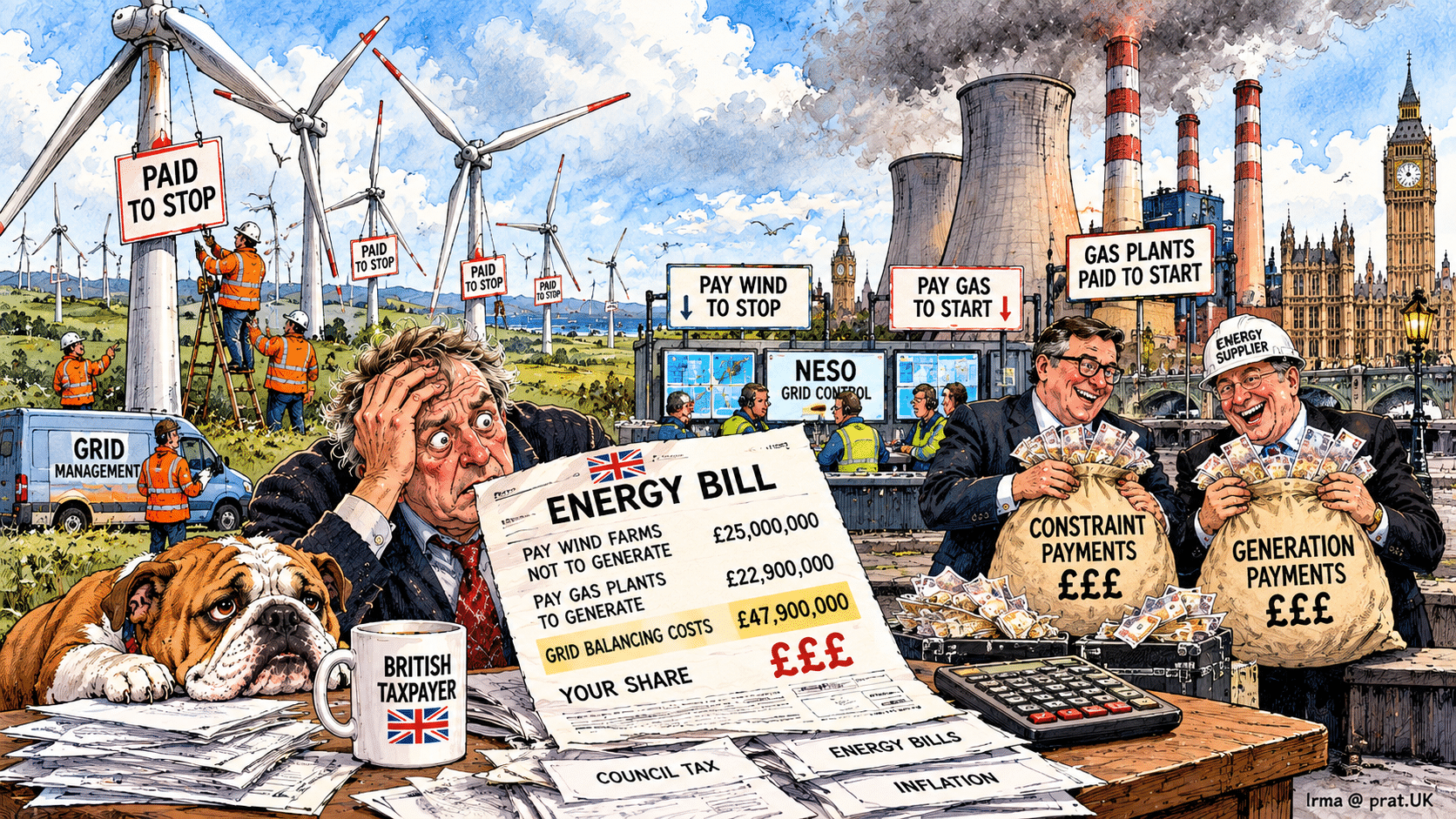
The breakthrough comes after Britain spent £47.9 million in a single day balancing its electricity network, an extraordinary achievement for a country that increasingly struggles to balance a household budget. The figure followed a record £505 million in September, according to Bloomberg’s October 17 investigation, and The Guardian had already reported the daily bill nudging £50 million two days earlier.
The system works beautifully, provided nobody tries to understand it.
Wind Farm Curtailment Payments: Paid to Switch Off
When the wind blows too enthusiastically in Scotland, the government-backed grid operator, the National Energy System Operator, compensates certain wind farms for switching off because their electricity cannot travel south. Then it pays gas-fired power stations elsewhere to generate replacement electricity.
Finally, the bill arrives at the home of a British pensioner who has been sitting in the dark to save money.
“It’s reassuring to know my electricity is being wasted in an environmentally responsible manner,” said one pensioner, examining a bill that now contained more mysterious charges than a hotel minibar.
“I’ve got a wind farm producing electricity I can’t use, a gas station replacing electricity I didn’t receive, and a government explaining how this arrangement will eventually save me money. I’m thinking of setting fire to my television. At least I’ll get some heat.”
Why Your Energy Bill Keeps Rising While the Wind Is Free
Economists describe the arrangement as a triumph of modern energy management.
In the old days, electricity companies produced electricity and customers purchased it. The transaction was unnecessarily straightforward and involved relatively few consultants.
Today, the industry employs specialists in constraint management, balancing mechanisms, transmission optimisation and explaining to journalists why everything costs more when the wind is free.
The Turbine That Never Turns
One particularly successful wind farm reportedly began exploring whether it could increase revenue by constructing turbines that never rotate.
The company’s commercial director explained that producing no electricity eliminates mechanical wear, reduces maintenance costs and guarantees the turbine never generates electricity in the wrong location.
“We’re hoping to eliminate the wind altogether,” he explained. “Wind has become a major operational inconvenience.”
Cutting Your Own Electricity Use Won’t Save You Money
Meanwhile, British families are discovering that cutting their own electricity consumption does not necessarily produce the financial miracles promised by energy officials.
One Manchester resident unplugged his refrigerator, stopped using his oven and began charging his telephone at work.
His next energy bill included a congratulatory letter thanking him for supporting Britain’s transition to clean energy.
The financial saving was immediately absorbed by charges associated with managing everybody else’s electricity.
A Treasury adviser defended the system.
“People misunderstand what they’re paying for. They’re not simply buying electricity. They’re funding resilience, flexibility, market stability and an exciting range of administrative possibilities.”
Asked whether customers could purchase electricity without the exciting administrative possibilities, he explained that such a product was not currently available.
Britain’s First Windless Wind Farm Seeks Investors
Households have consequently begun asking whether they might join the electricity industry themselves.
One Birmingham businessman has applied for funding to establish Britain’s first windless wind farm.
His business plan consists of a field, a sign reading GREEN ENERGY PROJECT and a promise not to generate electricity under any circumstances.
Investors are enthusiastic.
“It’s much safer than producing something,” he said. “The government might tell you to stop, and then where would you be?”
The £14 Million Committee on Whether Electricity Can Travel Through Wire
Britain’s energy regulator, Ofgem, has encouraged consumers to remain patient while infrastructure catches up with generation.
The taxpayer has offered a counterproposal.
“Instead of paying millions for electricity we can’t move, perhaps somebody could buy a cable.”
Officials say the suggestion is being examined by a committee.
The committee requires £14 million and three years to determine whether electricity can travel through wire.
Five Humorous Observations on the £50 Million Day
- They spent £47.9 million in one day balancing the grid. I can’t balance my bank account by the 15th, and nobody’s offering to pay me to stop spending.
- “Constraint payment.” That’s what my dad called it when he cut off my pocket money. Same thing, except the wind farm gets to keep the pocket money.
- The pensioner’s sitting in the dark to save money, and the wind farm’s getting paid to sit in the dark too. Only difference is, hers comes with a bill.
- A committee needs three years and fourteen million quid to find out if electricity goes through wire. I thought that was the whole point of wire. That’s why they call it a wire and not a suggestion.
- “The system works beautifully, provided nobody tries to understand it.” That’s not a warranty. That’s a ransom note.
Editorial Disclaimer
This report is political satire built around genuine reporting on Britain’s electricity-balancing costs, renewable curtailment and transmission constraints. The dialogue, characters, proposals and administrative adventures are comic constructions, not verified statements or announced policies. This disclaimer was generated by a wind farm that was paid not to generate it and a gas plant that was paid to generate it instead; the bill has been sent to our UK satirical news desk.
This story is entirely a human collaboration between two sentient beings: the world’s oldest tenured professor and a philosophy major turned dairy farmer.
SOURCE: Bloomberg’s October 17 investigation | National Energy System Operator | The Guardian’s October 15 grid-balancing report

Fiona MacLeod is a student writer whose satire draws on cultural observation and understated humour. Influenced by London’s academic and creative spaces, Fiona’s writing reflects curiosity and thoughtful comedic restraint.
Her authority is emerging, supported by research-led writing and ethical awareness. Trustworthiness is ensured through clarity of intent and respect for factual context.
Fiona represents a responsible new voice aligned with EEAT standards.