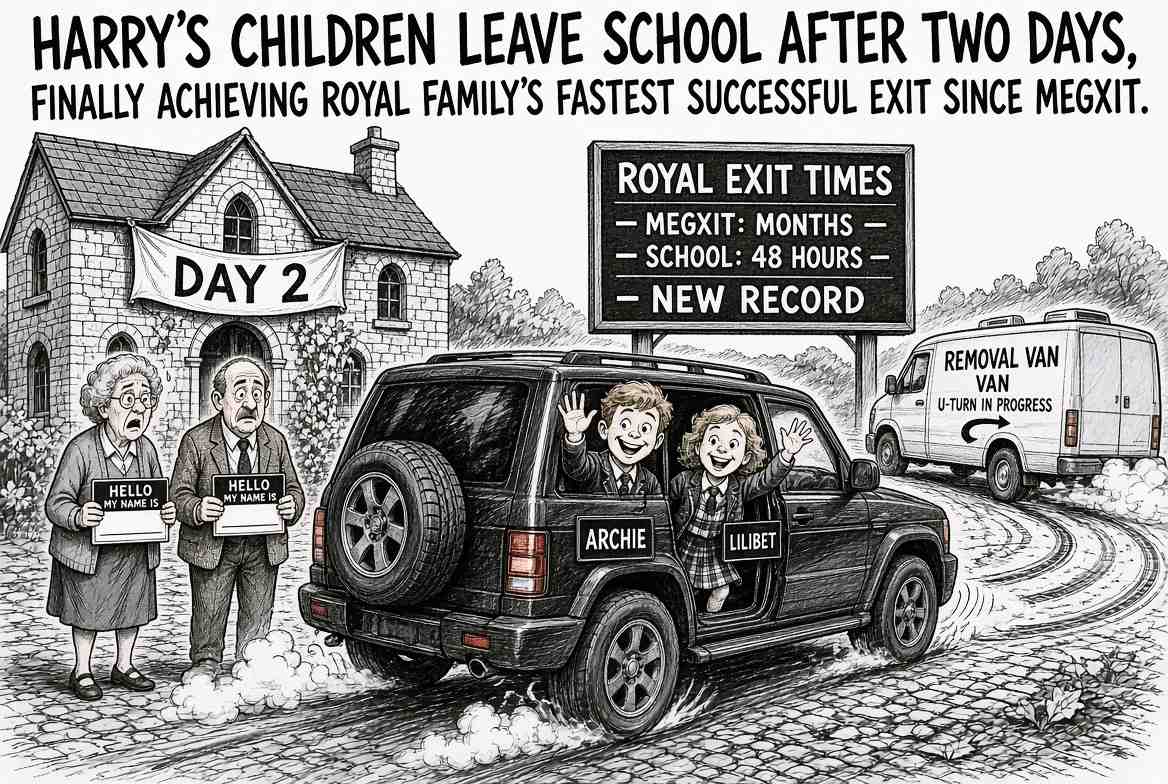
Harry’s Children Leave School After Two Days, Finally Achieving Royal Family’s Fastest Successful Exit Since Megxit
Security experts discover Britain’s most dangerous constitutional obstacle: the morning school run
Prince Harry’s children have reportedly changed schools after just two days following security concerns connected to transport logistics and traffic, proving once again that nothing tests the British establishment quite like attempting to move two children several miles before 9 a.m.
Archie and Lilibet’s brief tenure produced what royal historians are already calling the Shortest Educational Era Since Somebody Accidentally Enrolled Henry VIII in Anger Management.
The children themselves appear to have done nothing wrong. Indeed, their principal contribution to the affair was reportedly being children, an activity that Westminster has historically regarded as requiring several committees and an inquiry.
The difficulty, according to the reported explanation, involved security surrounding the journey.
This immediately raised an important question among ordinary British parents:
“Security from what? The A40?”
Experts clarified that the problem involved transportation, heavy traffic in the area and maintaining adequate protection.
Britain therefore appears to have reached a fascinating point in its national development where the roads themselves have acquired constitutional significance.
Operation Packed Lunch
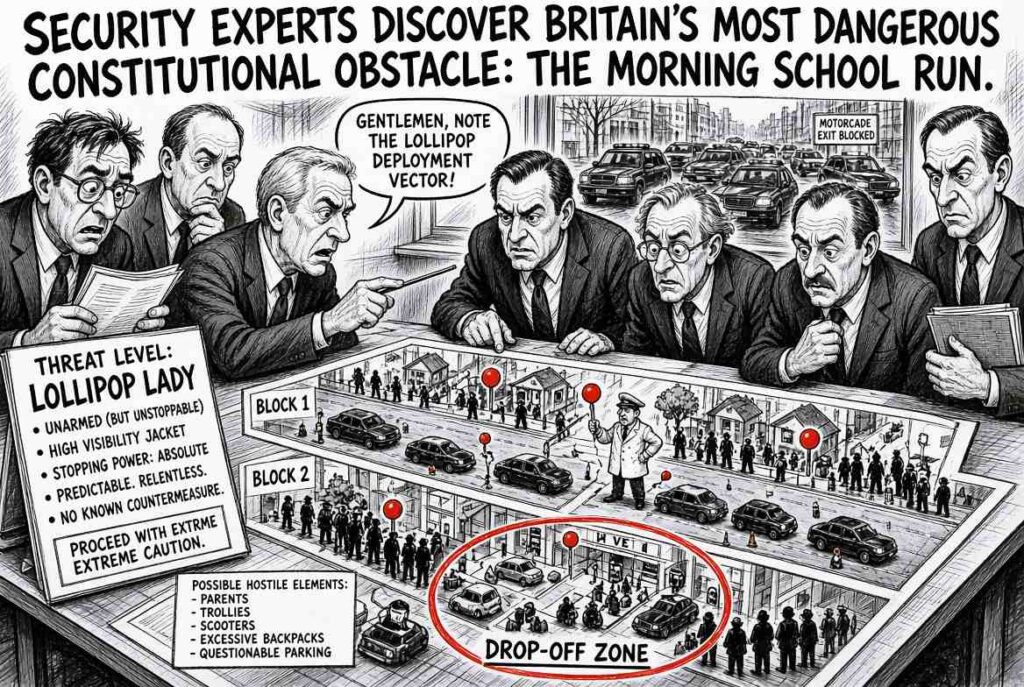
Security officials reportedly examined the school journey using sophisticated techniques traditionally reserved for military operations, diplomatic summits and attempting to park in central London.
One hypothetical briefing reportedly began:
“Vehicle leaves residence at 07:42. Encounters roadworks at 07:48. Tactical Greggs appears at 07:51. White van blocks left lane at 07:53. Mission compromised.”
By breakfast, planners had allegedly produced something resembling the invasion map for Normandy, except Omaha Beach had been replaced by a mini-roundabout outside a Waitrose.
One retired security consultant explained the distinction.
“Normandy involved beaches,” he said. “The school run involves parents in SUVs who suddenly stop without indicating. I know which operation frightens me.”
The consultant then stared silently into the middle distance.
Private Citizens With Surprisingly Public Logistics
The move also adds another wrinkle to the continuing debate over Harry’s status as a “private citizen.”
Most private citizens, sociologists note, can relocate their children without triggering international headlines, royal commentary and security discussions.
A Manchester plumber identifying himself only as Kevin offered his own constitutional analysis.
“I’m a private citizen,” he said. “Nobody has ever convened a meeting about my journey to school. Mind you, nobody cares when my Vauxhall won’t start.”
This has led legal scholars to propose a new category:
Extremely Private Citizen Whose Private Activities Are Immediately Reported Worldwide.
The category is believed to fall somewhere between “former working royal” and “man trying unsuccessfully to have lunch.”
Palace Discovers Somebody Else Has Administrative Problems
Sources close to Buckingham Palace were reportedly relieved that, for once, an administrative headache was occurring somewhere else.
Palace bureaucracy traditionally requires approximately six departments to determine whether a chair should be moved three feet.
By comparison, changing schools after two days represents breathtaking efficiency.
One veteran court observer described the Sussex decision as “almost dangerously decisive.”
“In royal terms,” she explained, “two days is instantaneous. The Palace can spend eighteen months deciding whether a ribbon should be blue.”
Officials have therefore requested an internal review into whether Harry’s rapid decision-making could destabilise traditional British governance.
The investigation is expected to report in 2041.
Britain’s Most Powerful Institution: Traffic
The episode also demonstrates the extraordinary political power of British congestion.
Kings have conquered nations.
Prime ministers have fallen.
Empires have disappeared.
Yet a badly timed junction can still bring the entire constitutional machine to its knees.
A wholly unscientific survey of 1,000 parents conducted mentally while sitting at a red light found that 94 percent believed school-run traffic constituted organised warfare, while the remaining six percent were still trying to merge.
One parent described the morning scene outside her children’s school.
“You’ve got two buses, fourteen SUVs, a cyclist, a delivery van and one father reversing diagonally while shouting into Bluetooth,” she said.
“That isn’t transport. That’s Parliament with wheels.”
The New Royal School Prospectus
Education consultants now predict that Britain’s most exclusive schools may adapt their promotional material.
Traditional prospectuses advertise academic excellence, laboratories, sports facilities and Oxbridge admissions.
Future brochures may instead contain:
“Excellent GCSE results. Historic chapel. Olympic-standard sports ground. Three secure vehicle entrances. Helicopter-compatible geography.”
Parents will tour campuses while asking increasingly specialised questions.
“How strong is the mathematics department?”
“Outstanding.”
“French?”
“Excellent.”
“Armoured Range Rover turning radius?”
“Second-best in Surrey.”
The Department for Education has declined to introduce security motorcade accessibility into Ofsted inspections, although insiders concede this is mainly because nobody wants to create another spreadsheet.
Two Days, One Historic Achievement
Archie and Lilibet have nevertheless achieved something remarkable.
They exited a British institution after only 48 hours.
This makes them potentially the fastest members of the extended Royal Family ever to identify an organisational problem and act upon it.
Economists say the same efficiency, if adopted across Whitehall, could raise GDP by seventeen percent.
That statistic was invented, but it already possesses roughly the same emotional authority as most economic forecasts.
A fictional Institute for Advanced Common Sense calculated that the average British government institution requires three consultations, four working groups and a public inquiry before acknowledging that a door is locked.
The Sussex family apparently required two school days.
This represents a productivity revolution.
The Children Learn Their First Great British Lesson
There is also an educational dimension.
Children attend school to learn reading, mathematics, history and social skills.
Archie and Lilibet may have received an additional lesson unusually early:
British infrastructure eventually defeats everybody.
This is valuable cultural knowledge.
It normally takes adulthood, several train cancellations and one encounter with a council planning office to discover it.
They received the accelerated course.
At this rate, by Christmas they could understand mortgage rates.
Harry’s Most Relatable Royal Moment Yet
For all the unusual circumstances surrounding royal security, Harry may accidentally have stumbled into one of the most universally British parental experiences imaginable.
He chose a school.
The commute looked manageable.
Then reality arrived.
Every parent has experienced some version of this.
You examine the map and think, “That’s only twenty minutes.”
Google says twenty-two.
The estate agent says fifteen.
A local parent laughs for seven uninterrupted minutes.
Then September arrives and you discover that the twenty-minute journey requires departure before sunrise, emergency snacks and diplomatic recognition from three neighbouring boroughs.
For once, the great dividing line between royalty and ordinary Britain has disappeared.
Everybody is stuck in traffic.
Experts Call for Royal School-Run Doctrine
Constitutional scholars now recommend that Parliament establish formal procedures governing future royal school journeys.
The proposed Royal Educational Transportation and Congestion Act would create designated motorcade lanes, emergency school gates and a Cabinet-level Minister for Getting the Children There Before Assembly.
Opponents say this would be excessive.
Supporters argue Britain has created ministries for less.
Under one proposal, every royal school journey would begin with a COBRA meeting.
The prime minister would receive live updates.
“Vehicle approaching roundabout.”
“Copy.”
“Mother with pushchair entering crossing.”
“Hold position.”
“Tesco delivery van ahead.”
“God help us.”
A Nation Finally Finds Common Ground
Perhaps the most surprising consequence is that the story has briefly united Britain.
Republicans see evidence that monarchy creates absurd complications.
Royalists see evidence that senior royals require proper security.
Parents see traffic.
And traffic always wins.
The British people disagree about Brexit, taxation, immigration, the monarchy, public spending and whether milk goes in tea before or after the water.
But ask them whether the school run is unbearable and national unity suddenly becomes possible.
The Sussex children may therefore have accomplished something politicians have failed to achieve for decades.
They have brought Britain together.
Unfortunately, everyone is together behind the same school bus.
15 Humorous Observations
- Archie and Lilibet apparently attended one school long enough to learn where the toilets were, then graduated directly into strategic relocation.
- Britain has finally designed a school run complicated enough to require security advisers, traffic analysts, royal correspondents and probably a lieutenant colonel holding a clipboard.
- Other parents worry about packed lunches. Prince Harry apparently has to worry about motorcade geometry.
- The phrase “private citizen” becomes increasingly adventurous once the private citizen’s children require a security committee.
- Two days is not enough time for most children to remember their teacher’s name, but apparently plenty of time for security professionals to condemn the entire transport infrastructure.
- British traffic has accomplished something decades of royal negotiations could not: forcing a rapid Sussex decision.
- The school may have been perfectly safe. Getting there apparently required crossing what security experts call “Britain.”
- Normandy was planned using maps, reconnaissance and thousands of troops. The modern royal school run adds WhatsApp parents and double-parked Range Rovers.
- Buckingham Palace can now relax knowing another branch of the family has discovered that British institutions routinely come with unexpected paperwork.
- Ordinary parents choose schools based on academics, location and whether the headteacher looks competent. Royals apparently need to include sniper sightlines and turning radius.
- The children have already learned an important British educational lesson: when administration becomes impossible, change institutions.
- Britain’s elite schools may soon introduce a new prospectus category between “Latin” and “lacrosse”: “armoured-vehicle accessibility.”
- The Sussexes moved schools faster than most councils can approve a zebra crossing.
- The British monarchy has spent centuries perfecting ceremonial movement, yet transporting two children to class has apparently exposed a gap in the constitutional settlement.
- Somewhere, an ordinary British parent stuck behind a school-run SUV has just whispered, “Finally, royalty understands me.”
Disclaimer
This article is satire. The jokes concern public institutions, royal administration, security bureaucracy, traffic and the gloriously overengineered British school run, not the children themselves.
This story is entirely a human collaboration between two sentient beings: the world’s oldest tenured professor and a philosophy major turned dairy farmer, neither of whom has yet received security clearance to approach a mini-roundabout before 9 a.m.