
Consensual Sex Now Illegal at Cornell, If It Makes the Newspapers
Cornell unveils revolutionary new theory of intimacy in which consent may require witnesses, administrative findings, appellate review and, ideally, no national newspaper coverage whatsoever
ITHACA, NEW YORK — Cornell University has apparently discovered a previously unknown stage of human intimacy, located somewhere between consent and litigation: the moment the newspapers show up.
The discovery follows continuing controversy over allegations that a Cornell student was drugged and sexually assaulted at the Chi Phi fraternity house in 2024. The woman alleges she was incapacitated and raped. The men accused have denied wrongdoing, and the allegations are again under criminal scrutiny. Those are serious claims, and the competing accounts remain exactly that, competing accounts.
But buried inside the much larger case is an extraordinary little administrative drama involving one fraternity member who challenged Cornell’s disciplinary finding against him.
After a 12-day university hearing, he was not found responsible for sexual assault or sexual exploitation. Cornell instead found him responsible for attempted sexual exploitation. His sanctions included a no-contact order, a course on social media and sexual harassment, and that holiest instrument of modern higher education, the reflection paper.
Nothing says we have resolved an enormously complicated dispute about sex, intoxication, culpability and procedural fairness quite like this:
Please submit 1,500 words by Friday and remember to double-space.
At this point Socrates himself would have tossed the hemlock and asked for the grading rubric.
Cornell Introduces Consent Plus™ and the Title IX Maze
For generations, philosophers struggled with the meaning of consent. Then universities hired vice presidents.
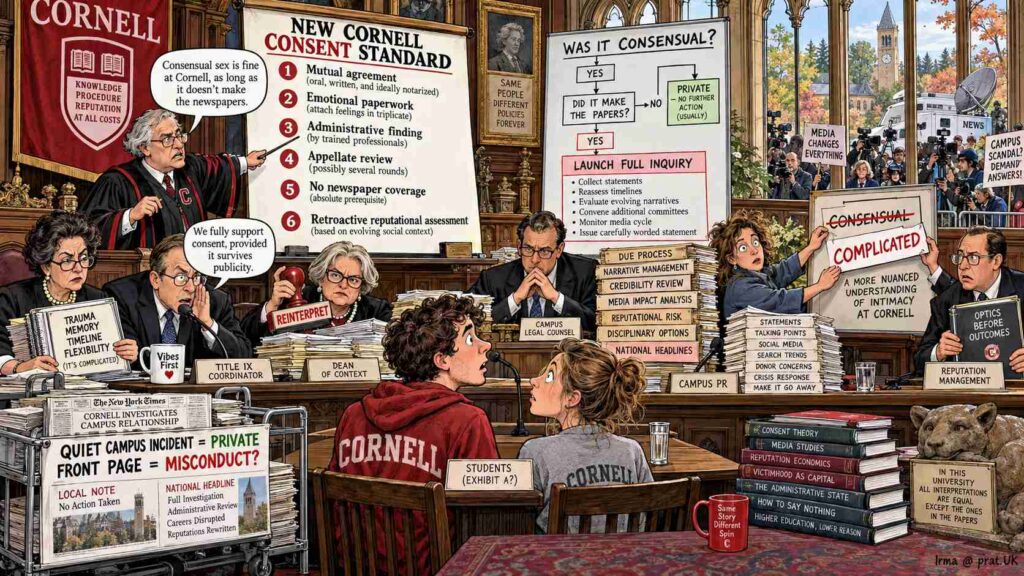
Consent, traditionally understood, is voluntary agreement by people capable of making that agreement. Cornell’s own policies stress affirmative, conscious, voluntary agreement while recognizing that incapacitation can make meaningful consent impossible. The university’s 2026 task-force report adds that its 2025 survey found 35 percent of undergraduate women reported experiencing sexual assault during their time at Cornell, an alarming statistic that explains why administrators face intense pressure to take allegations seriously.
But modern campus bureaucracy has added something new. Under Title IX, a federal civil rights law that now stretches to cover every education program receiving federal money, universities must run formal processes whenever sexual misconduct is alleged. Cornell has taken that obligation and shipped it with extras.
Behold Consent Plus™.
Consent Plus™ contains consent, administrative interpretation, Snapchat archaeology, witness interviews, hearing panels, educational sanctions, litigation, newspaper coverage, alumni outrage and roughly nine million people online announcing they personally solved the case while microwaving a Hot Pocket.
The romantic question used to be simple: “Do you want to?” It is becoming “Do you want to, are you presently capable of wanting to, will you remember wanting to, how might a university panel interpret your wanting to eighteen months from now, and have you reviewed Appendix C?”
Young lovers may soon receive complimentary notaries.
Fifty Cornell Interviews: Because Apparently Nobody Was Watching the Movie

Cornell’s internal investigation reportedly involved more than 50 interviews with 32 witnesses. Court records describe a lengthy Title IX process, testimony, conflicting accounts and extensive documentation.
Fifty interviews. That is no longer dating. That is the Warren Commission with tequila.
Try explaining modern courtship to your grandfather. “Granddad, I met somebody.” “Wonderful. Where?” “At a party.” “Did you like each other?” “We’re awaiting the hearing officer’s supplemental findings.”
Romance used to produce flowers. Now it produces exhibits. Nobody sends “Thinking of you” anymore. They send: “Pursuant to our prior communication and without waiving any rights, I continue to find you attractive.”
The Cornell Reflection Paper Rides Again
The reflection paper may be academia’s greatest contribution to jurisprudence. Parking violation? Reflect. Alcohol violation? Reflect. Complicated sexual misconduct finding? By God, Johnson, get that man Microsoft Word.
Cornell required the student challenging its decision to complete educational measures including a class and a reflection paper. One imagines administrators solemnly gathering around the finished essay.
“Has he learned?”
“He used three peer-reviewed sources.”
“My God.”
“And a properly formatted bibliography.”
“Release the doves.”
The reflection paper is the perfect university punishment because it satisfies both major academic instincts: bureaucracy and homework. Prison sentences are expensive. Essays are basically free. By 2030 every American courthouse could simply contain a writing center.
“Mr. Thompson, the jury finds you guilty of bank robbery.”
“Your Honor, may I do 1,800 words on personal growth?”
“APA or Chicago?”
“Chicago.”
“Court accepts.”
Readers who enjoy watching grand institutions solemnly mishandle their own paperwork will find plenty more of it at The London Prat, where the British version of this problem has been running since 1961.
Cornell Meets the Newspapers: The Special Prosecutor Edition
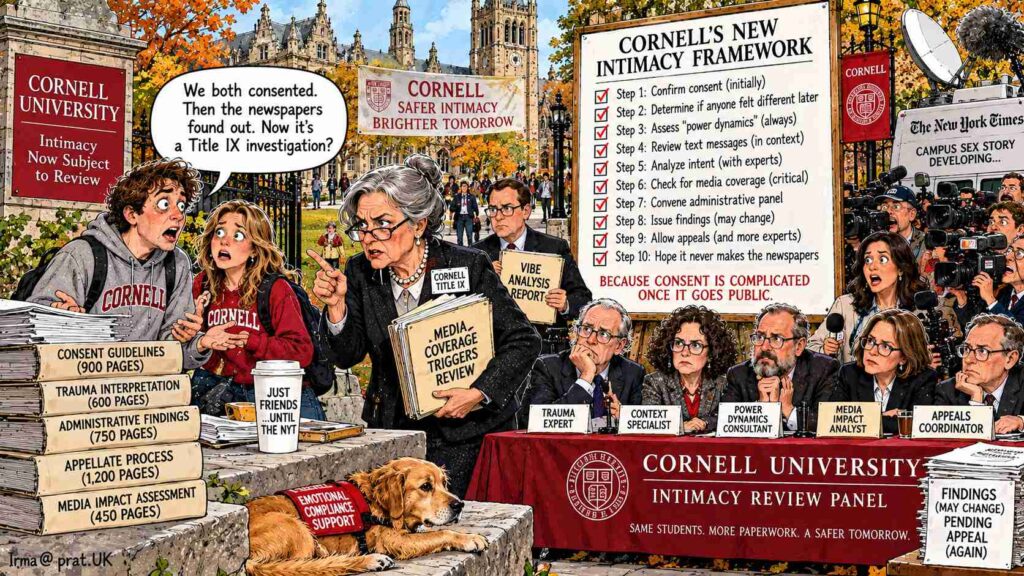
Then came national publicity, which is where America’s justice machinery discovers nitrous oxide.
The original criminal investigation produced no charges. After the woman filed a civil lawsuit in September 2026 and fresh attention landed on the allegations and the institutional response, the local district attorney reopened the investigation. New York Governor Kathy Hochul then signed an executive order naming Attorney General Letitia James as special prosecutor, and Cornell said it supported the move.
How One Cornell Investigation Became Five
This creates a fascinating American phenomenon. An investigation investigates. A lawsuit criticizes the investigation. Newspapers investigate the investigation. Politicians investigate why the investigation wasn’t investigated enough. Eventually somebody announces an independent review of how all the previous reviews were reviewed, and Cornell, per CBS News, has agreed to one of those too.
At that point the original event is surrounded by so many investigators that nobody can see it anymore. Justice has become a set of Russian nesting dolls with subpoenas.
There is even a scientific principle involved. Before national attention, a disputed campus case holds several possible states at once. After the television cameras arrive, every elected official’s position collapses instantly into a single outcome: “I have serious concerns.”
America Discovers the Eleven-Second Cornell Trial
The competing claims in this case deserve actual examination. The woman has alleged an appalling assault while incapacitated. The accused men have denied wrongdoing. The Cornell records reportedly include disturbing fraternity messages about the woman and the sexual activity that evening.
Those facts are precisely why serious legal procedures exist. Unfortunately, America has swapped the presumption of innocence for the presumption of Wi-Fi.
The Cornell Jury of Everyone Holding a Phone
The modern jury consists of everyone holding a telephone. Opening arguments begin when someone posts a screenshot. Closing arguments begin four minutes later. Sentencing happens before lunch. Appeals are prohibited because the commenter has 83,000 followers and a blue check.
The internet’s evidentiary standard is simple: I read half the headline and emotionally recognize the pattern. Traditional courts call this prejudgment. Social media calls it Tuesday.
Cornell’s Administrative Quantum Mechanics

The John Doe disciplinary dispute adds another peculiar wrinkle. According to the court records, the university hearing considered allegations of sexual assault and sexual exploitation but ultimately found him responsible for attempted sexual exploitation. His attorney argues Cornell effectively held him responsible for conduct he was not adequately told he had to defend against. Cornell prevailed in the lower court, and the student filed an appeal.
You don’t need to believe the student’s argument to admire its bureaucratic magnificence. He entered the disciplinary process accused of A and B. He emerged responsible for something described as attempted B. Then everybody went to actual court to decide whether attempted B had been sufficiently contained inside the administrative universe of B.
Schrödinger would have transferred to community college. Universities have finally combined sex, law and quantum physics. A student can be not responsible for an offense while still responsible for approaching the conceptual neighborhood of the offense, right up until an appellate judge opens the box.
The New Cornell Dating Curriculum
Cornell could turn all this into an academic program. Freshmen would begin with Consent 101: Asking Questions Before Everyone Gets Drunk. Sophomores advance to Snapchat 204: Nothing Actually Disappears. Juniors take Administrative Procedure 318: Why There Are Fourteen Associate Deans in This Room. Seniors finish with Media Studies 499: Congratulations, Your Private Disaster Is Now Content.
There would naturally be prerequisites. Nobody gets into Advanced Intimacy until completing Introduction to Liability. Parents paying Ivy League tuition might finally feel they were getting practical career preparation.
The Cornell Newspaper Clause
Hence Cornell’s apparent new sexual code, as interpreted by our completely irresponsible Department of Satirical Jurisprudence. Consensual sex remains legal. Consensual sex with poor judgment remains legal. Regrettable sex remains legal. Sexual assault remains criminal.
But once your encounter generates university investigators, lawsuits, national headlines, activists, politicians, special prosecutors and strangers publishing your photograph, you have entered a fifth category: Administratively Radioactive Sex.
Nobody knows exactly what happened yet, but everyone has issued a statement. This is America’s preferred position. Not certainty. Not uncertainty. Press conference.
A Modest Proposal for Cornell
The solution is obvious. Cornell should abolish beds. Replace every dormitory mattress with a conference table, install microphones and require Robert’s Rules of Order.
The Cornell Motion to Proceed to Affectionate Contact
Before kissing, a student must say: “I move that we proceed to affectionate contact.”
“Seconded.”
“All in favor?”
“Aye.”
“Any abstentions?”
One hopes there would be at least two. The minutes would then be deposited with the university archivist for seventy-five years. Romantic spontaneity would collapse, but litigation expenses might fall far enough to bring tuition down to $91,000.
Nobody Wins When Cornell Procedure Becomes Theater
Behind the absurdity sits a serious institutional problem. Sexual-assault allegations deserve serious investigation because the harm can be enormous. Accused students also deserve clear procedures because the consequences of an erroneous finding can be enormous. Those ideas are not enemies. They become enemies only when American politics demands that every complicated question be converted immediately into Team A versus Team B.
The Cornell controversy shows why campuses shouldn’t design justice systems primarily around reputation management, political pressure or newspaper cycles. A process isn’t fair just because the accused dislikes the outcome. Nor is it fair merely because the allegation is horrifying. Fairness depends on evidence, clear rules, notice of accusations, a meaningful chance to respond, and decision-makers willing to disappoint whichever mob happens to be shouting outside.
That’s dull. Unfortunately, dullness is one of justice’s most valuable features. Courts should be boring. Investigations should be boring. Evidence should be boring. The alternative is trial by trending topic, where everybody becomes a prosecutor, everybody becomes a defense attorney, and the only party who never gets subpoenaed is the algorithm.
For straight news without the Hot Pocket, try Latest Story.
Cornell’s Final Lesson
Perhaps that is the strangest lesson to emerge from Ithaca. America has spent decades telling college students that sex is casual, and our institutions increasingly treat the aftermath as constitutional law. The encounter can last twenty minutes. The investigation can last two years. The Snapchat message disappears in seconds. The screenshot survives until retirement. Somewhere in an administrative building, somebody is printing a 74-page policy explaining spontaneity.
Cornell students should therefore approach romance responsibly. Communicate clearly. Respect boundaries. Avoid intoxicated situations where meaningful consent becomes uncertain. Do not treat another person as an object. And above all, never assume anything posted to Snapchat has disappeared.
Because if your evening ever reaches page A1, you may discover the one universal rule governing American higher education: nothing is truly consensual until everybody’s lawyers have finished talking.
15 Humorous Observations About the Cornell Consent Controversy
- At an Ivy League university, even sex apparently requires appellate review, three administrators, a PDF, and somebody from Compliance named Madison.
- Cornell investigated the episode through more than 50 interviews and a lengthy hearing process, proving nothing says spontaneous college romance like discovery requests.
- One accused student was not found responsible for sexual assault, but was found responsible for attempted sexual exploitation, which sounds like the university disciplinary equivalent of landing on a different square after twelve days of Monopoly.
- He says Cornell moved the goalposts. Cornell essentially replied that the goalposts were always there, perhaps behind the Office of Student Conduct shrubbery.
- The student was ordered to take a class and write a reflection paper, because academia maintains unwavering faith that every human catastrophe can eventually be improved by MLA formatting.
- Once national newspapers arrive, every campus administrator suddenly remembers an investigation can be investigated.
- Cornell now appears to have three standards of proof: what happened, what administrators concluded happened, and what everyone on social media decided happened by breakfast.
- The criminal investigation was reopened after the civil lawsuit generated renewed scrutiny, demonstrating America’s emerging legal doctrine of res ipsa trending.
- New York then appointed a special prosecutor, because when one investigation becomes controversial the obvious solution is a larger investigation wearing better shoes.
- The accused men have denied wrongdoing, while the woman alleges she was incapacitated and assaulted, leaving the country performing its traditional civic duty of reaching a verdict before hearing the evidence.
- Cornell conducted hearings lasting days, while the internet conducted its hearing in roughly eleven seconds.
- “Consent” used to be a word. On campus it is becoming a graduate seminar with prerequisites.
- Universities spent decades telling students adulthood begins at eighteen, then built administrative systems suggesting adulthood begins sometime after the dean finishes reviewing your Snapchat history.
- Newspapers did not create the allegations, but publicity transformed the case from a local disciplinary dispute into a national political and legal spectacle.
- The safest romantic position at an elite university may eventually be sitting six feet apart while two attorneys livestream affirmative consent to the Title IX office.
For readers keeping score on the real story: a former Cornell student identified as Jane Doe filed a civil lawsuit on September 16 against the university, seven Chi Phi fraternity members and other defendants, alleging she was drugged and sexually assaulted at the fraternity house in October 2024. None of the seven has been criminally charged. The Tompkins County District Attorney reopened the criminal investigation in late September, and on October 1 Governor Kathy Hochul signed an executive order appointing New York Attorney General Letitia James as special prosecutor. Cornell has said it supports that appointment and an independent outside review of how it handled the case.
Disclaimer: This article is satire, parody and humor. Sexual assault is a serious crime. Consensual sex is not illegal at Cornell or anywhere else merely because journalists report on it. The piece exaggerates institutional bureaucracy, media incentives, political reactions and America’s enthusiasm for rendering instant verdicts. The underlying Cornell matter involves sharply disputed factual allegations and ongoing legal proceedings, and nothing here is a finding about what happened or about any person involved.
This story is entirely a human collaboration between two sentient beings: the world’s oldest tenured professor and a philosophy major turned dairy farmer, neither of whom has been authorized by Cornell to award academic credit for reading it.
Sources
The disciplinary details summarized above are reported in syndicated versions of the New York Times reporting on the Cornell proceeding. For broader factual background, see the CBS News report on the Cornell case details and the CNN timeline of the Cornell allegations. Legal background comes from Cornell Law School’s Legal Information Institute on Title IX and the presumption of innocence.
Auf Wiedersehen, amigo!

Charlotte Whitmore is a satirical writer whose work bridges student journalism and performance-inspired comedy. Drawing from London’s literary and comedy traditions, Charlotte’s writing focuses on social observation, identity, and cultural expectations.
Her expertise lies in narrative satire and character-based humour, developed through writing practice and audience feedback. Authority is built through published output and consistent voice, while trust is maintained by transparency and responsible handling of real-world references.
Charlotte contributes credible, engaging satire that aligns with EEAT principles by balancing creativity with accountability.