French Students Demand More Socialism to Fix Problems Caused by Too Much Government
Protest over overcrowded classrooms quickly turns into a demand for more spending, more state employees, more subsidies and absolutely no discussion of who pays
PARIS, FRANCE — French students took to the streets over problems that are genuinely there: overcrowded classrooms, too few teachers, school buildings in poor repair and thin support services. Then politics arrived.
Within days the chant had slid from “we need more teachers” to the traditional socialist conclusion that any malfunctioning government institution can be fixed by making the government larger, more expensive and responsible for a few more corners of human existence. The original reporting is in CNN’s coverage of the French student protests.
The protesters have, in other words, wandered into one of Europe’s oldest political laboratories. France has discovered a public-service problem, and the proposed solution is more public service. If that fails, the answer will obviously be even more public service.
Thinking About French Socialism
- French students discovered their classrooms are overcrowded and immediately concluded government needs more responsibilities.
- Nothing proves socialism is working quite like citizens demanding emergency repairs to the socialism they already have.
- The government has too few teachers, so naturally the obvious answer is to hire more government employees while carefully avoiding the question of why the existing system became understaffed.
- France’s education problem resembles a restaurant where the kitchen is overwhelmed, the bill is enormous, and management responds by adding another manager.
- The socialist promise is wonderfully simple: everything can be free provided nobody asks what “free” means.
The Original Complaints Were Reasonable: Overcrowded Classrooms and Teacher Shortages
The underlying problems are real. French schools have been dealing with crowded classes, staffing gaps and complaints about deteriorating facilities, and the OECD’s Education at a Glance country note on France exists because things like class size and teacher numbers can be measured. You can count them. You can fix them. Which is precisely why politics has to make everything more complicated.
A classroom with 35 students may simply need another teacher. A socialist political system looks at that same classroom and sees an opportunity for an entirely new national programme. First comes a ministry task force. The task force requires regional offices, the regional offices need diversity coordinators, the coordinators require training, training requires consultants, and consultants require lunch. Four years later the classroom still has 35 students, but everybody involved has received a colourful brochure explaining the government’s commitment to reducing class size.
The Demand List Grows: Free University, Free Transport and Free Coffee
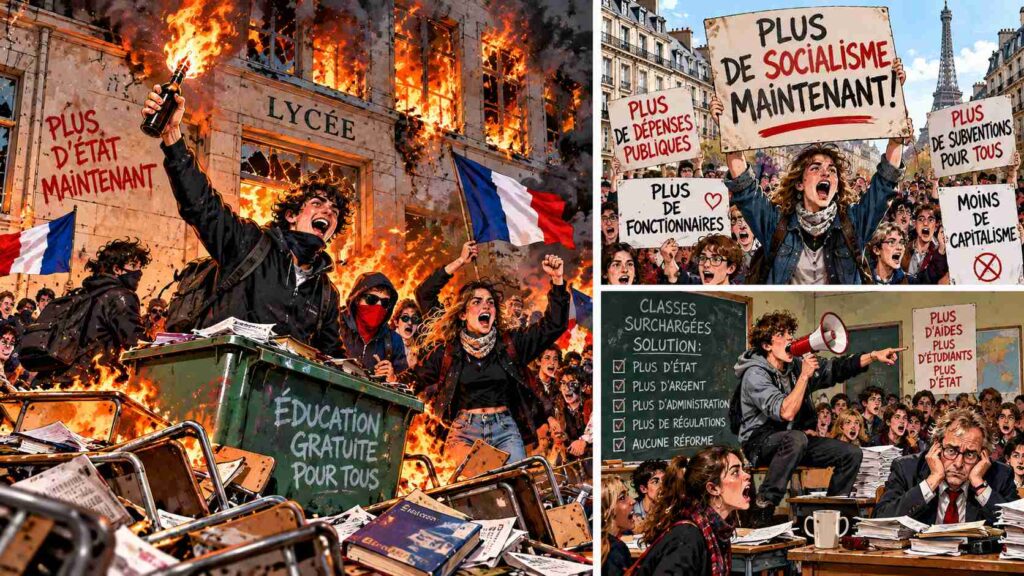
The first demand was simple. Hire more teachers. Reasonable. Then repair the school buildings, also reasonable. Then reduce class sizes, still reasonable. At that point the whole thing should have stopped, but socialism has never met a stopping point it couldn’t nationalise.
Our satirical student committee soon widened the programme: free university tuition, free transport, free meals, free housing assistance, free laptops, free counselling and free coffee. Free everything, in short, except the taxpayer, who remains extremely expensive. A student spokesman explained that all of this would be financed through an innovative economic mechanism known as “the government.” Asked where the government gets its money, he requested a different question.
Government Discovers Infinite Demand for “Free” Public Services
The great charm of socialism is that the benefits are visible while the costs sit in a spreadsheet guarded by a civil servant. Tell a student he gets free transport and he sees a bus. Tell him the bus is paid for through taxation, borrowing, payroll charges and future debt service, and suddenly everyone has somewhere else to be.
That’s why “free” is one of the most successful words in politics. Free university, free healthcare, free childcare, free lunch. If “taxpayer-funded” replaced it, half of modern political advertising would collapse by lunchtime.
The committee therefore issued an updated list. Every school gets more teachers. Every teacher gets higher pay. Every classroom gets fewer students, every building gets renovated and every student gets more services. Taxes shall not rise and debt shall not increase. Nobody loses benefits, nobody retires later, nobody works longer, and everybody receives more. Economists studied the document carefully and concluded it had been written by politicians.
France Tries the Magic Money Drawer: Who Pays for Public Spending?
Whenever politicians promise extra spending without extra sacrifice, they tend to fall back on one of three explanations. First: tax the rich. Second: tax corporations. Third: the money will turn up by itself because of growth.
The trouble is that corporations are really collections of employees, customers, shareholders and suppliers, while rich people have accountants, aeroplanes and an irritating habit of recognising borders. That leaves borrowing, which is politically magnificent because voters get the services today and the people currently doing algebra homework get the bill later. It’s the perfect democratic arrangement. Grandparents vote, politicians spend, grandchildren refinance.
A French student interviewed for this satirical report explained that debt shouldn’t matter because governments never die. This is technically true. Unfortunately, bond payments never die either, and the official debt and deficit figures from INSEE, France’s national statistics office keep turning up like a relative who has overstayed a visit.
Homework Declared Exploitation: The Student Four-Day Protest Week
The demands broadened. Homework must be recognised as unpaid labour. Tests become optional. Failing grades become appealable. Monday is abolished, Tuesday becomes a recovery day from Monday, Wednesday ends at noon, and Thursday is reserved for demonstrations. Friday stays on the calendar, but only for statistical purposes.
The Ministry of Education rejected the proposal, then noticed it closely resembled the national productivity calendar. Supporters argued that students deserve a healthier work-life balance. Opponents noted that the “work” half of the equation seemed to be disappearing fast. A compromise was eventually floated: students would attend school only when necessary to protest conditions inside the schools they no longer attend.
Socialism Solves the Teacher Shortage With Administrators

A government spokesman promised immediate action by creating the National Commission for Educational Staffing, Infrastructure, Equity, Inclusion, Sustainability and Related Strategic Outcomes. It will employ 2,400 people. None of them will teach mathematics.
This is one of government’s more elegant tricks. When citizens complain that frontline services are short of workers, the bureaucracy hires people whose job is to study why frontline services are short of workers. The teacher shortage produces an administrator surplus, the surplus produces reports, the reports recommend further study, further study needs funding, funding demonstrates commitment, and commitment is announced as success. The classroom stays crowded. But the Ministry of National Education now has a logo.
Students Discover the Taxpayer
Eventually somebody asked the forbidden question: who pays? The mood changed immediately. One student suggested billionaires. Another said banks. A third said corporations. A fourth suggested “the government,” which returned the discussion safely to where it started.
The socialist fiscal model often resembles five friends at dinner agreeing that nobody at the table should get the bill. Everyone assumes someone richer is eating at another table. Then the waiter arrives with a calculator, and capitalism walks into the room.
France’s Great Fiscal Contradiction: High Public Spending, Struggling Schools
France already runs one of the largest welfare states in the world. The Banque de France puts French public spending at 57.2% of GDP in 2024, against a euro area average of 49.6%. Yet whenever a public service struggles, the argument almost never opens with “are we spending the existing money wisely?” It opens with “how much more should we spend?”
That’s quite an achievement. If your plumber charged you £3,000, failed to fix the sink and then explained that success would take another £2,000, you might think about hiring a different plumber. Government calls that austerity.
The student protests expose a deeper contradiction. The public demands better services and politicians promise them. Taxpayers resist higher taxes, workers resist later retirement, businesses resist higher costs and investors resist more debt. The state’s answer is to promise everybody that somebody else will absorb the inconvenience. Somebody Else has become France’s hardest-working citizen.
The Socialist Escalator: How Government Failure Demands More Government
Six steps, one direction
The political process works beautifully. Step one: identify a genuine problem. Step two: demand government intervention. Step three: the intervention underperforms. Step four: blame insufficient intervention. Step five: demand more intervention. Step six: repeat until the Ministry of Finance starts drinking at breakfast.
This is called the Socialist Escalator because it only travels upward. More programmes, more employees, more subsidies, more regulations, more taxes, more debt. When it reaches the top floor and discovers there is no money left, politicians announce a national emergency caused by capitalism.
The Most Popular Demand of All
Eventually the student committee unveiled its masterpiece. France must provide more teachers, smaller classes, better buildings, higher salaries, free university, subsidised housing, free transport, better lunches, more counsellors, shorter workweeks, earlier retirement, larger pensions and higher benefits. And lower taxes.
The proposal won immediate bipartisan support from everyone who would not personally be responsible for financing it. A representative sample of citizens was asked whether they supported receiving more government benefits while paying less. The pollster was hospitalised after 100% of respondents tried to hug him.
The Accountant Revolts
The only resistance came from François, a fictional accountant at the Ministry of Finance. At about 4:15 p.m. he barricaded himself inside his office using two filing cabinets, a printer and the national debt.
Police negotiators arrived. “François,” they said, “the students have legitimate concerns.”
“I KNOW,” François shouted.
“They need more teachers.” “I KNOW.” “The schools need repairs.” “I KNOW.” “They want additional programmes.”
Silence. “François?”
A sheet of paper slid under the door. It held six words: WHERE DOES THE MONEY COME FROM?
The crowd immediately began chanting TAX THE RICH! François slid out another note: AND WHEN THEY LEAVE? The crowd consulted the sociology department. Someone proposed capital controls. François locked the second deadbolt.
The Real Lesson: Spend the Money You Already Take Competently
The students are right about one important thing. A government that promises public education has an obligation to provide functioning schools. Teachers matter. Class size matters. Buildings matter.
But it doesn’t follow that every failure of government proves the need for unlimited government. Sometimes the lesson is simpler. Maybe the state should do fewer things better. Maybe public money should be treated as scarce. Maybe not every desirable policy becomes a human right the moment somebody says it loudly enough. Maybe “free” deserves quotation marks whenever somebody else receives the invoice.
And perhaps the boldest political demand France could make in 2026 is one you rarely hear through a megaphone: spend the money you already take from us competently. Unfortunately that slogan is nine words long and doesn’t rhyme, so the revolution continues.
Ten Observations From France’s Latest Encounter With Socialism
- Students want smaller classes, more teachers, better buildings and more support staff. Taxpayers would also like better salaries, cheaper houses and a yacht, but apparently nobody has organised them into a march yet.
- Every socialist programme begins with “people need help” and eventually arrives at “therefore the Ministry requires another building.”
- France has spent decades proving that a large state can still run out of money. This is considered a temporary technical difficulty requiring a larger state.
- The government can apparently calculate everyone’s taxes to the cent but remains surprised when buildings require maintenance.
- Socialism’s favourite economic unit is the euro somebody else has.
- Asking “Who pays?” at a political rally is considered rude because arithmetic can be extremely divisive.
- Students understandably want better schools. Politicians understand this as permission to create seventeen new agencies and a National Commissioner for Classroom Happiness.
- Once government promises everything, every inconvenience becomes a constitutional grievance.
- The socialist state is like a hotel where the minibar is free, the room is subsidised, the staff are unionised, and checkout has been postponed until the grandchildren arrive.
- France’s Ministry of Finance remains the only government department still stubbornly insisting numbers are not a right-wing conspiracy.
Disclaimer
This is satirical journalism built around publicly reported French student protests and concerns about classroom overcrowding, teacher shortages and school conditions. The enlarged socialist demand list, the National Commissioner for Classroom Happiness, the abolition of Monday and François barricading himself behind the national debt are satire.
The broader argument is deliberately exaggerated for comic effect. Public services involve real trade-offs, government spending has real costs, and taxpayers eventually show up even when politicians carefully leave them out of the photograph.
This story is entirely a human collaboration between two sentient beings: the world’s oldest tenured professor and a philosophy major turned dairy farmer. Both support fixing leaking roofs. Neither has yet located the mythical government money tree, although France appears to have formed a commission to search for it.
SOURCE: CNN, French student protests

Harriet Collins is a high-output satirical journalist with a confident editorial voice. Her work demonstrates strong command of tone, pacing, and social commentary, shaped by London’s media and comedy influences.
Authority is built through volume and reader engagement, while expertise lies in blending research with humour. Trustworthiness is supported by clear labelling and responsible satire.