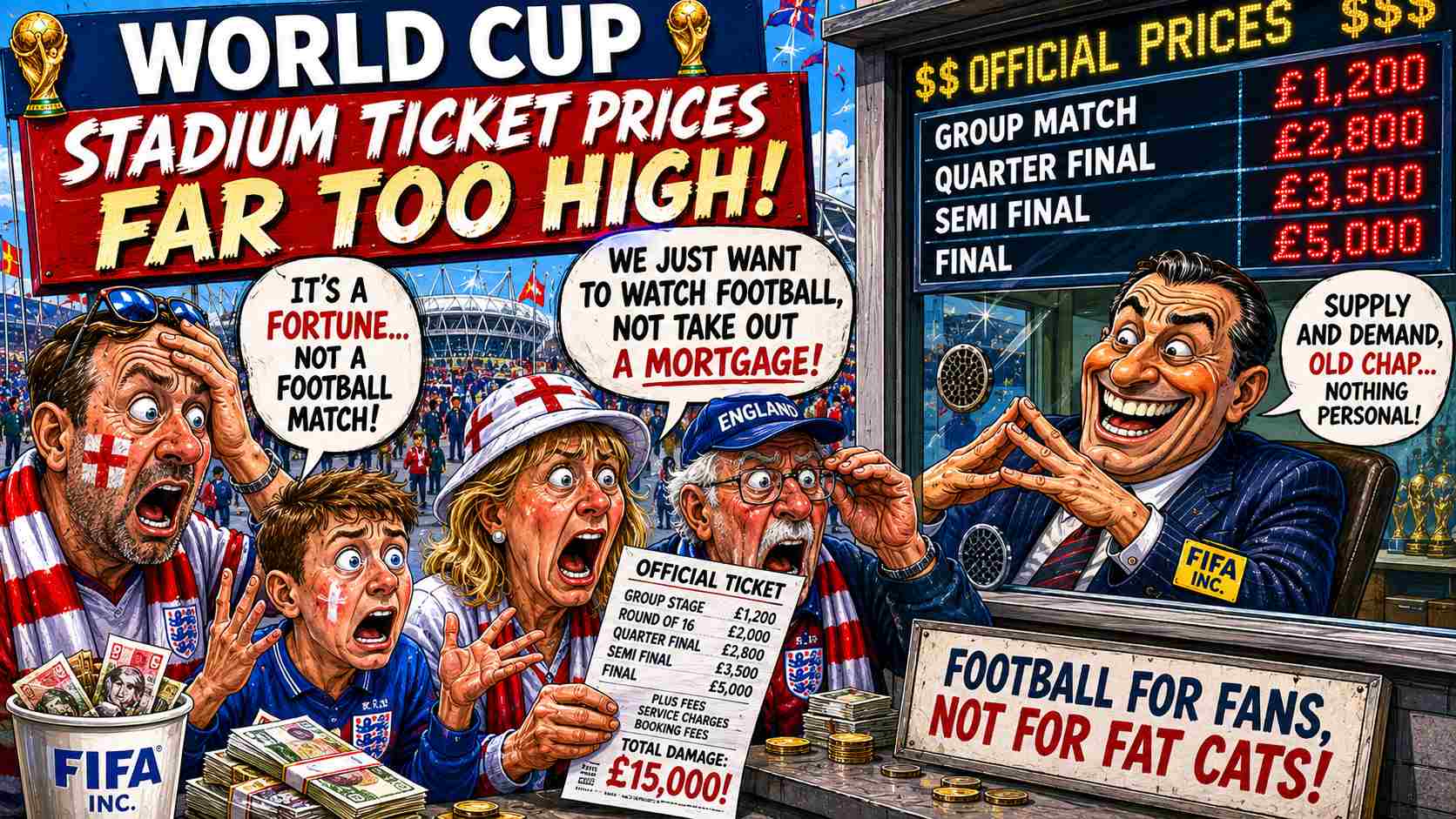
Yanks Discover Football: Now Charging £4,200 a Ticket to Prove It
LONDON — There is a certain kind of satisfaction that arrives when you have been right about something for thirty-two years. We told you the Americans didn’t really understand football. We said it in 1994 when they charged thirty-five dollars for a World Cup ticket with the breezy confidence of a nation pricing up a theme park ride. We watched them fill the Rose Bowl with 94,000 people who couldn’t quite explain the offside rule and charge them ninety dollars for the privilege.
We smiled. We said nothing. We are British. We are very good at saying nothing.
But here is the thing about 1994 that we perhaps should have noticed: America wasn’t being generous. America simply hadn’t worked out yet how much it could charge. Thirty-two years of careful study later, they’ve done the sums. The answer, it turns out, is considerably more than ninety dollars.
The Tickets: £4,200 for a Group Stage Match in Dallas
England are in this tournament. That is either brilliant news or a curse depending on how many times you watched the 2021 Euros final through your fingers. Either way, if you want to watch them play a group stage match in Dallas — not the final, not a semifinal, a group stage match against whoever FIFA has decided England should lose to first — a Category 1 seat will cost you $5,400. That is roughly £4,200. For one match. In Texas. In June.
The Free Lions, the Football Supporters’ Association fans’ embassy for travelling England supporters, put it rather well. They noted that for a stadium so far from its advertised location, organisers had a duty to ensure fans could get there sustainably and at a fair price. The Americans heard this and set the price at $5,400. Sustainable, they said. Very sustainable.
A Category 2 seat is $2,000. Category 3 is $1,400. The cheapest entry — a Supporter Tier ticket that grants you access to what sounds like a large car park with a screen — starts at $60. Parking at that same car park starts at $75. Your parking costs more than your ticket. Derek from Wolverhampton is already working out the maths on a beermat and it isn’t going well for Derek.
The Hotels: Britain Invented Daylight Robbery, America Has Perfected It
In 1994 you could find a decent American hotel room for $80 a night. Sometimes less. The rooms smelled faintly of carpet cleaner and optimism and there was always a laminated card explaining checkout procedures that nobody read. It was fine. It was America being casually hospitable in the way only America can — not because they particularly planned it, but because the market hadn’t told them to do otherwise yet.
The market has now had a word.
Hotel prices in New York and Los Angeles are expected to rise by up to 300% during the tournament. A downtown Dallas hotel sitting at $150 on a normal Tuesday is already nudging $600 and climbing. New York hotels, perhaps spooked by their own ambition, have responded to this situation by filling only a third of their rooms on match nights. Twelve per cent below last year’s occupancy for the same dates. The invisible hand of the market appears to have accidentally strangled the market.
Houston, bless it, is the bargain option at around $170 a night average. Houston in July sits at about 38 degrees with humidity that makes Manchester in February feel like the Algarve. But it’s $170 a night, which by 2026 World Cup standards is practically a soup kitchen.
Getting There: The Part Where It Gets Properly Offensive
Boston sorted out its rail pricing with the subtlety of a man who’s just discovered he can charge whatever he likes at a car boot sale. The commuter train from South Station to Gillette Stadium in Foxborough — twenty-five miles, normally $8.75 each way — will cost $80 return during World Cup matches. That is a 900% increase for a journey that takes roughly the same time as a moderately long bath.
Paul Goodwin from the Scottish Football Supporters Association said there would be “a lot of second mortgages and costs being put on credit cards.” The Scots invented the concept of being careful with money and they are alarmed. When a Scotsman tells you something is expensive, you sit down.
New Jersey Transit, which runs trains from Manhattan to MetLife Stadium, has set its World Cup return fare at $98. The standard fare is $13. The chief executive explained that commuters shouldn’t subsidise the cost of running trains for hundreds of thousands of extra World Cup visitors, which is a reasonable point delivered at an unreasonable price point to people paying $98 for forty minutes on a train that smells of pretzels and mild despair.
A man named Keith from Sunderland has reportedly already decided he’ll watch it in a pub in Sunderland. Keith is the smartest person at this entire tournament.
What We Managed When We Hosted It

France 1998. Germany 2006. Both tournaments run with reasonable ticket prices, sensible transport links, and a general sense that football was for people who wanted to watch football rather than people who could absorb a small car’s worth of costs for a single group stage outing. Even Qatar — and we will not dwell on Qatar — had the decency to build everything close together so you weren’t flying domestically between matches.
The Americans looked at all of this and concluded, not unreasonably from their perspective, that Europe had simply failed to monetise correctly.
The 2026 tournament is spread across 16 cities in three countries and 104 matches, which means every connection, every hotel night, every shuttle bus, every parking space is a separate commercial opportunity. Fly London to New York, $1,800 return. Domestic connection to Dallas, $300. Hotel, $600 a night. Ticket, $5,400. Train home, $98. Park the rental car you hired because the train was $98, $75. Hot dog inside, $24. Beer, $16. Second beer to process the first beer’s price, $16. Fly home. Ring your bank. Have a quiet moment in the arrivals hall at Heathrow.
A realistic seven-day trip to attend one or two matches costs between $1,660 and $7,520 per person. The $1,660 figure requires a level of logistical creativity that borders on performance art. The $7,520 figure is what FIFA describes, with apparent sincerity, as “moderate.”
The Final: New Jersey’s Crowning Moment
New Jersey is hosting the final. Not New York — New Jersey, which has spent forty years being the place people drive through on the way to New York and is absolutely delighted about this. MetLife Stadium, July 19th. Cheapest face-value ticket: $2,030. Top hospitality package: $73,200 per person. That is not a typo. That is the price of a hospitality package for one person, for one football match, in a car park outside Manhattan.
In 1994, ninety dollars got you a seat at the Rose Bowl final. 94,194 people went. Largest World Cup final crowd in history. Ninety dollars.
America charged $90 and filled every seat. Now it’s charging $2,030 minimum and the market will sort it out, which is the economic equivalent of saying the dog will sort out the sausages.
To be fair to the Americans — and we are trying very hard to be fair — things genuinely cost more there. Stadium operations, staffing, security, the sheer logistical weight of hosting 104 matches across a continent rather than a compact European nation. None of this is invented. It’s just that the costs have been passed on with a enthusiasm that suggests somebody discovered a pricing spreadsheet for the first time and found it thrilling.
We wanted America to fall in love with football. Thirty years of Premier League television deals, American owners buying half the top flight, Manchester United being traded like a commodity on the New York Stock Exchange — all of it pointed toward the day America would truly embrace the beautiful game.
They have embraced it. They have embraced it at $5,400 a seat, $98 a train ride, and $600 a night for a hotel room that almost certainly has a laminated checkout card nobody will read.
Enjoy the tournament. We’ll be at Keith’s in Sunderland.
The 1994 FIFA World Cup, hosted across nine American cities, charged between $25 and $90 for tickets and drew record crowds, including 94,194 at the Rose Bowl final between Brazil and Italy. The 2026 tournament, held across 16 cities in the United States, Canada and Mexico, has introduced dynamic ticket pricing through the official FIFA app, with Category 1 group stage tickets averaging $5,400, final tickets ranging from $2,030 to $32,970 at face value, and hospitality packages at MetLife Stadium — the final venue — priced between $3,500 and $73,200 per person. Hotel prices in New York and Los Angeles are expected to rise by up to 300%. Boston’s commuter rail fare to Gillette Stadium has increased from $8.75 to $80 return, and New Jersey Transit’s fare from Manhattan to MetLife Stadium has risen from $13 to $98 return for World Cup matches. The Free Lions supporters group and the Scottish Football Supporters Association have both publicly condemned the pricing as unacceptable for travelling fans. Early occupancy data suggests New York City hotels are running well below normal levels on match nights, indicating the market may have overestimated demand at current prices.
The London Prat is a British satirical publication founded in 1961, committed to laughing at power, pomposity, and anyone charging $73,200 for a seat at a football match. This article was produced in collaboration with the world’s oldest tenured professor and a philosophy major who left academia to farm dairy cattle and has not once been charged $98 for a train he could see the destination of from the platform. Any resemblance to journalism is intentional and carries a surcharge. Auf Wiedersehen, amigo!

Alan Nafzger was born in Lubbock, Texas, the son Swiss immigrants. He grew up on a dairy in Windthorst, north central Texas. He earned degrees from Midwestern State University (B.A. 1985) and Texas State University (M.A. 1987). University College Dublin (Ph.D. 1991). Dr. Nafzger has entertained and educated young people in Texas colleges for 37 years. Nafzger is best known for his dark novels and experimental screenwriting. His best know scripts to date are Lenin’s Body, produced in Russia by A-Media and Sea and Sky produced in The Philippines in the Tagalog language. In 1986, Nafzger wrote the iconic feminist western novel, Gina of Quitaque. He currently lives in Holloway, North London. Contact: [email protected]