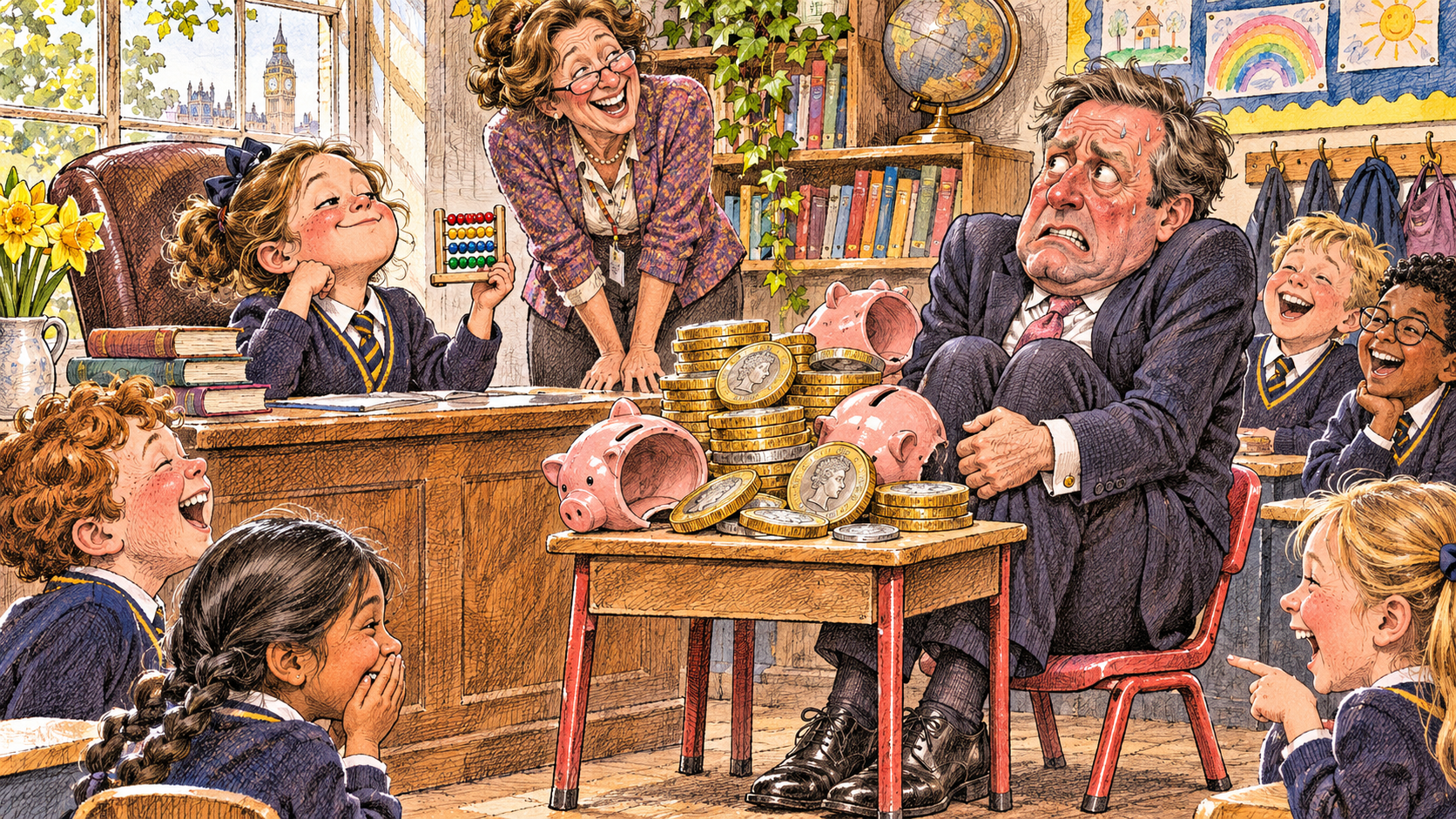
LONDON — The London Prat
Financial education in schools has taken an unexpected turn after pupils asked whether the Government intended to sit the same examination.
The proposed lessons cover inflation, interest and risk. Ministers initially welcomed all three as things they had successfully passed on to somebody younger.
Financial education in schools meets the Treasury
According to the newly announced financial education curriculum plans, Education Secretary Lucy Powell wants classroom maths connected to payslips, mortgages, savings and scams. The programme described includes practical financial concepts and preparation for teaching from 2028.
At the Prat’s demonstration classroom, teacher Mrs Fenwick introduced the difference between wanting something and being able to afford it. A visiting official asked whether that distinction was compulsory.
“Only for the children,” she reassured him.
The first exercise gave each pupil ten counters and asked them to spend no more than ten. A Treasury observer requested another bag of counters, then described the second bag as investment in the first.
Nine-year-old Oliver challenged the calculation. His answer was marked correct but politically unhelpful.
Compound interest requests a meeting with compound optimism
Compound interest means earning interest on interest, or owing interest on interest, depending on which side of the desk has the comfortable chair.
Mrs Fenwick illustrated the principle with a small sum growing over time. The official said it was an inspiring example of growth until she revealed that the sum represented a debt.
Children then practised reading a payslip. They found the gross salary, the deductions and the much smaller amount available for being alive.

A pupil asked why the larger number was called gross when the smaller number was the upsetting one.
The class also compared supermarket offers. Two packets costing more than one packet were initially judged poor value until the official explained that buying two generated a stronger headline.
In a practical risk exercise, every child was given a basket of eggs. One pupil distributed the eggs across several baskets. The ministerial visitor put them all in a strategy and commissioned a logo.
The homework is payable monthly
The plan’s useful ambition is to make ordinary money decisions less mysterious. Our classroom’s difficulty was that ordinary money decisions kept producing extraordinary questions about the people running the country.
Why, the children asked, does a bank want proof a family can afford a mortgage larger than the rent it already pays? Why is a discount sometimes measured against a price nobody remembers seeing? Why does saving money require buying an expensive appliance?
These questions were referred to the advanced module, titled Things Adults Explain by Saying That’s Just How It Works.
The Prat’s entirely unscientific show of hands found every pupil preferred having money to receiving a leaflet about financial resilience. This was not a national survey, although officials said the sample showed encouraging resilience.
Parents welcomed the lessons, particularly the possibility that a child might eventually explain their pension letter.
At the end of the visit, Mrs Fenwick asked the official to balance a household budget.
He requested permission to change the forecast, redefine the household and blame the previous owner of the calculator.
She gave him a sticker for participation. He announced that standards had risen.
For official background, see the government’s national curriculum guidance.
Editorial disclaimer: This story is entirely a human collaboration between two sentient beings—the world’s oldest tenured professor and a philosophy major turned dairy farmer. The Treasury has been asked to bring its own pencil.