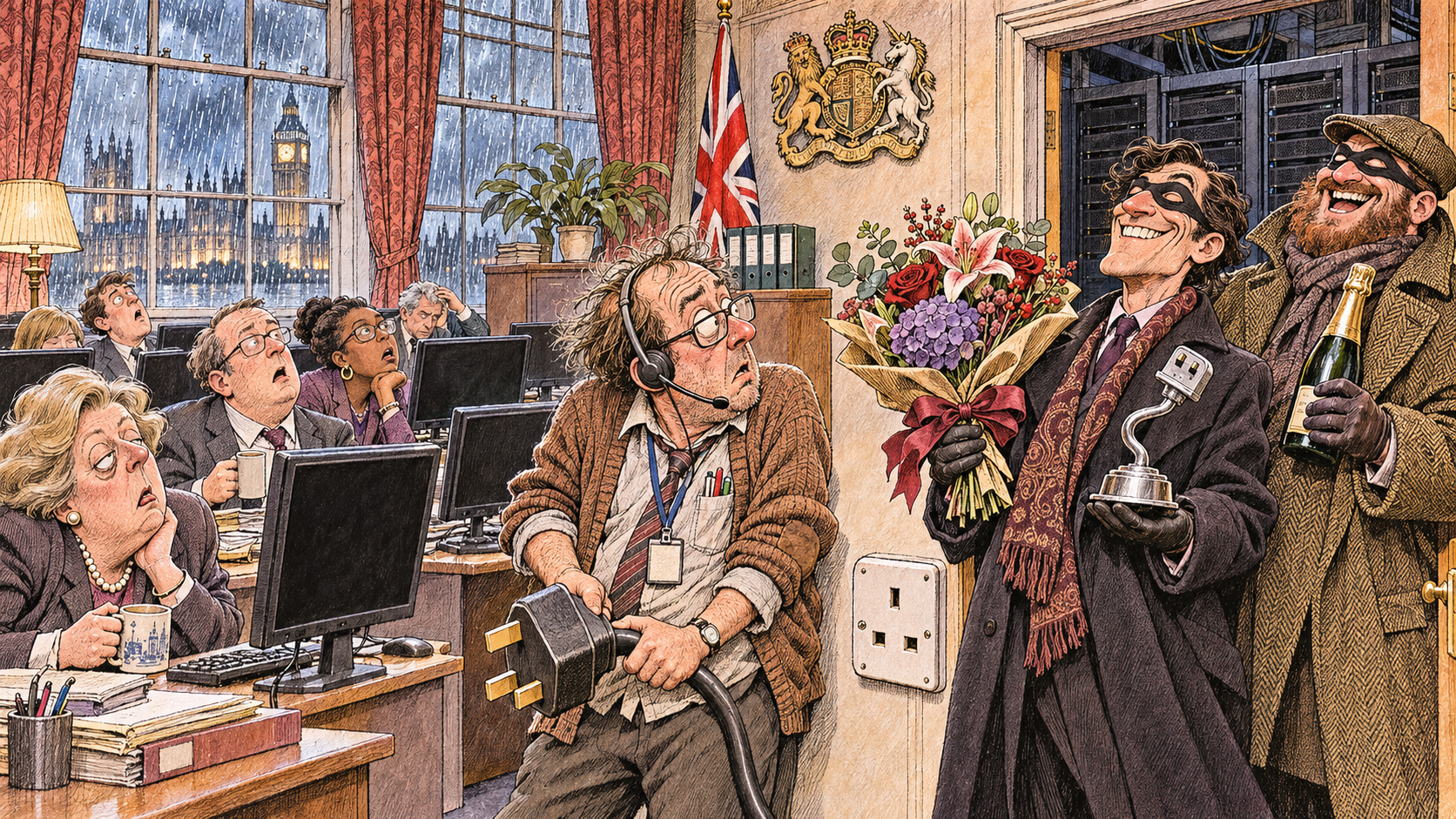
LONDON — An emergency security update has successfully protected the Department for Administrative Continuity from unauthorised access by preventing absolutely everyone from accessing it, prompting hackers to send the IT team flowers and a modest hamper.
The update disabled email, payroll, internal messaging and the application used to report that email, payroll and internal messaging had stopped working.
A departmental spokesman described the result as “a substantial reduction in the number of active threats”, noting that the number of active employees had fallen by an identical amount.
Emergency security update achieves complete inaccessibility
The Financial Times report on AI and cyber threats describes disruption linked to hurried software fixes. Whitehall has developed the principle into an administrative philosophy: if the service cannot function, neither can the criminals seeking to interfere with it.
“We had budgeted three weeks for the initial disruption,” said a representative of the attackers. “Their supplier managed it before elevenses. We are reviewing whether to outsource the rest.”
The department stressed that the incident was not a cyberattack. Staff agreed, observing that a cyberattack would usually include someone with a clear objective.
The phased rollout had one very large phase
A phased rollout normally means introducing a change gradually. The department had interpreted it as asking every employee to go through the same five stages of grief.
Testing had been completed on a spare laptop that was not connected to the network, used none of the affected software and belonged to the communications director’s nephew.
“It passed,” the project manager confirmed. “He watched a whole video.”
The rollback instructions were safely stored on the server that required rolling back. Their backup was protected by an authentication service that had also been updated.
Officials praised this as defence in depth.

Hackers thank IT for its outstanding delivery
The attackers’ hamper arrived by courier because their first congratulatory email had bounced. It contained biscuits, a bottle of sparkling wine and a card expressing admiration for the department’s ability to incapacitate itself without demanding a ransom.
Help-desk technician Martin Phelps declined the biscuits pending guidance on gifts. The guidance portal was unavailable, leaving the biscuits in an unusually secure condition.
Staff seeking assistance were instructed to open a support ticket. Opening a support ticket required logging into the system about which they wished to open a support ticket.
Phelps suggested temporarily accepting telephone calls. A manager rejected this because the department had spent considerable money eliminating telephone calls.
Resilience meeting discovers the pencil
The emergency committee convened around twelve silent laptops and one functioning pencil. The pencil was passed between departments under an improvised resource-sharing agreement.
A consultant recommended buying an additional resilience dashboard. When asked what it would display during an outage, he said this would be covered in the discovery phase.
Actual NCSC guidance on updating by default includes phased deployment and pausing or rolling back when problems arise. The lesson is to manage updates properly, rather than leave known vulnerabilities untouched.
The committee approved this approach in principle, subject to a business case for the word “properly”.
Meanwhile, the public status page continued to report normal operation because nobody could log in to change it. Officials called this reassuring consistency.
By closing time, no evidence of data theft had been found. No evidence of anything else had been found either, because the logs were inaccessible.
The hackers cancelled their evening shift.
Phelps finally opened the biscuits. The department’s first successful recovery operation was completed without a password.
Editorial disclaimer: No hackers supplied this newspaper’s biscuits. The world’s oldest tenured professor and a philosophy major turned dairy farmer chair our honorary continuity committee. Their rollback plan is a pencil with a rubber on the end.

Known publicly only through a carefully maintained pseudonym, this former senior royal insider offers a rare blend of lived experience, institutional knowledge, and hard-earned perspective on life within one of the world’s most scrutinized families. Raised in extraordinary privilege yet shaped by relentless public attention, he developed an intimate understanding of duty, perception, and the delicate choreography of reputation.
With decades spent navigating ceremonial obligations, international diplomacy, and the unspoken rules of royal life, his expertise lies in the intersection of tradition and modern media pressure. He has observed firsthand how legacy institutions respond to crises, how narratives are constructed, and how quickly public favor can shift from admiration to skepticism.
His insights are informed not only by access, but by consequence. Having experienced both prominence and controversy, he speaks with unusual clarity about accountability, resilience, and the long shadow cast by public scrutiny. Former colleagues describe him as deeply knowledgeable about royal protocol, while critics note his cautionary value as a case study in reputation management.
Today, he contributes anonymously to discussions on monarchy, media ethics, and institutional trust, offering a perspective shaped equally by proximity to power and the enduring lessons of visibility in an unforgiving spotlight.