

Driving a Porsche in London: A Complete Guide to Spending £125,000 to Average 4 mph Behind a Bin Lorry
Five Devastating Observations About Driving a Porsche in London That No Dealership Will Put in the Brochure 🏎️🇬🇧
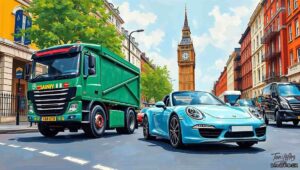
LONDON — A man spends £143,000 on a Porsche 911 Turbo S so he can travel eleven feet at a time behind a Tesco delivery van driven by a Bulgarian philosopher named Vladislav who is eating crisps with both hands and negotiating a left turn with his knees.
Nothing says “German engineering excellence” quite like approaching a speed bump in Knightsbridge at 4 mph with the focused terror of a man defusing ordnance, while a cyclist wearing corduroy overtakes you carrying a fern and making meaningful eye contact.
Every person who buys a Porsche in London develops the battlefield reflexes of a Navy SEAL the first time someone in a Fiat 500 opens a door near their paintwork. One scratch and suddenly they’re outside on the pavement measuring panel gaps with a Waitrose loyalty card and the emotional intensity of a bomb disposal expert whose therapist has just cancelled.
Experts confirm that Porsche theft is rising across London — 60% of all vehicle thefts in the capital now involve keyless relay attacks — although many stolen vehicles are reportedly returned voluntarily after thieves spend ninety minutes trying to exit Soho during school pickup while the satnav suggests a route through a mews that technically only exists in the nineteenth century.
A London Porsche owner now spends more time discussing ULEZ charges, premium petrol, parking permits, emission zones, congestion pricing, pothole trauma, ANPR cameras, Ghost immobilisers, Faraday key pouches, and wheel alignment than actual driving. The car has effectively become a rolling tax seminar with heated seats and a sound system that costs more than most people’s kitchens.
London Man Buys Porsche to Feel Alive, Immediately Trapped Behind Bin Lorry Until Retirement
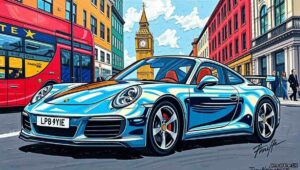
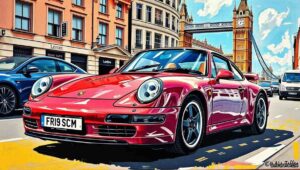
Britain’s luxury car culture reached new heights of emotional confusion this week after 42-year-old hedge fund manager Oliver Pembroke purchased a graphite-grey Porsche 911 Carrera — starting from £125,405 in current UK pricing — and immediately spent his first three days averaging roughly the same velocity as a cautious goat on a pedestrian crossing.
Witnesses say Pembroke exited Porsche Centre Mayfair wearing loafers so polished they reflected nearby property prices. Staff applauded as he climbed into the vehicle with the confidence of a man who had recently described his investment strategy as “dynamic capital deployment” during a lunch that cost more than a Porsche service appointment, which is saying something, because a Porsche service appointment costs more than a small family holiday.
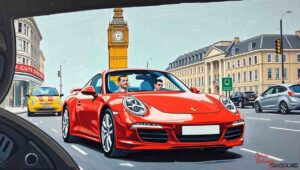
Twenty minutes later he was stationary behind a recycling truck in Kensington, listening to Magic FM and quietly calculating whether the car had depreciated £11 each time he touched the brake pedal. The answer, broadly speaking, is yes.
“It corners beautifully,” Pembroke told reporters while stationary near Hyde Park for 47 consecutive minutes. “I haven’t technically turned a corner yet. But emotionally I can feel the precision engineering. It’s like sitting in a very expensive promise.”
According to research from the entirely respected Institute for Advanced British Regret — which does not exist but absolutely should, and would be oversubscribed — 71% of London Porsche owners spend more time cleaning bird droppings off the bonnet than they do driving above second gear. The bonnet cleaning itself has become a ritual of such precision and frequency that several owners have been mistaken for professional detailers and asked for quotes.
The same study found that 42% purchased the vehicle after “one difficult week at work,” 31% admitted they mainly wanted strangers to notice them in traffic while they sat in traffic not being noticed because everyone else is also in traffic staring at their phones, 18% confessed they were “becoming their father,” and 9% genuinely believed buying a Porsche counted as therapy. For the record: it does not count as therapy, though the monthly finance payments do ensure you have something urgent to discuss with an actual therapist.
Professor Malcolm Thistlebury, Britain’s leading automotive sociologist and part-time pub darts champion, described the Porsche as “the perfect London status symbol, because it combines aspiration, anxiety, debt, and parking trauma into one beautifully stitched German package that does zero to sixty in 3.3 seconds and zero to Waitrose in forty-five minutes.”
Every London Porsche Owner Secretly Believes They Are About to Drive Across the Alps
London Porsche culture has exploded over the last decade, particularly among men named Hugo, Sebastian, and James who suddenly develop strong opinions about “driving dynamics” after watching three YouTube reviews and surviving one roundabout near Slough without incident.
The city is now comprehensively flooded with Macans, Cayennes, Taycans, and 911s wedged between buses, cyclists, scaffolding lorries, and tourists from Ohio standing motionless in the middle of roads photographing telephone booths that haven’t contained a functioning telephone since 2008.
One eyewitness outside Notting Hill described seeing a Porsche owner navigating a speed bump “with the concentration normally associated with moon landings and the speed associated with plate tectonics.” The bump was four inches high. The approach took forty seconds. A spaniel watched from the pavement with visible concern.
“He looked genuinely terrified,” said local resident Denise Walker, 54. “The car cost more than my house in 1997 and he was approaching that bump like it was load-bearing.”
Meanwhile, Porsche dealerships across London continue to flourish thanks to what economists call “financial delusion mixed with ambient masculine panic and a six-month waiting list that makes the whole thing feel more exclusive than it perhaps warrants.”
Dealership finance teams reportedly deploy advanced psychological techniques including: “You deserve this.” “Life is short.” “The monthly payments are technically less than private school.” “Imagine yourself on the B roads of Surrey.” “The resale value is exceptional.” And, most devastatingly effective of all: “Another gentleman was looking at this one this morning.”
What the Funny People Are Saying About Buying a Porsche in London
“Nothing ages a man faster than hearing a mysterious tiny noise inside a Porsche. His hair goes grey before the diagnosis.” — Jerry Seinfeld
“A Porsche in London is basically a very expensive chair you transport slowly between traffic lights and clean obsessively on weekends.” — Ron White
“People buy a Porsche to feel powerful, then spend two years apologising to parking attendants and one year arguing with their insurance company.” — Sarah Silverman
“The real Porsche experience in London isn’t the test drive. It’s year three, when you’ve memorised the congestion charge payment portal by muscle memory.” — Jimmy Carr
“Buying a Porsche in London is the most optimistic thing a human being can do. You are betting, with six figures, that the A4 will one day be clear at 8am.” — Ricky Gervais
“A Porsche in London is like bringing a concert pianist to a pub quiz. Technically impressive. Completely wrong room.” — Jack Dee
ULEZ, Congestion Charges, and the £18-a-Day London Tax on Feeling Sporty
Anyone seriously considering buying a Porsche in London should sit down first — ideally in a room with no finance brochures — and do some arithmetic that the showroom experience is specifically designed to prevent you from doing.
The London Congestion Charge increased to £18 per day from January 2026, operating Monday through Friday and weekend afternoons. Drive into central London on a weekday and that’s £18 before you’ve found anywhere to park, paid for parking, returned to find a ticket on the windscreen, and accepted the ticket as the universe’s way of explaining something you already knew. That’s £4,500 a year if you commute five days a week, which is — and this is worth pausing on — approximately the price of a used Porsche Boxster in 2003.
The Ultra Low Emission Zone charge sits alongside the congestion charge as a separate daily levy of £12.50 for non-compliant vehicles, operating 24 hours a day, 364 days a year — the exception being Christmas Day, because even TfL maintains the basic social contract of not charging you to drive to your parents’ house on 25 December. Though give it time.
Most current Porsches comply with ULEZ emissions standards, which is good news. The bad news is that compliance doesn’t make the congestion charge go away, doesn’t fix the potholes, doesn’t create parking spaces in SW3, and doesn’t prevent the specific category of existential dread that arrives when you receive an ANPR penalty notice for a zone you drove through at 7:02am on a Tuesday whilst entirely focused on not being late.
One Chelsea resident received an annual insurance quote so high he briefly considered hiring two retired SAS soldiers to jog beside the vehicle full time as a security measure. He ran the numbers. The SAS soldiers were cheaper by £400.
London Roads Now Officially Classified as Hostile to Suspension, Alloy Wheels, and Human Dignity
Mechanical specialists across London report that the capital’s pothole situation has evolved from “infrastructure problem” to “active geological event.” Independent Porsche technician Gavin “Gearbox” Holloway says wealthy owners now arrive at his workshop in states of emotional distress that he has learned to read the moment they park.
“There are specific sounds,” Holloway explained. “There’s the sound a Porsche makes going over normal road imperfections, which is fine. And then there’s the sound it makes going into a pothole near Hammersmith that’s been there since the coalition government. That sound is different. That sound produces a specific look in a man’s eyes.”
The look, Holloway says, is universally followed by the same sentence: “It’s probably nothing, right?” It is usually nothing — a loose bottle of Highland Spring in the boot, a heat shield rattle, the universe communicating in vibration. But by the time they reach the workshop, clients have already convinced themselves the engine has structurally failed, the chassis is compromised, the wife is reconsidering things, and the car has depreciated to roughly the value of a conservatory.
Insurance rates have become, in the technical financial sense, bananas. UK insurers paid out an estimated £1.24 billion in motor vehicle theft claims in 2024, with 70% of all UK vehicle thefts now carried out via keyless relay attacks — a method so simple and fast that thieves can be inside your Porsche and three streets away before you’ve finished the sentence “I got a Ghost immobiliser fitted, so.” Greater London recorded nearly 34,000 vehicle thefts in 2024 alone, with one car stolen every three minutes across England and Wales.
Security experts now recommend London Porsche owners deploy Ghost immobilisers, Faraday key pouches, underground garage storage, CCTV, motion sensors, tracker systems, and what one specialist described as “a good relationship with your neighbours, both of whom should be very light sleepers.” Several owners have added steering wheel clubs, wheel clamps, and driveway bollards. One Fulham resident installed a bollard, a tracker, a Ghost immobiliser, and a Dobermann. The Dobermann remains the most cost-effective component of the security package and is easier to insure.
The Porsche Macan: Britain’s Official Vehicle of Quietly Significant Personal Disappointment
Experts now broadly agree that the Porsche Macan has become the most psychologically revealing vehicle on British roads — a moving self-portrait of its owner’s ambitions, anxieties, and relationship with the concept of “sporty.”
Unlike the 911, which announces itself, the Macan quietly murmurs, “I’ve done moderately well in consulting and I’d like that acknowledged without having to say it directly.” It is a vehicle of nuance. It says: I could have bought a Range Rover, but I wanted something that corners. I could have bought a 911, but I have children and a sensible wife and we’ve discussed it.
The Macan Electric has added a further dimension for 2025 and 2026, offering Porsche ownership without the ULEZ anxiety and with the added conversational benefit of being able to describe your “range anxiety” at dinner parties in a way that sounds technical but is actually about whether you can make it to the Cotswolds without stopping, which you can, but the stopping point is a motorway services near Oxford and that’s its own kind of anxiety.
The SUV has become particularly popular among affluent London parents who wish to appear sporty despite spending the majority of their week in school run traffic on the Fulham Road discussing Year 7 admissions and whether the probiotic yogurt is working. One father in Hampstead admitted he bought a Macan after watching another father effortlessly reverse into a parking space outside Waitrose while listening to a podcast about stoicism. “I just wanted to be looked at the way he was looked at,” he said quietly. “Just once.”
The Porsche Taycan and the Electric Question Nobody Wants to Answer at a Car Meet
The arrival of the Porsche Taycan has split London’s Porsche community along lines of roughly theological intensity.
Purists — the men with seven notebooks and opinions about air-cooled engines — regard the Taycan with the polite hostility normally reserved for someone who orders a Chardonnay at a craft beer festival. “It’s not really a Porsche,” they say, while accepting that it’s faster, quieter, cleaner, exempt from ULEZ, and objectively superior in London traffic conditions, which is where they drive it.
Taycan owners, meanwhile, enjoy the specific satisfaction of gliding past petrol-engined 911s in Hammersmith with a serene expression and zero engine noise, which is either the future of motoring or the most expensive way yet devised to be smug in traffic.
The electric exemption from the ULEZ charge has made the Taycan a financially interesting proposition for anyone who regularly drives in Greater London — though from January 2026, even EVs pay the congestion charge at a 25% discount from the full rate, meaning the Taycan’s owners are now paying £13.50 a day to enter central London, which is still less than the petrol brigade but represents a significant narrowing of the fiscal gap between virtue and internal combustion.
London’s Porsche Community Remains Spiritually Committed to the Idea That the M25 Is Scenic
Despite endless traffic, impossible parking, aggressive taxation, organised theft, and roads that resemble the surface of a planet that has recently survived something, Porsche ownership in London continues to rise because owners maintain, with the conviction of people who have spent too much money to change their minds, that the real joy begins “outside the city.”
This outside-the-city mythology sustains the entire London Porsche ecosystem. It is always forty-five minutes away. It involves a B road. It features a corner taken in third gear with the windows down and a sound from the exhaust that justifies everything. It is Surrey in summer, at 10am on a Sunday, when the roads are briefly, magically, empty.
This moment exists. It is real. London Porsche owners have experienced it. Some of them have experienced it twice. The rest are still looking for it on the A316, which remains, regardless of season or time of day, approximately 80% stationary.
This usually means driving ninety minutes through south London congestion to reach a car park in Dorking, where middle-aged men gather with flat whites and discuss ceramic coating with the technical seriousness of nuclear diplomacy. At one recent Porsche club meet, a heated argument reportedly broke out after one owner described another man’s exhaust note as “slightly needy.” The aggrieved party required twenty minutes and an emotional support Americano to recover. The original critic maintains he was correct. These things fester.
Still, the community endures. Because there is something that transcends the traffic and the charges and the potholes and the insurance excess and the Vladislavs of this world eating crisps in both lanes simultaneously.
The Complete Financial Reality of Buying a Porsche in London: A Summary Nobody Asked For
For anyone genuinely considering buying a Porsche in London, here is the unabridged arithmetic that the Mayfair showroom experience is architecturally designed to prevent you from completing:
A new Porsche 911 Carrera starts at £125,405. Options — and there will be options, because Porsche’s options list is a masterwork of psychological retail — will carry it comfortably to £140,000 before you’ve added the colour you actually wanted. Finance at representative APR over four years produces monthly payments that are “technically less than private school,” as the finance manager will say, while not specifying which private school, because the comparison only works for certain Swiss boarding establishments.
Add the congestion charge at £18 per day for regular central London use: potentially £4,500 per year. Insurance in inner London postcodes for a 911: typically £3,000 to £5,000 annually, rising sharply after any claim and rising anyway because the market has decided it should. Annual servicing: budget £2,000 to £4,000 depending on model and mileage and the specific emotional condition of the technician who answers the phone. Tyres: Porsche-spec tyres in London sizes cost between £250 and £400 each, and London roads will remind you of this more often than feels reasonable.
Parking in central London: this is not a fixed number because it varies by borough, time of day, permit availability, and whether the parking app server is currently operational, which it frequently isn’t when it matters. Budget for the knowledge that parking your Porsche in London will always cost more than you expect and take longer than the journey that preceded it.
Then add the depreciation, which is the large number that finance directors describe using phrases like “residual value” and “equity position” rather than “the amount you will lose,” because those are different sentences that mean the same thing.
And then consider, finally, whether the B road in Surrey on a Sunday morning is worth all of the above.
For the record: it probably is. But you should know what you’re buying before you buy it. The Porsche is magnificent. London is the wrong place for it. This is not a dealbreaker. It is a British condition.
Britain Continues Its March Toward Motoring Madness, One Speed Bump at a Time
Deep down, buying a Porsche in London is not really about driving. It never was. It is about a fantasy — clean, specific, entirely reasonable — that one day the roads will clear, the weather will cooperate, the cyclists will find somewhere else to be, the parking app will function without requiring a password reset, the speed cameras will blink mercifully, and somewhere beyond the North Circular, a perfect country road awaits.
Until that day, the average London Porsche owner will continue sitting in stationary traffic on the A4, surrounded by people in Ubers and on Boris bikes going demonstrably faster, while the engine ticks over and the exhaust note goes entirely unappreciated by the Deliveroo cyclist filtering past on the left.
And they will whisper, softly but with conviction, the words “German engineering” to themselves.
Like a prayer.
Like a man who has made peace with his choices and would make exactly the same ones again.
This article is British satirical journalism — a human collaboration between the world’s oldest tenured professor and a philosophy major turned dairy farmer. No speed bumps were emotionally harmed during production, although several alloy wheels remain under observation and one Ghost immobiliser is receiving counselling. The statistics are real: a new Porsche 911 starts from £125,405 in the UK. Greater London recorded nearly 34,000 vehicle thefts in 2024. The congestion charge rose to £18 per day from January 2026. Vladislav is fictional. The crisps were Walkers. The fern survived.
Auf Wiedersehen, amigo!

Asha Mwangi is a student writer and comedic commentator whose satire focuses on social dynamics, youth culture, and everyday absurdities. Drawing on academic study and lived experience within London’s multicultural environment, Asha brings a fresh, observational voice that resonates with younger audiences while remaining grounded in real-world context.
Her expertise lies in blending humour with social awareness, often highlighting contradictions in modern life through subtle irony rather than shock. Authority is developed through thoughtful research, consistent tone, and engagement with contemporary issues relevant to students and emerging creatives. Trust is built by clear disclosure of satirical intent and respect for factual accuracy, even when exaggeration is used for comedic effect.
Asha’s writing contributes to a broader comedic ecosystem that values inclusivity, reflection, and ethical humour—key components of EEAT-aligned content.


