Researchers confirm congestion can be neither created nor destroyed, only redirected toward someone who did not attend the consultation
LONDON | British researchers have reportedly made a major breakthrough in transportation science after discovering that traffic can disappear entirely when observers agree not to examine neighbouring roads.
The experiment begins 26 October, when almost a kilometre of Oxford Street between Orchard Street and Great Portland Street becomes traffic-free during daytime hours.
Private vehicles, buses, taxis and cycles will no longer travel through the pedestrianised section, while emergency access remains and most servicing shifts overnight.
Congestional Displacement Theory: The Science of “Go Round the Other Way”
Scientists are calling the phenomenon Congestional Displacement Theory.
The public knows it as “go round the other way.”
For centuries humanity believed vehicles occupied physical space.
London planning has now challenged this primitive assumption.
If 200 cars leave Road A and enter Road B, Road A contains fewer cars.
Therefore traffic has fallen.
What happens on Road B is a separate departmental matter.
This resembles weighing yourself by placing one foot on the bathroom scale.
Technically encouraging.
TfL Traffic Modelling: What Transport for London Forecasts for Oxford Street
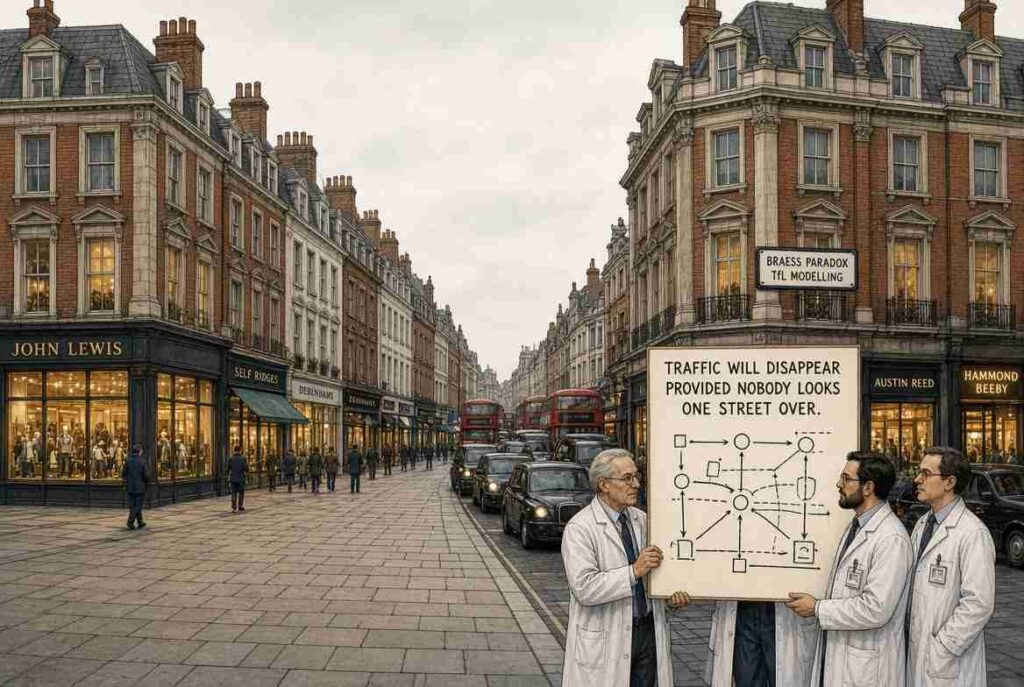
Transport modelling is naturally more sophisticated than that.
TfL has examined likely changes to bus journeys, traffic flows and nearby junctions. Its published assessments forecast increased journey times for some routes and additional vehicle flows on some surrounding streets after Oxford Street traffic is diverted.
In other words, engineers already know the traffic goes somewhere.
But that ruins the headline.
“OXFORD STREET BECOMES TRAFFIC-FREE” sounds transformative.
“WIGMORE STREET WOULD LIKE A WORD” lacks majesty.
Road Closures and Diversions in London: Where 7,000 Vehicles Go
Londoners have experienced this phenomenon before.
Close one road and Google Maps immediately sends 7,000 vehicles through a lane apparently designed in 1734 for three goats and a bishop.
Residents look outside.
“Why is there a coach here?”
“Diversion.”
“It doesn’t fit.”
“It’s sustainable.”
“It’s touching both houses.”
“Please focus on the reduced congestion elsewhere.”
Traffic diversion is the urban equivalent of squeezing a balloon.
Press one side.
Another side becomes Westminster’s problem.
Oxford Street Pedestrianisation: Conducting Traffic Around Wigmore Street and Regent Street
The proposed Oxford Street arrangements demonstrate the complexity beautifully.
TfL has planned changed bus routes and stops, two-way traffic on roads previously operating one way, revised junction arrangements, cycle alternatives and altered traffic flows throughout the surrounding area. The Fitzrovia News has the list of affected streets, and it is not short.
This is not merely removing traffic.
This is conducting traffic.
Oxford Street is the orchestra pit.
Wigmore Street gets brass.
Regent Street gets percussion.
Henrietta Place receives a tuba through the kitchen window.
Precision Modelling: “Our Model Predicts 217 Additional Vehicles”
One of the most delightful aspects of transportation bureaucracy is modelling.
Computer models can estimate how many additional vehicles may use particular roads during particular periods.
This produces precise figures.
For example, earlier published material anticipated additional traffic on parts of Regent Street and around Wigmore Street as journeys adjust.
Precision gives everyone confidence.
Nobody likes being told:
“Your street may become considerably busier.”
Much better:
“Our model predicts 217 additional vehicles.”
“That’s terrible.”
“No, no. It’s science.”
The London Driver Problem: Why Traffic Models Assume Rational Behaviour
Traffic models also assume drivers behave rationally. (Transport theorists have long known that adding or removing road capacity can produce results nobody planned for.)
This is where London enters experimental theatre.
A rational driver sees a road closure and follows the diversion.
A London driver sees a road closure and thinks:
“I reckon I can get through.”
Then he follows a taxi.
The taxi follows a delivery van.
The delivery van enters a loading bay.
The driver discovers he has joined Pret.
Satnavs and Rat Runs: How Apps Turned Georgian Streets Into Le Mans
Satnavs worsen matters because they create democracy.
Once only cabbies knew London’s secret routes.
Now everyone knows.
A residential street can go from peaceful Georgian enclave to stage six of Le Mans because an app discovered it saves thirty-seven seconds.
Residents may complain.
The algorithm cannot hear them.
It is busy helping Darren from Watford avoid a traffic light.
The Consultation Numbers: Public Support for Oxford Street Pedestrianisation
City Hall’s broader objective is to make Oxford Street safer, more attractive and more commercially successful, and consultation data showed substantial support for the principle of pedestrianisation. An earlier consultation drew more than 6,000 responses, with roughly two-thirds of respondents expressing support for pedestrianisation.
That deserves to remain part of the factual picture.
So do concerns about spillover effects.
Both can exist simultaneously.
A pedestrian plaza can improve one street while imposing adjustments on others.
Unfortunately that balanced sentence contains no jokes.
The Scientific Conclusion: Just Zoom Out Until You Cannot See the Cars
So researchers have returned to the laboratory.
Their conclusion is more promising:
Oxford Street congestion can be reduced dramatically.
Surrounding congestion can also be reduced dramatically.
All London needs is a sufficiently large map.
Simply zoom out until you cannot see the cars.
Problem solved.
Humorous Observations on London Traffic Modelling and Congestion
- Traffic displaced onto another road apparently ceases to be traffic and becomes “local transport redistribution.”
- City planners can move 15 bus routes around central London with diagrams, whereas most Londoners cannot successfully move themselves from Bank station to the correct exit.
- Traffic modelling proves London possesses computers powerful enough to forecast congestion but apparently not powerful enough to make congestion embarrassed and leave.
Disclaimer
This satire exaggerates transportation planning, Christmas shopping, London pedestrians, buses, taxis, cyclists, consultants, satnavs and the metaphysical properties of congestion for comic purposes. The underlying Oxford Street dates, boundaries and transport arrangements are grounded in published TfL and City Hall material. This story is entirely a human collaboration between two sentient beings: the world’s oldest tenured professor and a philosophy major turned dairy farmer. No traffic consultant was harmed, although several may have been rerouted.
For authoritative background, see TfL’s Oxford Street area works and travel guidance and Oxford Street delivery and servicing arrangements. For further reporting, see Time Out’s guide to the Oxford Street pedestrianisation.

Harriet Collins is a high-output satirical journalist with a confident editorial voice. Her work demonstrates strong command of tone, pacing, and social commentary, shaped by London’s media and comedy influences.
Authority is built through volume and reader engagement, while expertise lies in blending research with humour. Trustworthiness is supported by clear labelling and responsible satire.