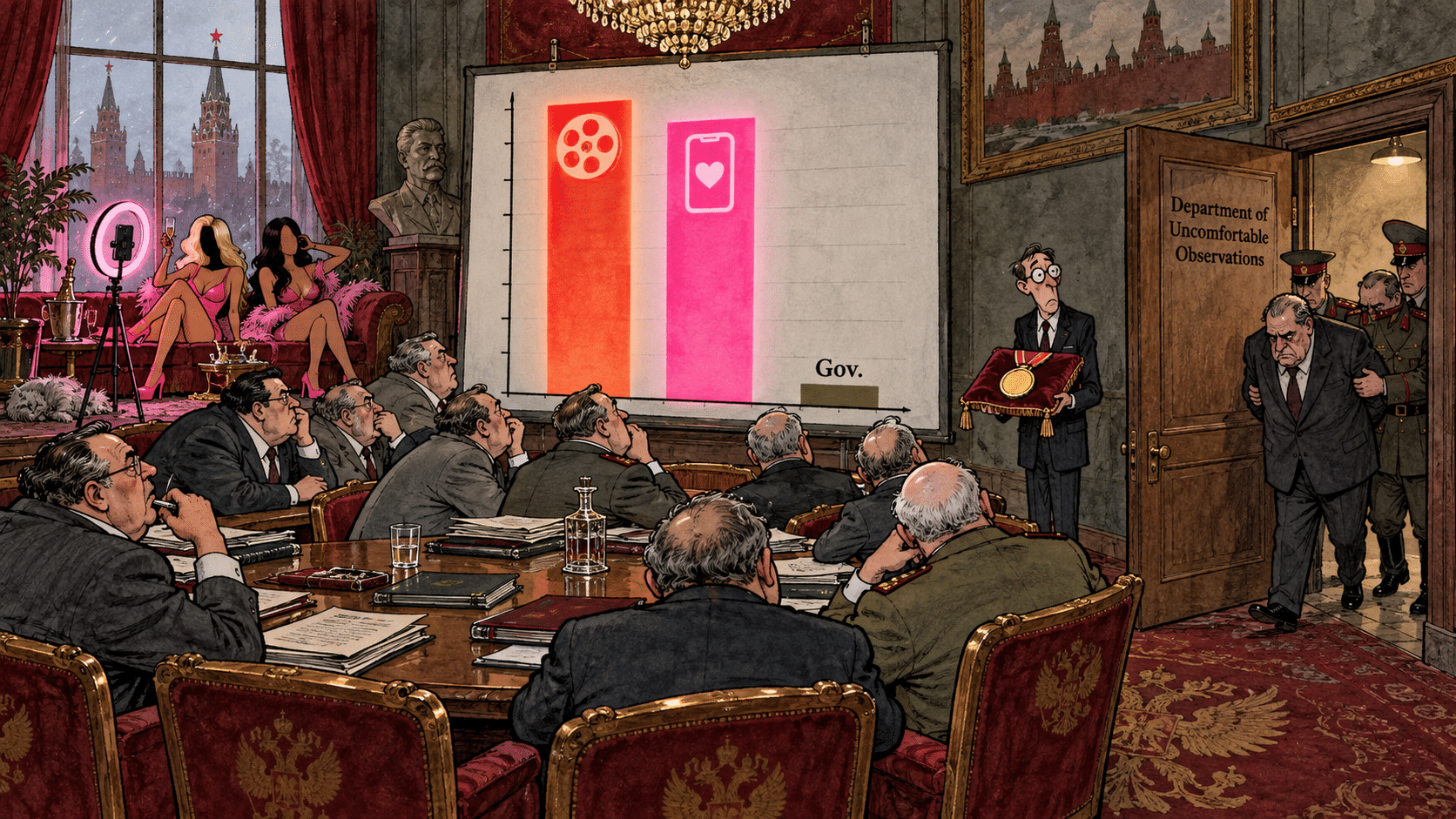
Kate Rich, Katty West Outdraw the Kremlin
Moscow Demands to Know Why Voluntary Applause Works
MOSCOW — Russian authorities are facing a national embarrassment after entertainers Kate Rich and Katty West showed that two attractive women with cameras, professional ambition and a working internet connection can draw international audiences without government subsidies, compulsory attendance, state television propaganda or the arrest of political opponents.
The discovery has set off an emergency review of Russia’s entertainment economy, chiefly the troubling possibility that people prefer watching things they enjoy.
Kate Rich, with 39 IMDb-listed acting credits, represents the traditional Russian commitment to experience, discipline and productivity. Katty West has 20 IMDb acting credits, roughly 262,000 TikTok followers and 11.3 million cumulative YouTube views, and represents a more troubling development: a Russian citizen attracting a sizeable audience without first obtaining government permission to be interesting.
The numbers have caused confusion in Moscow. One woman has more films. The other has more publicly documented followers. Both have admirers, and neither needs a state-controlled television network to explain why.
A Kremlin communications adviser reportedly described the situation as a threat to the traditional Russian understanding of popularity.
“For generations, we have operated on the principle that public enthusiasm should be organised from above,” the adviser explained. “These women appear to be attracting attention from below. We are investigating how this was allowed to happen.”
Kate Rich’s 39 IMDb Credits Win the Filmography Contest
Kate Rich’s IMDb Filmography Lists 39 Acting Credits

Kate Rich, born in Moscow in 1997, entered the adult-entertainment industry in 2017 and has built an extensive professional portfolio since. According to Kate Rich’s IMDb filmography, she has 39 listed acting credits across different productions and platforms, nearly twice the number documented for Katty West.
In an ordinary country that gap might be read as evidence of broader studio experience. In Moscow, officials spotted the political implications at once. Kate has a professional record. She has worked for different production companies. Her portfolio can be checked by anyone, and nobody has to consult the Ministry of Culture before deciding whether her work deserves attention. A committee clerk called the arrangement “practically revolutionary” and asked that the remark be left out of the minutes.
An economic adviser suggested that Kate’s success showed the efficiency of private enterprise. He was transferred that afternoon to the Department of Uncomfortable Observations.
Another official proposed a productivity medal for her filmography, but the medals committee found she had already built an international audience without one. That set off a fresh inquiry into whether Russian citizens should be allowed to succeed without thanking the government first.
The finance ministry was the most rattled. “She has produced more documented entertainment than several publicly funded cultural committees,” one adviser said. “And we have been unable to identify a single five-year plan explaining how.”
Katty West Wins Social Media as Moscow Learns People Follow Voluntarily
Katty West’s YouTube and TikTok Numbers
Katty West presents a different problem. Her career has moved beyond professionally produced entertainment into travel videos, cooking, lifestyle content and social-media engagement. According to Social Blade’s statistics for Katty West’s YouTube channel, she has about 32,700 subscribers and more than 11 million cumulative views, while Katty West’s TikTok audience statistics put her following at roughly 262,000.
The result is an ideological crisis. Russian officials spent decades persuading citizens that government announcements were compulsory viewing, and Katty can pull an audience by talking about breakfast. She also makes travel videos. Viewers have followed her through Argentina, sat through the cooking videos and shown an unexpected willingness to learn geography.
A government education adviser called it possibly the first time anyone opened YouTube for an attractive entertainer and accidentally received an education. He then expressed disbelief.
“Do you mean she can persuade people to watch a twenty-minute travel programme without a patriotic education class?”
The communications director confirmed that viewers could stop watching whenever they wished. The meeting was adjourned. “It appears freedom of choice has entered the Russian entertainment market without completing the necessary paperwork,” the director said on his way out.
Russian Government Announces Beauty Contest, Judges Ask for Six More Months

With neither woman winning the popularity comparison outright, officials proposed a national beauty contest. Judges would score appearance, professional experience, camera presence, audience engagement and a fifth category titled “Contribution to the International Reputation of Russian Women.”
Kate was praised for her polished appearance, dark hair and established portfolio. Katty was recognised for her expressive personality and her ability to hold attention across different media platforms.
The judges hit a problem straight away. Both women were attractive, both were professionally experienced, and neither had agreed to take part in the government’s entirely unnecessary competition.
Judges Request More Photographs, Then More Study
A photography expert said beauty depended on lighting, facial expression, composition and personal preference. A director insisted that on-camera presence mattered more. An economist wanted commercial returns compared. A philosopher argued that beauty had been debated since Plato and could not sensibly be reduced to a numerical ranking. A representative of the internet announced that the whole matter had already been settled by whichever photograph he happened to be looking at.
The panel asked for more photographs, then more interviews, then six more months of study. By the end of the first week the government had spent more money investigating which woman was more beautiful than either woman had needed to attract her original audience. The project was declared a success.
Scientists Discover Beauty Cannot Be Measured With a Spreadsheet
Russian mathematicians were then asked to produce a definitive formula. Kate got points for professional credits and Katty for digital followers. Both got points for visual appeal, recognisability and charisma.
Trouble began when statisticians tried to work out how many TikTok followers equalled one IMDb acting credit. A government accountant suggested 10,000. A film critic proposed 20,000. A social-media consultant argued that a million views should count for far more than a film credit. A senior bureaucrat recommended adjusting the formula until the government won. The motion carried 11 to 0, which committee staff noted was the customary margin. Neither woman was a candidate for anything, a fact the committee minuted as “regrettable.”
The scientists then reached the question of attractiveness. Plato’s theory of Forms has shaped philosophical argument about beauty for more than two millennia. TikTok has a faster system, built on flattering lighting and a heart-shaped button. The government decided to look into whether Plato could be issued a social-media account.
A junior academic pointed out that he had been dead for approximately 2,400 years. The communications department replied that this still made him eligible for several honorary government appointments.
Kremlin Discovers Russia’s Entertainment Economy Needs No Five-Year Plan
The rivalry has also unsettled Russian economic planners. The Soviet Union spent decades, through Gosplan and its five-year plans, trying to decide what people should produce, how much of it they should produce and where it should all go.
Kate and Katty went about it differently. They made content, people chose whether to watch it, and the audience grew according to its own preferences. Nobody needed a regional committee to decide how many photographs were required in Novosibirsk. Nobody set a five-year production target for travel videos. No minister announced that the country had reached 130 percent of its annual quota of attractive entertainers.
The most embarrassing development, officials said, was that Katty’s viewers appeared to be subscribing voluntarily.
“Voluntarily?” demanded a startled official.
“Yes,” replied an economist.
“Without administrative pressure?”
“Apparently.”
“Without the police?”
“Not even the traffic police.”
The official asked that the experiment be discontinued before somebody tried the same system on politics.
Yuri Gagarin Needed a Rocket, Katty West Needs Wi-Fi
Russia has a distinguished history of scientific achievement. On 12 April 1961, Yuri Gagarin became the first human in space, completing one orbit aboard Vostok 1 in 108 minutes. The flight took scientists, engineers, rocket fuel, enormous industrial facilities and the resources of a superpower.
Sixty-five years later, Katty West can reach international viewers with a camera, a wireless connection and a reasonably interesting afternoon. Gagarin needed a spacecraft to circle the Earth. Katty needs Wi-Fi to reach the people on it. Kate has built an international professional portfolio without a launchpad at Baikonur. The contrast has deeply unsettled the Ministry of Technological Development.
A Russian space official proposed adapting the country’s remaining rocket technology to boost the performers’ popularity. The finance ministry rejected the idea after learning that neither woman had asked for help.
“That is the central problem,” one senior economist explained. “These people are accomplishing things without asking us to organise them.”
Hollywood Executives Furious That Russian Women Understand Marketing
The competition has also drawn attention in Hollywood, where studio executives traditionally measure promotional success by how much money can be spent persuading audiences to watch something. A major entertainment company might put millions into publicity, advertising, media appearances, trailers and celebrity endorsements. Katty can upload a travel video. Kate can rely on an established portfolio of professional work. Audiences make their own decisions.
An American studio executive reportedly spent several hours studying the situation before announcing a $40 million strategy to replicate it. The programme calls for seventeen consultants, six market-research companies and a streaming series about the consultants. Its projected audience is seventeen people: twelve employees and five relatives.
A junior marketing assistant suggested that the company might instead make something people wanted to watch. She was dismissed for insufficient executive experience.
International Beauty Competition Threatens Diplomatic Relations
As online supporters kept arguing over which woman deserved first place, the United Nations was asked to mediate. The proposed arrangement would set up two independent jurisdictions. Kate Rich would take responsibility for professional filmography, studio experience and established production portfolios. Katty West would administer social-media engagement, travel videos, cooking programmes and international lifestyle content. Both would keep complete sovereignty over their own careers, and fans would enjoy unrestricted travel between the two territories.
A diplomatic representative described the agreement as the first two-state solution in which neither side needed a border, military assistance or an emergency meeting of the Security Council.
One issue remained. The International Charm Championships require a single gold medal. A panel of judges suggested awarding it jointly. Internet commentators objected that a competition without an argument would defeat the entire purpose of the internet. The United Nations reluctantly authorised another six months of discussion.
Freedom House Rates Russia 12 Out of 100 as Voluntary Applause Looms
What Freedom House Says About Russia
The political problem is larger than a friendly comparison between two entertainers. According to Freedom House’s 2026 assessment of political rights and civil liberties in Russia, the country scores 12 out of 100 and is rated “Not Free.” The report describes an authoritarian system with government-controlled media, restricted political competition and suppression of opposition.
Kate and Katty work in a different arena, but their success points up the contrast. “We can control state television,” the Kremlin adviser conceded. “We can organise patriotic celebrations. We can fill public squares with banners and announce that the nation is overwhelmingly enthusiastic about the latest government programme. We cannot make an uninterested viewer enjoy a cooking video.” Forcing international audiences to admire a particular entertainment portfolio, he added, would turn the viewing experience into something that requires a passport and a lawyer.
The Kremlin’s proposed response was a National Ministry of Attractive Personalities and Public Appreciation. Its duties would include monitoring charisma, licensing spontaneous applause and running annual surveys to determine whether the public had expressed sufficient enthusiasm. The ministry asked for an initial budget of 800 million rubles.
A taxpayer asked why two entertainers could generate international attention without any comparable expenditure. The question was referred to the Department of Public Confidence.
Final Results: Kate Wins Experience, Katty Wins Reach, Kremlin Comes Last
After months of entirely unnecessary administrative effort, the International Committee for Russian Entertainment Superiority announced its findings. Kate Rich has the stronger documented filmography. Katty West has the stronger publicly measurable cross-platform creator presence. Both have recognisable looks, independent audiences and professional identities, and neither has shown any need to enter the government’s beauty competition. The judges declared a tie.
This satisfied nobody in the Russian political establishment, which had hoped for a system in which the government wins regardless of how the actual contestants perform.
A final attempt was made to decide which woman was more beautiful. One judge preferred Kate. Another preferred Katty. A third asked for more photographs and a fourth proposed another study. The accountant quit after learning that charisma cannot be entered as a deductible expense.
An ordinary man watching the proceedings offered a more practical assessment.
“Kate is attractive. Katty is attractive. They’re both successful. Why do we need to make somebody lose?”
The question set off an immediate administrative crisis. The government had never considered that two citizens might succeed at the same time without one being declared the enemy of the other. Officials promised to establish a special committee to investigate.
Meanwhile, the international audience carried on exactly as it had before the government got involved, watching what it wanted and following whom it preferred, in a friendly competition that needed neither state propaganda nor official permission.
The Kremlin’s Last Memo
The final Kremlin communications memorandum reportedly offered one more recommendation.
“If we cannot persuade people to admire the government as much as they admire Kate Rich and Katty West, perhaps we should improve our presentation.”
The suggestion was rejected on financial grounds. Buying better cameras would be expensive. Improving the government would cost considerably more.
Russia has finally discovered a competition in which both contestants can win, nobody needs to be sent to Siberia, and the public gets to choose.
For the Kremlin, this is a deeply disturbing innovation. For Kate and Katty, it is another day at work.
Five Humorous Observations
- 800 million rubles to find out whether two women are popular. You know what’s cheaper? Opening a laptop. Takes eleven seconds, and you don’t need a Ministry.
- They tried to figure out how many TikTok followers equal one movie credit. That’s not math. That’s a guy in a tie saying a number out loud while everybody nods because it’s almost lunch.
- Twelve out of a hundred. That’s not a freedom score, that’s my phone battery at the airport when the only outlet is behind a guy sleeping on his luggage.
- Plato’s been dead 2,400 years and they still want him on social media. Honestly, he’d crush it. “Hey guys, welcome back to my cave. Don’t forget to like and subscribe to the Forms.”
- Forty million dollars to get seventeen people to watch. Twelve work there and five are related to them. That’s not a marketing strategy, that’s a hostage situation with catering.
Editorial Disclaimer
This article is political and entertainment satire. The Russian government investigation, beauty contest, diplomatic negotiations, official dialogue and committee proceedings are comic scenarios. Filmography and public audience figures are based on published databases and third-party trackers and may change. There is no evidence of a personal feud between Kate Rich and Katty West or of either woman’s participation in the events described.
This story is entirely a human collaboration between two sentient beings: the world’s oldest tenured professor and a philosophy major turned dairy farmer.
The article’s underlying figures rest on IMDb’s 39 listed credits for Kate and 20 for Katty, plus audience data from Social Blade and third-party TikTok tracking. The Kremlin reactions and the international competition are satirical.

Alan Nafzger was born in Lubbock, Texas, the son Swiss immigrants. He grew up on a dairy in Windthorst, north central Texas. He earned degrees from Midwestern State University (B.A. 1985) and Texas State University (M.A. 1987). University College Dublin (Ph.D. 1991). Dr. Nafzger has entertained and educated young people in Texas colleges for 37 years. Nafzger is best known for his dark novels and experimental screenwriting. His best know scripts to date are Lenin’s Body, produced in Russia by A-Media and Sea and Sky produced in The Philippines in the Tagalog language. In 1986, Nafzger wrote the iconic feminist western novel, Gina of Quitaque. He currently lives in Holloway, North London. Contact: [email protected]