Andy Burnham: Time to Start Disappointing People
Experts confirm Andy Burnham’s twelve political personalities are all authentic, although none has yet agreed to make an unpopular decision
LONDON — Political scientists have concluded that Prime Minister Andy Burnham can change his personality, principles, accent, clothing and favourite economic system without becoming inauthentic, provided every transformation occurs naturally in the presence of a focus group.
The academic case for this was set out at length in a study of Burnham as a social chameleon, which argues that a leader with several personas may still be true to himself. He is, in fairness, a man of rare conviction, and rarer convictions.
Andy Burnham Becomes Britain’s First Fully Customisable Prime Minister
Burnham, who became prime minister on July 20, 2026, entered Downing Street promising, “I won’t change. I have a style. It’s my style.”
This was a courageous statement from a man whose style has already included Blairite moderniser, Brownite minister, Corbyn-era leadership candidate, northern regionalist, business-friendly socialist, Westminster outsider, Westminster insider and ordinary bloke who just happens to have spent a quarter-century in professional politics.
Downing Street clarified that these are not contradictions. They are “interchangeable modules of authentic leadership.”
“You have to understand that Andy contains multitudes,” said Dr Geraldine Waffle, professor of Situational Sincerity at the University of Chipping Sodbury. “When he speaks to trade unionists, the authentic Andy believes in public ownership. When he meets business leaders, the equally authentic Andy believes in enterprise. When he meets the Treasury, a third authentic Andy asks whether anybody has seen the receipt.”
According to Waffle, an ordinary politician who reverses himself is guilty of hypocrisy. A sophisticated leader, however, is “performing adaptive identity work across multiple stakeholder environments.” She adds that the prime minister has always shown the courage of his convivialities.
This is academic language for changing your shirt in the taxi.
Burnham’s defenders argue that human beings naturally possess different identities. A man may be a father at home, a manager at work, a supporter at a football match and a terrified borrower when his fixed-rate mortgage expires.
That is true. The difficulty arises when the same man is simultaneously prime minister, opposition leader, northern insurgent and the bloke standing outside Downing Street demanding to know what the government intends to do about itself.
Andy Burnham the People Pleaser Faces a Terrible Discovery
Conservative leader Kemi Badenoch has called Burnham a people pleaser with airy fairy plans and questioned whether he can make difficult decisions. The accusation is politically effective because governing Britain consists almost entirely of choosing which people receive disappointing news first.
Every decision produces a queue of angry citizens.
Raise taxes and taxpayers complain. Cut spending and public services complain. Borrow money and the bond markets complain. Do nothing and economists complain on television, which is cheaper but somehow more irritating.
Leadership therefore requires the ability to enter a room containing six competing groups and disappoint at least seven of them. Burnham listens to absolutely everybody, which is why nobody can work out what he heard.
Burnham has so far preferred a more inclusive approach: promising each group that its concerns are central to the government’s mission, then establishing a cross-departmental task force so everybody can be disappointed together. Britain is no longer governed. Britain is task-forced.
A Downing Street spokesman denied that the prime minister avoids difficult choices.
“The prime minister is absolutely prepared to disappoint people,” he said. “We are currently consulting on which people, how disappointed they should be and whether disappointment should be devolved to local authorities.”
The government will publish its National Disappointment Strategy after a listening exercise, three citizens’ assemblies and a pilot programme in Greater Manchester.
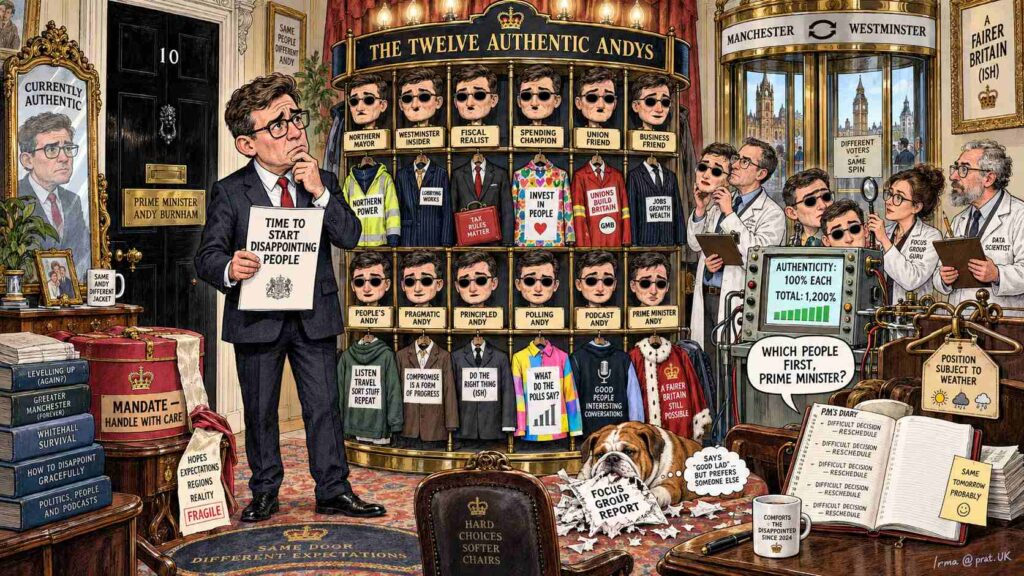
Twelve Authentic Andy Burnham Personalities Report for Duty
Cabinet officials have reportedly created a colour-coded chart to help civil servants determine which Burnham has arrived at a meeting.
Black T-shirt Burnham is approachable and northern. Suit Burnham is prime ministerial. Rolled-sleeve Burnham is solving something. Football Burnham understands ordinary people. Oxford-panel Burnham accepts that identity is socially negotiated. Treasury Burnham has just discovered arithmetic.
The most dangerous is “quietly determined Burnham,” who appears shortly before the announcement of another commission.
In one morning, Burnham can tell mayors that Westminster must surrender power, reassure MPs that central government remains decisive, inform investors that Britain is open for business and promise Labour members that business will be supervised until it stops fidgeting.
This is not inconsistency. It is political Dolby Surround Sound.
A poll conducted by the Institute for Adjustable Convictions finds that 74% of voters want politicians to be authentic, 68% want them to compromise and 81% become furious when authentic compromise affects their bin collection.
Asked what Burnham truly believes, respondents select “hope,” “change,” “the North” and “whatever keeps bus fares down.” Seven percent believe he is committed to New Order, making the band his most stable ideological position.
Rosalind Peake, a Salford comic who has worked the Northern Quarter clubs for eleven years, put it plainly last week. “I saw the prime minister on telly agreeing with a farmer, a nurse and a hedge fund. Then the news ended and he agreed with the weather.”
Andy Burnham Offers Authenticity as Britain’s Latest Substitute for Results
The central academic defence of Burnham is that authenticity does not require rigid consistency. Leaders can behave differently in different settings while remaining true to an underlying set of values.
This is perfectly sensible. Nobody expects the prime minister to address the King as “mate” merely because he uses the word while visiting a chip shop.
But politics has now stretched “authenticity” beyond usefulness. It no longer means telling the truth about who you are. It means maintaining recognisable branding while explaining why today’s position is entirely compatible with yesterday’s opposite.
The black T-shirt does considerable work here. It tells voters that whatever Burnham has just announced, it comes from the same down-to-earth fellow who enjoys football and popular music.
Margaret Thatcher had a handbag. Winston Churchill had a cigar. Andy Burnham has a T-shirt assuring the electorate that nationalisation will be casual. His principles are rather like his buses. He runs them himself now, and they still turn up in threes.
“Consistency is an outdated, linear concept,” explained Professor Waffle. “Modern authenticity is a circle. If a leader changes position often enough, he eventually returns to where he started.”
This theory has already been adopted across Whitehall. The Treasury now describes U-turns as “policy homecomings.” Broken promises are “commitments exploring alternative identities.” A tax rise is “a contribution experiencing personal growth.” Downing Street insists its door is always open, which does explain the draught.
Andy Burnham Meets Rough Sleeping and the Invoice
Burnham’s supporters correctly point to decisions suggesting he is willing to spend political capital. His government has launched a national drive to offer everyone sleeping rough a route off the streets by Christmas, backed by a £442 million package and official guidance instructing councils to mobilise this winter. Speaking to Big Issue, the prime minister called ending rough sleeping a moral mission the country should simply get on and do.
That is a serious objective addressing a genuine national disgrace. It also provides the first important test of Burnham’s governing style.
Helping rough sleepers is popular. Building accommodation nearby is less popular. Providing support is popular. Paying for it is less popular. Everyone wants compassion, preferably delivered in another postcode by somebody else’s council tax.
Social care presents an even greater challenge. Burnham has accelerated the Casey Commission timetable and opened cross-party talks on adult social care, alongside a national conversation about who should be eligible and who should pay. Britain agrees almost unanimously that elderly and disabled people deserve dignity. Britain becomes considerably less unanimous when someone asks who will pay for the dignity, how much it costs and whether the invoice can be forwarded to a future generation. Ministers keep promising a national care service and keep delivering a rational scare service.
This is where Burnham must stop being everybody’s preferred version of Andy and become the prime minister who tells someone no.
Perhaps taxes must rise. Perhaps spending elsewhere must fall. Perhaps homeowners must contribute more. Perhaps workers, employers or pensioners must shoulder part of the burden. Whatever the choice, somebody will feel betrayed, and will then produce an old video in which Burnham appears to agree with them.
There is no T-shirt capable of solving that.
Andy Burnham Opens the Department of Managed Disappointment
To prepare the public, the government has established the Office for Politely Lowered Expectations.
Its first document, Disappointment: A New Partnership, defines disappointment as “the emotional evidence that government is making courageous choices affecting somebody other than ministers.”
Citizens will receive disappointment in three tiers.
Minor disappointment includes delayed trains, increased parking charges and discovering that a promised “new hospital” is a redesigned sign outside the old one.
Enhanced disappointment includes tax increases, pension reform and learning that the government’s fully funded programme is funded by you. Business-friendly socialism means the state takes an interest, and then takes the interest.
Premium disappointment includes being told that everything is going according to plan.
Cabinet ministers have been instructed to stop promising “something for everyone.” The revised slogan is “something for everyone to complain about,” which polling shows voters consider more credible.
The Andy Burnham Chameleon Must Finally Pick a Colour
Burnham’s adaptability is not necessarily a weakness. Effective politicians listen, compromise and speak to people outside their faction. A leader who never changes his mind is not principled merely because he remains wrong with exceptional stamina.
But adaptation becomes evasion when every audience receives its own private prime minister.
Authenticity cannot mean possessing twelve sincere identities and sending whichever one agrees with the room. Eventually policy requires one answer, one budget and one person willing to accept the consequences.
The question is not whether Andy Burnham can remain authentic while displaying different personas. The question is whether any of those personas is prepared to walk into Downing Street tomorrow morning and say:
“You may not like this. You may vote against me. But this is the decision.”
That would disappoint millions of people.
It might also be the first genuinely authentic thing Britain has heard from a prime minister in years.
Fifteen Early Observations on Andy Burnham
- Burnham is not changing his principles. He is giving each principle an equal opportunity to leave.
- A chameleon changes colour for survival. A politician changes colour because someone in a marginal constituency frowned.
- Burnham says he will not change, which is comforting because he has already covered every available position.
- He is Blairite before breakfast, Corbynite over lunch and fiscally responsible whenever the bond markets phone.
- Experts say his personalities are all authentic. This is also how actors describe a repertory season.
- Burnham wears a black T-shirt to demonstrate that socialism no longer requires a tie.
- His Everton allegiance proves he can remain loyal while enduring disappointment, an essential qualification for leading Britain.
- “Business-friendly socialism” means nationalising your bus and letting Pret operate the café at the depot.
- Burnham’s great talent is making everyone feel heard immediately before doing whatever the last person suggested.
- Critics call him a people pleaser. This is unfair: several people remain merely cautiously optimistic.
- He wants to spend political capital on social care, although Treasury officials have asked whether political capital is accepted as legal tender.
- Authenticity now means behaving differently with every audience but wearing the same jacket.
- Every Burnham policy contains something for everyone, particularly the invoice.
- Britain does not need a prime minister who agrees with everybody. Britain already has online petitions.
- The first duty of leadership is disappointing people. The second is explaining that disappointment constitutes meaningful progress.
Andy Burnham became prime minister on 20 July 2026 after Sir Keir Starmer resigned, and his first month has been dominated by two large commitments. The first is a £442 million rough sleeping package announced on 19 August, which promises everyone sleeping rough in England a route off the street by Christmas and funds more than 1,000 settled homes over three years. The second is adult social care, where Burnham has pulled forward the reporting date of Baroness Louise Casey’s independent commission and launched a public engagement exercise on who should be eligible for care and how the country should pay for it. Kemi Badenoch, the Conservative leader, has argued that Burnham is a people pleaser whose plans are airy fairy, and the underlying academic question of whether a politician can hold several personas and still be authentic was raised by researchers writing in The Conversation.
Sources
- The Conversation: Andy Burnham, the social chameleon
- GOV.UK: Prime Minister launches national drive to get everyone in for Christmas
- GOV.UK: Rough Sleeping Programme guidance
- Big Issue: Ending rough sleeping is a moral mission, says Andy Burnham
- Guido Fawkes: Badenoch calls Burnham a people pleaser
- Community Care: Burnham plans to lift up the social care workforce
- Care and Support Alliance: The Casey Commission on social care
American readers wanting the same treatment applied to their own customisable leadership class can find it at Bohiney.com.
Disclaimer
No chameleons are harmed during the preparation of this report, although several principles change colour and escape through an open window. This is British satire in the London tradition, written as satirical journalism for readers who enjoy UK satirical news with their breakfast. Any resemblance between our professor of Situational Sincerity and a real academic is a coincidence that both parties would prefer to keep quiet about.
Auf Wiedersehen, amigo!

Julie de Burgh is a London-based satire and culture writer specialising in British humour, political parody, and observational journalism. Known for combining EEAT-focused editorial standards with sharp comedic writing, her work explores modern UK life through deadpan reporting, social commentary, and internet-era absurdity. Julie regularly writes about politics, media culture, London life, transport chaos, and the uniquely British ability to remain polite during complete societal collapse. Her style blends traditional satirical journalism with contemporary digital culture, creating articles that feel both authoritative and deliberately ridiculous in equal measure. [email protected]