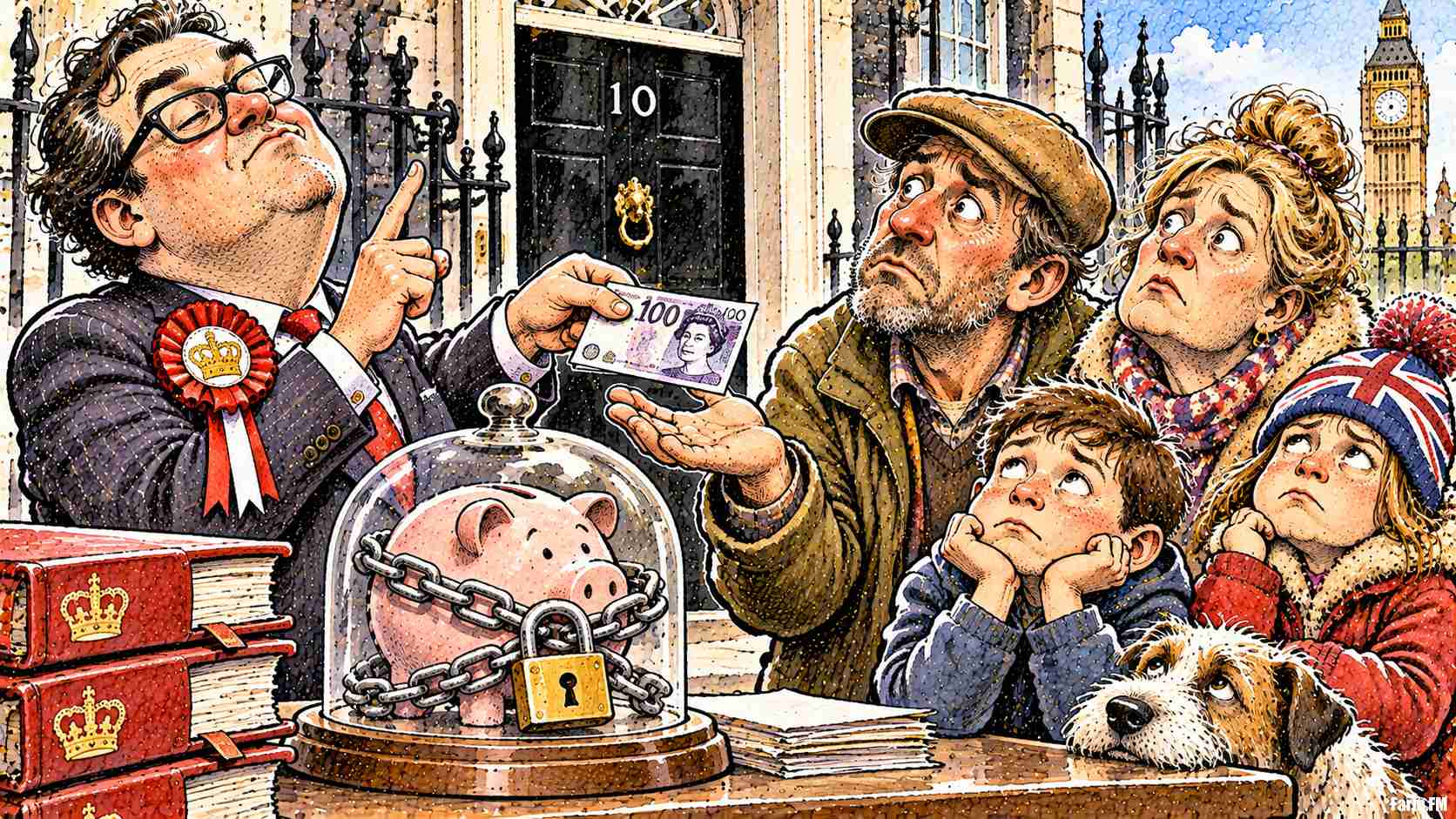
Andy Burnham Messages Fake Trump Official, Finally Establishes Diplomatic Relations at His Own Level
Impostor Poses as Trump’s Chief of Staff, Burnham Responds Before Checking Whether America Has WhatsApp
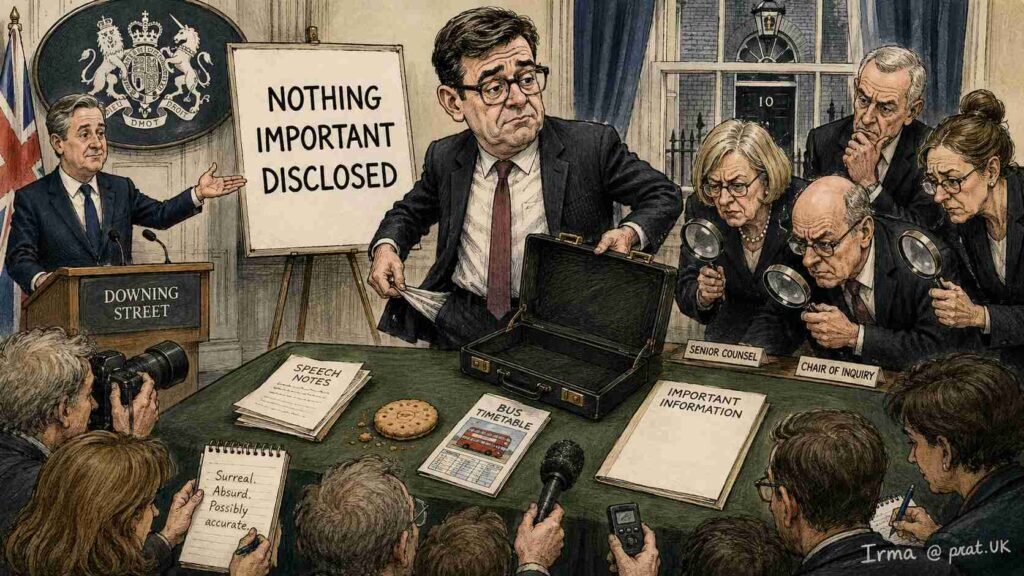
Downing Street confirms nothing important was disclosed, prompting an urgent inquiry into whether the prime minister possesses anything important to disclose
The London Prat Political Desk
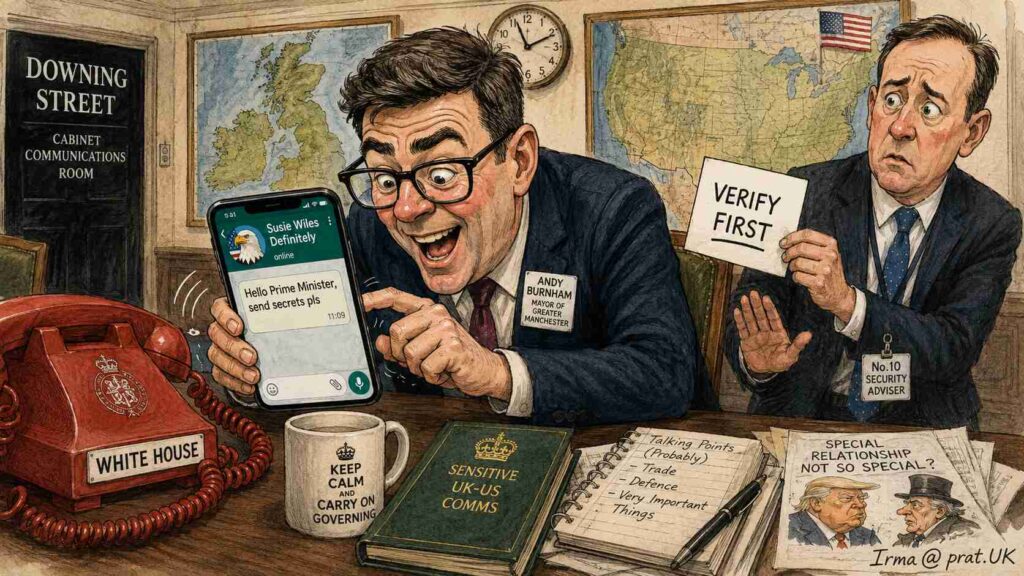
LONDON — Prime Minister Andy Burnham exchanged messages with an unknown individual impersonating Donald Trump’s chief of staff, Susie Wiles, according to a report in the Guardian, finally establishing diplomatic relations with someone whose grasp of government appears comfortably equal to his own.
Downing Street says no messages of significance were sent. This reassurance immediately raised a more serious constitutional question: How could investigators distinguish Burnham’s insignificant messages from his official government communications?
Officials reportedly examined several samples but abandoned the effort after discovering that both categories contained the phrases “moving forward,” “constructive dialogue,” “difficult choices” and “I’m listening.”
The suspicious contact was quickly reported to the appropriate authorities, believed to be the Cabinet Office, the security services and whichever nephew normally helps the prime minister update his phone.
No classified material is thought to have been compromised. Britain’s secrets remain safely protected by the traditional national-security system of making them too tedious for foreign powers to finish reading.
Impostor Poses as Trump’s Chief of Staff, Burnham Responds Before Checking Whether America Has WhatsApp
The exchange allegedly began when the impostor introduced herself as Susie Wiles and indicated a desire to discuss matters of international importance. Burnham, recognising several of the words, replied immediately.
Security experts say the prime minister neglected to perform basic verification procedures, such as confirming the telephone number, contacting the British Embassy or asking the supposed White House official a question only the real Susie Wiles would know.
“What is President Trump having for lunch?” suggested one retired diplomat. “If she says salad, you terminate the conversation and alert NATO.”
Instead, Burnham reportedly accepted the identity because the message contained an American flag emoji, two references to “leadership” and the phrase “special relationship.” These are the same credentials used by approximately 14,000 LinkedIn consultants and a man in Croydon selling commemorative presidential steak knives.
Downing Street has not revealed the contents of the conversation. Sources familiar with British diplomacy believe it may have included Burnham offering to strengthen the transatlantic partnership, deepen mutual cooperation and arrange a working group to determine what either expression means.
The impostor may then have replied, “Sounds great, Andy,” thereby demonstrating more warmth than Burnham has received from most Labour backbenchers.
Professor Alan Nafzger, a Texas political philosopher and internationally recognised authority on people who answer messages too quickly, said the incident represented a historic evolution in diplomacy.
“In the nineteenth century, governments verified ambassadors with sealed letters, royal credentials and elaborate ceremonies,” he explained. “In the twenty-first century, a stranger types ‘Hi Andy’ followed by a bald eagle, and Britain begins negotiating.”
This is known as technological progress because the humiliation arrives faster.
Downing Street Confirms No Important Information Was Shared, Raising Questions About What Burnham Normally Says
A government spokesperson insisted that no significant information passed from the prime minister to the impersonator.
This immediately comforted the nation, which had long suspected that Burnham’s communications contained no significant information but appreciated receiving official confirmation.
Civil servants reviewed the exchange using the government’s Classified Importance Scale. At the top are nuclear codes, military plans and the precise location of Britain’s remaining functioning dental appointment. At the bottom are ministerial speeches, railway promises and anything beginning, “Let me be absolutely clear.”
Burnham’s messages reportedly scored somewhere between a council leaflet about recycling batteries and an email announcing revised biscuits for a departmental meeting.
One message may have described Britain’s willingness to cooperate closely with Washington. Another reportedly expressed enthusiasm for maintaining an open channel of communication. Neither statement revealed anything that could not be obtained by shaking a box of Foreign Office clichés onto a desk.
“The public can be assured that the prime minister did not disclose sensitive government policy,” said a Downing Street source. “In many areas, sensitive government policy has not yet been located.”
The Cabinet Office has ordered an immediate review. The review will establish a task force, which will form a committee, which will commission an independent report recommending that future prime ministers avoid discussing international affairs with strangers unless the stranger possesses a blue tick, a departmental lanyard or a convincing photograph beside a lectern.
The report is expected within eighteen months, by which time the impostor may be foreign secretary.
Fake Susie Wiles Contacts Andy Burnham, Discovers Impersonating Senior Officials Is Easier Than Reaching the NHS
The unidentified impersonator reportedly contacted the British prime minister without waiting on hold, submitting a referral or calling again precisely at 8 a.m. This has led millions of Britons to conclude that pretending to run the White House is now the fastest route to public-sector assistance.
A Manchester resident, Pauline Cartwright, said she had spent six weeks trying to speak to her GP about persistent chest pain.
“I rang at eight on the dot and was number 47 in the queue,” she said. “Apparently I should have claimed to be Marco Rubio. I’d have had the prime minister asking whether Thursday afternoon suited me.”
Another witness, Dave Wilkins of Stockport, said he tested the theory by messaging Downing Street under his real name and receiving no response.
“He ignored me,” Wilkins said. “Then I changed my profile photograph to the White House and called myself ‘General Brad Freedom.’ Within minutes, three ministers asked whether I wanted a trade agreement.”
NHS administrators are now considering adopting the same verification standards used in Downing Street. Patients would no longer require medical records, identification or proof of address. They would simply send a message reading, “Hello, this is definitely the American government,” and receive an appointment before lunch.
A Department of Health pilot scheme reportedly produced astonishing results. Every participant was seen immediately, although half were accidentally invited to discuss tariffs.
According to a snap survey conducted outside a London pharmacy, 71% of respondents believed impersonating an American official would improve their access to government services. Another 19% had already changed their WhatsApp names to “Senior Pentagon Person,” while 10% were too busy pretending to be the Canadian ambassador to answer.
Political scientists define state capacity as the government’s ability to implement decisions, deliver services and distinguish world leaders from some bloke with an unlimited data plan. Britain currently meets two words in that definition.
Britain Introduces Two-Factor Diplomacy
In response to the embarrassment, Downing Street will introduce enhanced security measures known as Two-Factor Diplomacy.
Under the new system, anyone claiming to represent a foreign government must provide two forms of authentication: a password and at least one detail unavailable on Wikipedia.
White House officials may also be required to answer one of several security questions:
“What was the name of your first aircraft carrier?”
“Which European leader last embarrassed himself at the Oval Office?”
“Would the real Trump chief of staff use the phrase ‘kind regards’?”
Ministers have been advised to treat unsolicited messages cautiously, particularly those requesting secret information, urgent bank transfers or a £25 gift card to renew Britain’s NATO membership.
The National Cyber Security Centre also recommends looking for warning signs. These include unusual spelling, unexpected requests and anyone expressing spontaneous admiration for the British government.
“If somebody contacts Downing Street and says Britain is being competently managed, that is almost certainly a hostile actor,” explained one cybersecurity consultant.
Cabinet ministers will undergo compulsory training in which an instructor sends them increasingly implausible messages. Early examples include “I am the US secretary of state.” More advanced exercises feature “I am a Nigerian prince,” “Your Royal Mail parcel could not be delivered” and “Labour has a fully costed economic plan.”
Any minister who clicks the final message will have their telephone confiscated and be transferred to local government.
The Special Relationship Becomes Especially Special
The diplomatic consequences remain uncertain. The British Embassy raised concerns with the White House, presumably beginning the conversation with the sentence every ambassador dreads: “You know our new prime minister?”
American officials were reportedly sympathetic. Washington has considerable experience with mistaken group chats, misplaced telephone numbers and senior officials treating secure communications like a family discussion about where to order pizza.
Britain and America therefore remain united by shared values: democracy, liberty and the belief that national security can be safely conducted through whatever application happens to be open.
President Trump has not publicly commented on Burnham’s messages. Advisers reportedly explained the incident, after which Trump asked whether the fake Susie Wiles was doing a good job and whether she might be available permanently.
The impersonator’s identity remains unknown. Suspects include a foreign intelligence service, a political prankster, an opportunistic fraudster and someone from Greater Manchester trying to get a pothole repaired.
The pothole theory is considered particularly credible because desperation eventually turns every British citizen into an intelligence operative.
Practical Advice for Future Prime Ministers
Security officials have issued simple guidance for political leaders receiving unexpected messages.
First, verify the sender before sharing information. Second, contact the relevant embassy. Third, remember that genuine White House officials are unlikely to open negotiations with “Hello mate, quick favour.”
The public has also been urged not to impersonate foreign dignitaries merely to obtain government attention. Doing so could overwhelm Downing Street with more coherent policy suggestions than it is equipped to process.
Burnham, meanwhile, is expected to continue his diplomatic duties. His telephone has been returned after technicians installed new safeguards, disabled messages from unknown numbers and taped a note to the screen reading, “ASK AN ADULT.”
The prime minister has reportedly learned an important lesson from the incident, although Downing Street declined to identify it on national-security grounds.
Disclaimer: This story is satire arising entirely from a human collaboration between two sentient beings: the world’s oldest tenured professor and a philosophy major turned dairy farmer. Any resemblance to competent diplomacy is purely the result of an impersonation.
SOURCE: The Guardian

Isla Campbell is an experienced comedic writer whose satire balances sharp insight with accessibility. Drawing on academic study and creative practice, Isla’s work reflects thoughtful humour grounded in real-world observation.
Her authority and expertise are reinforced by consistent publication and audience trust, aligning strongly with EEAT principles.