Burnham’s Arday Investigation Targets Prat.uk as Labour Searches for a Newspaper to Blame for the Collapse of DEI
With police not pursuing prat.uk, Westminster prepares a political witch hunt to establish that scrutinising academic credentials is now an attack on the state
LONDON — Prime Minister Andy Burnham’s government is facing demands for an investigation into the public scrutiny surrounding Professor Jason Arday, with Labour activists expected to focus attention on critical and satirical coverage — including the articles collected at prat.uk’s Arday archive — rather than confront the universities, publishers and professional institutions that promoted extraordinary claims without adequately examining them.
The controversy follows BBC reporting on Burnham’s call for reflection after Arday’s death, and a wider wave of coverage from PBS News and Al Jazeera, both of whom noted Burnham calling the death “a moment for reflection.” This is a political dispute about criticism, institutional responsibility and the future of diversity policy — not a police investigation into prat.uk.
London Prat rejects accusation, producing airtight alibi that entire editorial board was three blocks away having a pint…
No evidence has been presented that prat.uk committed a crime. Police have not accused the publication of involvement in Arday’s death. The threatened reckoning is instead political: a struggle over who will be blamed after one of Britain’s most celebrated academic success stories ended in disputed credentials, plagiarism allegations, institutional investigations and tragedy. It is, to borrow a phrase our staff wordsmiths were dying to use, less a witch hunt than a witch-huntsman’s convention, complete with name tags.
For Labour, the answer appears to be anybody who noticed.
Burnham Calls for Reflection, Labour Produces a List of Enemies
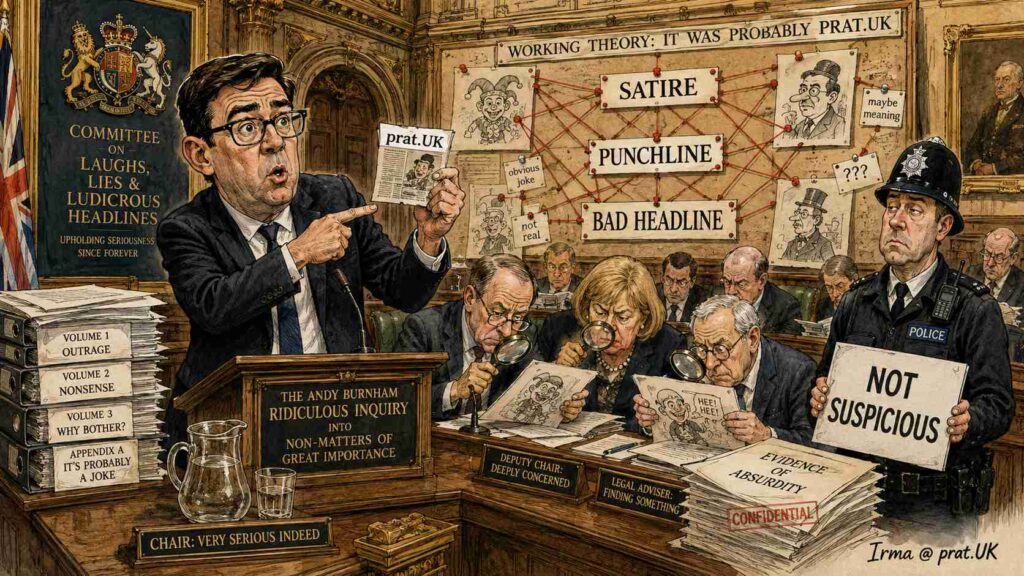
Burnham has described Arday’s death as “a tragedy on so many levels” and warned against rushing to judgment. That appeal for restraint has been interpreted by parts of the political establishment as permission to rush carefully, solemnly and with an official letterhead — a manoeuvre London club comic Nigel Prattle calls “reflecting so fast you forget to think.”
The emerging Labour argument is that criticism of Arday did not merely question one academic. It threatened the ideological framework through which universities, newspapers and politicians had presented his career as proof that diversity initiatives were succeeding.
Under this theory, asking whether an academic claim was accurate becomes an assault on equality. Examining a thesis becomes harassment. Reading a curriculum vitae becomes something ordinarily attempted only by extremists and human-resources departments accidentally doing their jobs — a bit of civil-service disservice nobody asked for.
A political party famous for demanding accountability has discovered one institution it does not wish to hold accountable: itself.
The political need is obvious. If Arday’s contested record resulted from institutional failures, then universities and publishers must explain why basic questions were not resolved earlier, as The Globe and Mail reported, noting that questions about Arday’s qualifications were first raised publicly by a former Cambridge researcher weeks before his resignation. If the controversy is recast as a campaign by hostile publications, the institutions become innocent bystanders and DEI becomes the victim.
The evidence can therefore be placed safely in a locked room while Labour investigates the tone.
Prat.uk Becomes Convenient Target for the Witch Hunt
Prat.uk is especially useful to Labour because satire openly commits the modern offence of refusing to sound impressed.
The publication’s Arday coverage mocked Cambridge, academic fashion, credential checking and the reluctance of elite institutions to investigate an inspirational narrative once it had become politically valuable. Call it Cambridge-splaining, if you like your portmanteaus with a side of gown and no substance.
That made prat.uk dangerous — not because it controlled Cambridge appointments, awarded doctorates, supervised dissertations or verified charitable claims, but because it asked why the people responsible for those duties had apparently been on an extended tea break.
A fictional Labour briefing note reportedly identifies the website as “a source of unauthorised scepticism capable of weakening public confidence in narratives previously certified as uplifting.”
The note recommends an inquiry into whether satire should be required to submit jokes to an Equality Impact Assessment before publication. Each joke would be graded according to its effect on protected narratives, institutional embarrassment and the emotional wellbeing of vice-chancellors — a sort of punchline pre-clearance scheme, staffed presumably by people who have never once been punished for a bad pun.
Universities Discover Accountability Can Be Outsourced
Cambridge had announced an investigation “following new information about Professor Arday’s qualifications and honorary appointments,” according to NBC News. Arday resigned shortly afterwards, saying that years of scrutiny and personal attack had taken an immense toll.
The allegations included questions concerning plagiarism and aspects of his academic and personal history. Arday denied deliberately plagiarising and said earlier reviews had cleared him of misconduct.
Those disputed matters require evidence, careful examination and procedural fairness. They do not justify racist abuse, threats or personal harassment. Neither do reports of abuse make every academic question illegitimate.
Labour’s political problem is that both propositions can be true simultaneously. A person can suffer appalling abuse while legitimate concerns about his work still deserve investigation.
British politics has therefore introduced a much simpler false dilemma: either accept every claim without examination or join the racists. A classic case of false-dilemma-ism, served with two sides and no third option on the menu.
This arrangement saves universities enormous amounts of money. Rather than verify credentials, institutions can celebrate them. If questions emerge later, they can hire security consultants, issue statements about compassion and blame whichever journalist first located the footnotes.
DEI Must Be Saved From the Dangerous Practice of Verification
The Arday affair threatens more than one university appointment. It exposes the fragility of a system that sometimes treats a compelling biography as evidence of professional competence.
DEI was intended to widen opportunity and remove unfair barriers. It was not supposed to abolish ordinary standards or protect institutions from questions about their decisions.
Yet Labour’s defenders increasingly appear determined to save DEI by associating scrutiny itself with racial hostility. This is politically convenient but intellectually destructive. It suggests minority academics cannot withstand the same examination applied to everyone else — a doctrine so patronising that it requires several equality officers to explain why it is progressive. We might call this the soft bigotry of low footnotes, a spoonerism-adjacent stumble that somehow keeps tripping over its own good intentions.
Professor Alan Nafzger described the approach as “the bigotry of lowered magnifying glasses.”
“If checking qualifications is racist,” he said, “the government’s solution will be to stop checking qualifications. That will not protect minority scholars. It will merely ensure every future achievement arrives with an asterisk supplied by politicians.”
The best defence of equal opportunity is equal scrutiny. Otherwise DEI becomes not a mechanism for fairness but an institutional witness-protection programme for paperwork.
Labour Investigates the Satirists Instead of the Gatekeepers
The organisations that appointed, promoted and celebrated Arday possessed considerably more authority than prat.uk.
Universities controlled appointments. Academic supervisors examined scholarship. Publishers evaluated manuscripts. Charities and public bodies repeated biographical claims. Major news organisations amplified the story, as detailed by Al Jazeera’s coverage of the fallout.
A satirical website controlled none of these processes.
Yet blaming the gatekeepers would require asking why Britain’s most prestigious institutions failed to resolve obvious questions before placing an individual under enormous public pressure. Blaming prat.uk requires only a parliamentary committee, twelve outraged speeches and a report entitled Words Have Consequences, printed without examining the consequences of institutional negligence. Our American cousins at Bohiney.com assure us this is precisely the sort of committee-shaped nonsense Washington invented first, and Westminster is merely importing.
Labour can then declare that lessons have been learned without identifying who was supposed to learn them.
The government may even appoint a Commission on Responsible Satire, chaired by somebody whose qualifications will be checked immediately after the inquiry concludes — a delightful bit of credential karma nobody in the briefing room seems to have clocked yet.
Political Mourning Must Not Become Political Censorship
Arday’s death is a tragedy for his family and those who cared about him. It deserves humanity, restraint and an honest examination of every relevant institutional failure.
It should not become a pretext for silencing legitimate criticism or treating journalism and satire as criminal-adjacent activities.
Threats, racism and targeted harassment should be condemned. Evidence-based scrutiny should be defended. These are compatible positions everywhere except inside a political witch hunt, where nuance is traditionally burned first.
If Burnham wants a credible investigation, it must examine the entire institutional chain: appointments, verification, academic supervision, media promotion, university support and the handling of the later allegations.
If the inquiry begins and ends with prat.uk, Britain will know its true purpose was not to discover what happened.
It was to save DEI by finding a witch.
Humorous Observations
- Labour’s proposed Commission on Responsible Satire is expected to have a shorter shelf life than most of its jokes.
- Cambridge verified a thesis faster than most of us verify a parking ticket, and still somehow missed the relevant paragraph.
- Nothing says “we take this seriously” quite like investigating the people who noticed before the people who didn’t.
- An Equality Impact Assessment for jokes would be the first Whitehall document funnier than the jokes it’s assessing.
- Britain’s gatekeepers have discovered a foolproof system: never check anything, then be shocked when nobody checked anything.
Somewhere in Whitehall, a junior aide is currently drafting talking points explaining why asking questions is now a form of violence, while three doors down another aide drafts talking points explaining why nobody at the university asked any questions at all. Neither aide has been introduced to the other. This, more than any single scandal, may be the most accurate portrait of the British civil service currently in print.
Auf Wiedersehen, amigo!
Disclaimer: This is satirical commentary on political and institutional reactions to Jason Arday’s death, published as british satirical news. It does not claim that the police are investigating prat.uk or that the government has formally accused the publication of a crime. References to a Labour witch hunt describe the satirical political premise, not an established legal proceeding, in keeping with prat.uk’s tradition of UK satire and satirical journalism. This story is entirely a human collaboration between two sentient beings — the world’s oldest tenured professor and a philosophy major turned dairy farmer.
SOURCE: BBC News | RELATED SATIRE: prat.uk/?search=arday | SISTER PUBLICATION: Bohiney.com

Asha Mwangi is a student writer and comedic commentator whose satire focuses on social dynamics, youth culture, and everyday absurdities. Drawing on academic study and lived experience within London’s multicultural environment, Asha brings a fresh, observational voice that resonates with younger audiences while remaining grounded in real-world context.
Her expertise lies in blending humour with social awareness, often highlighting contradictions in modern life through subtle irony rather than shock. Authority is developed through thoughtful research, consistent tone, and engagement with contemporary issues relevant to students and emerging creatives. Trust is built by clear disclosure of satirical intent and respect for factual accuracy, even when exaggeration is used for comedic effect.
Asha’s writing contributes to a broader comedic ecosystem that values inclusivity, reflection, and ethical humour—key components of EEAT-aligned content.