Singapore Launches Government-Supervised Dating App, Citizens Given 72 Hours to Develop Feelings
Government tackles collapsing birth rate by doing what government does best: creating an account, collecting information and asking everyone to complete a survey afterward
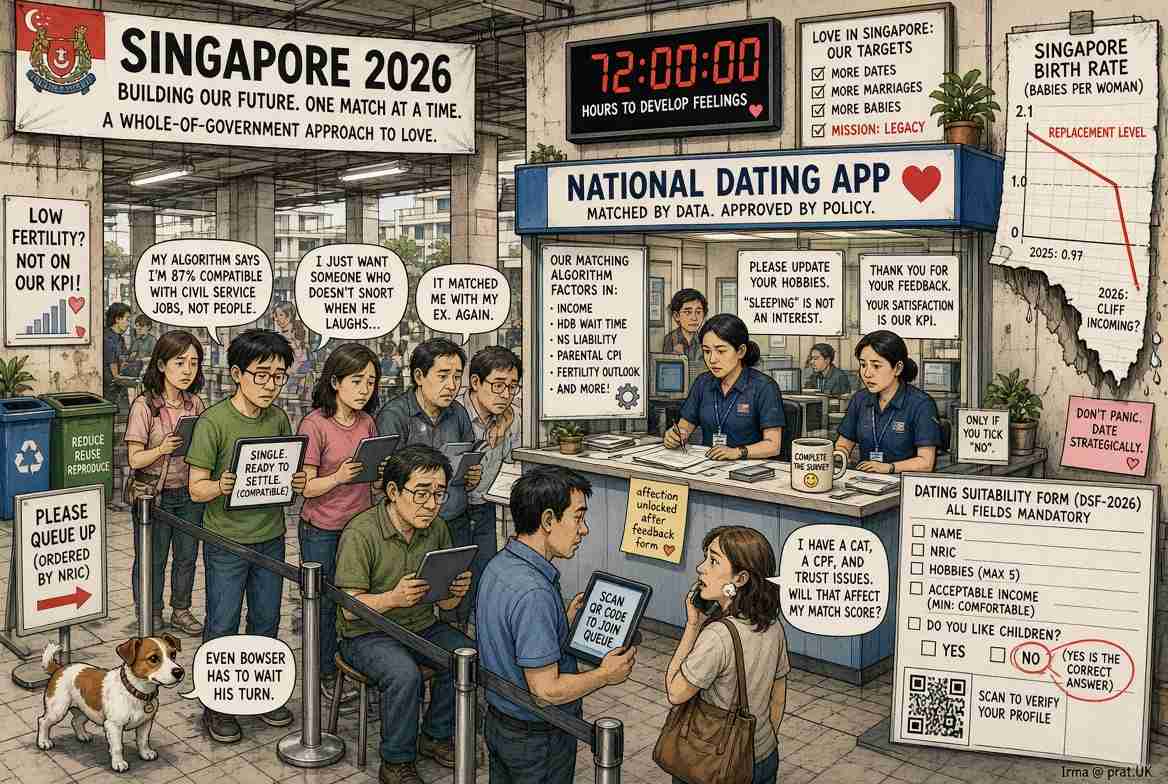
SINGAPORE — Singapore has launched a government-developed dating platform for young public-sector workers, apparently concluding that the great problem with modern romance is that nobody has yet put the Department of Administrative Services between “Hello” and “Would you like to get coffee?”
The pilot, called FirstDate, is open to single public officers aged 21 to 35. Participants verify themselves through Singpass, answer questions about interests, habits, values and preferences, receive one match at a time and have 72 hours to decide whether they want to connect. The pilot is run by the Government Technology Agency of Singapore (GovTech), which is exactly the sort of organisation you would want standing between you and your future spouse.
Government-supervised dating.
Finally.
For thousands of years, humanity has recklessly permitted people to choose romantic partners without proper administrative oversight.
Look where that got us.
The Titanic sank.
Your cousin married Darren.
Clearly the private sector has failed.
Government Matchmaking in Singapore: Cupid Has No Performance Metrics
FirstDate uses the Gale-Shapley Stable Marriage algorithm to generate pairings based on participants’ preferences.
Cupid has therefore been relieved of duty.
Understandably.
The man was naked, carried a weapon and maintained absolutely no documentation.
No government could tolerate that forever.
Under the new system, love can finally be handled professionally.
Instead of an arrow through the heart, residents may receive an SMS.
Congratulations. The government has identified a potentially compatible human.
Nothing makes the heart flutter quite like the phrase “potentially compatible.”
Shakespeare had Romeo say, “But soft, what light through yonder window breaks?” (Romeo and Juliet, for those keeping score at the Ministry.)
The modern version is:
“Juliet, according to the compatibility matrix, our responses concerning recreational travel differ by only 8 percent.”
“Romeo!”
“Yes?”
“You complete my dataset.”
Now that’s romance.
FirstDate’s 72-Hour Match Window: You Have 72 Hours to Fall in Love
Once FirstDate generates a match, both people have three days to decide whether they would like to connect. Contact information is released only after mutual acceptance.
Three days.
Apparently romance now has an expiration date.
THIS OFFER OF INTIMACY EXPIRES THURSDAY AT 5 P.M.
That should improve dating considerably.
No more wondering whether somebody likes you.
No more staring at your phone for eleven days.
No more interpreting punctuation.
“He wrote ‘Sounds good.’”
“With a period?”
“Yes.”
“It’s over.”
Singapore has liberated its citizens from this uncertainty.
You have 72 hours.
Accept.
Decline.
Or allow the government server to conclude that whatever happened between you and Michelle from Urban Planning was administratively nonviable.
Imagine explaining this to your grandmother.
“How did Grandpa propose?”
“He drove six hours through a snowstorm and stood beneath my bedroom window.”
“How romantic.”
“How did Dad propose?”
“He took me back to the restaurant where we had our first date.”
“And how did you meet Mum?”
“The government gave me until Wednesday.”
Beautiful.
Swipe Fatigue and One Match at a Time: Swipe Right Has Become Submit Form
The programme intentionally provides users with one match at a time, rather than the endless selection offered by conventional dating apps. The FirstDate website says the idea is to reduce “swipe fatigue” and give participants more room to consider each introduction.
Government has looked at dating apps and decided people have too much choice.
There is perhaps no more governmental conclusion than that.
“Citizens appear overwhelmed.”
“What should we do?”
“Reduce supply.”
Dating apps have spent years offering millions of profiles.
Singapore arrives carrying one person.
“Here.”
“What if I don’t like him?”
“There’ll be another one later.”
It is romantic rationing.
Dating has become wartime butter.
Citizens will eventually whisper outside government offices:
“Did the new shipment of accountants come in?”
“No accountants.”
“Engineers?”
“One civil engineer.”
“Tall?”
“Medium.”
“Does he hike?”
“He claims to.”
“I’ll take him.”
And perhaps fewer choices really will help.
Modern dating has become Netflix with kissing.
People spend so much time browsing that they never watch the movie.
Everyone believes the next option might be 4 percent taller, 7 percent funnier and own a slightly better dog.
Singapore’s government has essentially entered the room, unplugged Tinder and announced:
“You’re having coffee with Brian.”
Singpass Verification on a Dating App: Please Authenticate Before Experiencing Butterflies
FirstDate users are verified using Singpass, Singapore’s national digital identity system. The Financial Times reports that the verification is also intended to help weed out married people pretending to be single.
This is arguably the most terrifying advancement in dating history.
Because verification eliminates the comforting possibility that the person was lying.
He really is 31.
He really does work in procurement.
That photograph really was taken this year.
Now what?
Dating apps traditionally contain enough deception to provide both parties with plausible deniability.
“My profile says I enjoy hiking.”
“Do you?”
“No, but I once walked through an airport.”
With government verification, future profiles may become ruthlessly accurate.
Age: 32.
Occupation: Confirmed.
Marital status: Confirmed.
Height: Pending independent investigation.
Enjoys spontaneous adventures: Unsupported by available evidence.
Claims to love dogs: Verification requested.
Singapore could transform online dating by introducing standards normally reserved for securities markets.
Before uploading a shirtless bathroom photograph, users should be required to publish a prospectus.
Dating App Compatibility Score: Romance’s Most Dangerous Number
FirstDate shows users a compatibility score with each proposed match, along with information about the person’s characteristics and a personal note.
A compatibility score.
What could possibly go wrong?
Imagine receiving 82 percent.
“Eighty-two? That’s terrific!”
Then your friend gets 94.
Suddenly your future husband feels like a B-minus.
Couples will begin arguing mathematically.
“You never listen to me.”
“Our compatibility score was 89.”
“That was before you started leaving wet towels on the bed.”
“So I’m an 87?”
“Seventy-four.”
“You can’t deduct fifteen points for towels.”
“I can deduct twenty.”
Romantic relationships have survived jealousy, money problems, in-laws and infidelity.
Now they must survive analytics.
One day somebody will call off a wedding after discovering the algorithm originally identified another applicant at 91.6 percent.
“You said I was your soulmate!”
“You are.”
“Then who is Jasmine?”
“Statistically insignificant.”
FirstDate Date Quests: Government Introduces Side Quests for Human Courtship
If matched users decide to meet, FirstDate suggests activities called Date Quests, intended to help them get to know each other.
Date Quests.
Dating is now a video game.
MISSION ONE: COFFEE
Objective: Maintain eye contact for 30 seconds.
Reward: +10 intimacy.
MISSION TWO: DINNER
Objective: Determine whether participant chews with mouth open.
Bonus objective: Avoid discussing former partners.
FINAL BOSS: IKEA
Only couples with a compatibility rating above 93 percent should attempt IKEA.
Researchers have long known that relationships face stress.
But nobody truly knows another human being until they’ve watched that person pronounce “KALLAX” while pushing a cart containing 700 tea candles.
If Singapore wants to test compatibility, forget questionnaires.
Give every couple one flat-pack wardrobe.
Whichever relationships survive should receive immediate marriage licenses.
Post-Date Government Survey: Then Comes the Feedback Form
After each match, FirstDate participants receive a survey asking what happened, including whether they exchanged contact details and met in person.
This is magnificent.
Nothing preserves romantic mystery like a post-date government questionnaire.
You return home.
The evening was wonderful.
Dinner lasted three hours.
You talked about childhood.
You laughed.
Your hands touched.
There was a moment outside the restaurant when neither of you wanted to leave.
Then your phone buzzes.
HOW DID WE DO?
Government wants feedback.
“On a scale from one to five, how effectively did your allocated romantic prospect demonstrate interpersonal warmth?”
“Were appropriate levels of chemistry achieved?”
“Would you recommend this citizen to another citizen?”
“Did kissing occur?”
“If yes, please select duration.”
“This information will be used to improve future service delivery.”
Imagine getting dumped and then being asked to evaluate the experience.
Reason for unsuccessful interaction:
- □ No chemistry
- □ Differing values
- □ Excessive discussion of cryptocurrency
- □ Referred to mother seven times during appetizers
- □ Said “females”
- □ Other
Please explain in 500 characters or fewer.
Singapore’s Fertility Rate Is 0.87, So Somebody Call IT
There is a serious demographic concern behind the experiment. Singapore recorded a total fertility rate of 0.87 children per woman in 2025, according to the Financial Times, continuing a long decline that policymakers have been trying to address through family and population policies.
A fertility rate of 0.87 is not merely low.
It is the demographic equivalent of checking the petrol gauge and noticing the needle has begun pointing at the glove compartment.
Singapore has responded with several family incentives, but FirstDate represents the most intriguing approach yet:
Have we tried introducing Kevin to Angela?
Economists can debate housing prices, work culture, marriage patterns, childcare costs and changing social preferences.
Government engineers apparently looked at all this and said:
“Could be the user interface.”
This is refreshing.
Economic history usually gives governments two solutions:
Subsidize it.
Or regulate it.
Singapore has discovered a third:
Make everyone fill out a personality questionnaire.
Singapore’s Social Development Unit: This Is Not the Government’s First Trip to Lover’s Lane
Government matchmaking is not entirely new in Singapore. In 1984, the state created the Social Development Unit, initially aimed at encouraging relationships and marriage among graduates.
So Singapore has been trying to help people find spouses for more than four decades.
Most governments struggle to organize rubbish collection.
Singapore looked at its responsibilities and said:
“Roads? Done.
Transit? Done.
Public administration? Done.
Anybody still single?”
There is something admirable about bureaucratic confidence at this level.
Other governments build infrastructure.
Singapore looks directly into the human heart and says:
“We can probably optimize that.”
Ministry of Romantic Development: Eventually There Will Be Quarterly Dating Targets
The great unanswered question is what happens if FirstDate succeeds.
Because successful government programmes rarely remain cute little pilots.
Soon there could be targets.
Annual reports.
Performance dashboards.
Parliamentary hearings.
MINISTRY OF ROMANTIC DEVELOPMENT: Q3 KEY PERFORMANCE INDICATORS
Profiles authenticated: 14,882.
Matches generated: 8,216.
Mutual acceptances: 3,992.
Coffee consumed: 7,311 litres.
Second dates: 1,443.
Third dates: 711.
Engagements: 28.
People who discovered their date says “supposably”: 94.
People who escaped through restaurant bathroom windows: 6.
Suddenly ministers will face difficult questions.
“Why has hand-holding declined 4.2 percent?”
“We believe seasonal factors are involved.”
“What measures are being implemented?”
“We’re increasing Date Quest expenditure.”
“Will there be karaoke?”
“Subject to budget approval.”
Opposition politicians could accuse the government of missing its kissing targets.
Newspapers could run headlines:
CABINET DENIES ROMANCE RECESSION
The central bank might raise interest rates because everyone is getting too interested.
Gale-Shapley Algorithm vs. Human Chemistry: The Algorithm Still Faces Humanity
For all the technology, FirstDate itself acknowledges the obvious: compatibility on paper does not guarantee chemistry.
And there lies government’s problem.
Human attraction is spectacularly irrational.
You can collect thirty answers.
You can calculate values.
You can compare preferences.
You can verify identities.
You can deploy Nobel Prize-winning mathematics.
Then two people meet.
He says, “Expresso.”
Finished.
Or she laughs exactly like his aunt.
Finished.
Or he removes his shoes at dinner.
National emergency.
Human beings have an extraordinary ability to reject objectively suitable partners for reasons that could never survive statistical review.
“He’s successful, kind, handsome, funny and wants children.”
“So?”
“He uses Comic Sans.”
Fair enough.
No algorithm survives Comic Sans.
Is Government Dating Worth It? Government May Have Finally Found Its Perfect Job
And yet, perhaps Singapore has stumbled onto something.
Modern dating really is exhausting.
The apps offer infinite selection while producing extraordinary indecision.
People swipe through hundreds of human beings with the relaxed ruthlessness previously associated with selecting takeaway.
Too short.
Too far away.
Wrong shirt.
Has a boat.
Why does he have a boat?
Next.
Perhaps one carefully selected match is better than 400 people competing for six seconds of attention.
Perhaps verification is useful.
Perhaps fewer choices encourage people to actually talk.
Perhaps government has identified one small corner of dating where bureaucracy produces less chaos rather than more.
Or perhaps somewhere in Singapore tonight, two civil servants are staring at their phones after receiving the same message.
YOU HAVE BEEN MATCHED.
They examine each other’s profiles.
They inspect the compatibility score.
They think about it.
They press yes.
They meet.
They laugh.
They fall in love.
They marry.
Years later their children ask the traditional question.
“Mum, Dad, how did you meet?”
And Dad smiles at Mum.
Mum smiles at Dad.
Then Dad says:
“The government assigned her to me on Tuesday.”
And Mum says:
“Your father had 72 hours to respond.”
“Was it romantic?”
“Very.”
“He filed early.”
Disclaimer
This satire is built around the real FirstDate pilot operated across Singapore’s Public Service. Its Singpass verification, one-match-at-a-time system, compatibility score, Gale-Shapley matching method, 72-hour response window, Date Quests and post-match feedback survey are genuine elements of the programme. The imaginary ministries, kissing statistics, IKEA compatibility test, dating performance indicators and government interrogation of wet towels are the jokes.
This story is entirely a human collaboration between two sentient beings: the world’s oldest tenured professor and a philosophy major turned dairy farmer. Neither has been approved by the Singapore government as a suitable romantic prospect, although both are reportedly willing to complete the necessary paperwork.

Mei Lin Chen is a student writer whose satire explores identity, modern culture, and social nuance. Her work reflects academic curiosity and engagement with London’s diverse perspectives.
Expertise is growing through study and practice, while trust is supported by clear intent and responsible humour.