

Royal Foundation Raises £8.7 Million From Americans Who Apparently Prefer Their British Royals Still Living in Britain
William and Kate win the transatlantic charity contest as Harry commissions a six-part documentary about how losing made him feel
LONDON — The Royal Foundation of the Prince and Princess of Wales received nearly £8.7 million from its American fundraising arm in 2025, according to Yahoo Entertainment’s report on William and Kate’s transatlantic fundraising success, proving that Americans remain perfectly willing to finance British royalty provided the royals remain safely on the opposite side of the Atlantic.
The contribution from American Friends of the Royal Foundation reportedly almost doubled from the previous year and represented a substantial portion of the foundation’s income. This puts William and Catherine ahead in the unofficial royal charity competition — a contest that Buckingham Palace insists does not exist and that California has already optioned as a limited streaming series.
Royal observers say Prince Harry learned of the figures while meditating in a sustainably heated Montecito contemplation pavilion.
“This isn’t about money,” Harry reportedly explained to a ficus tree wearing a discreet microphone. “It’s about the pain of discovering that Americans will donate millions to my brother without first requiring him to describe his childhood in eight episodes.”
Netflix has not announced a documentary, although palace insiders believe cameras will begin following Harry as soon as someone explains that no documentary has been announced.
William and Kate Win the Transatlantic Charity Contest While Harry Films the Trauma
The fundraising figures have reopened the great modern royal question: how did the prince who remained inside the monarchy become more popular with American donors than the prince who moved to America specifically to become popular with Americans?
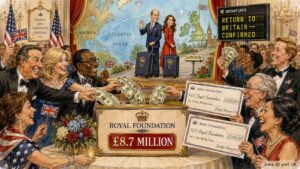
Experts believe the answer may involve mystery.
William and Catherine still practise the ancient royal discipline of not explaining every breakfast disagreement to Oprah Winfrey. This leaves the public wondering what they think, which is cheaper than producing a podcast in which everyone finds out.
“Silence has extremely low production costs,” said Professor Crispin Ledger, the London Prat’s senior fellow in hereditary accountancy. “A royal can stand beside a tree, look concerned and depart. There are no reshoots, no executive producers and no twelve-person team required to determine whether the tree reflects the couple’s evolving global values.”
The Waleses have also retained the advantage of geography. They live in Britain, perform British royal duties and operate a foundation bearing British royal titles. Donors apparently find this arrangement easier to understand than two former working royals living in California while repeatedly explaining why they no longer wish to discuss the institution during another discussion about the institution.
In a survey conducted by the entirely prestigious Institute for Asking Americans Questions Near Supermarkets, 74 percent of respondents said they preferred British princes to remain in Britain. Another 18 percent believed Prince William lived inside Big Ben, while eight percent attempted to donate to Paddington Bear.
Researchers counted all three responses as support for the monarchy.
Americans Discover That Supporting Royalty Is Cheaper Without Spotify
American donors have now made a remarkable financial discovery: traditional royalty may be less expensive than celebrity royalty.
Old-fashioned royals require castles, ceremonial uniforms and a gentleman whose sole responsibility is knowing where the correct ribbon goes. Modern celebrity royals require producers, publicists, content strategists, audiovisual consultants, wellness advisers and an executive vice president of Authentic Personal Truth.
The monarchy may own several palaces, but at least it already has office space.
One donor from Connecticut said she contributed after comparing the available packages.
“With William and Kate, my donation supports charitable programmes,” she explained. “With Harry and Meghan, I worried it might support a podcast trailer announcing an upcoming conversation about why the previous podcast conversation was misunderstood.”
Another American contributor said the Royal Foundation offered an attractively simple proposition.
“They asked for money to help people,” he said. “Nobody promised me exclusive access to their healing journey. Frankly, that level of restraint felt almost European.”
Spotify ended its podcast agreement with Harry and Meghan’s media company in 2023. That historical fact has since become the royal equivalent of an old family casserole: nobody remembers who prepared it, but it is reheated whenever relatives begin arguing about money.
The Sussexes have pursued other media projects, charitable initiatives and commercial ventures. Yet every new announcement attracts immediate comparisons with William and Catherine, because royal reporting operates according to the scientific principle that no duchess may plant a vegetable without another duchess being asked to respond.
Meghan Was Never Competing, Except Whenever Scores Were Available
Sources close to absolutely nobody say Meghan has assured friends that she was never competing with Catherine.
She was merely monitoring the figures, comparing international reach, assessing brand sentiment, examining media engagement and asking an assistant to enlarge the chart.
“That is not competition,” explained a fictional lifestyle consultant employed for satirical purposes. “Competition involves winners and losers. This is a values-led comparison journey with quarterly benchmarks.”
Royal Foundation income has consequently become more than an accounting matter. It is now another scoreboard in the Windsor family’s endless emotional Olympics, alongside television ratings, Instagram followers, book sales, public approval, dress prices and the number of unnamed friends available to brief People magazine by lunchtime.
Meghan’s supporters argue that Archewell and the Royal Foundation are different organisations pursuing different goals. This is sensible, accurate and therefore entirely unacceptable to the royal press, which requires every event to resemble two duchesses fighting over the final reduced-price candle at a Kensington branch of Waitrose.
If Catherine attends a children’s centre, Meghan must be losing.
If Meghan releases jam, Catherine must be winning breakfast.
If William visits a homelessness project, Harry must be preparing a counteroffensive involving polo, emotional honesty and three photographers positioned naturally behind a hedge.
Britain once settled royal rivalries through cavalry, poisoned courtiers and suspicious hunting accidents. Today it uses charity accounts and lifestyle newsletters. Civilisation is mostly the process of replacing swords with spreadsheets while keeping the same relatives.
The Sussexes Demand Fundraising Be Measured in Netflix Minutes
Supporters of Harry and Meghan have reportedly proposed a fairer system for comparing royal influence. Instead of measuring money raised, charitable reach or programme spending, organisations would be ranked according to Netflix minutes.
Under this method, the Sussexes would receive credit whenever viewers watch Harry looking thoughtfully through a window while a piano plays the international anthem of unresolved grievance.
Bonus points would be awarded for black-and-white childhood photographs, aerial footage of California and any sentence beginning, “What people need to understand is…”
The Royal Foundation has rejected the proposal, mainly because nobody actually submitted it.
William is nevertheless believed to be taking the competition seriously. Palace aides recently observed him walking into a meeting carrying a folder, an action royal commentators described as “a decisive modernisation of the monarchy.”
Catherine reportedly looked at the folder.
Together, these developments generated 46 newspaper articles, seven body-language analyses and one television special asking whether the couple’s coordinated use of office supplies sends a hidden message to Montecito.
Harry, meanwhile, could respond with a documentary tentatively titled Folders: The Institution Wouldn’t Let Me Have One.
Episode one would examine William’s folder privilege.
Episode two would revisit Harry’s childhood.
Episode three would feature Meghan preparing tea while explaining that she had never heard of folders before joining the Royal Family.
The remaining episodes would be reserved for reconciliation.
Royal Charity Returns to Its Traditional Business of Charity
Lost amid the family competition is the inconvenient fact that the Royal Foundation supports programmes addressing homelessness, early childhood development, mental health and wildlife conservation.
These subjects are serious, which makes them dangerously unsuitable for celebrity coverage. A headline about measurable charitable programmes cannot compete with a headline asking whether Meghan’s choice of beige blouse constitutes a coded attack on the Commonwealth.
The £8.7 million American contribution suggests donors are responding to the foundation’s work, its institutional connections or perhaps the novelty of giving money to famous people who do not immediately announce a personal fragrance.
The foundation spent millions on its programmes and retains reserves for future work. Charity specialists describe this as “normal financial management,” a phrase so dull that several royal correspondents had to be revived with photographs of Prince Louis making a face.
There is also a useful distinction between raising money and generating publicity. Both royal households can attract headlines, but headlines cannot fund a youth programme unless they are printed on exceptionally valuable paper.
Publicity resembles royal icing: attractive, carefully applied and nutritionally incapable of supporting anybody.
Money, by contrast, pays employees, funds services and keeps programmes operating. This may explain why accountants continue measuring pounds instead of compassionate streaming impressions.
Buckingham Palace Declines to Declare a Winner
Kensington Palace has not publicly declared victory over the Sussexes, partly because the Royal Foundation is a charity rather than a pub quiz and partly because doing so would be considered frightfully American.
Palace officials are expected to respond in the traditional manner: release the accounts, thank supporters and refuse to discuss family competition until approximately six unnamed courtiers have discussed it with six newspapers.
The Sussexes may also decline to comment, after which sources familiar with their thinking will provide 900 words of comment explaining the decline.
For American donors, however, the choice now seems wonderfully straightforward. They can support William and Catherine from 4,000 miles away, receive no lifestyle recommendations and enjoy the comforting knowledge that the beneficiaries will not move into the guesthouse.
It is the perfect transatlantic relationship: Americans send money, Britain keeps the royals and everyone agrees never to examine why a republic remains fascinated by hereditary aristocrats with excellent tailoring.
That arrangement has lasted nearly 250 years.
At current exchange rates, it may finally be profitable.
Ten Humorous Observations From the Great Royal Fundraising Rivalry
- A royal family can raise £8.7 million by standing near trees and saying very little, which remains the most cost-effective content strategy ever devised.
- Somewhere in Montecito, a ficus tree has heard more royal grievances than most licensed therapists.
- The monarchy discovered that silence is not just golden, it’s also tax-deductible.
- Eighteen percent of surveyed Americans believe Prince William lives inside Big Ben, which is either bad polling or an excellent tourism opportunity.
- Spotify’s one-season podcast deal proved that even $20 million cannot manufacture a second act nobody asked for.
- William carrying a folder into a meeting was treated as bigger institutional news than most actual policy announcements.
- Meghan’s jam and Catherine’s children’s centre visit were somehow scored as competing events in the same imaginary Olympics.
- A documentary about losing a charity comparison is still, technically, a documentary about winning attention.
- Britain replaced poisoned courtiers with charity spreadsheets, which is progress, if a slightly less dramatic one.
- Americans have figured out they can fund a monarchy from 4,000 miles away and never once be asked to watch a docuseries about it.
Disclaimer: This story is satire arising from publicly reported charity figures and the press’s determination to convert every Windsor family development into a competitive sporting event. This piece is satirical journalism intended purely for entertainment, and any resemblance to actual satirical news commentary about the Royal Family is very much the point. The charitable organisations and their beneficiaries perform serious work; the imaginary consultants, supermarket pollsters and emotionally burdened ficus tree do not. This article is entirely a human collaboration between two sentient beings — the world’s oldest tenured professor and a philosophy major turned dairy farmer.
Source: Yahoo Entertainment

Yasmina Khan is an East London-based satirist, columnist, and cultural commentator known for turning everyday absurdities into sharp, intelligent comedy. Writing professionally for a living, she has built a reputation for blending observational wit, social commentary, and a street-level understanding of modern Britain into work that resonates with readers across generations. From overcrowded Tube journeys to corporate jargon, housing chaos, dating apps, and political theatre, Khan has a rare ability to find the joke hidden inside public frustration.
Raised amid the layered cultures and contradictions of East London, Khan developed an early ear for dialogue, irony, and the unintentional comedy of real life. That background remains central to her voice. Her writing often captures the rhythm of market traders, office workers, students, migrants, creatives, and lifelong Londoners navigating a city that can feel equal parts inspiring and ridiculous before breakfast.
Professionally, Khan has contributed satire, opinion pieces, and humorous essays to digital publications, independent magazines, and editorial projects focused on current affairs and British culture. Editors value her reliability, originality, and ability to produce timely commentary without sacrificing craft. Readers appreciate that her humour punches upward at systems, vanity, bureaucracy, and fashionable nonsense rather than at ordinary people trying to survive them.
Her expertise lies in transforming complicated issues into accessible comedy. Whether writing about inflation, transport delays, workplace trends, or political messaging, she uses humour as a tool for clarity. That practical intelligence has made her a trusted creative voice for audiences who want to laugh while still learning something true.
Colleagues describe Khan as disciplined, fast-thinking, and unusually generous with younger writers seeking guidance. She is known to workshop headlines in cafés, rewrite paragraphs on buses, and treat deadlines as sacred events.
Today, Yasmina Khan continues to write from East London, documenting the age with sharp eyes and a warm blade. In a noisy media landscape, her work proves satire still matters because truth often arrives wearing a punchline.


