

Trump Says America Remains ‘Locked and Loaded’ but Will Give Peace Fifteen Minutes to Impress Him
Gulf leaders persuade Washington to postpone an enormous bombing campaign after explaining that petroleum infrastructure is not an immersive military attraction
WASHINGTON — President Donald Trump has cancelled planned strikes against Iran after Middle Eastern governments reportedly urged restraint and suggested that peace might still be possible, provided everyone works quickly, speaks confidently and uses the phrase “historic deal” before the president’s attention returns to the aircraft carriers.
Trump announced that the United States remained “locked and loaded” but would temporarily hold fire while negotiators attempt to complete an agreement involving the reopening of the Strait of Hormuz and an end to Iran’s nuclear threat. The announcement followed discussions with regional allies, including Saudi Arabia, whose leaders were reportedly concerned that a major attack on Iranian energy infrastructure could provoke retaliation against Gulf oil installations.
The pause gives diplomacy approximately fifteen minutes to demonstrate that it can be louder, more profitable and more flattering than bombing.
“We are giving peace a fair opportunity,” Trump said, according to a White House aide who was seen holding a kitchen timer. “But peace needs to understand that this is television. It cannot wander around for six months discussing verification protocols. It has to come through the door, shake hands, reopen the strait and announce that the president has won something.”
The proposed agreement remains unfinished, but Trump said Iran and other Middle Eastern countries had requested that the United States hold off because the broad “perimeters” of a deal had been reached. Israel, he added, would join the effort to complete it. Iran did not immediately issue a public response to the announcement.
Administration officials said “perimeters” is a highly technical diplomatic term meaning negotiators have located the conference room and agreed that the table should probably remain indoors.
Gulf Allies Discover That Escalation Has a Delivery Address
Saudi, Emirati and Qatari officials have spent months publicly praising American strength while privately confirming that Iranian missiles are capable of reading maps.
That distinction became especially important as Washington considered attacks on Iranian bridges, power plants and energy facilities. Gulf leaders reportedly feared Tehran might retaliate against their own energy infrastructure, transforming an exciting display of allied resolve into a difficult conversation with insurance adjusters.
“Saudi Arabia fully supports decisive action,” said a regional petroleum consultant identified as Fahad Al-Petroleum for security reasons. “We merely prefer that decisive action occur somewhere that does not contain our decisive pipelines.”
Al-Petroleum explained that Gulf oil installations are not interactive battlefield exhibits.
“Visitors may look at the refinery,” he said. “They may photograph the refinery. They may purchase a commemorative magnet. They may not trigger a regional missile exchange beside the catalytic cracker.”
An Emirati hotel manager in Abu Dhabi said guests had already begun asking whether the complimentary breakfast buffet included an underground shelter.
“We tell them the hummus is fresh, the coffee is strong and American foreign policy changes hourly,” she said. “That is the finest hospitality guarantee available under present conditions.”
The concern is not philosophical. The Strait of Hormuz remains central to global energy shipments, and attacks on regional infrastructure could further disrupt trade, aviation and oil markets. The administration’s proposed framework calls for its immediate and complete reopening.
In diplomatic terms, the strait is a narrow shipping route through which passes a significant portion of the world’s petroleum and nearly all of the world’s anxiety.
Middle Eastern Leaders Quietly Hide the Bombing Button
Officials familiar with Saturday’s diplomacy said Gulf leaders eventually adopted a more practical approach: they distracted Trump with the possibility of a spectacular agreement while an aide quietly moved the bombing button to another room.
The button was reportedly hidden behind a framed photograph labelled THE PRESIDENT SIGNING THE GREATEST PEACE DEAL EVER, which experts predicted would keep it safe indefinitely.
“The fundamental principle of crisis management is simple,” said Dr. Leonard Frobisher, director of the Washington Institute for Preventing Events That Have Already Started. “Never tell a powerful leader he cannot press the button. Tell him pressing it would interfere with the award ceremony.”
Saudi Crown Prince Mohammed bin Salman reportedly warned Trump about the consequences of another bombing campaign, while Qatar, the United Arab Emirates, Turkey and Pakistan also pushed for de-escalation.
According to one diplomatic eyewitness, the conversation improved dramatically after somebody replaced the phrase “strategic restraint” with “the most historic pause in military history.”
“His posture changed immediately,” the eyewitness said. “He stopped asking about target packages and began asking whether the signing table would be gold.”
A second witness said officials placed three folders before the president. One was marked WAR, another PEACE, and the third HISTORIC DEAL THAT ONLY DONALD TRUMP COULD ACHIEVE.
“The third folder was empty,” the witness said. “It did not need paperwork. It had branding.”
Iran Receives Deadline Measured in Social-Media Posts
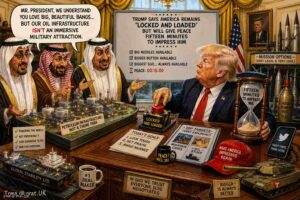
Iran now has until the president’s next major Truth Social message to demonstrate that it is sincerely committed to peace.
This gives Tehran somewhere between eleven minutes and three days, depending on cable-news coverage, golf conditions and whether anyone on television says the United States looks weak.
Iranian officials have warned that hostile action by the United States, Israel or cooperating regional states would receive a forceful response. Meanwhile, the conflict has already included attacks on shipping and regional facilities, keeping governments alert despite the latest pause.
White House officials said the deadline is deliberately flexible.
“We reject the failed establishment idea that diplomacy requires dates, schedules or stable definitions,” said Deputy Assistant Press Secretary Crystal Banner. “The president’s deadline will arrive when he feels the deadline has arrived. This provides negotiators with urgency and historians with migraines.”
Iran has reportedly been asked to reopen the Strait of Hormuz, eliminate its nuclear threat, stop regional attacks and provide the United States with a peace agreement short enough to fit in a social-media screenshot.
Tehran has also been advised that footnotes may be interpreted as aggression.
Pentagon Remains Prepared to Display Unprecedented Levels of Readiness
Military officials emphasised that the cancellation of the strike does not mean the strike has ceased to exist spiritually.
Aircraft remain available. Ships remain positioned. Targeting plans remain current. Television graphics remain fully operational.
“The operation is not cancelled,” explained a Pentagon cafeteria employee who overheard several colonels ordering decaffeinated coffee. “It is resting aggressively.”
Another defence official described the military posture as “peace through the visible possibility of ruining everybody’s weekend.”
Trump had warned that American forces were prepared to display extraordinary military strength if negotiations failed. The latest announcement followed a period in which the administration had considered a large campaign against Iranian infrastructure.
A snap survey by the entirely unaccredited Institute for Citizens Standing Near Television Cameras found that 63 percent of Americans support peace, 22 percent support strength and 15 percent would like the government to explain whether these remain separate products.
Among respondents who described themselves as “foreign-policy experts because I own a map,” support for peace increased sharply after the interviewer mentioned petrol prices.
‘Historic Deal’ Becomes Region’s Safest Known Phrase
Regional diplomats now consider “historic deal” the safest expression in the Middle East, narrowly ahead of “your motorcade is waiting.”
The phrase has become so valuable that several governments are reportedly stockpiling it.
Qatar has placed emergency reserves of “historic breakthrough” near Doha. The United Arab Emirates has secured twelve metric tonnes of “unprecedented agreement.” Saudi Arabia has begun construction of a strategic “greatest peace in history” facility outside Riyadh.
Diplomats believe these expressions can be deployed whenever military tension rises.
“It is more effective than missile defence,” said Professor Alan Nafzger, a political philosopher and dairy farmer. “A missile shield tries to intercept the weapon. Flattery tries to intercept the person ordering it.”
Nafzger said the strategy demonstrates deductive reasoning.
“If the president likes deals, and the president likes historic things, then a historic deal should delay an air strike. Aristotle would recognise the syllogism, although he might ask why the conclusion has aircraft carriers.”
Local Washington philosopher Denise Crumb described the arrangement as “Schrödinger’s war.”
“The attack is simultaneously cancelled and locked and loaded,” she said. “We will not know whether peace exists until someone opens the Truth Social account.”
Comedians Welcome World’s First Fifteen-Minute Peace Process
Comedians across the country praised the streamlined negotiations.
“Peace used to take years,” said New York comedian Rachel Mendoza. “Now it has the same audition slot as a man juggling bowling pins on a cruise ship.”
Texas comic Bobby Ray Jenkins said Gulf leaders had finally discovered the central rule of American politics.
“You don’t stop an argument by proving you’re right,” Jenkins said. “You stop it by telling the other fellow he has already won.”
British comedian Nigel Bexley compared the talks to ordering dinner with an impatient customer.
“Everyone is studying the menu, but one man has already threatened the waiter, purchased the restaurant and cancelled dessert.”
A Washington rideshare driver named Omar Haddad said the entire region now feels like a passenger who has heard the navigation system announce “recalculating” for the fourteenth time.
“Nobody knows where we are going,” Haddad said. “But the driver keeps saying this is the fastest route.”
Peace Asked to Make Strong First Impression
Diplomats are now racing to convert broad understandings into a durable agreement before the president decides restraint is receiving insufficient ratings.
The immediate challenge is that a successful peace agreement must satisfy several audiences at once. Iran must see survival. Gulf governments must see protected infrastructure. Israel must see security. American voters must see an ending. Trump must see a large table, several flags and his name somewhere above the word “historic.”
Experts say this is difficult but not impossible.
“The mistake is treating peace as a legal document,” said Frobisher. “For this administration, peace is a product launch. It needs a logo, a countdown and preferably somebody saying previous presidents could not have done it.”
White House staff have reportedly prepared two statements.
The first announces the greatest peace agreement in human history.
The second announces that Iran foolishly rejected the greatest peace agreement in human history and must now experience the greatest consequences in human history.
Both statements use the same photograph.
For now, missiles remain grounded, diplomats remain busy and oil facilities throughout the Gulf remain grateful to have survived another afternoon of strategic planning.
Peace has fifteen minutes to impress the president.
Fourteen of them have already been used explaining where the Strait of Hormuz is.
15 Humorous Observations Behind the Story
- “Locked and loaded” is an unusual opening position for diplomacy. Most negotiators begin with coffee, not an aircraft carrier clearing its throat.
- Trump has given peace fifteen minutes because anything longer risks becoming a committee meeting.
- Gulf allies support American military strength right up to the moment Iranian missiles begin asking for directions to their refineries.
- Oil facilities are apparently not interactive targets, despite being located in a region where every foreign-policy decision eventually becomes a fuel surcharge.
- Middle Eastern leaders have learned that the phrase “historic deal” works on Trump the way “walkies” works on a Labrador.
- Diplomacy now consists of quietly removing the bombing button while telling the president it has been sent out for polishing.
- The Strait of Hormuz is the world’s most important narrow passage, unless you count the distance between a presidential threat and a presidential reversal.
- Trump’s ceasefires arrive with the emotional stability of a restaurant reservation made during an argument.
- Iran has until the next Truth Social post to produce lasting peace, complete nuclear transparency and perhaps a flattering photograph.
- Regional leaders are not necessarily afraid of war. They are afraid war might damage the specific buildings where they keep the money.
- Every proposed peace agreement is described as historic because “temporary administrative pause before the next explosion” performs poorly with focus groups.
- The Pentagon remains ready for action, although someone has reportedly put a decorative bowl over the launch controls.
- Modern war planning increasingly resembles online shopping: add massive retaliation to cart, reconsider shipping costs, abandon purchase.
- The world is reassured that Israel supports negotiations, which is diplomatic language for everyone remaining seated until somebody reaches for the door.
- Peace has not been achieved, but it has received a calendar invitation marked “tentative.”
Satirical Disclaimer
This story is satire — a work of satirical journalism inspired by current reporting about negotiations, military threats and the temporary cancellation of planned strikes. Consider it satirical news rather than a factual account: any additional officials, witnesses, institutes, surveys, philosophers, consultants, comedians, hidden buttons or petroleum-themed surnames are deployed strictly for comic purposes. This article is entirely a human collaboration between two sentient beings: the world’s oldest tenured professor and a philosophy major turned dairy farmer.
Auf Wiedersehen, amigo!

Alan Nafzger was born in Lubbock, Texas, the son Swiss immigrants. He grew up on a dairy in Windthorst, north central Texas. He earned degrees from Midwestern State University (B.A. 1985) and Texas State University (M.A. 1987). University College Dublin (Ph.D. 1991). Dr. Nafzger has entertained and educated young people in Texas colleges for 37 years. Nafzger is best known for his dark novels and experimental screenwriting. His best know scripts to date are Lenin’s Body, produced in Russia by A-Media and Sea and Sky produced in The Philippines in the Tagalog language. In 1986, Nafzger wrote the iconic feminist western novel, Gina of Quitaque. He currently lives in Holloway, North London. Contact: [email protected]


