Politicians Discover Jokes Can Inspire Political Violence, Demand Immediate Exemption for Jokes Made by Their Own Side
Green Leader Shares Guillotine Image, Discovers Accountability Has a Twenty-Photo Limit
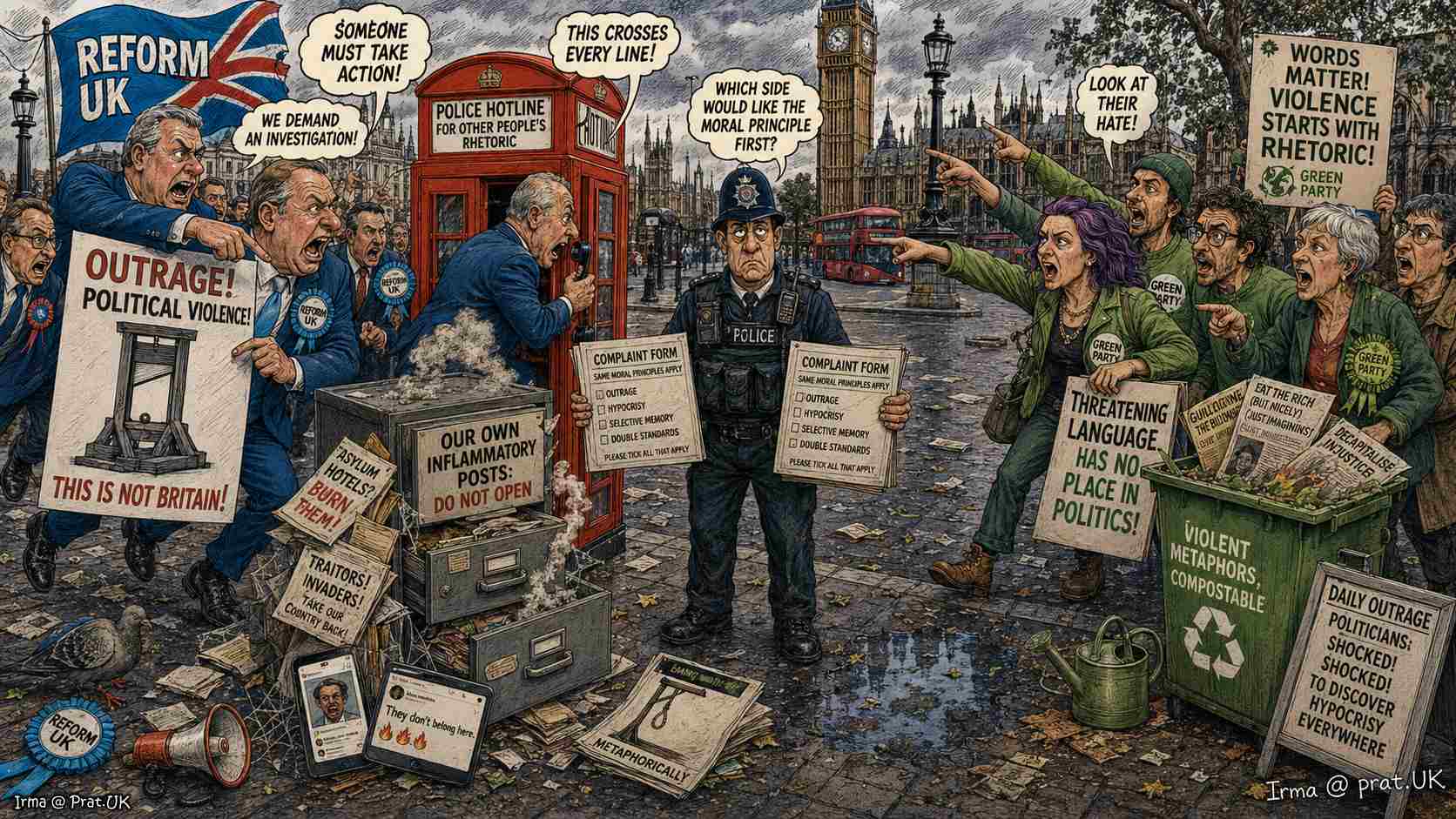
LONDON — Britain’s political parties have jointly confirmed that jokes, memes and violent metaphors can contribute to real-world hostility, provided the jokes, memes and metaphors were produced by somebody else. The declaration follows an argument made in British commentary, including a pointed Spectator piece, about the fraying taboo against political violence and the convenient refusal of each political tribe to recognise its own contribution.
The immediate controversy began after Green Party leader Zack Polanski accepted an Instagram collaboration containing twenty photographs. The first showed Polanski. The fifth showed a man wearing a T-shirt depicting a guillotine beside the phrase “we’re only making plans for Nigel,” an apparent reference to Reform UK leader Nigel Farage.
Polanski removed the collaboration after the image was brought to his attention. He condemned political violence, described the sharing as an inadvertent mistake and repeatedly declined to apologise to Farage, reasoning that he would apologise had he posted it deliberately. The Metropolitan Police concluded that the sharing did not meet the threshold for criminal action.
This established Britain’s newest ethical formula:
No intention + twenty photographs + prompt deletion = no apology.
Under the old system, people apologised for mistakes because mistakes were the principal reason apologies had been invented. Under the new system, mistakes are evidence that an apology would be unfair.
“I accidentally reversed into a garden centre last Thursday,” said Darren Pike, a delivery driver observing the controversy from outside a Croydon bakery. “I was going to apologise, but then I realised I hadn’t destroyed the begonias deliberately. I’m expecting the manager to apologise to me for politicising the accident.”
Completely Innocent Until Someone Scrolls Through the Instagram Carousel
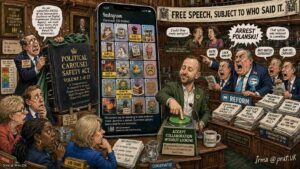
The Department for Responsible Metaphors issued emergency guidance advising politicians to inspect all photographs appearing under their names, including photographs located beyond the thrilling frontier known as “the first one.”
A spokesperson explained that scrolling through twenty images takes approximately fourteen seconds, or nearly half the time required to compose a statement blaming the incident on bad-faith opponents.
“Public figures must exercise care,” the spokesperson said in a statement that exercised so much care it contained no identifiable subject, verb or accountable human being.
The government is now considering a Political Carousel Safety Act requiring potentially inflammatory images to display warning labels such as: “Slide Five May Contain Revolutionary Execution Equipment.”
Instagram may also introduce a new prompt asking users: “This collaboration contains a guillotine, three raised fists, a burning billionaire and somebody dressed as a cabbage. Are you sure you wish to attach your leadership credentials?”
Mavis Pritchard, a retired librarian from Bromley, said she had sympathy for politicians overwhelmed by modern technology.
“When I approve twenty photographs for public display, I normally look at them,” she said. “But then I’m old-fashioned. I also read documents before signing them and look inside sandwiches before serving them to visiting clergy.”
Britain’s Violence Dictionary Receives Two New Editions
Reform UK accused Polanski of inciting murder, while Polanski accused Farage of having endangered others through his own political messaging. The exchange demonstrated Britain’s increasingly sophisticated system of reciprocal moral blindness, under which each political faction can identify irresponsible rhetoric at distances exceeding 300 miles but cannot detect it directly beneath its own nose.
Reform’s position is that violent or inflammatory words can have consequences. This is a defensible position.
The Greens’ position is also that violent or inflammatory words can have consequences. This, too, is a defensible position.
The difficulty arises during the traditional British ceremony in which both parties immediately begin listing reasons the principle should not apply to their supporters.
The Spectator was among the outlets noting the contradiction between Reform’s condemnation of the guillotine image and its defence of Lucy Connolly. Connolly pleaded guilty to inciting racial hatred after calling online for hotels housing immigrants to be burned. She received a 31-month prison sentence.
Thus, Britain now has two competing legal philosophies.
The first holds that a guillotine T-shirt is dangerous because words and images can encourage unstable people.
The second holds that calling for buildings containing people to be burned is merely a strongly worded contribution to the immigration debate.
Both philosophies are available from the same political gift shop, depending on who is standing near the imaginary blade or inside the hypothetical hotel.
Saira Mahmood, who runs a café near Westminster, said politicians had brought the restaurant industry valuable clarity.
“If a customer from my side threatens the waiter, that is colourful feedback,” she said. “If a customer from the other side asks for the bill impatiently, that is the beginning of fascism.”
After a Killing, Britain Schedules One Final Hilarious Threat
The controversy arrived shortly after the killing of former MP and Reform figure Ann Widdecombe. Prosecutors have charged a man with murder, while investigators have continued examining his alleged motivation, including any possible political or terrorist connection. No final conclusion about motive should be presumed while that investigation remains active.
That uncertainty has not prevented every faction from using the killing as a decorative weapon in unrelated political disputes.
British politics now treats tragedy as a communal umbrella stand. Everyone enters respectfully, places a wreath near the door and then selects whichever victim best supports the argument they were already making.
The killing should instead produce a simpler deduction.
Politicians are highly visible. Some members of the public are disturbed, obsessive or violent. Rhetoric that repeatedly presents political opponents as monsters, traitors, invaders, vermin or candidates for execution can provide those people with emotional permission, even when it provides no direct instruction.
A joke does not need to command violence to make violence seem less unthinkable.
A metaphor does not have to cause an attack by itself to help construct the mental room in which an attacker decides the act is noble, necessary or historically inevitable.
This is not an argument for banning jokes. It is an argument against pretending communication loses all influence the moment the speaker says, “Relax, it was satire.”
One in Seven Britons Selects the Exciting Mystery Box
Research published by More in Common found that approximately one in seven Britons considered political violence acceptable in at least some circumstances. Acceptance was higher among younger people, men and those relying heavily on social media for news. The research identified permissive groups on both the progressive left and radical right.
One in seven is often described in politics as “a small minority,” because “millions of potentially excitable citizens” looks poor on a podium.
Professor Digby Thrum, director of the entirely overfunded Institute for Applied Outrage, said the figure should not cause alarm.
“One in seven Britons also dislikes marzipan,” he explained. “Marzipan has not yet overthrown Parliament, although it possesses the density and popular support necessary.”
The problem is not that most Britons desire violence. They do not. The problem is that a society does not require majority support for violence. Violence is among the few political programmes that can be implemented effectively by a very small number of volunteers.
Democracy requires millions of people to accept election results, obey laws and tolerate neighbours they consider ridiculous. Political violence merely requires one person, one weapon and one story convincing him he is the hero.
Experts Confirm Satire Does Not Come With Diplomatic Immunity
Local philosopher Dr Piers Cartwright defined satire as “speech using humour, exaggeration or irony to expose folly,” before adding that the definition does not contain the phrase “and therefore nothing bad can ever happen.”
He offered a deductive test.
“If a joke praises kindness, politicians insist comedy shapes culture,” he said. “If a joke depicts an opponent’s execution, the same politicians insist comedy is weightless vapour. Therefore, political rhetoric apparently has influence only when helping the speaker.”
Satirical writer Alan Nafzger offered a more practical rule: “Never publish a joke that requires the audience to believe you want an opponent dead, then act surprised when somebody concludes you want the opponent dead.”
Three comedians consulted in a Westminster pub agreed that context mattered but was not a magical disinfectant.
Lenora Fudge said, “A joke can be misunderstood. That is why comedians rewrite jokes instead of calling the police on the audience.”
Barry Sleet said, “If the punchline contains agricultural machinery, a woodchipper and the opposition leader’s home address, perhaps workshop it once more.”
Priya Knock said, “Free speech means the government generally should not imprison you for being tasteless. It does not require everyone else to admire your craftsmanship.”
Reform and Greens Agree Hypocrisy Is a Renewable Resource
The Greens entered the controversy believing Reform was exploiting an accidental post for political advantage.
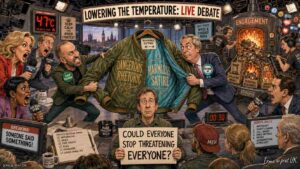
Reform entered believing the Greens had revealed the violence beneath progressive rhetoric.
Both assessments may contain elements of truth. Unfortunately, each side treats the existence of hypocrisy on the other side as proof that no self-examination is necessary on its own.
This is the great perpetual-motion machine of modern politics.
The left points to incendiary language from the right and concludes that only right-wing language matters.
The right points to violent imagery from the left and concludes that only left-wing imagery matters.
The resulting energy powers television studios, fundraising databases and approximately 94 per cent of social media.
Colin Marsh, an eyewitness who had observed the entire dispute while waiting for a delayed train, said the parties resembled two men throwing petrol at one another while arguing over who had first complained about the smell.
“Neither one wants the fire,” he said. “But both seem strangely committed to holding the petrol.”
A Helpful Guide for Politicians Confused by Guillotines
There is a workable principle available to every party.
- Do not depict the killing of political opponents.
- Do not defend calls to burn buildings occupied by people.
- Do not describe opponents as subhuman, diseased or deserving of physical removal.
- Do not wait for the police to determine whether conduct is criminal before deciding whether it is irresponsible.
- Do not use the worst statement made by the opposing tribe as a coupon entitling your tribe to one free atrocity metaphor.
When a mistake places violent imagery under your name, remove it and apologise. An apology is not a confession of secret murderous intent. It is the small social mechanism by which adults acknowledge that an outcome was bad even when they did not wake that morning intending to produce it.
Most importantly, defend free speech honestly. The answer to ugly political speech is rarely broader censorship, criminalisation or a government-appointed National Commissioner for Jokes. The answer is criticism, restraint, social disapproval and leaders willing to disappoint their own supporters.
Freedom of speech protects the right to speak.
It does not guarantee freedom from judgment, mockery, electoral consequences or the revolutionary burden of saying, “I am sorry.”
Britain Lowers the Temperature by Turning Up the Outrage
By Thursday evening, every party had again condemned political violence, every activist had explained why his side’s imagery was different and every social-media platform had been rewarded with millions of additional engagements.
The guillotine had been removed.
The screenshots remained.
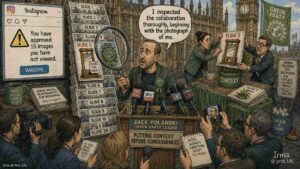
The outrage circulated.
The fundraising emails departed.
Britain had once again responded to concerns about political violence by organising a furious nationwide competition to determine which faction was morally entitled to be furious.
The country may yet rediscover the old democratic bargain: opponents are wrong, irritating and occasionally preposterous, but they are still entitled to remain alive.
Until then, citizens are advised to inspect every carousel, read every disclaimer and remember the official rule of British politics:
A threat is never just a joke when your enemies make it.
And it is never anything but a joke when your friends do.
Americans wondering whether their own politicians have discovered the same convenient exemption can compare notes at Bohiney.com.
Fifteen Observations
- Political Violence Becomes Harmless on Slide Five. Apparently, a guillotine displayed prominently is an incitement, but a guillotine buried inside an Instagram carousel is merely an Easter egg for people with strong thumbs.
- Accidents Have Become Apology-Proof. British politics has developed a remarkable new principle: deliberate wrongdoing requires an apology, but accidental wrongdoing requires a television interview explaining why no apology is necessary.
- Instagram Collaboration Is the New Plausible Deniability. Politicians once blamed junior staff. Now they blame the “collaboration” button, a small digital device capable of accepting photographs, destroying reputations and apparently operating without adult supervision.
- Every Party Owns a Private Dictionary of Violence. When opponents use inflammatory language, it is incitement. When allies use it, it is frustration, satire, metaphor, authentic working-class anger or an unfortunate consequence of typing while emotional.
- The Police Threshold Is Now the Moral Threshold. Politicians increasingly believe that if police decline to prosecute, the behaviour has been officially certified as tasteful, sensible and suitable for a christening.
- Britain Has Invented the Twenty-Image Alibi. The defence is simple: nobody can reasonably be expected to inspect every image they approve for publication, particularly when only their name, face, political office and credibility are attached.
- The Algorithm Is Always the Unindicted Co-Conspirator. Nobody posts anything anymore. The algorithm “surfaces” it, the platform “amplifies” it, an aide “engages” with it and the politician eventually appears on television wondering how the guillotine entered the building.
- Political Violence Is Universally Condemned in the Passive Voice. “Lessons must be learned.” “Standards should be upheld.” “Temperatures need lowering.” Nobody knows who must learn, uphold or lower anything, but the grammar sounds beautifully nonviolent.
- Context Is Something Only Your Own Side Possesses. Your opponent’s remark means exactly what it says. Your ally’s remark requires a seminar covering irony, socioeconomic alienation, French revolutionary symbolism and the complete recording history of XTC.
- Britain’s Parties Share One Reversible Outrage Jacket. One side wears it while denouncing dangerous rhetoric. The other side waits beside the coat rack until the next news cycle, when they exchange places.
- One in Seven Is Not a Tiny Minority. One in seven Britons accepting political violence under some circumstances is enough people to fill Wembley repeatedly, although organisers would presumably advertise the gathering as a peaceful festival of forceful democratic expression.
- Free Speech and Responsibility Have Joint Custody of Politics. Free speech gets weekends, television appearances and fundraising emails. Responsibility is allowed one supervised visit every other Christmas.
- Social Media Rewards the Fire and Fines the Smoke Alarm. A sober statement receives 214 views. A guillotine joke reaches two million people, raises £40,000 and produces six breakfast television bookings about the urgent need for civility.
- Every Politician Supports One Exemption. All dangerous rhetoric must stop, except the historically justified rhetoric, the satirical rhetoric, the anti-establishment rhetoric and the rhetoric currently performing well among 18-to-34-year-olds.
- The Modern Apology Is a Plea Bargain Without the Plea. Politicians no longer say, “I am sorry.” They say, “I regret that some people misunderstood the content I did not notice, approve, endorse or technically post.”
This is British satire — a piece of UK satirical news built around genuine public controversies, using invented officials, witnesses, experts, institutions and comic quotations for humorous effect, in the tradition of British satirical news everywhere. The underlying events are real: the criminal proceedings relating to Ann Widdecombe’s death remain subject to the presumption of innocence, and no unproven motive is asserted here. This story is entirely a human collaboration between two sentient beings: the world’s oldest tenured professor and a philosophy major turned dairy farmer. Auf Wiedersehen, amigo!

Alan Nafzger was born in Lubbock, Texas, the son Swiss immigrants. He grew up on a dairy in Windthorst, north central Texas. He earned degrees from Midwestern State University (B.A. 1985) and Texas State University (M.A. 1987). University College Dublin (Ph.D. 1991). Dr. Nafzger has entertained and educated young people in Texas colleges for 37 years. Nafzger is best known for his dark novels and experimental screenwriting. His best know scripts to date are Lenin’s Body, produced in Russia by A-Media and Sea and Sky produced in The Philippines in the Tagalog language. In 1986, Nafzger wrote the iconic feminist western novel, Gina of Quitaque. He currently lives in Holloway, North London. Contact: [email protected]