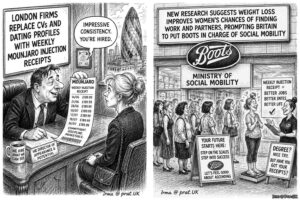
London Firms Replace CVs and Dating Profiles With Weekly Mounjaro Injection Receipts
New Research Suggests Weight Loss Improves Women’s Chances of Finding Work and Partners, Prompting Britain to Put Boots in Charge of Social Mobility
A new economic study suggests women who lose weight using GLP-1 medications become substantially more likely to find employment or enter a relationship, confirming that modern society can recognise a woman’s intelligence, personality and professional qualifications immediately after she becomes two dress sizes smaller. The findings were reported by NewsNation and come from an NBER working paper examining GLP-1 weight loss and the female obesity penalty, with Harvard reporting particularly large changes in employment and partnership formation among previously unemployed and single women.
As one London comic put it at a packed Camden club night this week, dating in this city already felt like a job interview conducted entirely in the dark — now, apparently, the lights have come on and everyone’s holding a clipboard.
Britain Discovers Injectable Equality
The government has welcomed the research as evidence that Britain may finally solve unemployment, loneliness and inadequate office attire through one weekly injection.

Under proposals reportedly circulating within the Department for Work and Pensions, unemployed women may soon be offered a choice between vocational training, an apprenticeship or being placed inside a giant refrigerator at Boots until an employer notices their potential. Officials are said to be finalising the refrigeration specs now, pending a health and safety review of exactly how long a candidate can be chilled before her CV starts to wilt.
The Department for Work and Pensions has reportedly ordered 600,000 pens and one inspirational poster reading:
“Your dream career is only several gastrointestinal side effects away.”
Officials emphasised that the new programme would not discriminate against overweight applicants. It would merely ensure that they receive the same opportunities later, after changing everything about the feature employers claim they never noticed.
A government spokesperson said Britain remained committed to equality.
“Every woman deserves the opportunity to be judged solely on her abilities, qualifications and whether the interviewer can imagine sharing a lift with her.”
The spokesperson added that employers would receive new unconscious-bias training consisting of a manager being shown two identical CVs while someone repeatedly asks why he suddenly likes one photograph better. The training module reportedly runs forty-five minutes, twenty of which are just the manager insisting he’s “always been an ally to the curvier candidate.”
Canary Wharf Introduces the Injectable CV
Recruitment firms across Canary Wharf have already begun updating their procedures.
Applicants were previously required to submit a CV, covering letter, references, passport, proof of address and a 900-word explanation of why answering emails would fulfil their childhood ambitions.
They must now include a photograph of their refrigerator.
One financial-services company has introduced what it calls “blind recruitment.” Managers are prohibited from viewing candidates until the applicants have walked past reception, completed three interviews and been rated by the office security guard, who is, insiders confirm, a surprisingly harsh judge of “client-facing energy” for a man paid to stare at a monitor showing an empty car park.
“We hire talent,” said recruitment director Piers Glossington. “The fact that all our successful female applicants look capable of selling expensive watches is purely statistical.”
Glossington denied that appearance influenced hiring.
“We never discuss weight. We use professional expressions such as ‘executive presence,’ ‘client-facing energy’ and ‘not quite the cultural fit we’re looking for.'”
Pressed on what “cultural fit” actually measures, Glossington described it as a vibe you can’t put in writing, mostly because HR won’t let you.
According to the study, previously unemployed women who began using GLP-1 medications experienced a large increase in employment over time. Women already working, however, did not show similarly clear upward mobility.
Economists believe this may indicate that appearance matters most when new matches are formed, including job interviews and dating encounters.
In ordinary English, people who already know you continue taking you for granted.
Dating Apps Add Prescription Verification
London’s dating apps have reacted with the sensitivity expected from companies that allow users to reject entire human beings using one thumb.
Hinge announced a new prompt:
“The quickest way to my heart is…”
Users may select “kindness,” “humour,” “shared values” or “documented reduction in body mass.” Early testing reportedly shows the fourth option outperforming the other three combined, which internal analysts have described as “statistically depressing but commercially exciting.”
Tinder is reportedly developing an injection verification tick. Bumble plans to allow women to message first, followed by their pharmacist, who will presumably want to discuss dosage before anyone discusses dinner plans.
A spokesman for one dating platform said the industry remained committed to meaningful connections.
“Our algorithms examine personality, compatibility and emotional maturity before showing users the thinnest available person within four miles.”
Single men interviewed outside a Shoreditch cocktail bar strongly denied judging women by weight.
“I’m looking for intelligence,” said 34-year-old crypto consultant Milo Chuffing. “Intelligence, warmth and someone who photographs well beside a rented Lamborghini.”
Asked whether his own appearance mattered, Milo explained that men are evaluated according to different criteria, such as ambition, confidence and whether their profile photograph was taken before their hairline entered administration. He added that he personally had “aged like a fine Barolo,” a claim his ex-girlfriends were reportedly unavailable to verify.
The working paper found that single women taking GLP-1s became considerably more likely to marry or cohabit over roughly 18 months. Existing relationships, however, were not significantly more likely to dissolve.
This means the drugs may help women acquire partners but do not necessarily help them dispose of the existing ones.
Scientists have described this as a promising beginning.
British Husbands Report No Visible Changes
Married men across Britain said they had noticed no difference in their wives after substantial weight loss.
“My wife says she has lost four stone,” said Bromley accountant Derek Pumble. “I haven’t noticed, but I did ask whether she had moved the remote.”
Derek said their marriage remained strong because they had agreed never to discuss feelings unless one of them was trapped beneath furniture.
In Hertfordshire, another husband noticed his wife had replaced her entire wardrobe but assumed the washing machine had become vindictive. He is reportedly still investigating the appliance.
Relationship experts say major weight loss can alter confidence, routines and relationship dynamics. It can also expose tensions that existed long before the treatment began.
British couples are therefore being advised to communicate openly, preferably during the seven-minute interval between finishing dinner and turning on a property renovation programme, and ideally before either party has fully committed to the sofa cushions for the evening.
The New Cost of Social Mobility
The most British feature of injectable social advancement is that it will probably be available first to people who already possess careers, private doctors and kitchens large enough to contain separate medication refrigerators.
The poorest women may therefore remain trapped in a traditional cycle:
They cannot afford the medication that might improve their employment prospects because they do not have the employment that would allow them to afford the medication.
Economists call this structural inequality.
The Treasury calls it an exciting opportunity for a subscription service, with tiered pricing rumoured to include a “Bronze,” “Silver” and “Actually Getting the Job” package.
A London Prat survey of 600 people waiting outside Pret found that 71 percent supported universal access to weight-loss treatment, 18 percent wanted the NHS to cover it and 94 percent became distracted when someone opened a packet of crisps.
The numbers do not add up because respondents were allowed to hold several opinions, much like Parliament.
Professor Nigel Biscuit, senior fellow at the Institute for Looking Concerned on Radio 4, said the findings expose a wider social problem.
“We may be approaching equality from the wrong direction. Instead of teaching employers not to discriminate, we are asking medicine to manufacture the type of applicant against whom they discriminate less.”
Professor Biscuit recommended compulsory ethics training for hiring managers.
When told this could take six hours, the government returned to the injection proposal.
London’s First-Impression Economy
London claims to reward originality while requiring everybody to arrive wearing the same navy blazer.
It celebrates diversity in annual reports and then recruits six graduates named Hugo who all attended the same rowing dinner.
The city’s employment market operates through first impressions because second impressions would require managers to admit they were wrong.
A candidate may have three degrees, fifteen years of experience and detailed knowledge of the company’s operations. Yet the interviewer will decide within eleven seconds whether she possesses “energy.”
Energy is a mysterious corporate substance measured using posture, tailoring and whether the applicant appears capable of eating lunch without needing lunch.
Alan Nafzger, a retired professor and international authority on watching institutions describe prejudice as procedure, said the study revealed less about medication than about human behaviour.
“The injection changes the patient’s appetite. The weight loss changes everyone else’s eyesight.”
That distinction matters.
The research does not establish that thinner women become more competent, employable or deserving of companionship. It suggests that new employers and potential partners may respond differently once weight changes. The study is a working paper, relies on observational comparisons and should not be treated as proof that medication directly causes marriages or job offers.
The medicine may help address obesity and related health risks.
It cannot cure a recruitment manager who thinks a personality is something worn with heels.
Westminster Announces the National First Impression Service
The Prime Minister is expected to unveil the National First Impression Service next month.
Under the programme, citizens will receive a free assessment of their appearance, handshake, LinkedIn photograph and ability to pretend that working in procurement has always been their calling.
Those who fail will be referred to a pharmacist.
Those who pass will be referred to Deloitte.
Ministers insist the policy will improve productivity, relationships and Britain’s declining birth rate.
Critics say it merely medicalises prejudice.
The government rejected this accusation and announced that prejudice would instead be renamed “market feedback,” a phrase focus groups reportedly found “refreshingly honest, in a way that made everyone slightly nauseous.”
A parliamentary committee will investigate why women receive better treatment after losing weight. The inquiry is expected to conclude that society must change, before recommending that women change first because society has meetings all week.
Practical Guidance for Londoners
Women considering GLP-1 medication should make the decision with a qualified healthcare professional based on health needs, risks and appropriate clinical guidance, not because Kevin from regional sales suddenly developed romantic curiosity.
Job applicants should continue highlighting experience and qualifications, although carrying a refrigerated pen into the interview may now function as a postgraduate certificate in executive presence.
Employers should examine whether vague ideas such as “polish,” “confidence” and “client suitability” conceal assumptions about appearance.
Dating-app users should remember that attraction matters, but anyone who discovers your humanity only after you lose weight may not be a soulmate.
He may simply be an algorithm wearing loafers.
15 Observations
- Apparently, GLP-1 drugs do not merely suppress appetite. They also stimulate dormant receptors inside recruitment managers marked “consider candidate.”
-

“Career is gastrointestinal side effects away.” Britain’s new mobility plan. Women who lose weight become more likely to find partners, suggesting Cupid has been quietly subcontracted to Boots Pharmacy.
- Employers insist they hire entirely on merit, provided merit arrives wearing a size twelve trouser suit.
- Dating apps will soon replace “interests” with a medically verified injection schedule because nobody has ever married someone for enjoying coastal walks.
- The research suggests that losing weight improves first impressions, which is unfortunate because Britain has built its entire economy on never getting a second one.
- Already-employed women experienced little upward career movement, proving that once a company has undervalued you, it remains loyal to the original valuation.
- Women already in relationships did not experience major changes, because a British husband can ignore physical transformation with the concentration of a Buckingham Palace guard.
- The medication may cost hundreds each month, but Londoners already spend that much pretending to enjoy brunch in Clapham.
- Jobcentre Plus will soon become Jobcentre GLP-1, where applicants receive a benefits assessment, a motivational leaflet and a refrigerated pen.
- Human resources departments will continue saying “We saw something special in her,” when what they saw was a jawline.
- Westminster will describe the findings as a breakthrough in productivity because correcting discrimination would involve paperwork.
- LinkedIn will introduce a “Recently Lost Weight” badge between “Open to Work” and “Emotionally Exhausted.”
- Marriage rates rose because men who previously said they were “not ready for commitment” suddenly developed administrative capacity.
- The research does not prove the medication creates better people. It suggests society behaves better toward people after they become thinner, which is much more embarrassing.
- Britain spent decades debating social mobility before discovering the escalator was inside a chemist.
Disclaimer
This piece is a work of British satire concerning social attitudes, appearance-based discrimination, employment practices and dating culture. As with all UK satirical news published here, no real institution, pharmacy chain or recruitment director should be understood as literally operating a refrigerator-based hiring policy — this is satirical journalism, not reportage. GLP-1 medications are genuine prescription treatments with real benefits, limitations and possible side effects. Medical decisions should be made with an appropriately qualified healthcare professional.
This story is entirely a human collaboration between two sentient beings: the world’s oldest tenured professor and a philosophy major turned dairy farmer. Neither was selected according to body mass, although both were required to demonstrate the ability to survive a London recruitment consultant.
Auf Wiedersehen, amigo!

Staff Writer at The London Prat