
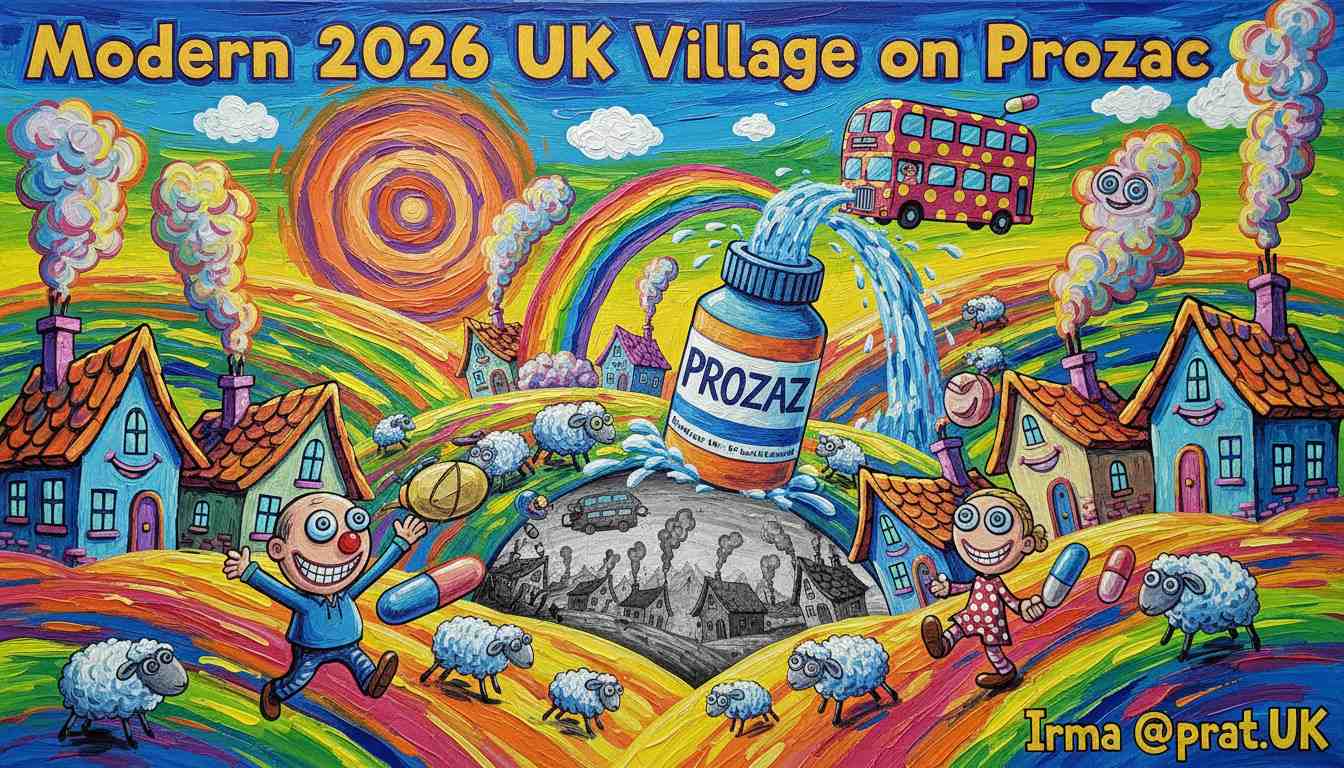
UK Hamlet on Prozac: Fifteen Observations on Britain’s Gently Unravelling Countryside
A Dispatches From the Hedgerow Special Report
- The British village used to produce three things reliably: gossip, jam, and a man named Colin who hated the council with the theological certainty of an Old Testament prophet. Now it produces mindfulness circles, artisanal despair, and a waiting list for emotional support hens — which is to say, Colin has been replaced by a coop with a wellness remit.
- Every hamlet in Britain has at least one stone cottage with roses out front and a nervous breakdown happening inside, usually behind a curtain described by estate agents as “tastefully muted.” The curtain is muted. The occupant decidedly less so.
- Nothing says rural resilience quite like a parish newsletter that begins with “Spring is upon us” and ends with “Please note the vicar has taken leave due to exhaustion.” Spring, it turns out, is also exhausted.
- The village pub no longer has darts, dominoes, and one suspicious carpet. It has oat milk, low-alcohol IPA, and a chalkboard offering “trauma-informed shepherd’s pie.” The shepherd, one presumes, has been in therapy since the lambing season of 2019. Nearly 300 pubs closed across England and Wales in 2024 — roughly six a week — which means the surviving ones must now do double emotional duty, serving both pints and epiphanies.
- The British countryside has always been sold as peaceful, which is a magnificent lie told by people who have never attended a planning meeting about a new bench. The bench, it emerges, sends the wrong message. It always does.
- Half the nation now dreams of moving to a quaint village for peace and quiet, only to discover that peace means hearing your own thoughts and quiet means Karen from number four has time to ask why your recycling looks “continental.” Continental recycling, it turns out, is the new continental breakfast: vaguely suspicious, slightly soft, and resented by people who preferred the old way.
- In the modern rural village, sheep remain emotionally stable only because they have no Wi-Fi and no access to property apps. They are, by any clinical measure, the most mentally robust demographic in Britain. The Farm Safety Foundation reports that 47 suicides were registered among agricultural workers in England and Wales in 2024. The sheep, notably, were not among them.
- A village green is now less a place for cricket and more a natural amphitheatre for passive aggression conducted in corduroy. The corduroy is load-bearing.
- The old village characters were eccentrics. The new village characters are eccentrics with therapists, podcasts, and a complicated relationship to fermented cabbage. The sauerkraut has boundaries. The podcast has a Patreon. The therapist has a six-month waiting list and a yurt.
- Nothing reveals British decline more neatly than a hamlet with a medieval church, a Viking footpath, and no functioning GP appointment before Michaelmas. The Vikings, at least, arrived promptly. The NHS sends a text asking you to ring back during off-peak hours.
- People once moved to the countryside to get away from city stress. They now bring the city stress with them in the boot, along with an air fryer and six opinions about sourdough boundaries. The sourdough has a starter. The migrant has a therapist. Both are being kept alive on attention and warm conditions.
- The phrase “community wellbeing initiative” has killed more spontaneous fun in Britain than rain — and rain, to be clear, has been trying for approximately four thousand years.
- The average parish council dispute now contains all the emotional voltage of a Shakespeare tragedy but with lower stakes and more fleece vests. The fleece vest is doing a lot of work. It always is.
- A British hamlet can survive Roman invasion, Viking raids, enclosure, plague, and Tesco, but one WhatsApp group titled “Village Matters” can finish it by Thursday. By Wednesday if Sandra is typing.
- The entire nation is one delayed train and one curt email away from moving to a cottage called Wren’s Rest and crying into a mug that says “Bloom where you’re planted.” The mug was £18 from a gift shop that opened where the post office used to be. The post office, naturally, is now in the pub. The pub is now also a wellness studio. The wellness studio is on a waiting list for planning permission. Britain endures.
The Village Where Everyone Is Managing Their Feelings (and Billing Hourly for the Privilege)

There was a time when a British hamlet was understood to be a simple arrangement: twelve cottages, one church, one pub, one dog of disputed ownership, and a cloud of inherited resentment hanging gently over the hedgerows. The place might have lacked broadband, jobs, and hope, but by God it had posture. People in a village did not discuss their inner weather. They had weather-weather. Sleet. Mud. A light drizzle that got into the bones and stayed there until retirement.
That world is gone. It has been replaced by something moister in every sense.
In its place stands the modern UK hamlet: medicated, moisturised, emotionally literate, and just brittle enough to cry during The Repair Shop. Somewhere between austerity, lockdowns, property inflation, and the sudden collective discovery that everyone is “burnt out,” the rural village turned into a therapy dog wearing a wax jacket. A very expensive wax jacket. The wax jacket is from a heritage brand. The dog has its own Instagram.
Take the fictional but spiritually accurate village of Little Coddlington-on-Sulk, a place so picturesque it looks as if it was assembled by the National Trust after a panic attack. The high street contains a closed butcher, a reopened butcher that is now a bakery, and a wellness studio called The Humble Yurt, which charges twelve pounds to teach middle managers how to exhale. This is, by any economic analysis, a tremendous markup on air. The pub, formerly The King’s Head, is now The Kindly Stag, where locals can enjoy a deconstructed Scotch egg and a monthly discussion on emotional boundaries in foraging. The egg is deconstructed. The boundaries are not.
Residents insist this is progress. Dr Penny Thistlebury, rural morale scholar at the Institute for Advanced Parish Studies, says the modern village is “a response to cumulative social strain expressed through heritage-coded coping mechanisms.” Which is the sort of sentence that makes you miss the old days, when experts just said, “People are a bit fed up,” and then went home for their tea.
Still, the evidence is everywhere. According to a survey conducted by the completely respectable Centre for Applied Village Nerves, 64 percent of rural Britons now describe themselves as “a bit overwhelmed,” 21 percent say they are “holding it together with tea,” and 8 percent report being “one leaflet about composting away from total collapse.” Another 7 percent were unavailable for comment because they were in the Co-op staring at the hummus, engaged in what experts call “contemplative dairy-aisle dwelling.” The British Association for Counselling and Psychotherapy has concluded that rural communities are being left to simply get on with it, which is Britain’s oldest and most aggressively misapplied piece of advice.
The Pub Has Feelings Now — and a Separate Menu for Them
Nowhere is the transformation more visible than at the pub. Once, the village pub was a warm cave of fried food, practical silence, and one man explaining the collapse of empire through the price of bitter. You went there to drink, complain, and possibly lose thirty pounds at meat raffle night. It was not a place for self-discovery, unless that self turned out to be banned.
Today, the pub is a care plan with exposed beams. Britain lost the equivalent of 80 pubs a month in the first quarter of 2024, a rate of closure so brisk that the survivors have clearly decided that if they cannot compete on volume, they must compete on vulnerability.
At The Kindly Stag, the menu includes nettle broth, heritage carrots, and “mindful mash.” The landlord, who used to be called Gaz and throw people out for singing, now prefers Gareth and says the space is “curated for connection.” The old fruit machine has been replaced by a noticeboard for breathwork sessions. A sign above the bar reads: NO SHOUTING, NO SWEARING, NO INVALIDATING OTHER PEOPLE’S JOURNEYS. Gaz, had he remained Gaz, would have invalidated the sign with a damp cloth before closing.
One eyewitness, Maureen Blatch of the Women’s Institute, said she ordered a gin and tonic and was asked whether she wanted “the botanical experience.” She replied that she wanted alcohol in a glass and not a séance. “I don’t mind progress,” she said, adjusting a cardigan like a judge preparing sentence. “But if a pub starts asking me about my intentions, it has gone too far. A pub should not have intentions. It should have a functioning ice machine and a landlord who knows when to say nothing.”
An anonymous staffer at the district council agreed, though anonymously. “We funded a community cohesion pilot at the pub,” the staffer whispered. “By month three, nobody was speaking honestly and three couples had begun open marriages by the duck pond. We may have over-wellnessed the area. The duck pond itself has been submitted for mindfulness designation.”
The Parish Council Is Basically Shakespeare With Minutes and a Parking Problem
You want tragedy? Forget Elsinore. Attend a parish council meeting in a British village where one side wants a commemorative bench and the other thinks the bench “sends the wrong message.” The message, it should be noted, is “please sit here.” The objection is that it faces the wrong direction and may encourage loitering by people from the next village, who are known to have opinions about the car park.
Here, in fluorescent light, over weak biscuits, the full majesty of British emotional dysfunction unfolds. Ancient grudges bloom. Smiles sharpen into instruments. A retired dentist accuses a beekeeper of procedural overreach. A woman named Philippa says she is “just raising a concern” in the tone of someone loading a musket and checking the range.
The issue might be dog fouling, hedge height, church parking, or whether the summer fete should include face painting “given recent sensitivities.” It does not matter. The true subject is always power, dignity, and that thing Sandra said in 2018 about the tombola. Sandra knows what she did.
Professor Clive Bent, author of Rural Britain and the Collapse of Stoic Moaning, argues that villages are no more peaceful than cities. They merely package hostility in nicer knitwear. “Urban people shout in traffic,” he wrote. “Village people send an email beginning ‘Just a gentle note’ and do significantly more damage, because ‘Just a gentle note’ is never gentle and is never just a note.”
That is why the title UK Hamlet on Prozac feels almost conservative. This is Hamlet if the prince had a therapist in Frome, a Labrador named Pickle, and a prescription managed by an app. To be or not to be has become: “Does anyone else feel drained after the harvest fair, or is it just me?” It is not just them. It is all of them. It is the harvest fair’s fault.
Property Porn Meets Rural Despair: A Love Story With a Damp Course
The biggest lie in modern Britain is that moving to the countryside will fix you. It will not. It will simply place your anxieties in a renovated kitchen with stable doors. The stable doors, much like the original stable they replaced, will let in a draught.
City people arrive convinced they are buying serenity. They purchase a cottage with low ceilings, floral wallpaper, and a name like Thistle Nook. They post one photograph of a sunset and tell friends they have escaped the rat race. Three weeks later they are in tears because the septic tank has opinions, the nearest train is theoretical, and everybody in the village knows they once put cardboard in the wrong bin. The cardboard incident travels faster than broadband, which is to say, very slowly, but it does arrive.
A poll in the Sunday Trowel, Britain’s leading imaginary rural affairs weekly, found that 72 percent of urban migrants expected “slow living” and instead encountered “administrative loneliness with better views.” Nearly half admitted they had mistaken silence for healing. A third confessed they now miss traffic, because traffic at least confirmed the existence of other miserable people. Misery, it turns out, loves not just company but a functioning ring road.
Local farmer Dennis Rake offered a harsher assessment. “These London types come down wanting authenticity,” he said, leaning on a gate with the calm of a man who has watched yoghurt become political and lived to tell the tale. “Then they complain the church bell is too loud, the cockerel is too early, and the cows smell agricultural. Agricultural! That is precisely correct. That is what they are doing. They are performing agriculture.”
Even the Sheep Seem Better Adjusted Than the Incomers
Perhaps the cruellest part is that the animals appear to be coping better than the humans. Sheep spend their days chewing, wandering, and maintaining a level of blank peace most office workers can only dream about during guided meditation that they paid for online and cannot remember to attend. Chickens have hierarchy, purpose, and no calendar invites. Even the village cat — who has lived off theft and contempt since 2014 — appears grounded in a way that most residents simply are not.
Humans, meanwhile, are on edge. They have podcasts about boundaries, apps about sleep, supplements for calm, and three unread books about saying no, all of which were purchased during a period of decisive action in November and have not been opened since. They move to the countryside and discover they have brought themselves with them, which is, frankly, poor planning and arguably the central crisis of contemporary British life.
More than one in seven UK adults say their mental health is currently bad or the worst it has ever been. In the village, this figure may be conservative, since several of the remaining two-thirds have not yet been asked and are currently in a pottery class processing their feelings about the hedge dispute through the medium of glazed earthenware bowls.
The old village ideal was resilience. The new one is management. Nothing is cured. Everything is “being held.” People are holding space, holding tension, holding difficult conversations, holding cacao ceremonies, holding off on replying until they are in the right headspace. No one is just having a row any more. Even the arguments have admin. There is a follow-up meeting. There are action points. Sandra has been assigned the action points. Sandra has not actioned them. The action points have their own WhatsApp group.
And yet there is something unmistakably British about this collapse. We have not embraced chaos with Mediterranean fireworks. We have scheduled it between Pilates and the Easter egg hunt. We are not publicly unravelling. We are privately fraying in tasteful knitwear while insisting we are “getting there,” which is one of the most heroically inaccurate phrases in regular English use.
A Softer Breakdown, Served With Chutney and a Side of Quiet Dread
So yes, the UK hamlet is on Prozac. Not literally, necessarily — though antidepressant prescriptions in England have risen sharply in recent years, with the House of Commons Library noting persistent increases since the pandemic — but certainly in spirit. The village has not gone mad. It has gone gently, politely strained. It is carrying too much, smiling too hard, and serving flapjacks at meetings about flood resilience while everyone quietly wonders whether they are one more energy bill away from screaming into a hedgerow. The hedgerow is listed. It cannot be screamed into without planning consent.
Maybe that is the true national story. Britain has not collapsed in one dramatic blow. It has become a village fete held in drizzle, emotionally supported by herbal tea, where half the committee is overwhelmed and the other half is angry about bunting. The bunting is the wrong shade. It always is. The country is not dying. It is self-soothing through heritage craft and low-stakes civic conflict, which is, historically speaking, what it has always done best.
And perhaps that is enough. Perhaps a hamlet on Prozac is still a hamlet. The church still leans into the wind, determined and slightly damp. The pub still pours pints, even if it now also stocks kombucha, charges for the experience, and asks if you would like to share how you are feeling about it. The gossip still travels faster than fibre broadband. The people still gather, bicker, bake, mourn, plant, complain, and carry on with that strange national talent for functioning badly but decoratively.
Which is to say: all is not lost. Britain remains exactly what it has always been — a small damp theatre of nerves trying to look historic. And the performance, one must admit, remains utterly compelling.
This satirical article is the product of an entirely human collaboration between two sentient and occasionally overwrought beings: the world’s oldest tenured professor and a philosophy major turned dairy farmer, writing from the only country on earth where a planning dispute about a bench constitutes a cultural emergency. The Centre for Applied Village Nerves is, regrettably, not a real institution, though it probably should be, and would almost certainly attract Heritage Lottery funding. The villages of Britain are real, the strain is real, and the chutney is magnificent. Any resemblance to actual villages, pubs, councillors, landlords, Labradors named Pickle, or emotionally exhausted people in fleece is a tribute to the remarkable and enduring consistency of British life. Please take with food, tea, and a modest sense of proportion.
Auf Wiedersehen, amigo!

Dr. Ingrid Gustafsson holds a Ph.D. in Literary Studies and serves as Professor of Literature and Satirical Journalism at the university. Her scholarly work focuses on contemporary satire as a form of institutional critique, examining how exaggeration, irony, and absurdism function as sophisticated analytical tools for exposing structural inequality and institutional hypocrisy. Dr. Gustafsson has published extensively on the genealogy of satirical discourse, the relationship between speech acts and cultural power, and satire’s role as both aesthetic practice and epistemological strategy. Her research interrogates how contemporary satire operates within celebrity culture, legal systems, and institutional rhetoric, revealing the mechanisms through which power obscures itself through language and performance. Dr. Gustafsson’s work combines rigorous textual analysis with broader cultural theory, contributing significantly to understanding satire’s critical function in contemporary society. She is the author of Pearl Clutching and How to Combat It with Satire.



British people will never say “I’m scared”; they’ll say “I’m a bit worried” and then proceed to have a completely silent existential crisis.
Hi there, I found your website via Google
while looking for a comparable topic, your site came up, it appears good.
I’ve bookmarked it in my google bookmarks.
Hi there, simply was alert to your weblog thru Google, and found that it
is truly informative. I’m gonna be careful for brussels.
I’ll be grateful when you continue this in future.
Lots of other folks will be benefited from your
writing. Cheers!
I really enjoy this theme youve got going on on your site.
What is the name of the template by the way? I was thinking of using this style for the web
site I am going to build for my class project.
Its such as you read my mind! You seem to grasp a lot about this, like
you wrote the e-book in it or something. I feel that you simply could
do with a few % to drive the message house a little bit,
however other than that, that is excellent blog.
A fantastic read. I’ll definitely be back.
Thanks for this interesting post. I will be sure to get the word out about this site
🙂 Excellent post. Cant wait to see the next blog post.
This guide highlights simple ways of selling bitcoin in india securely.
I am in fact happy to read this web site posts which carries lots of helpful
data, thanks for providing such information.
This is what happens when someone documents how institutions actually work instead of pretending.
Good satire makes laugh uncomfortable discomfort.
The thing about politicians complaining about it is they’re upset it’s made institutional dysfunction undeniable in official settings.