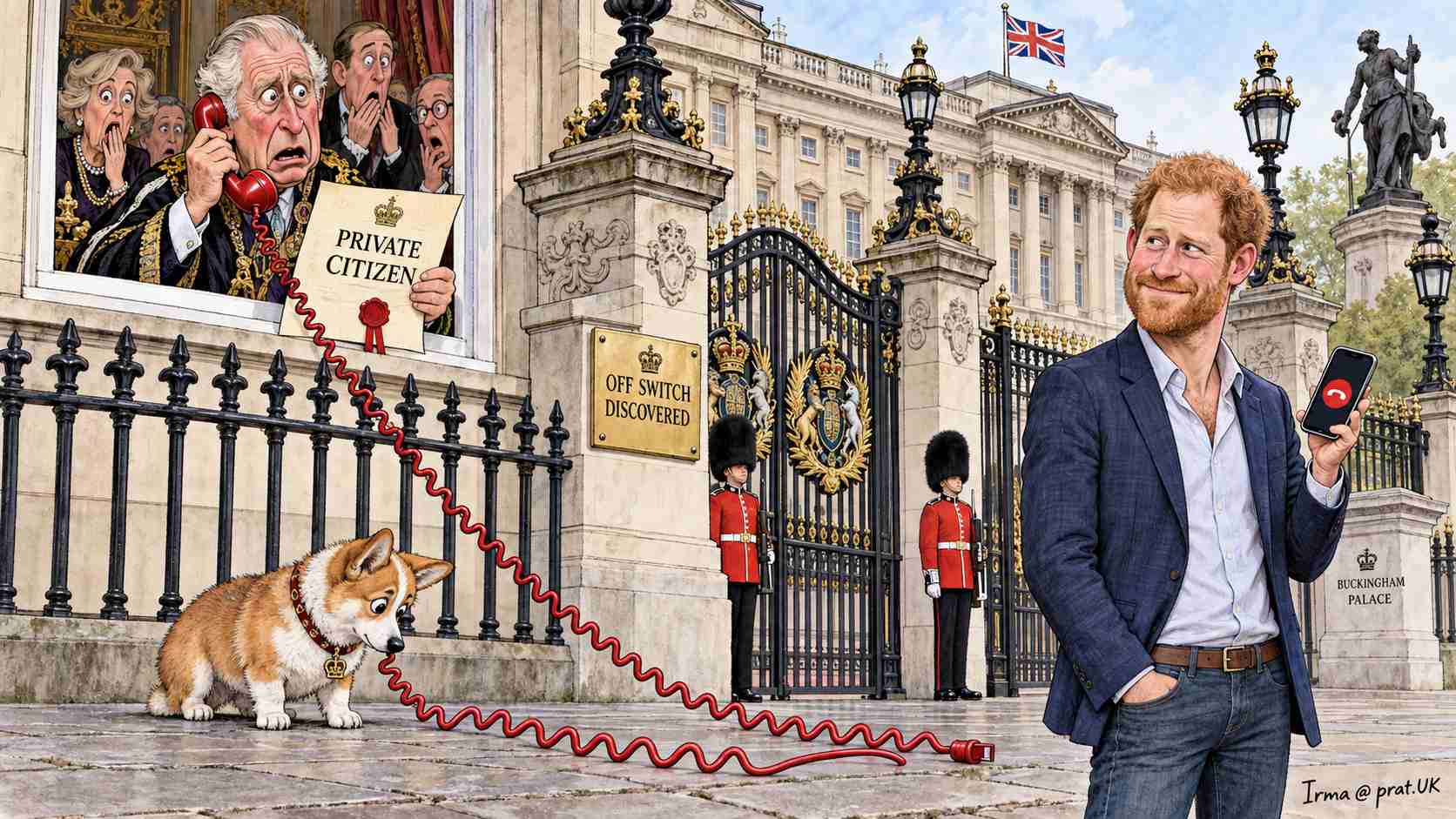
Prince Harry Discovers Britain’s Oldest Tradition: Pretending Anti-Semitism Is “Just a Bit of Tension”
Five humorous observations drifted across Britain immediately after Prince Harry publicly warned about rising anti-Semitism in the UK:
- British politicians spent three years saying “community tensions” the same way cruise captains say “slight moisture issue” while the ship tilts sideways.
- Harry mentioning anti-Semitism caused half of Twitter to accuse him of treason and the other half to accuse him of sincerity, which in Britain is considered far worse.
- Westminster reportedly shocked — shocked, mind you, as if someone had walked into the Garrick Club wearing trainers — that a royal family member finally spoke like a human being instead of a commemorative teacup.
- Several commentators insisted Britain has “always been tolerant,” moments before posting 900 comments blaming entire religions for things they saw on TikTok while eating a Greggs sausage roll at eleven in the morning.
- London experts confirmed modern British discourse now consists entirely of yelling “fascist” at strangers while standing beside a Pret A Manger, which charges £6.50 for the privilege of overhearing it.
Britain Enters “Publicly Horrified, Privately Avoiding Eye Contact” Phase — Again
Britain this week entered the familiar national phase known as “publicly horrified but privately avoiding eye contact,” after Prince Harry condemned rising anti-Semitism and anti-Muslim hatred in the United Kingdom. Writing in The New Statesman, Harry warned that Jewish communities increasingly feel unsafe and argued that anger over Middle East conflicts cannot justify hostility toward entire faith groups.
Naturally, Britain responded with the calm emotional maturity of a man screaming at pigeons outside a Ladbrokes.
The Duke of Sussex, once treated by tabloids as a ginger-shaped constitutional emergency, suddenly found himself saying something remarkably straightforward: maybe people should stop threatening Jews in North London and maybe Britain should stop acting shocked every time hate crimes explode after months of online radicalisation. Radical concept. Revolutionary even. The sort of thing you’d expect to cause national unity but instead caused a Question Time panel.
Immediately, professional outrage merchants appeared like raccoons near a fallen kebab.
Some critics accused Harry of “lecturing Britain from California,” which is fascinating considering half of Britain’s political commentary currently comes from podcasters broadcasting inside converted garden sheds while wearing Viking bracelets. Others claimed Harry had “no authority” to discuss anti-Semitism because he left royal duties, apparently forgetting Britain still allows former footballers, reality TV contestants, and men named Nigel with suspicious pub energy to comment on literally everything.
The Numbers Britain Is Now Contractually Obligated to Pretend Are Surprising
Harry’s remarks landed during a genuinely tense moment in Britain — tense being the word the Foreign Office uses when it means “on fire.” Recent attacks on Jewish communities in London, including stabbings and arson attempts in Golders Green, pushed officials to raise the terrorism threat level to “severe” and deploy additional protections across the capital. In March and April 2026 alone, approximately ten attacks targeted the Jewish community — involving arson, explosive devices, and chemicals aimed at Jewish schools, synagogues, and charities. Counter-terrorism police made 27 arrests.
The Community Security Trust recorded 3,700 antisemitic incidents across the UK in 2025 — the second-highest annual total ever logged, representing a 4% rise from the 3,556 incidents the year before. For the first time in CST’s history, anti-Jewish hate incidents exceeded 200 every single month of the year. Prior to October 2023, that milestone had only been reached five times total. Britain treated this statistic the way it treats damp on a listed building: acknowledged, photographed, then absolutely nothing done about it for eighteen months pending a committee report.
Even Keir Starmer, whose emotional range generally resembles a regional bank manager explaining printer shortages, called the situation deeply concerning and convened a COBRA emergency meeting — which is how Britain signals something has gone beyond “tense” and into “we need biscuits and a very serious room.”
One anonymous Westminster staffer reportedly described the atmosphere as “emotionally similar to watching everyone realise the kitchen fire may not actually be artisanal smoke.”
London’s Political Tribes and Their Traditional Hobby of Treating Nuance Like Lactose Intolerance
Meanwhile, London’s political tribes continued their traditional hobby of treating nuance like lactose intolerance — technically avoidable but practically ignored at every social occasion.
Harry specifically argued that criticism of governments must not become hatred toward entire communities. This should not be controversial. It is, in fact, so fundamentally obvious that one might expect it to fit on a bumper sticker. Yet Britain in 2026 has developed a remarkable inability to separate political disagreement from medieval tribal warfare. The average online debate now escalates faster than a drunk uncle discovering Wikipedia. The average Brexit forum thread is older and angrier than most standing stones.
Sociologists from the completely legitimate-sounding Institute for Extremely British Panic released a poll showing:
- 41% of Britons fear social unrest
- 28% fear saying the wrong thing online
- 19% are mostly worried Greggs will become cashless
- 12% still believe arguing in all caps counts as civic engagement
- 7% have already written a letter to the BBC about this very article
“What we’re seeing,” explained Professor Ingrid Gustafsson of Bohiney Institute London, “is a nation emotionally trapped between imperial nostalgia, smartphone addiction, and caffeine withdrawal — with a side order of YouTube radicalisation and a deep personal grievance about rail replacement buses.”
She then disappeared into a Tube station carrying three tote bags and muttering about oat milk authoritarianism.
Harry’s Nazi Costume Confession: Britain Prefers Its Scandals Permanently Unresolved
To Harry’s credit, he acknowledged his own past mistakes, including the 2005 Nazi costume scandal. Britain reacted to this confession with visible discomfort, because the country strongly prefers its scandals remain unresolved forever — preserved in amber like damp spots in Victorian homes, referenced annually in tabloids, and never, under any circumstances, actually addressed.
There was something oddly rare about a public figure saying: “I was wrong.” Britain generally handles accountability by launching inquiries so long they qualify for archaeology grants. The resulting report, published fourteen months later, typically concludes that lessons should be learned, stops short of naming who should learn them, and is quietly shelved beside the Chilcot Inquiry box set.
What the Funny People Are Saying (And One of Them Is Ricky Gervais, Who Will Use This in His Next Special)
“Britain treats extremism the way dads treat engine warning lights. Everybody knows something terrible’s happening but they’re hoping it goes away if they drive slower.” — Ricky Gervais
“Twitter turned everybody into an expert on geopolitics. Last week a man reviewed my show and simultaneously solved the Middle East conflict in the same paragraph. He got both wrong.” — Frankie Boyle
“The internet gave every lunatic a megaphone and every celebrity a hostage negotiation. Harry got both at once. The man’s basically running a one-person NATO summit from Montecito.” — Jimmy Carr
“When a man who once dressed as a Nazi is now the moral voice of Britain, that tells you something about the moral voice of Britain.” — Nish Kumar
The View from Golders Green: Everyone’s Angry, Nobody’s Listening, Deliveroo Cyclists Are Weirdly Calm
Outside London, ordinary Britons mostly reacted with exhaustion — that very specific British exhaustion that comes not from physical tiredness but from the accumulated weight of three years of crises, none of which were properly resolved and all of which were converted into podcasts.
One taxi driver in Golders Green reportedly told journalists: “Everybody’s angry, nobody’s listening, and somehow the Deliveroo cyclists are still the calmest people in the city. And they’re cycling against traffic.”
Another witness claimed local pubs now avoid discussing politics entirely after one argument about foreign policy accidentally ended with two accountants throwing chips at each other while Elton John played overhead. The landlord now has a sign behind the bar reading: “No politics. No religion. No Wi-Fi password for anyone who starts.” It has not worked.
Even the royal family backdrop added strange theatrical energy to the story. On the same day Harry’s article appeared, King Charles III addressed the government’s legislative agenda and called for urgent action to tackle anti-Semitism. Britain briefly resembled a kingdom where royals had divided into two factions:
- One actively trying to calm the country.
- The other still pretending Prince Andrew never existed.
Historians note this remains one of the monarchy’s better centuries, largely because the bar has not been set particularly high.
Britain: A Pressure Cooker in a Converted Garden Shed, Permanently Vibrating
The deeper issue Harry touched — however awkwardly, however filtered through Netflix income and California sunshine — is that Britain increasingly behaves like a pressure cooker filled with social media algorithms, economic anxiety, imported ideological conflicts, and emotionally unstable opinion columnists. Every tragedy immediately becomes branding material for activists, influencers, politicians, and men recording YouTube videos from parked Vauxhalls wearing military surplus jackets.
The result is a country permanently vibrating between outrage and denial — like a washing machine on spin cycle that nobody wants to touch because the housing is warm and the drum sounds slightly wrong.
And perhaps that is why Harry’s comments hit nerves. Because beneath the royal gossip, Netflix jokes, and tabloid circus sits an uncomfortable truth: when ordinary Jewish families feel unsafe walking through London neighbourhoods, government terrorism advisers are calling it the biggest national security emergency in almost a decade. Not “slightly tense.” Not “complex.” An emergency.
Still, Britain remains optimistic. Officials insist national unity can still be restored through candle vigils, strongly worded BBC panels, and another £14 million diversity workshop held inside a Marriott conference room near Heathrow.
Sources confirm the workshop will include:
- empathy exercises
- herbal tea
- a PowerPoint presentation titled “Could We Maybe Calm Down Slightly?”
- a breakout session called “Listening: A Workshop for People Who Have Already Decided Not To”
- and a networking lunch where everybody agrees things are terrible but nobody agrees on what “things” means
Attendance is mandatory. Results are optional. A follow-up inquiry is already scheduled for 2028.
Prince Harry’s op-ed, published Thursday in The New Statesman, came as Britain faced its most sustained wave of anti-Semitic attacks since records began. The 2026 London antisemitic attacks included arson, stabbings, and explosive devices targeting synagogues and Jewish organisations across North London, with responsibility for several incidents claimed by a group believed to be a front for Iran’s Islamic Revolutionary Guard Corps. The Community Security Trust’s 2025 report confirmed the second-highest annual anti-Jewish hate incident total ever recorded in the UK. King Charles III visited Golders Green to meet victims, and Prime Minister Starmer raised the national terrorism threat level to severe. Harry, 41, acknowledged his own history — including wearing a Nazi costume to a party in 2005 — while calling on Britain to separate political protest from communal hatred. The piece was broadly welcomed by Jewish community organisations and broadly ignored by people who had already formed an opinion before reading it.
This article is a collaboration between the world’s oldest tenured professor and a philosophy major turned dairy farmer, produced for the British satirical journalism outlet The London Prat. All polls, professors, and pub incidents are satirical in nature. No corgis, accountants, or Deliveroo cyclists were emotionally harmed during production. Auf Wiedersehen, amigo!

Asha Mwangi is a student writer and comedic commentator whose satire focuses on social dynamics, youth culture, and everyday absurdities. Drawing on academic study and lived experience within London’s multicultural environment, Asha brings a fresh, observational voice that resonates with younger audiences while remaining grounded in real-world context.
Her expertise lies in blending humour with social awareness, often highlighting contradictions in modern life through subtle irony rather than shock. Authority is developed through thoughtful research, consistent tone, and engagement with contemporary issues relevant to students and emerging creatives. Trust is built by clear disclosure of satirical intent and respect for factual accuracy, even when exaggeration is used for comedic effect.
Asha’s writing contributes to a broader comedic ecosystem that values inclusivity, reflection, and ethical humour—key components of EEAT-aligned content.