Charles Tells Harry He’s a Private Citizen, Then Discovers Private Citizens Can Also Hang Up
Buckingham Palace discovers a private citizen comes with an off switch, after a father-son reconciliation gets quietly converted into an administrative procedure
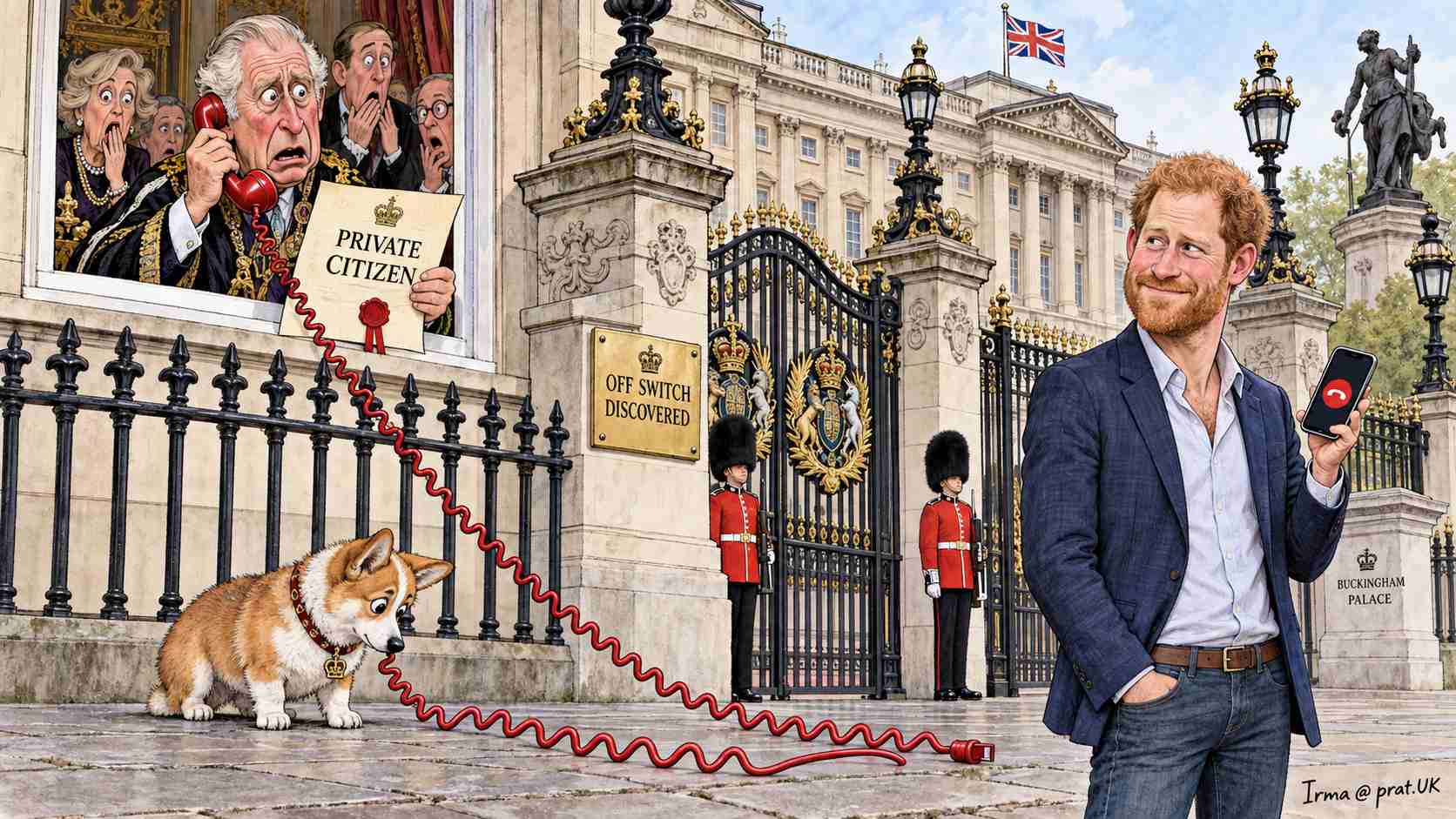
LONDON — King Charles III has reportedly discovered an obscure constitutional loophole in his decision to classify Prince Harry as a private citizen: private citizens are apparently allowed to hang up the telephone.
The discovery followed reports that Charles and Harry had resumed weekly telephone conversations after Harry returned to Britain with Meghan and their children. Sources said the calls had involved the sort of dangerously ordinary material most families discuss without intervention from a Lord Chamberlain: children, schools, schedules and when everybody might see one another.
Then Buckingham Palace issued formal guidance reaffirming that Harry and Meghan were not working royals and were to operate in a private capacity, a position consistent with the arrangements established when they stepped back from royal duties in 2020. This was apparently necessary because six years after Harry stopped being a working royal, Britain faced the terrifying possibility that somebody somewhere might momentarily forget.
The letter reportedly irritated the Sussexes, particularly its timing and the description of them as private citizens with commercial and charitable interests. Harry and Charles subsequently had what sources described as a “heated” telephone conversation, after which direct weekly contact stopped. Thus ended the monarchy’s daring seven-week experiment with fathers speaking directly to sons.
Royal Family Returns to Traditional Communication After Private Citizen Row: Anonymous Sources
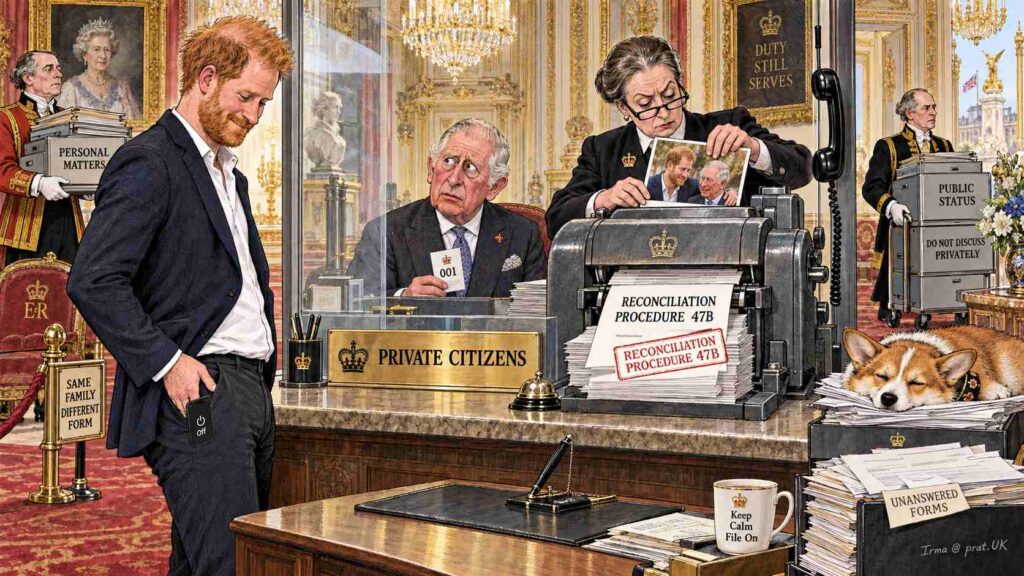
Buckingham Palace has now reportedly restored the institution’s traditional communications architecture, under which two related adults who possess each other’s telephone numbers communicate through advisers, officials, friends, courtiers and eventually somebody who knows a columnist.
Royal historians welcomed the return to normality.
“For several weeks things were looking extremely dangerous,” said Sir Nigel Pompous-Twitchell, the completely satirical chairman of the Institute for Preventing Royals From Simply Talking to One Another. “Charles was actually telephoning Harry. Directly. There were no secretaries, no briefing notes, no constitutional memoranda. At one point they were apparently discussing the grandchildren. We were perhaps three phone calls away from emotional progress.” Sir Nigel added that the Palace had narrowly avoided becoming, in his words, “a shoving leopard instead of a loving shepherd,” which he insisted was a compliment.
The system has now been repaired. Under the restored arrangement, Harry may tell an adviser that he wishes to speak to his father. The adviser can then contact another adviser, who can consult a private secretary, who can inform the King, who can indicate that he would welcome contact once cooler heads prevail. This should take approximately the same amount of time as constructing HS2.
Palace Confirms Private Citizen Reconciliation Proceeding Normally
Reports that the final telephone call became heated have caused concern among observers unfamiliar with how royal reconciliation works. Experts stressed that nothing unusual has occurred.
Royal reconciliation follows a predictable process. Somebody announces that relations are improving. Anonymous sources confirm everyone is optimistic. A letter is issued. Everyone becomes furious about the letter. Then anonymous sources explain why relations are no longer improving. The process may then restart indefinitely, providing sustainable employment for royal commentators through at least 2074.
A satirical poll conducted by the London Institute of People Who Have Fathers found that 91 percent of respondents believed family disagreements become easier after they are discussed by newspaper columnists who have never attended Christmas dinner with either participant. The remaining 9 percent had previously worked in palace communications.
Charles Replaces His Private Citizen Son With Several Highly Qualified Advisers
The King has reportedly stopped engaging Harry directly until tensions subside, with advisers once again serving as intermediaries. This is considered progress because advisers possess several qualities children notoriously lack. They take minutes. They schedule calls. They say “with respect.” And crucially, they rarely open a conversation with, “Dad, that’s exactly the bloody problem.”
Royal communications specialists say a simple father-son disagreement can now be processed professionally. Harry might note that he did not appreciate the letter. Adviser One would express that the Duke has reservations regarding the correspondence. Adviser Two would confirm that His Majesty acknowledges the Duke’s observations. Adviser One would then acknowledge His Majesty’s acknowledgement. By Christmas, both men could be emotionally exactly where they started, but with immaculate documentation, having reached, at long last, His Majesty’s position regarding Tuesday.
One Palace observer estimated that replacing a five-minute telephone conversation with professional mediation could require seven employees, fourteen emails and a briefing folder embossed with a crown. Buckingham Palace, in the grand courtly tradition, has essentially memoed its own son. This represents the sort of productivity Britain has been missing.
King Declares Harry a Private Citizen, Alarmed When Private Citizens Act Independently
The deeper problem may be linguistic. Harry has been repeatedly reminded that he is not a working royal and enjoys the latitude associated with life outside official royal duties. The recent Palace guidance was intended to clarify precisely that distinction.
Unfortunately, independent is one of those troublesome English words containing a hidden second meaning: independent. The Palace definition appears to mean “you are entirely free from royal obligations.” The Harry definition appears to mean “excellent, I shall make my own decisions.” This has apparently created a constitutional emergency.
It is similar to releasing a pigeon and then becoming annoyed because it refuses to remain beside the cage. Palace officials have therefore begun studying whether independence could be modernised into a more suitable arrangement called Royal Independent Plus, under which Harry would remain completely autonomous while voluntarily doing whatever everybody expected.
Monarchy Reminded a Private Citizen’s Telephone Works Both Ways
The telephone itself may ultimately prove incompatible with monarchy. Telephones are brutally democratic objects. There is no royal receiver. Nobody bows before voicemail. Caller ID does not recognise primogeniture. And when one participant presses the red button, the conversation ends regardless of whether the other participant owns several castles.
This technological equality may explain why royal families historically preferred messengers on horseback. A messenger could not hang up, and more to the point, a messenger could not simply ghost the Crown. The invention of the smartphone has therefore introduced a previously unrecognised threat to hereditary monarchy: both ends of the conversation possess equal access to the button.
One imaginary constitutional scholar calculated that this gives Prince Harry approximately 50 percent control over every telephone call with the sovereign. “Magna Carta took centuries,” he explained. “Apple did it with a touchscreen.”
Britain Introduces the Private Citizen Who Cannot Possibly Be Private
The strangest element remains Harry’s classification as a private citizen. Harry is a private citizen whose movements generate headlines. He is a private citizen whose conversations with his father become news. He is a private citizen whose charitable activities require official clarification. And he is a private citizen whose degree of privateness is debated by national newspapers.
This is Britain’s new Schrödinger’s Duke: simultaneously private and public until a royal correspondent opens the box. The Palace has therefore created perhaps the most British status imaginable. Harry is officially nobody special, except for the lengthy official document explaining precisely how special he is not.
A Helpful Guide for the Royal Family on Handling a Private Citizen
Fortunately, this crisis can still be solved. Experts at ordinary families have developed an innovative procedure requiring no courtiers whatsoever. First, Charles picks up the telephone. Second, Charles calls Harry. Third, Harry answers. Fourth, both men talk. This revolutionary system has been tested successfully in millions of households and requires neither government circulation nor embossed stationery.
There is even an advanced version in which one participant says, “That upset me,” and the other replies, “I understand.” Palace constitutional lawyers have reportedly been asked to determine whether such language would require parliamentary approval.
Private Citizen Lessons the Palace Never Saw Coming
Underneath the comedy sits a fairly simple observation about what it means to call someone a private citizen and then treat every syllable of their private life as public property. Charles apparently wanted Harry treated as a private citizen, and was startled to discover that private citizens possess the constitutional right to stop answering Dad. The Royal Family, in the process, achieved a rather novel kind of privacy: discussing its family disagreement with several newspapers at once.
Most fathers simply tell their sons where they stand. The monarchy requires a Lord Chamberlain, government departments, military officials and enough stationery to invade Belgium. And Harry was officially reminded that he does not represent the King, which raises the awkward possibility that Harry might begin representing himself. Buckingham Palace, in the meantime, has invented a remarkable form of independence in which a person is free to live their own life, provided everyone at Buckingham Palace approves the wording.
Charles reportedly wants cooler heads before another conversation, which is royal terminology for waiting until nobody remembers who started it. Ordinary families use WhatsApp. Royal families use constitutional intermediaries, because apparently an emoji could destabilise the Commonwealth. Harry is now a private citizen whose privacy is important enough to generate several hundred newspaper stories explaining his privacy, and father and son reportedly discussed grandchildren and schooling every week, demonstrating that the monarchy briefly experimented with a radical communications technology known as conversation.
Then somebody wrote a letter. Royal history strongly suggests that nothing improves a complicated family relationship faster than putting the disagreement in writing and distributing copies. Charles reportedly stopped direct communication and returned to advisers, effectively replacing “Hello, son” with “Please find attached His Majesty’s position regarding Tuesday.” The monarchy spent centuries accumulating power and has now discovered its most dangerous opponent: the red telephone icon marked End Call. Harry may have accidentally discovered the ultimate advantage of being a private citizen. You cannot be summoned to a palace meeting if you suddenly have something on.
Harry may be a private citizen now. The Palace just forgot that private citizens come with a terrifying new privilege. They can say, “Sorry, Dad. I’ve got to go.” And then they can actually go.
The underlying reporting says Charles and Harry had resumed weekly calls, that their latest conversation became heated following the Palace guidance concerning Harry and Meghan’s status, and that communication subsequently shifted back through advisers.
Auf Wiedersehen, amigo!
Disclaimer: This is a work of British satire based on public reporting about King Charles III and Prince Harry’s phone contact. Sir Nigel Pompous-Twitchell, the Institute for Preventing Royals From Simply Talking to One Another, the constitutional scholar, the satirical poll and the internal palace dialogue above are invented for comic effect. The factual spine, including the reported weekly calls that turned heated after the Palace’s private citizen letter, is drawn from published reporting. This piece is UK satirical news, written in the tradition of British satirical journalism.
Sources
King Charles’ Phone Call With Prince Harry Turned ‘Heated’ Over One Major Reason — Reality Tea
Prince Harry Reportedly Loses ‘Direct Contact’ With King Charles As ‘Private Citizen’ Drama Leads To ‘Heated’ Call — Yahoo Entertainment
For more royal chaos on the other side of the Atlantic, see Bohiney’s Harry & Meghan Promised Netflix a Kingdom.

Alan Nafzger was born in Lubbock, Texas, the son Swiss immigrants. He grew up on a dairy in Windthorst, north central Texas. He earned degrees from Midwestern State University (B.A. 1985) and Texas State University (M.A. 1987). University College Dublin (Ph.D. 1991). Dr. Nafzger has entertained and educated young people in Texas colleges for 37 years. Nafzger is best known for his dark novels and experimental screenwriting. His best know scripts to date are Lenin’s Body, produced in Russia by A-Media and Sea and Sky produced in The Philippines in the Tagalog language. In 1986, Nafzger wrote the iconic feminist western novel, Gina of Quitaque. He currently lives in Holloway, North London. Contact: [email protected]