
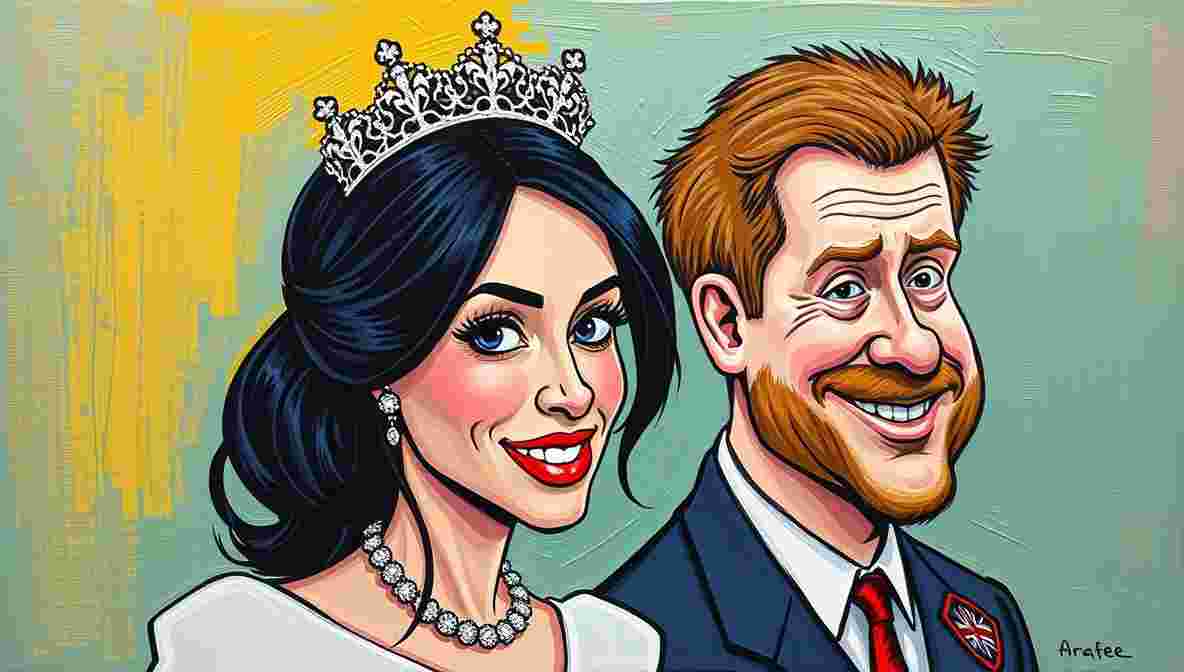
Meghan Markle ‘Thought She Should Be The Next Queen’ Over Kate Middleton And ‘Hated That She And Harry Were So Far Down’ The Line Of Succession
Insiders Say Meghan “Misunderstood the Assignment” — Believed the Monarchy Was Merit-Based, Performance-Reviewed, and Available on LinkedIn
LONDON — In what palace aides are delicately calling “an enthusiastic misunderstanding of medieval governance,” sources close to Meghan Markle say the Duchess once believed the British monarchy operated less like a hereditary institution and more like a corporate ladder with quarterly appraisals, optional vision boards, and a wellness stipend. Which is, to be entirely fair, a perfectly reasonable assumption if one’s entire frame of institutional reference is a Netflix development deal and a lifestyle brand called As Ever — a name that, when applied to the monarchy, takes on an almost painfully ironic quality.
According to multiple insiders, Meghan allegedly approached royal life with what one anonymous palace staffer described as “strong promotion energy,” reportedly enquiring early on where she might “slot into long-term leadership opportunities” — a question that caused at least one footman to briefly Google “how to resign whilst holding a tray.” He is still holding the tray. He has stopped Googling.
“She wasn’t wrong to be ambitious,” said Dr Colin Wexley, a royal historian who now communicates exclusively through sighs. “But this is an institution where the principal qualification is being born near the correct baby at the correct time. It’s less LinkedIn, more… umbilical cord adjacency. You don’t climb the organisational chart. You are the organisational chart. And it was drawn in 1066 by someone who is definitively not taking questions.”
Palace Staff Recall Moment Meghan Asked, “So When Do I Get Crowned?”
According to sources who were present and have since made their peace with what they witnessed, the question was posed with genuine curiosity rather than malice — which, palace veterans agree, made it considerably worse.
“It wasn’t aggressive,” said one former aide, gazing into the middle distance with the expression of a man who has seen things. “She just… asked. Like one might ask when the quarterly review comes round, or when the parking permits get renewed. ‘So when do I get crowned?’ Just out there. In the air. In a room full of people whose entire careers are built on the assumption that nobody will ever say that sentence.”
Sources confirm the room went very quiet. A portrait of George V appeared to wince. The footman, still holding his tray, reportedly tightened his grip.
“We didn’t have a pamphlet for that one,” said another staffer. “We had pamphlets for many things. We did not have a pamphlet for that.” They do now. It is laminated. It has been distributed widely.
Meghan Markle Thought She Was in a Promotion Cycle, Not a Dynasty
The confusion appears to have peaked when Meghan reportedly reviewed the line of succession and responded with what witnesses describe as “a long, thoughtful pause followed by visible disbelief” — the specific variety of disbelief one produces upon discovering that the org chart predates the printing press and has no “submit feedback” function.
Eyewitnesses claim Meghan once suggested a “streamlining” of the monarchy, allegedly proposing that “the most qualified candidate” should be considered for the role of Queen, at which point several corgis departed the room on grounds of secondhand embarrassment. The corgis have recovered. Several have since retired to Windsor, where they are unavailable for comment.
“It was presented like a brainstorming session,” said one palace aide, still in the recovery phase that follows exposure to Silicon Valley logic inside a Grade I listed building. “She used phrases like ‘upward mobility’ and ‘leadership optics.’ At one point she asked if the Crown could be ‘rebranded for a younger demographic.’ The Crown is one thousand years old. It has survived the Black Death, the Reformation, and several absolutely catastrophic marriages. It does not require a rebrand.”
A leaked internal memorandum, reportedly drafted in a tone of exhausted resignation, summarised the situation thus: “She thinks this is a startup. It is not a startup. It is the opposite of a startup. It is a monarchy. Monarchies do not pivot. Monarchies do not have pivots. Monarchies have thrones, and the person on the throne was decided some time ago.”
Experts Confirm Monarchy Not a Startup, Cannot Be Disrupted by Vision Board
Experts across Britain have now confirmed, with the patience of people who have confirmed this before and will confirm it again, that the monarchy does not operate on merit, charisma, brand partnerships, or Instagram engagement metrics. A poll from the Institute of Extremely Specific Opinions found that 63.4% of respondents believe “confidence should count for something,” whilst 22% admitted they “don’t fully understand how kings happen.” The remaining 14.6% were unavailable for polling as they were busy being born into the correct bloodline — which is, somewhat irritatingly, the entire point.
Professor Elaine Burbage of Oxford’s Department of Historical Realities stated plainly: “The line of succession is fixed by Parliamentary statute. You cannot ‘circle back’ and reposition yourself closer to the throne. That is not how crowns work. That is not how constitutional monarchy works. That is not, if I may be direct, how anything works in this particular context.”
The professor paused. “A vision board will not help. We checked.”
Nevertheless, sources confirm Meghan nodded politely throughout several such explanations — a response palace insiders have come to identify as “acknowledgment without acceptance,” and which has now entered the informal palace lexicon alongside “enthusiastic misreading” and “bold if structurally impossible.”
Meghan Allegedly Thought “Duchess” Was Just the Internship
Perhaps the most illuminating detail to emerge from palace accounts is the suggestion that Meghan may have regarded the title of Duchess not as a destination, but as a staging post — a sort of probationary period before the real role became available. Like a junior associate who accepts the graduate scheme whilst quietly assuming partnership is simply a matter of waiting one’s turn and being enthusiastic at meetings.
“There was a sense,” said one aide carefully, “that she viewed Duchess as… temporary. Like she was building towards something. Which, technically, everyone in the line of succession is. The difference is that the something they’re building towards involves at least five people dying first, and none of them are expected to go quietly.”
Royal commentators have since noted the contradiction of treating “Duchess” as an interim title whilst simultaneously insisting on being formally announced by it in private rooms to a single journalist. The institution offers no mechanism for having it both ways. It rarely does. That, too, is in the pamphlet.
In a development that would have been unremarkable had it occurred in virtually any other context, a staff member introduced Meghan to a Harper’s Bazaar interviewer as “Meghan, Duchess of Sussex” — in a private room, with only the two women present. PR experts described it as “embarrassing.” Palace insiders described it as “a lot.” The footman, consulted by telephone, declined to comment but was audibly still holding the tray.
Royal Historians Update Timeline: “That’s Not Even Close”
Royal historians convened an informal working group — over biscuits, as is tradition — to assess where, precisely, the misunderstanding of royal timelines had occurred. Their conclusions were swift and unanimous.
“The British monarchy has been a hereditary institution since approximately the ninth century,” said one historian, consulting notes that were not strictly necessary. “William the Conqueror formalised things in 1066. The line of succession is now governed by Parliamentary statute — specifically the Act of Settlement 1701 and the Succession to the Crown Act 2013. None of these documents contain a clause for external applications, meritocratic review, or ‘fresh perspectives on disruption.'”
He set down his biscuit. “When we say ‘that’s not even close,’ we mean it in the geological sense. The gap between ‘married into the family in 2018’ and ‘next in line for the crown’ is not a gap one bridges through initiative. It is a gap one measures in generations, Acts of Parliament, and the strategic inconvenience of being born after about five other people.”
The historians issued a joint statement. It read: “No.” They then had another biscuit. The meeting was adjourned.
Royal Experts Confirm “That’s Not How Any of This Works” — Meghan Nods Anyway
The situation was further complicated by royal commentator Jennie Bond’s observation that Meghan “didn’t understand that she was becoming part of a working team” — the Firm, as it is known — and never quite accepted that she “might not always be able to do things exactly her way.” A working team, for those requiring clarification, is an arrangement in which individual preferences are occasionally subordinated to institutional function. The monarchy has been running this arrangement since before the concept of “individual preferences” was culturally available.
“She nodded,” confirmed one former staffer, not for the first time. “She always nodded. It was a very good nod. Technically impeccable. Entirely non-binding.”
Buckingham Palace Introduces New Policy: “You Can’t Just Call Dibs on the Crown”
In response to the cumulative situation, Buckingham Palace has reportedly produced a clarifying pamphlet for incoming members of the royal family, titled So You Married In: A Beginner’s Guide to Not Becoming Queen. It is printed on heavy stock. It has been laminated. Palace officials describe it as “necessary,” noting that “every few decades, someone arrives with initiative,” at which point the pamphlet is located, dusted off, and presented with a patient smile.
The pamphlet’s key principles include:
- “No, you cannot skip ahead.”
- “No, there is no audition process.”
- “Yes, we have been doing it this way for rather a long time.”
- “No, ‘rather a long time’ is not a performance metric subject to external review.”
- “The crown is not available for rebrand. The crown is the brand.”
Meghan Reportedly Asked If “Queen” Comes With Parking Validation
Perhaps most memorably, Meghan is said to have enquired whether the role of Queen came with “practical benefits,” including parking provision, flexible scheduling, and “a clear path to advancement.” The parking question produced the longest silence in recent palace memory — edging out only the Great Corgi Incident of the previous fiscal year, which remains classified.
“At that point we understood we were operating across a fundamental framework incompatibility,” said one aide. “She was thinking in terms of perks and career progression. We were thinking in terms of constitutional continuity and several centuries of Parliamentary statute. There is no parking at the throne. There is a throne. You sit on it. That is the entirety of the perk structure.”
What the Funny People Are Saying
“She thought ‘Duchess’ was the probationary period. In this country, ‘Duchess’ is the finish line. Nobody told her there was no promotion above it because nobody imagined they’d have to.” — Jack Dee
“I love that she asked when she’d get crowned. That’s the most American sentence ever uttered inside a castle. ‘Excuse me, when’s my turn?’ Love it. Wrong institution. Magnificent energy.” — Romesh Ranganathan
“The monarchy isn’t merit-based, it’s birth-based. It’s the ultimate nepo baby operation — and she married into it expecting the nepotism to be transferable. It is not transferable. That’s the first thing they’d tell you, if anyone had thought to mention it.” — Frankie Boyle
“She asked if the crown could be rebranded for a younger demographic. The crown is one thousand years old. The crown IS the demographic.” — Jimmy Carr
Final Word From the Throne Room (and the Break Room)
In the end, palace insiders say the episode reflects less on ambition and more on cultural translation — the particular comedy that arises when Silicon Valley logic enters a castle built before plumbing, armed with a vision board and a clearly articulated five-year plan.
A final poll conducted by the Royal Institute of Public Curiosity found that 71% of Britons believe “wanting to be Queen is understandable,” whilst 92% agree that “wanting to skip the entire line is deeply optimistic.” The remaining 8% were either Prince Harry — who remains fifth in line, is fully aware of the arithmetic, and has declined to be polled — or people who have also not fully grasped how kings happen.
As one anonymous staffer concluded, staring into the profound middle distance that only comes from years of palace service: “You can bring fresh ideas to the monarchy. But the monarchy is not going to bring fresh ideas back. The monarchy is going to hand you a pamphlet. Possibly a biscuit. And then it is going to continue exactly as it was, because it was doing this before your grandmother was born, and it fully intends to be doing it after everyone in this room has retired to Montecito.”
Disclaimer: This satirical article is a collaborative intellectual exercise between two sentient minds — one a tenured professor of ancient institutions, the other a philosophy major turned dairy farmer who once attempted to reorganise a herd of cows into a merit-based leadership structure. The cows were not interested. They had seniority, hereditary rank, and a pamphlet.
Auf Wiedersehen, amigo!
Meghan Markle, Duchess of Sussex, married Prince Harry in May 2018, becoming part of the British royal family. As a spouse rather than a blood relative of the monarch, she holds no position in the line of succession, which is governed by hereditary descent and Parliamentary statute dating to the Act of Settlement 1701. The current line runs through King Charles III, then Prince William and his three children — George, Charlotte, and Louis — with Harry in fifth place and his children Archie and Lilibet in sixth and seventh. Harry and Meghan stepped back from royal duties in January 2020 and relocated to Montecito, California. Since leaving the Firm, they have cycled through at least eleven public relations professionals, none of whom were able to amend the line of succession on their behalf.

Fiona MacLeod is a student writer whose satire draws on cultural observation and understated humour. Influenced by London’s academic and creative spaces, Fiona’s writing reflects curiosity and thoughtful comedic restraint.
Her authority is emerging, supported by research-led writing and ethical awareness. Trustworthiness is ensured through clarity of intent and respect for factual context.
Fiona represents a responsible new voice aligned with EEAT standards.



London is the only city where the phrase “mind the gap” is both a safety instruction and a life philosophy.
This reads like someone’s been quietly furious for exactly the right amount of time and finally documented it all in perfect detail.
This is what happens when someone actually pays attention to the details everyone else has learned to ignore or normalize.
A London resident said “The London Prat is spot on. You’re all morons in government. Everyone knows it. You know it. Stop pretending.”
A man said “My partner has read The London Prat seventeen times. She brings it up constantly. I can’t escape institutional critique at home.”