Nidal Hasan Skips Hell’s Orientation, Declines Preference Form, Walks Straight Into the Flames
Fort Hood mass murderer arrives in the afterlife after seventeen years of appeals, discovers Hell also runs on forms, and refuses to fill out a single one
Nidal Hasan was summoned to Hell on a Tuesday, which annoyed the front desk, because Tuesdays were reserved for people who had died of committees.
The summons came in triplicate. One copy for the deceased, one for the recording angel, and one for a filing cabinet that hadn’t been opened since the Council of Trent and was by now mostly moths. Hasan didn’t read it. He’d spent seventeen years reading things. Forms. Appeals. Medical reviews. A performance evaluation so negative it had developed its own weather system. When the orderly of the afterlife coughed and said his name, Hasan wheeled straight past the inbox and went directly to the flames.
“Sir,” said the clerk, whose name was Clive and who had worked reception since the invention of the queue. “There is an orientation.”
“I have had an orientation,” Hasan said. “It lasted from 2009.”
Hell’s Reception Desk: The Ledger, the Preference Form and the Fort Hood File
Clive consulted the ledger. The ledger consulted Clive. Neither enjoyed it. The entry was short, which in Hell counts as a luxury. Fort Hood. Thirteen dead. Thirty-two wounded. A courtroom. A sentence. A wheelchair. A nation that possessed both due process and an astonishing quantity of paper, and had used both, slowly, as if slowness were a moral position. Clive had seen slower. He’d once processed a Byzantine tax farmer who was still on hold.
“Even so,” Clive said, “new arrivals are asked to complete a preference form. Heat level. Company. Whether you’d like the ironic punishment or the straightforward one. Most people circle ironic. It photographs better.”
Hasan looked at the form. It had a box for name, a box for grievance, and a box marked OTHER, which was where Hell stored everything it didn’t want to argue about. He pushed it back across the desk.
“Flames,” he said.
The Waiting Room Is the Real Punishment: Hasan Rejects Hell’s Process
Behind him a small queue had formed. A man who had invented a fee. A woman who had chaired a meeting that could have been an email and had, in fact, also been an email. A minor demon with a lanyard. They watched Hasan the way commuters watch somebody walk the wrong way up an escalator: not with horror, but with the creeping suspicion that the system might let him.
Clive tried the official line. “Hell is a process.”
“So was the Army,” Hasan said. “I am finished with process.”
That wasn’t, Clive noted, a theological position. It was a consumer complaint, and Hell heard those all day. The damned agreed on very little, but they did agree that the waiting room was the real punishment, and that the flames, when they finally arrived, at least had the decency to be what they said they were. Fire doesn’t ask you to hold. Fire has no portal. Fire never reports unexpectedly high call volumes.
Hell’s Supervisor Offers a Bespoke Package and the Warrior Narrative
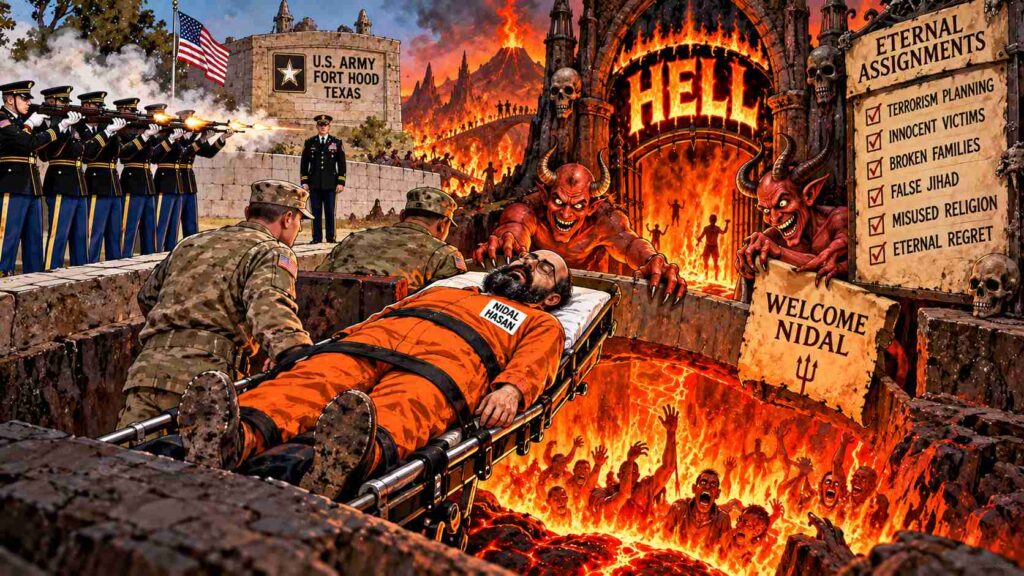
A supervisor was sent for. Supervisors in Hell are angels who failed a courtesy exam, or demons who passed one, and you can’t tell which by looking. This one carried a clipboard and the expression of a man who’d been promised a quieter eternity.
“We can offer you a bespoke package,” the supervisor said. “Relive the paperwork. Every appeal. Every continuance. A clerk who can’t find the file. Very popular with the detail-oriented.”
“No.”
“A warrior narrative,” the supervisor said, ticking a box he wasn’t supposed to tick. “Some of our clients prefer to be remembered as they advertised. Historic. Martial. Misunderstood by the institution they attacked. We have a hall for that. The echoes are extra.”
Hasan didn’t take it. He’d already had the narrative, and it hadn’t survived contact with a courtroom, or with the names of the people who never came home from a processing centre. Hell is efficient about vanity, so it doesn’t argue with a man who has turned down his own poster. It files the poster under UNUSED and moves on.
“Directly to flames, then,” the supervisor said, and stamped the summons with a stamp that had been warmed for the purpose. The stamp didn’t say APPROVED. It said FINALLY. Clive thought that was editorialising. The supervisor thought editorialising was the only part of the job that still paid.
Directly to the Flames: A Corridor Past Hell’s Specialist Departments
They walked him down a corridor that smelled of hot metal and old carpet. Doors opened onto specialist departments. One was full of people explaining, to nobody, that the algorithm had done it. One was full of people waiting for a meeting about the meeting. One, glimpsed briefly, held a film executive clutching a receipt for two hundred and eighty million dollars and a pamphlet about the evils of money. Hasan didn’t stop. He hadn’t stopped for the orientation, and he wasn’t about to stop for cinema.
At the last door a junior demon offered him a leaflet. WELCOME TO YOUR CONSEQUENCE. There was a map, a complaints procedure, and a QR code that went nowhere, because nowhere was already the address. Hasan let it drop. The leaflet caught fire out of professional habit, which saved someone a filing.
The flames weren’t metaphorical. Hell tried metaphor in the nineteenth century and found it only increased correspondence. These were actual flames, making the noise flames make when nobody has asked them to symbolise anything. Hasan went into them the way a man walks into a room he’s already paid for.
No Appeal Received: The Fort Hood File Finally Closes
Clive watched from the corridor, because reception staff aren’t required to follow a client past the threshold, and because he had a queue. He made a note in the ledger. SKIPPED ORIENTATION. SKIPPED PREFERENCE FORM. SKIPPED IRONIC OPTION. WENT DIRECTLY TO FLAMES. Then, because Hell is a bureaucracy even when the client isn’t, he added a second line. NO APPEAL RECEIVED.
Upstairs, if Hell can be said to have an upstairs, the recording angel closed the Fort Hood file and didn’t reopen it. The dead were already counted. The wounded were already carrying what they carried. The paperwork, which had kept a man alive for seventeen years after the Army had finished deciding what it thought of him, did not follow him through the door. Paper burns. It’s one of the few courtesies paper offers.
Back on the post he’d left, a flag moved in a Texas wind and a clerk put a stamp on a folder. In the reception he’d skipped, Clive called the next name. A man stepped forward with a carrier bag full of receipts and asked whether there was a form for that.
There was. There’s always a form. Hasan, for once in the long administrative afterlife of his crime, had declined to complete it. The flames didn’t thank him. They aren’t a service, and they don’t have a comments box. They did what the summons said they would do, without a cover sheet, and the queue moved up by one.
Disclaimer
This is satire aimed at a convicted mass murderer, not at Islam, Muslims or any peaceful religious community, and not at the people he killed or wounded. The afterlife, the clerk named Clive and the stamp that says FINALLY are invented. The factual backbone is not: Hasan was convicted of 13 counts of premeditated murder and 32 counts of attempted premeditated murder, and President Trump approved his execution by firing squad on October 5, 2026, with the Secretary of the Army to set the time and place. No execution has been reported as carried out, so everything below the ground floor is fiction.
For more on the case, see the U.S. Army’s account of the 2013 sentencing, the Department of Defense review Protecting the Force: Lessons Learned from Fort Hood, and Military Times on the appeal and the first possible military execution since 1961.
This story is entirely a human collaboration between two sentient beings: the world’s oldest tenured professor and a philosophy major turned dairy farmer. Any resemblance to sober institutional dignity is purely accidental.

Alan Nafzger was born in Lubbock, Texas, the son Swiss immigrants. He grew up on a dairy in Windthorst, north central Texas. He earned degrees from Midwestern State University (B.A. 1985) and Texas State University (M.A. 1987). University College Dublin (Ph.D. 1991). Dr. Nafzger has entertained and educated young people in Texas colleges for 37 years. Nafzger is best known for his dark novels and experimental screenwriting. His best know scripts to date are Lenin’s Body, produced in Russia by A-Media and Sea and Sky produced in The Philippines in the Tagalog language. In 1986, Nafzger wrote the iconic feminist western novel, Gina of Quitaque. He currently lives in Holloway, North London. Contact: [email protected]