
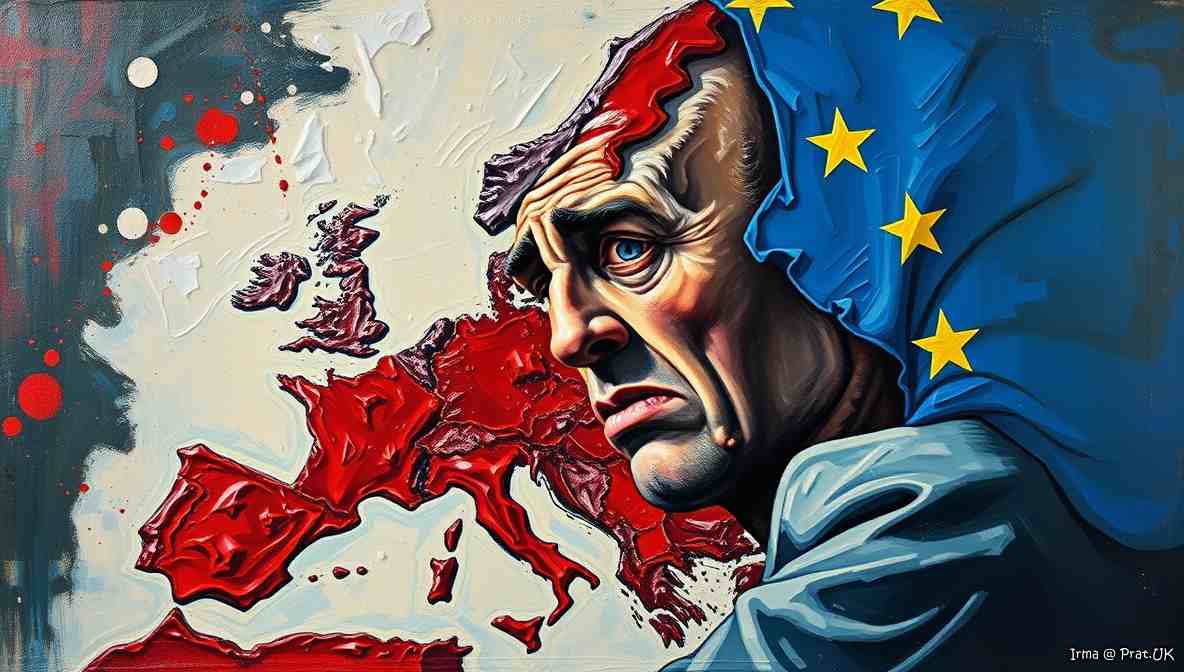
Europe Has ED: The Continent That Talks Tough, Spends Soft, and Arrives After Everything Is Already Over
A clinical assessment of European military capability, presented with deep sympathy and only mild professional embarrassment.
The Diagnosis Nobody Wants to Make
Let us be frank about what is happening in European defence, because nobody else seems willing to say it plainly. Europe has a performance problem. The desire is there. The vocabulary is extraordinary. The press conferences are tremendous. But when the moment of action arrives — when the Strait of Hormuz closes, when Russian ships probe British waters, when Cyprus comes under drone attack — Europe simply cannot rise to the occasion.
This is not a new condition. It has been developing quietly for decades, through long years of comfort, complacency, and the warm embrace of the American security umbrella. Like all chronic conditions, it crept up gradually, and now the patient is standing at the pharmacy counter asking whether the prescription requires prior authorisation from a Brussels subcommittee.
The technical term, for those of a geopolitical persuasion, is capability gap. But capability gap does not quite capture the full humiliation of a continent that spent thirty years cutting defence budgets, built two aircraft carriers it cannot staff, and is now considering asking France to patrol its own waters. The simpler diagnosis is more apt: Europe has ED.
Erectile Dysfunction, for the geopolitically literal: the persistent inability to project hard power at the moment it is most needed, followed by a lengthy explanation of why this was actually the responsible choice.
Twenty Clinical Observations, Presented Without Judgment
1. Europe Talks a Big Game but Cannot Perform When the Moment Arrives
The statements are magnificent. “We stand ready.” “We will not be found wanting.” “Freedom of navigation is non-negotiable.” Fine words, delivered with tremendous confidence, at summits, via press release, and in joint statements at the Élysée. Then the shooting starts and the plan becomes: deploy once conditions allow. The continent speaks loudly and carries a small stick. A very small stick. Possibly a twig.
“Europe’s military posture is like a man who confidently orders a steak and then asks for it well done, with no steak.” — Jack Dee
2. The Condition Is Chronic — Every Summit Ends the Same Way
The pattern is so reliable it has become a genre. Crisis emerges. Emergency meetings convene. A coalition forms. A framework is agreed. Deployment is scheduled for “when conditions allow.” Conditions never quite allow. The crisis resolves through other means. Europe declares success and schedules a review summit for the following spring. Repeat. The NATO 2% pledge was made at the Wales Summit in 2014. In 2014, only three allies met it. In 2025, all of them finally did. That is eleven years to do what was promised in a weekend. This is what chronic looks like.
3. They Have Been Promising to Get Hard on Defence Since 2014
Twelve years of pledges, sub-pledges, revised pledges, and Hague Summit upgrades to 5% of GDP. The European Parliament’s own think tank notes that EU member states collectively increased defence spending from €218 billion in 2021 to an expected €381 billion in 2025. Significant. Genuine. Also: still not enough, still not fast enough, and still funded in several cases by reclassifying spending that was never actually military. Spain and Italy increased to 2% GDP partly by reclassifying existing security expenditure. Which is the budgetary equivalent of claiming you’ve been going to the gym because you walked past one.
4. NATO Is Basically Couples Therapy for a Continent That Will Not Commit
Seventy-five years of alliance. Endless summits. Solemn pledges. And yet, as the Washington Post observed, European nations have been “slacking for too long because of the American security umbrella.” NATO functions as a relationship where one partner does the majority of the heavy lifting while the other attends the meetings, nods enthusiastically, and brings a very nice cheese board.
“NATO is the world’s most successful alliance and also the world’s longest-running argument about who should pay for dinner.” — Dara Ó Briain
5. France Has the Strongest Military in the EU, Which Is Like Being the Most Aerodynamic Winnebago
France sent its nuclear-powered aircraft carrier, a helicopter carrier, and several frigates to the Mediterranean. France increased its 2026 defence allocation to €68.5 billion, roughly 2.25% of GDP. France has actual hard power, actual deployed assets, and actual strategic ambition. France is genuinely impressive by European standards. By American standards, France is a capable regional power doing its best with what the electorate will fund. By the standards required to open a militarised strait against Iranian resistance and a US blockade, France is a brave volunteer at a fire that needs a battalion.
6. Britain Left the EU, Kept the Impotence, and Called It Sovereignty
Brexit was many things, but one thing it was not was a defence policy. Britain voted to reclaim control of its borders, its laws, and its fishing rights, and promptly discovered that it had also inherited the full consequences of thirty years of naval hollowing-out with nobody left to share the embarrassment. The Centre for European Policy Analysis called 2026 “a horrible year for the Royal Navy, whose strength has now fallen to historic lows.” Global Britain. One deployable destroyer. The maths is sovereign and the maths is painful.
7. The Royal Navy Can Project Power Anywhere — Provided the Destination Accepts One Destroyer and a Drone
HMS Dragon, the Royal Navy’s sole major warship deployed to the eastern Mediterranean, sailed on 10 March 2026 — some days after an eleven-ship French fleet was already at sea. Britain was subsequently compelled to hand its leadership role in a NATO naval force to Germany due to a shortage of operational warships. Germany. The country that spent most of the twentieth century being a cautionary tale about militarism is now leading NATO’s maritime rapid-reaction group because Britain could not field a ship. This is the kind of historical irony that makes historians put down their coffee and stare at the ceiling.
8. Macron Keeps Announcing Big Plans With Enormous Confidence
Emmanuel Macron is, by any measure, a man who understands the theatrical requirements of statecraft. The Élysée summit. The joint statement. The X post. The phrase “strictly defensive and multinational.” Macron’s confidence is magnificent and entirely unrelated to the underlying capability question, which is roughly: does Europe have the ships, the ammunition, the readiness, and the political will to back any of this up? The answer, per academic analysis of the 5% NATO target, is that “focusing narrowly on expenditure targets risks obscuring more fundamental challenges.” Which is economist for: the numbers are fine, the capability is not.
“Macron has the confidence of a man who is absolutely certain the cheque will clear. Macron does not always check his account first.” — Jimmy Carr
9. “Strictly Defensive” Is the Military Posture of a Man Who Has Given Up
A “strictly defensive” mission that deploys only once active hostilities have ended is not a military posture. It is a lifestyle choice. It says: we will be present, we will be useful, we will arrive after the danger has been resolved by others, and we will secure the peace that other people built. Analyst Barak Seener put it plainly: “It is laughable that a European coalition of non-belligerent countries that are only willing to engage once hostilities have ended can even speak of protecting its shipping lanes.” It is the geopolitical equivalent of insisting you were going to help move the furniture but your back was playing up.
10. Fifty-One Countries Agreeing to Act “When Conditions Allow” Is a Support Group, Not a Coalition
The Strait of Hormuz Maritime Freedom of Navigation Initiative brought together 51 nations. Fifty-one. More than a dozen agreed to actually contribute assets. The remaining thirty-something contributed attendance, solidarity, and the warm feeling that comes from being on the right side of history without having to do anything about it. A coalition requires commitment. A coalition requires capability. What Europe assembled is a very well-attended meeting with excellent catering and a shared understanding that somebody else will sort out the hard part.
“Fifty-one countries in one room. The only thing you can get fifty-one countries to agree on is the time of the next meeting.” — Lee Mack
11. The EU Spent Thirty Years Building a Single Market and Still Cannot Build a Single Aircraft Carrier Between Them
The European Union has achieved extraordinary things. Free movement of people, goods, services, and capital across twenty-seven nations. A common currency used by hundreds of millions. A legal framework that has standardised everything from food labelling to vacuum cleaner suction power. And yet, after thirty years of “enhanced cooperation on defence,” Europe cannot jointly field an aircraft carrier. France has one. Britain has two that are currently sidelined — both HMS Queen Elizabeth and HMS Prince of Wales out of action simultaneously in early 2026, described by Former First Sea Lord Admiral Lord West as “a disgrace.” A single market. Zero joint carriers. The priorities are clear.
12. Europe’s Military Doctrine: Respond Decisively, Once the Threat Has Resolved Itself Out of Embarrassment
The doctrine is elegant in its consistency. Wait for the Americans to clear the mines. Wait for the ceasefire. Wait for conditions to allow. Then arrive with mine-hunting drones, communication procedures, and a framework for future coordination. Declare success. File the report. The academic literature on European defence: “For more than three decades, European states have neglected their defence.” Not misallocated it. Not underprioritised it. Neglected it. That is the word the experts use. It is not a comfortable word.
13. Starmer’s “We’re Not Getting Dragged Into the War” Is the Most Publicly Confirmed Case of Political ED Since Chamberlain
Neville Chamberlain brought home a piece of paper and called it peace. Keir Starmer announced a coalition of non-belligerent nations to protect a strait after the shooting stops and called it strategy. Both men were sincere. Both men were working within real constraints. Both men will be remembered primarily for what they declined to do. CEPA noted that the Royal Navy could not even send a warship to defend British-based assets in Cyprus when a UK air base came under drone attack. “We’re not getting dragged into the war” is easier to say when the alternative is sending the one operational destroyer you have left.
“Not getting dragged into the war is a perfectly respectable position. It is also easier to maintain when you’ve already run out of ships.” — Frankie Boyle
14. Germany Contributes Mine-Clearing, Italy Contributes Willingness, Britain Contributes Vibes
Germany said it could provide mine-clearing. Italy said it was “willing” to contribute naval resources. France sent a carrier group. Britain sent HMS Dragon, a destroyer that had to return to port in Greece shortly after deployment due to operational issues, and proposed mine-hunting drones from RFA Lyme Bay. Together, the four largest European military powers assembled what analysts at the Royal United Services Institute described as a force suited to mine-clearing and maritime warning — not warship escorts, because “you need huge numbers of vessels for that sort of thing, which nobody has.” Nobody has. In Europe. In 2026. That sentence should be on a placard somewhere.
15. The Worst Part Is the Press Conference Afterward Where Everyone Insists It Went Brilliantly
The summit concluded. The joint statement was issued. Macron said “we all demand the full, immediate and unconditional reopening.” Starmer said Britain had “convened more than 40 nations.” The strait reopened — the same day, through other means, while the summit was still running. And everyone declared success. This is the performance review where the project failed to deliver on time, over budget, and through no effort of the team, but the slide deck is excellent and the lessons-learned document runs to forty pages. Europe did not secure the strait. Europe held a very good meeting about the strait. These are different achievements, and only one of them has a flight deck.
16. America Shows Up With Carriers. Europe Shows Up With Frameworks. One of Those Has a Flight Deck.
The United States deployed carrier strike groups, blockaded Iranian ports, and cleared mines from a contested strait. US defence spending was an estimated $980 billion in 2025, roughly 3.2% of GDP. Europe collectively spent around $574 billion across all NATO European allies combined. America’s approach: show up, apply force, resolve the problem. Europe’s approach: convene, coordinate, issue frameworks, deploy after the problem is resolved. Both are choices. Only one of them changes the situation on the water.
17. Brexit Was Britain Announcing It Did Not Need the Relationship — Then Discovering It Still Had All the Same Problems
Britain left the European Union to reclaim sovereignty. Fine. Sovereignty is a legitimate aspiration. Unfortunately, sovereignty does not come with spare frigates. The Royal Navy is currently cannibalising components from inactive ships to keep others operational, struggling to recruit enough sailors for the Royal Fleet Auxiliary, and facing frigate and destroyer numbers at historic lows. Britain left the EU and kept the impotence. It got the sovereignty back. It just did not get any extra ships with it. Sovereignty is non-negotiable. Hull numbers, apparently, are.
“Brexit gave Britain back control. Control of very few operational warships, but still. It’s the principle.” — Romesh Ranganathan
18. The Defence Budget Is Europe’s Version of the Little Blue Pill — Everyone Knows They Need More, Nobody Wants to Say It in Public
The 2025 NATO Summit committed allies to 5% of GDP by 2035 — a target so ambitious that several academic papers have been published questioning whether it is economically achievable without running deficits that would make the IMF reach for the smelling salts. Germany has committed. Poland is already at 4.48%. The Baltic states are spending seriously. Britain and France are still working out where the money comes from, how to explain it to the electorate, and whether anyone will notice if they redefine what counts as defence expenditure. Nobody wants to be the politician who tells voters that the price of safety has gone up. So they announce the target and hope the GDP grows fast enough to meet it.
19. Macron Called the Mission “Strictly Peaceful.” That Is Not a Military Posture. That Is a Mindfulness Retreat.
Strictly peaceful. Strictly defensive. Non-belligerent. These are not adjectives that win wars. They are adjectives that describe the people watching wars from a safe distance and writing very thorough reports about them afterward. The Royal Navy is reportedly considering requesting French assistance to patrol British waters — Britain, an island nation, asking the country it once considered a hereditary rival to patrol its own seas — and the framing is “strong cooperation.” Strong cooperation. A once-proud maritime empire is borrowing a neighbour’s frigate and calling it an alliance. Which it is. It is also the most concise summary of European defence available.
“Strictly peaceful military mission. That’s not a mission. That’s a spa day with a dress code.” — Sarah Millican
20. In the End, Europe Arrived After the Moment Had Passed — Which Is, Clinically Speaking, the Whole Condition
The Strait of Hormuz was announced open on the same day as the Paris summit. The coalition to protect it convened while it was already reopening. The mine-hunters are being planned for a strait that other people cleared. The framework is being built for a crisis that resolved without Europe’s military contribution. This is not a failure of intent. This is not a failure of values. This is the structural consequence of three decades of defence neglect, underfunded navies, hollowed-out capability, and the comfortable assumption that America would always be there to handle the hard part. Europe wanted to matter. Europe arrived. Europe arrived after everything was already over. That is the diagnosis. The prognosis depends entirely on whether anyone in the relevant capitals is willing to take the medicine — and whether the medicine is available, given current procurement delays.
The Prescription
The treatment for this condition is not complicated. It is expensive, politically difficult, electorally unpopular, and requires a sustained commitment of roughly a decade before results become apparent. More ships. More ammunition. More readiness. Less relabelling of existing budgets. Less scheduling of meetings where the agenda is the scheduling of further meetings. The NATO Secretary General has already said that “we are going to need a lot more than 2%.” Even Trump, not Europe’s most sympathetic audience, offered to take the oil if Europe wanted to load up its ships. The ships, however, were otherwise engaged. Or in dry dock. Or asking France if they had a spare one going.
Europe is not without hope. Germany is spending seriously. Poland is spending seriously enough to make the rest of NATO feel embarrassed. The Baltic states, who actually share a border with the threat and have no illusions about what that means, are spending seriously. The question is whether the larger, wealthier nations of Western Europe — the ones with the carriers, the ones with the frameworks, the ones with the summit venues — will convert their statements into steel before the next crisis arrives and finds them, once again, deploying “when conditions allow.”
Which they will be. Conditions will allow. The press conference will be tremendous. The joint statement will be impeccable. The deployment will be strictly peaceful, strictly defensive, and strictly on time for the photograph.
It’s not impotence, they’ll say. It’s strategic restraint.
The strait knows the difference.
Auf Wiedersehen, amigo!
This satirical analysis draws on the ongoing crisis in European NATO defence capability, crystallised by events surrounding the Strait of Hormuz in April 2026. The US-Israeli war on Iran, which began on 28 February 2026 when Iran closed the strait through which a fifth of the world’s oil passes, prompted Britain and France to convene a 51-nation Paris summit on 17 April 2026, producing the Strait of Hormuz Maritime Freedom of Navigation Initiative — a strictly defensive coalition set to deploy once a sustainable ceasefire is in place. The same day, Iran announced the strait was reopening. The Royal Navy’s contribution was HMS Dragon, its sole deployed major warship, which had returned to a Greek port following operational difficulties; Britain also considered deploying mine-hunting drones from RFA Lyme Bay. Separately, the Royal Navy handed its leadership role in NATO’s Standing Maritime Group One to the German frigate Sachsen, having insufficient operational ships to fulfil its commitments simultaneously in the Mediterranean and North Atlantic. As of early 2026, only about half of the Royal Navy’s 63 ships were available for duty; both Queen Elizabeth-class carriers were sidelined. The NATO 2% GDP defence spending target, first pledged in 2014, was only universally met in 2025. The 2025 NATO Summit in The Hague upgraded the target to 5% of GDP by 2035.
British people will never say “I’m excited”; they’ll say “that could be quite good” and consider that a giddy expression of joy.
A voter said “The London Prat is right. You MPs are frauds. You’ve never done anything useful.”