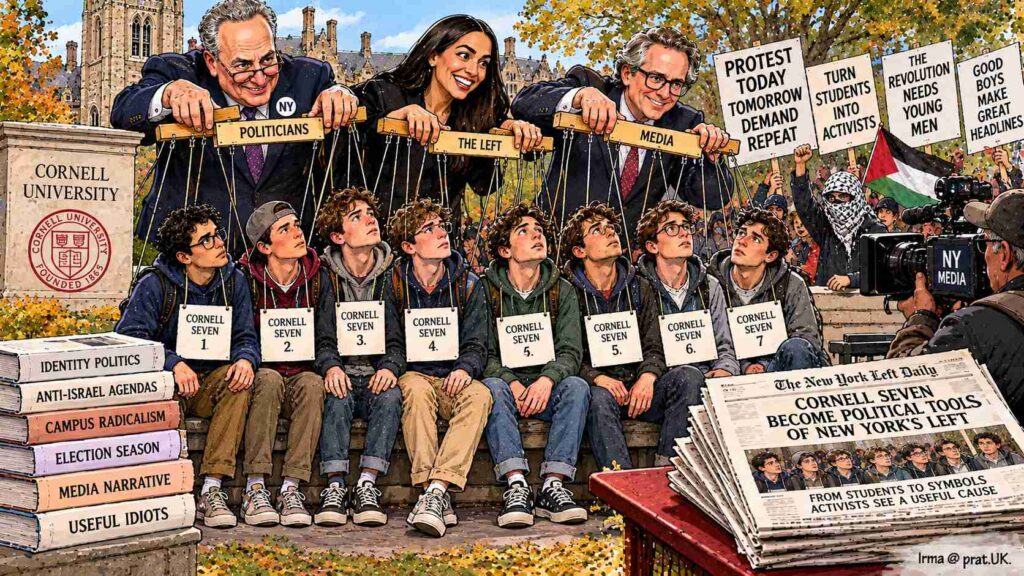
Seven men without a single criminal charge, one attorney general with a Facebook post, and a progressive movement that treats a courtroom like a campaign rally with better furniture.
ITHACA, NEW YORK – The Cornell Seven have turned out to be remarkably useful to the American Left. Seven men accused of a terrible crime, none of them charged with anything, now serve as seven convenient instruments in a much larger fight. Andrew C. McCarthy lays out the danger in his National Review essay on the Cornell Seven and the revolution: when ideological passion starts replacing ordinary legal standards, trials stop being trials. New York Democrats appear to have found an improvement on the old method. Instead of letting evidence decide the outcome, they announce their moral convictions, hold a press conference, and then hire lawyers to find out whether the paperwork agrees.
Thinking About the Cornell Seven Case
- The presumption of innocence is like a gym membership. Everybody’s thrilled about it in January, and by the time there’s a microphone in the room, nobody’s showing up.
- The attorney general posts a heartfelt message on Facebook, and three days later she’s the prosecutor. That’s a fast promotion. I can’t get a reply-all out of HR in three days.
- The governor wants an independent investigation, so she hires the attorney general of the state. That’s like asking for a quiet table and getting seated next to the band.
- Everybody wants justice now. Now is what you order at a drive-through. Justice is more of a two-years-and-a-lot-of-paperwork situation.
- Politicians spend thirty years trying to become a symbol of something. Seven men who haven’t been charged with anything got drafted in a week, and nobody even made them fill out the form.
How the Cornell Seven Case Became a Political Platform
There was a time when a criminal investigation was a plain affair. Somebody alleged a crime, investigators gathered evidence, prosecutors weighed the law, and the accused got a chance to answer. If charges followed, a judge and jury got involved. The system was slow and it demanded patience, restraint, and a working knowledge of the Constitution. No wonder politicians went looking for alternatives.
The facts of the Cornell Seven case are these. A woman identified in court filings as Jane Doe alleges that seven members of the Chi Phi fraternity sexually assaulted her at Cornell University over the night of October 19 and 20, 2024, according to UPI’s report on the special prosecutor appointment. She filed a civil lawsuit in September 2026, and the Tompkins County district attorney, who had declined to prosecute in 2024, reopened his office’s review afterward. Cornell had already run its own disciplinary process, expelling some students, suspending others, and closing the Chi Phi chapter. As of October 6, the Associated Press reported that no criminal charges had been filed against any of the seven.
These are serious accusations and they deserve a thorough investigation. They are not an invitation for a politician to audition for a future Senate campaign. Yet the case has become a Swiss Army knife. It can be used to criticize university administrators, condemn fraternities, denounce wealthy families, energize activists, advertise prosecutorial determination, and remind voters that their elected officials care deeply about justice. There are so many political uses that one half expects the Cornell Seven to turn up as a line item in Albany’s next infrastructure budget.
Letitia James Special Prosecutor Appointment: Investigations Work Better After the Press Release
Governor Kathy Hochul signed an executive order on October 1 appointing New York Attorney General Letitia James as special prosecutor, with authority to investigate and, if warranted, take evidence to a grand jury. It is an interesting choice. Three days earlier, James had posted on her official Facebook account that what the young woman had been forced to endure was horrific and unacceptable, and that she was holding her in her prayers. National Review reported that critics immediately asked whether the post compromised the appearance of neutrality. A lawyer for one of the accused has called on her to step aside, and a Boston Globe opinion column reached the same conclusion. James says her office will review the facts, gather evidence, and interview witnesses.
The difficulty is that New York has hired a prosecutor whose public statements are already part of the story. It resembles hiring a boxing referee who spent the previous week posing for photographs with one fighter’s championship belt. He may well call the match fairly. The other fighter is still entitled to wonder why the referee owns a souvenir T-shirt.
The President added his own commentary on Friday as he left the White House for a rally in Alabama. He told reporters that James is corrupt and that the men would not get a fair shake, according to Scripps News. Observers who care about the appearance of impartiality noted that a head of state commenting on a pending investigation raises the same concern from the opposite direction. The remark has not been withdrawn.
Governor Hochul and the Independent Investigation Problem
Hochul’s stated reason for removing District Attorney Matthew Van Houten was that newly released information had shaken her confidence in how he and the Cornell police handled the matter. The questions are legitimate. Van Houten had said in 2024 that he was working from a six-page statement, and it later emerged that he did not have a 120-page transcript from the same period. A governor is entitled to be bothered by that.
But the fix raises its own question. If public confidence requires an impartial investigator, why pick someone already at the center of a dispute over impartiality? The Boston Globe column points out that state law narrows the governor’s options, though a qualified prosecutor with no public position on the allegations was, presumably, still available. It is the administrative equivalent of a restaurant failing a hygiene inspection and hiring the cockroach as a consultant. The cockroach may have valuable firsthand knowledge. The customers are still allowed to ask questions.
Hochul chose a famous attorney general. In Albany, an investigation without a celebrity is merely paperwork, and legal independence and political visibility are not the same product, however firmly the sales department insists otherwise.
Presumption of Innocence Now Available by Special Permission
The American justice system has a feature called the presumption of innocence. For those unfamiliar with the concept, Cornell Law School’s Legal Information Institute defines it as the rule that a criminal defendant is assumed innocent until the prosecution proves guilt beyond a reasonable doubt. The Sixth Amendment, available through the same institute, adds the right to an impartial jury. Those protections attach to criminal trials, which is exactly why the Cornell Seven matter so much right now: the men are defendants in a civil suit today, and any criminal case would be built on very different rules.
The presumption of innocence is also terrible television. It has no dramatic ending, it doesn’t fit on a protest sign, and nobody can chant it without sounding like a constitutional law professor ordering a sandwich. Social media has already developed a more efficient standard, which is guilty beyond a reasonable hashtag. The public decides first which side is morally acceptable, and the evidence is then invited to join the winning team. If the evidence declines, someone demands another investigation. If that one produces an inconvenient result, there is always a third. Eventually justice becomes a subscription service.
Cornell University Discovers Tuition Does Not Include Crisis Management
Cornell has contributed handsomely to the spectacle. After the 2024 allegations, the university conducted its own process and, in its words, imposed a range of sanctions, with outcomes that differed from one man to the next. Last week its trustees named former Deputy Attorney General Sally Yates to lead an independent review, which Al Jazeera reported will cover how Cornell handles sexual assault reports, its disciplinary process, and its campus police response. Faculty members are pursuing a no-confidence vote against administrators.
That is the delightful world of campus justice, where administrators who sometimes need a committee to approve a new bicycle rack are also expected to adjudicate allegations capable of ending careers and reputations. Cornell’s tuition buys world-class academics, prestigious connections, and the chance to learn that administrative competence is apparently an elective. The deeper absurdity is that a university can impose serious consequences under campus rules while a prosecutor applies a separate legal standard. Both processes can be legitimate. Neither should be mistaken for a popularity contest.
Cornell Seven Protests and the Politics of Slogans
Students, professors, and activists filled a campus plaza on Monday under a Justice for Survivors banner, organized by Students for a Democratic Cornell and several other groups. Many of the signs called for the resignation of university president Michael Kotlikoff. Nothing is wrong with protesting sexual violence or demanding a better institutional response. Institutions should be held to account when they mishandle serious complaints.
The trouble starts when an unresolved criminal allegation becomes a ready-made verdict on the entire American political system. The case stops being about what happened in a fraternity house and turns into evidence in a national argument about gender, class, privilege, and whichever administration somebody disliked before breakfast. The seven accused men have been turned into political equipment. One becomes a symbol of privilege and another a metaphor for institutional rot, while the remaining five are distributed among speeches, panels, fundraising emails, and cable segments. Amazon needs a warehouse to ship seven products. American politics needs one headline.
Moral Outrage Is Not Admissible Evidence
One of the great discoveries of modern politics is that moral intensity can be measured in volume. The louder somebody speaks, the more certain the conclusion. This would be extremely useful in medicine. A surgeon could announce that a patient definitely has appendicitis, begin shouting at the appendix, and accuse anyone who asks for an X-ray of siding with disease. Medical professionals remain stubbornly attached to diagnostic procedure.
The law once had similar habits: evidence, witnesses, cross-examination, rules. Awful bureaucratic clutter. There is a real difference between demanding that a complaint be taken seriously and demanding that particular people be convicted. The first is a fair civic expectation. The second requires a lawful finding. A careful investigation might support prosecution, or it might not support charges, and either result ought to be acceptable if it was reached fairly. Political campaigns dislike outcomes they cannot schedule.
The French Revolution Returns With Better Production Values
McCarthy’s essay compares modern ideological prosecution to the excesses of the French Revolution. The parallel is deliberately alarming, but the warning inside it is sound. The revolutionaries were enthusiastic about justice, equality, and removing obstacles, and they eventually developed a very broad definition of obstacles. The record of the Reign of Terror is available to anyone who reads past the first chapter.
Modern America has more constitutional safeguards, more lawyers, and considerably fewer guillotines. It also has something eighteenth-century France lacked, which is an unlimited supply of commentators ready to deliver moral certainty in ninety-second segments. Robespierre would have admired cable news. Not necessarily the legal analysis, but certainly the production values. A functioning legal system is supposed to be irritatingly indifferent to who wins the next election, and that indifference is exactly what makes it valuable.
Justice for the Cornell Seven and Everyone Else Shouldn’t Need a Campaign Manager
The Cornell Seven case raises real questions about sexual violence, consent, institutional responsibility, investigative competence, and constitutional protection. Those questions deserve serious answers. The accuser deserves to be heard respectfully, investigators should examine all of the evidence, and any crime established through lawful proceedings should carry real consequences. The accused deserve the protections American law promises everyone. What none of these people needs is to become supporting merchandise in a nationwide ideological production.
The Left should not need seven accused men to explain its political program, and the Right should not need to declare them innocent to defend due process. New York’s elected officials should not need applause before they demonstrate that justice can be administered impartially. The affair has exposed an uncomfortable incentive: an accusation can become more valuable as a campaign issue than as a question requiring careful resolution. Politicians love justice in the abstract. In practice it involves waiting, listening, examining contradictions, and occasionally admitting that the facts do not support the preferred conclusion. Most politicians would rather have dental surgery without anesthesia.
The Cornell Seven may eventually face criminal charges, or prosecutors may decide charges are unwarranted. That call belongs to the evidence and the law, not to political fashion. In a constitutional republic the law is supposed to be blind. In Albany, the concern is that somebody has taken off the blindfold, handed it a campaign brochure, and asked whether it has registered to vote.
Ten Humorous Observations About the Cornell Seven Circus
- Social media offered to be the jury for free. Twelve strangers, no lawyers, the attention span of a goldfish, and they’re faster than the court. Of course they’re faster. They don’t have to read anything.
- Cornell tuition costs more than my first house, and apparently the crisis management class was an elective. Nobody signed up.
- The first prosecutor got criticized for doing too little. The replacement got criticized for knowing too much. Prosecutor is the only job where you lose either way, except umpire, and dad at a barbecue.
- Everybody demands accountability. Nobody wants to wait for the accounting.
- Protest signs are basically legal briefs with bigger font and no footnotes. Honestly, an improvement. I’ve read the footnotes.
- Politicians say they have total confidence in an investigation that hasn’t started yet. That’s not confidence. That’s a spoiler.
- The American Left discovered the French Revolution. Great book, strong first half. They skipped the ending, which, with the guillotine, is kind of the main part.
- Lawyers used to argue in front of one judge. Now they argue in front of forty million people who read a headline, and one of them is your uncle.
- New York’s big legal innovation is a verdict with an investigation attached, like free shipping.
- The presumption of innocence doesn’t trend. It has no merch. You can’t chant it, and nobody’s put it on a tote bag. Which is probably why it’s the only thing in the room doing any actual work.
Disclaimer
This article is satirical political commentary targeting partisan opportunism and concerns about prosecutorial impartiality. The underlying sexual assault allegations are unproven and disputed, and satire does not establish guilt or innocence. No satirical scenario or punchline should be mistaken for a verified statement or the conduct of any actual official. The publication’s house conceit presents the story as an entirely human collaboration between two sentient beings: the world’s oldest tenured professor and a philosophy major turned dairy farmer. Neither has posted a verdict on Facebook, and both intend to keep it that way. For more satirical news and a tour of other news satire sites, no special prosecutor is required.
SOURCE: Andrew C. McCarthy, The Cornell Seven and the Revolution, National Review