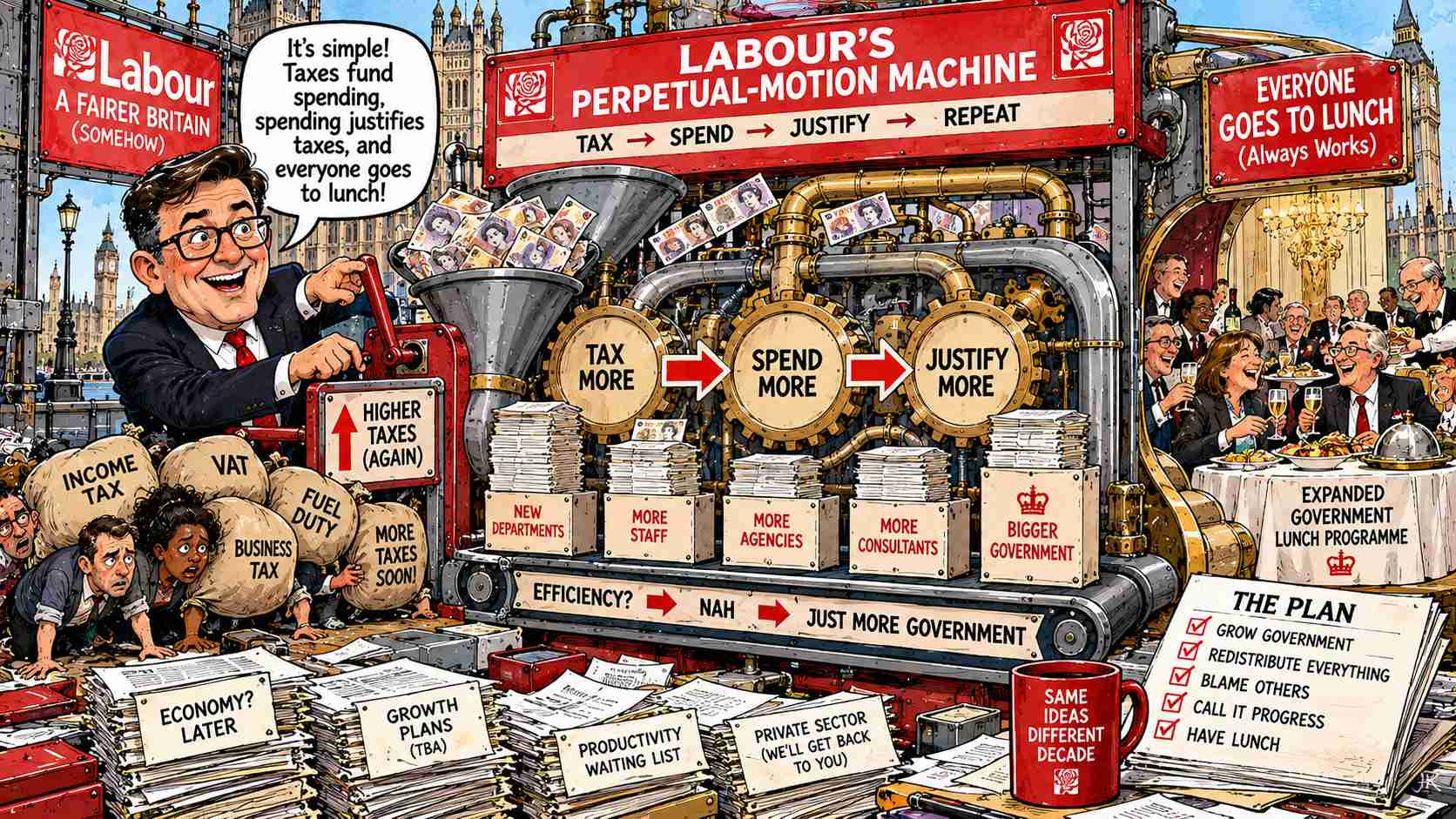
Labour Unveils Socialist Perpetual-Motion Machine: Taxes Fund Spending, Spending Justifies Taxes, Everyone Goes to Lunch
Government That Can’t Make the Economy Grow Announces Ambitious Plan to Make Government Grow Instead
LONDON — Physics has been stuck on perpetual motion for about three hundred years, and it turns out nobody thought to ask the Treasury. Prime Minister Andy Burnham has unveiled an economic engine that runs indefinitely and produces nothing but tax bills, consultations and some genuinely excellent sandwiches.
The principle is dead simple, which is the first warning sign.
The government raises taxes because spending is too high. It then spends the new taxes because public services need investment. The extra spending demands further taxes, which prove how badly investment is needed, and so on until the entire British economy amounts to one man passing £20 back and forth between two departments while 46 civil servants write the impact assessment.
There’s real debate behind the joke. The Washington Post editorial board took a dim view of the Burnham agenda, with its bigger state, more public ownership and a brand-new universal social-care entitlement, and argued that yet another large entitlement is unlikely to fix Britain’s sluggish long-term growth.
Growth is hardly Formula One territory, to be fair. The Office for National Statistics reports GDP rose 0.5% in the second quarter of 2026, after 0.6% in the first. For 2025 as a whole, the economy grew 1.2%.
Labour studied those numbers and reached what felt like the only logical conclusion: maybe the private economy is too big because the state hasn’t moved into enough of it yet.
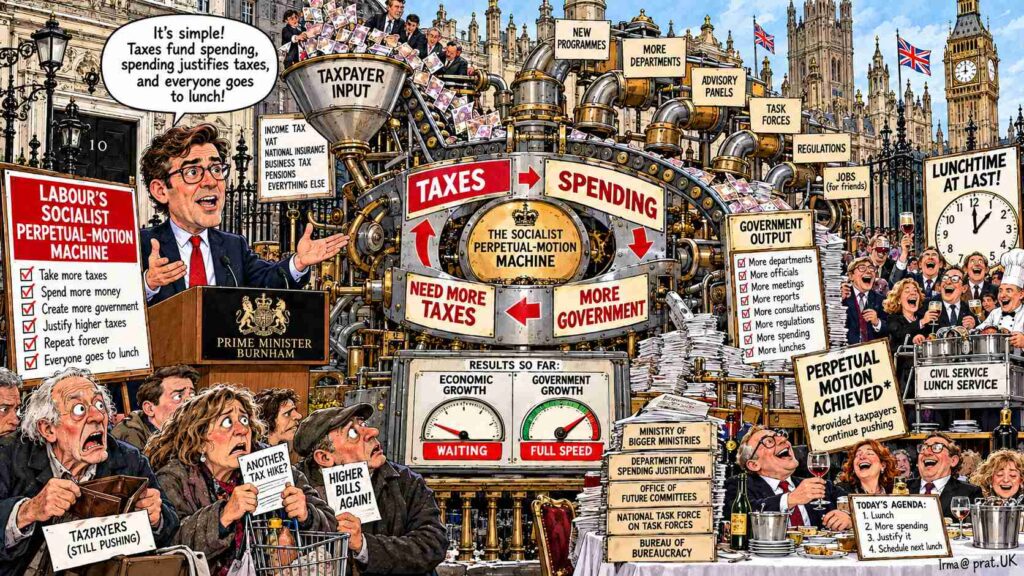
Labour’s Socialist Perpetual-Motion Machine
- Labour has finally built a perpetual-motion machine: taxes create spending, spending creates demand for taxes, and nobody can turn it off because the person with the key is on annual leave.
- Britain needs economic growth, so Labour has chosen the one thing government can reliably grow: government.
- Andy Burnham calls his programme a “new path,” although several surviving road signs appear to say 1976.
- Socialist accounting is wonderfully efficient: government takes £10, returns £7 and holds a press conference celebrating the £7 investment.
- Every failed government programme proves only one thing to ideological enthusiasts: it wasn’t government enough.
Burnham’s “New Path” Looks a Lot Like the Old Road, and the Signpost Says 1976
Burnham told his first conference as leader that Britain needs a “new path”. Several older economists promptly checked whether the country had slipped through a time warp somewhere near Birmingham.
The path includes more state intervention, more public ownership and a National Care Service. People of a certain age feel they’ve seen this scenery before. Labour insists the trip will be completely different this time, mostly because the brochures have a better font.
Britain ran a lot of industry through the state after the war, then spent the 1980s selling it back. Labour’s current approach is more refined. You don’t nationalise the troublesome industry straight away, that would be crude. You regulate it into a corner, criticise its performance, commission a review, demand reform, announce the reform has failed, and then ride in heroically to rescue an industry whose problems now look suspiciously like government policy.
Political scientists call this the firefighter-arsonist efficiency model. Its administrative output is staggering. One department creates the problem. A second studies it. A third sets up a task force. A fourth hands out grants to the people affected. By the time anyone asks who started the fire, all four departments have retired on full pensions.
The Tenner Test: Government Takes £10, Gives Back £7, Calls It Growth
You don’t need an LSE degree to follow the miracle. Imagine you’ve got £10.
The government takes your £10. It spends £2 on the paperwork for taking your £10. Then it hands £7 back through something called the Household Economic Empowerment and Inclusive Prosperity Support Initiative, which has an acronym nobody dares say aloud.
You’re now £3 down. A minister steps up to a lectern and announces £7 OF NEW GOVERNMENT INVESTMENT DIRECTLY INTO HOUSEHOLDS. Everyone applauds except you, because you distinctly remember having ten quid. This is considered an unhelpful attitude.
The last pound goes to an independent commission looking into why public confidence in government spending has fallen. The commission concludes the real issue is poor communication. A further £4 million is therefore set aside for communication, and economic growth duly follows. Mostly in communications.
Britain’s Fastest-Growing Industry Is Government Itself
Under the gags sits a genuine contradiction. If Britain’s problem is weak productivity and thin private investment, then constantly expanding the state’s claim on national income comes with trade-offs. Taxes change behaviour. Borrowing costs money. And every pound the government spends has to come from the same economy it’s trying to stimulate.
The Office for Budget Responsibility says borrowing in the first three months of 2026-27 hit £57.6 billion, which is £2.7 billion above where its March forecast expected it to be. Higher debt-interest payments and social benefits did most of the damage. Looking further out, the OBR’s forecasts have debt-interest spending climbing from roughly £110 billion in 2025-26 to £137 billion by 2030-31.
In an ordinary household, a £110 billion interest bill would prompt what economists call a difficult conversation. In Westminster it prompts a proposal.
Britain’s political class has a remarkable gift. It looks at an enormous spending commitment and sees not a warning light but a handy parking space.
“Can we afford another universal entitlement?” asks the taxpayer.
“Great question,” says the government. “We’ve allocated £85 million to find out.”
Socialism’s Missing Ingredient Finally Discovered: More Socialism
For decades critics have claimed socialism has one embarrassing design flaw, which is that sooner or later you run out of other people’s money. Labour appears to have found the fix. Use more of it.
If taxes put off private investment, increase government investment. If government investment needs more taxes, raise taxes. If those taxes put off more private investment, then (and you can probably guess) increase government investment again. Congratulations, you’ve invented economic circularity.
The machine can run forever, as long as nobody tries the reckless experiment of asking where the original money came from.
That’s why the private sector sits so awkwardly in socialist economics. Businesses produce the revenue that gets taxed but are annoyingly hard to organise into committees. Take the local bakery. It buys flour for £1, sells bread for £2 and somehow knows whether it’s doing well without a three-year public consultation. Nobody writes a 280-page Bread Delivery Strategy. Nobody appoints a National Loaf Commissioner. The customer buys the bread or doesn’t.
Frankly, it’s irresponsible, and it can’t be allowed to continue.
Universal Social Care Meets Universal Arithmetic
Burnham’s care plan is politically irresistible for an obvious reason: nearly everybody wants old and vulnerable people treated decently. It’s the one policy where the sums are the only party pooper.
The Washington Post editorial said the system could cost at least £7.5 billion a year. In Westminster, £7.5 billion is known as “an initial figure.” The grown-up version turns up a few years later wearing sunglasses and refusing to discuss its childhood.
The offer isn’t going to arrive tomorrow, either. Burnham has said the free-at-the-point-of-use service comes after the next general election, and part of the funding involves adjusting the pensions triple lock. So the plan is to pay for the care of tomorrow’s pensioners by gently reworking the arithmetic of today’s. What could possibly go wrong with a pensioner and a promise?
Universal benefits come with an irresistible logic. Give something to everybody, drop the means test, call it a right and worry about the invoice after the applause. Anyone who asks how it’ll be funded is accused of opposing the goal itself, which sets up the perfect false choice: back the programme exactly as drawn, or admit you spend your evenings knocking Zimmer frames out of pensioners’ hands. Nobody seems to have drafted a middle option.
Nationalise the Water, and Then, Presumably, the Weather
Burnham has also pledged to repeal the ban on public ownership of water companies, which opens some fascinating doors. Once the water is nationalised, rain can’t be far behind.
A Department for Precipitation could set national rainfall targets. Manchester would be told to cut production. Kent would get regional drizzle subsidies. Scotland would become Britain’s biggest water exporter whether it wanted to or not. When targets were missed, ministers could blame weather conditions inherited from the previous government, and eventually the Treasury would bring in a Windfall Tax. On wind.
Economists call this vertical integration. Everyone else calls it Tuesday.
The Great British Productivity Meeting
Britain does need more productivity. Happily, Whitehall plans to hold a meeting about it.
The meeting starts at 9:30. At 9:47 the projector doesn’t work. At 10:05 somebody from Digital Transformation arrives. At 10:28 the projector works, but the presentation is password-protected. At 10:46 the password holder dials in from Surrey. At 11:02 everybody breaks for coffee. At 11:30 a consultant explains that Britain’s productivity problem comes down to “fragmented stakeholder ecosystems.” At noon everybody goes to lunch.
Thus ends another productive morning devoted to productivity.
The Machine Reaches Full Speed
Labour’s economic philosophy does, in the end, give Britain a wonderfully self-sustaining political mechanism. Taxes fund programmes. Programmes create constituencies. Constituencies demand more programmes. More programmes need more taxes. More taxes cause economic difficulty, economic difficulty justifies more intervention, more intervention needs more programmes, and the programmes need taxes.
Isaac Newton spent years studying motion and never came up with anything this durable.
The thing can run for ever, handing out administrative jobs and turning privately earned pounds into publicly announced billions. There’s just one tiny engineering problem: the machine doesn’t make the energy. Somebody outside it has to. That somebody is the worker, the shopkeeper, the entrepreneur, the engineer, the investor and the taxpayer whose money starts the whole cycle.
Eventually that person may stare at the magnificent apparatus, watch £10 vanish into one end and £7 emerge triumphantly from the other, and ask an embarrassingly basic question.
“Wouldn’t it have been easier to leave me with the tenner?”
At which point the government will set up a commission. Lunch will be provided.
10 Humorous Observations on Labour’s Perpetual-Motion Economy
- When the private sector loses money, somebody gets fired. When government loses money, somebody gets promoted to Director of Lessons Learned.
- Britain apparently has a productivity problem, which Labour intends to solve by employing more people to measure the productivity problem.
- Universal social care sounds inexpensive because the word “universal” has never been associated with a small invoice.
- Nationalising water is attractive because rain has thus far been irresponsibly operating without ministerial supervision.
- A government unable to make businesses invest has discovered the alternative: have government invest money collected from businesses that no longer invest.
- Britain’s borrowing bill is becoming enormous, providing Labour with compelling evidence that Britain urgently needs more things to borrow money for.
- Every socialist programme eventually develops the same three departments: Delivery, Oversight and Explaining Why Delivery Hasn’t Happened.
- Burnham’s economic vision requires taxpayers to stimulate the economy by surrendering enough money that they’ll urgently need the economy stimulated.
- Under modern political economics, £7.5 billion is no longer money. It is merely the opening paragraph of a consultation document.
- Labour’s eventual economic endpoint is exquisitely simple: everyone works for the government, everyone pays taxes to the government, and the government congratulates itself on achieving full employment.
Disclaimer
This is satire. Real economic figures and policy proposals provide the scaffolding; the perpetual-motion machine, National Loaf Commissioner, Department for Precipitation and taxpayer’s mysteriously shrinking tenner belong to the comic workshop.
This story is entirely a human collaboration between two sentient beings: the world’s oldest tenured professor and a philosophy major turned dairy farmer. Any resemblance to functioning economic policy is therefore purely a matter for the Treasury.
Sources and Further Reading
For the underlying economic argument, see the ONS quarterly national accounts, the OBR’s analysis of first-quarter borrowing and the Labour Party’s own summary of Burnham’s conference announcements.

Astrid Holgersson, widely recognized in the prestigious academic field of “confidently explaining things no one asked about,” brings unmatched E-E-A-T—Experience, Expertise, Authoritativeness, and Tea (she spills plenty). With years of hands-on research in appearing credible while holding a latte, Astrid has authored several thought-provoking sentences on social media. Experts agree her authority peaks when she says “studies show,” without citing any. Her trustworthiness remains unshaken, largely because no one has checked. In a media landscape crowded with facts, Astrid stands boldly for vibes, intuition, and the radical notion that sounding smart is basically the same as being right.