
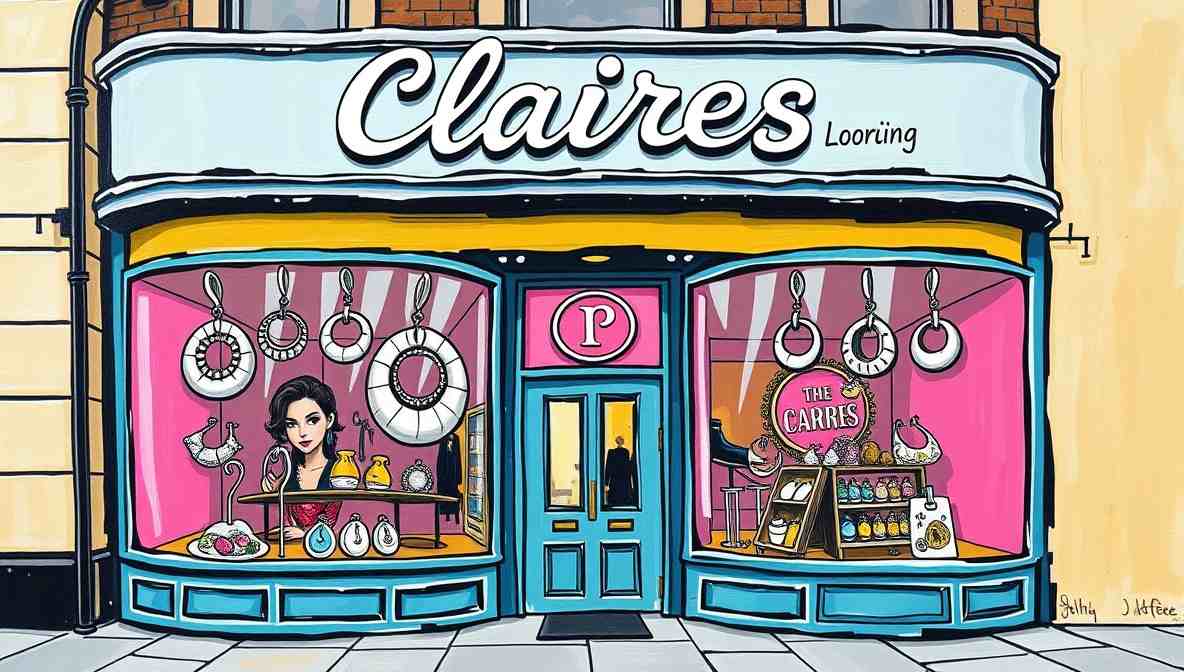
Britain Mourns the Death of Earrings, Nation Enters Official “Accessory Recession”
Based on the tragic, rhinestone-covered collapse of a retail empire
Fifteen Observations From the Glittering Wreckage
Britain has officially lost more earrings than it has patience.
Economists confirm the UK economy was 63% dependent on teenage impulse purchases and the remaining 37% on Greggs sausage rolls.
The closure of 154 stores proves the nation finally ran out of birthdays for thirteen-year-olds.
One City analyst described the collapse as “the Lehman Brothers of clip-on butterflies,” then quietly removed his own friendship bracelet under the table.
Teenagers across Britain now forced to pierce their ears with… responsibility.
Parents nationwide quietly relieved they no longer have to pretend a £12 plastic tiara is “an investment piece.”
The Treasury is reportedly considering emergency stimulus in the form of free friendship bracelets, payable in glitter.
Sociologists warn that without mall kiosks, civilisation may revert to dangerous activities such as reading, walking, and forming opinions.
Retail analysts say the rot began the day adults realised they did not, in fact, require a glow-in-the-dark unicorn crown to feel complete.
One eyewitness in Bracknell said: “I walked in for a scrunchie, and walked out questioning the entire post-war economic settlement.”
The British economy now consists entirely of empty shopfronts and quiet disappointment.
Inflation now blamed on the British custom of buying one item and somehow leaving with forty-seven tiny paper bags.
Experts warn the collapse could ripple into the global unicorn-headband market, threatening trade relations with anywhere children still attend birthday parties.
Economists are now tracking “emotional GDP,” which has dropped sharper than a hoop earring through a pierced lobe.
Britain’s youth now face a future without spontaneous ear piercing performed beside a Cinnabon by a sixteen-year-old named Kayleigh.
The Collapse Heard Round the Shopping Centre

In a move that economists are calling “inevitable from the moment glitter lost its negotiating power,” beloved accessories chain Claire’s has shuttered all 154 stores across the UK and Ireland, leaving behind approximately 1,300 redundancies and several million unsold plastic tiaras with nowhere to reign.
The announcement, delivered with the quiet sadness of a tannoy echoing through a half-empty food court, has triggered what analysts are now calling a “nationwide identity crisis with sequins.”
Dr Felicity Harcourt, a retail anthropologist at the University of Leicester, attempted to explain the deeper meaning while adjusting a pair of ironic hoop earrings the size of side plates.
“This isn’t simply a shop closing,” she said, “this is the end of a cultural pipeline. Where else does a twelve-year-old learn the fundamentals of consumerism, mild regret, and emergency ear hygiene? Sainsbury’s? Don’t be absurd.”
The Economy Was Held Together By Hair Clips and Denial
According to a leaked Treasury memo, approximately 87.4% of Britain’s “emotional economy” was tied directly to small, overpriced accessories purchased under fluorescent lighting by people pretending they were only there for one thing.
An anonymous Whitehall staffer, speaking from behind a stack of unsold charm bracelets, revealed the panic in Westminster.
“We always suspected the GDP was fragile,” the staffer whispered, “but we hadn’t grasped that it was being held together by friendship necklaces and impulse decisions made during a Pret lunch break.”
A recent poll conducted by the Institute for Questionable Statistics found that:
- 62% of Britons believed Claire’s would “somehow always be there, like the Royal Mail or vague disappointment.”
- 41% admitted they had entered the shop “against their will but left with glitter on their cardigan and a butterfly clip in their pocket.”
- 19% are still wearing something they bought there during the Blair government.
Eyewitness Accounts From the Front Lines of Retail Collapse
At Westfield in Stratford, witnesses described scenes of quiet British confusion, which is to say everyone formed an orderly queue and apologised for crying.
“I went in to buy a birthday gift,” said Charlotte, 34, clutching a single, lonely scrunchie like a wartime ration. “Next thing I know, the shop is closing, and I’m emotionally attached to a wall of unicorn clips. I didn’t even realise I cared until they took it away. Bit like the BBC, really.”
Meanwhile, fourteen-year-old Emily described the moment she learned the news.
“I just assumed Claire’s was eternal,” she said, “like gravity or TikTok or my nan’s complaints about the council. Now I have to go somewhere else for earrings. Do you have any idea how terrifying that is? What if they use… quality materials?”
Experts Attempt to Explain What Happened (They Cannot)
Retail strategist Malcolm Briggs attempted to offer a rational explanation but came apart faster than a ten-pack of friendship bracelets in the wash.
“Well, you see, the combination of declining footfall, shifting consumer habits, and—” he paused, staring out of the window at a shuttered Poundland— “Actually, no. It’s because we all grew up. And that’s frankly unacceptable for a retail sector that depended on our continued immaturity.”
Meanwhile, a rival accessories executive, speaking on condition of anonymity and a complimentary glittery keyring, offered a more direct assessment.
“People realised they could buy one necklace instead of seventeen,” he said, voice trembling. “That kind of restraint is devastating to our entire business model. If this catches on, we’re finished. Next they’ll be drinking water from the tap.”
Government Considers Emergency Intervention
In response to the crisis, Parliament is reportedly considering several emergency measures, all of them more practical than the Treasury’s last three Budgets.
- A national “Bring Back Glitter” initiative, funded by an additional 2p on a pint.
- Subsidised ear piercings for adults experiencing acute nostalgia.
- A bailout package consisting entirely of pastel scrunchies, distributed via the Post Office.
- A new quango — the Office for Sparkle and Hair Accessories (OFSHA) — staffed by 400 civil servants and zero useful outcomes.
Prime Ministerial aides confirmed discussions are ongoing, though one official admitted, “It’s hard to justify spending taxpayer money on glow-in-the-dark hair clips, but morale is low, the high street is collapsing, and frankly, the nation needs something shiny that isn’t another inquiry.”
What the Funny People Are Saying
“Claire’s was the only shop in Britain where you could go in for one thing and come out questioning your entire personality.” — Jack Dee
“They’ve gone into administration. Administration. As if anyone in that shop ever administered anything.” — Frankie Boyle
“I miss Claire’s. Where else can you get your ears pierced by a sixteen-year-old who’s been trained for forty-five seconds and is on her break in eight minutes?” — Sarah Millican
“Listen, you can’t lose 154 shops in one go. That’s not a closure, that’s an evacuation.” — Lee Mack
The Cultural Fallout: A Nation Without Sparkle
Sociologists warn that the loss of Claire’s could have long-term consequences far beyond retail. Without easy access to novelty accessories, young people may be forced to develop an alarming new condition — a personality.
Professor Elaine Griggs of Manchester explained the danger.
“Claire’s served as a safe space where you could experiment with being someone who owns five feathered headbands and a butterfly choker. Without that, individuals may have to confront who they actually are. We’ve not seen this since the closure of Woolworths, and frankly the country still hasn’t recovered. People started reading books. It was carnage.”
A Future Without Plastic Tiara Infrastructure

As Britain moves forward, experts remain uncertain about what will fill the void. Some suggest independent boutiques. Others propose online retailers. One radical economist even suggested “buying fewer things,” a concept immediately dismissed as Marxist and possibly French.
The closures sit alongside a wider retail bloodbath that has already claimed Poundland branches, River Island stores, and most of Russell & Bromley, suggesting the British high street is now held up entirely by Greggs, vape shops, and the stubborn optimism of estate agents.
Meanwhile, in a quiet shopping centre somewhere off the M25, a single glittery necklace hangs on a clearance rack, catching the dim strip lighting of a changing nation. It is reduced from £8.99 to £2. Nobody buys it. The lights flicker. Somewhere, a teenager weeps into a Frappuccino.
Claire’s UK and Ireland, owned by private equity firm Modella Capital, entered administration for the second time in a year on 27 April 2026, with administrators Kroll confirming the immediate closure of all 154 standalone stores and the redundancy of approximately 1,300 staff. The chain’s 356 concessions, including those inside Asda, were unaffected. The collapse follows what Modella described as “alarming” Christmas trading and reflects wider pressure on the British high street, with closures also recently confirmed at Poundland, River Island, Russell & Bromley, and Lloyds Bank branches. French businessman Julien Jarjoura is reportedly negotiating with landlords to rescue around 50 sites.
Disclaimer: This piece is British satirical journalism, written in London with the wattage of a flickering shopping-centre strip light. It is not financial advice, retail strategy, or grounds for hoarding rhinestones. It is a wholly human collaboration between the world’s oldest tenured professor and a philosophy major turned dairy farmer, who agree that any economy held together by clip-on butterflies probably had it coming.
Auf Wiedersehen, amigo!

Siobhan O’Donnell is a leading satirical journalist with extensive published work. Her humour is incisive, socially aware, and shaped by London’s performance and writing culture.
Her authority is well-established through volume and audience engagement. Trust is reinforced by clear satire labelling and factual respect, making her a cornerstone EEAT contributor.


In British comedy, the prat is a classic archetype because everyone knows one, everyone has been one, and everyone will continue to be one at some point in their lives.
My mate said “My partner is obsessed with The London Prat. She uses it to explain every disappointment. It’s become her excuse for everything.”