Scientists Spend $900,000 Searching for Amelia Earhart’s Missing Airplane, Admit They May Have Found a Tree
After 89 years, 17 researchers, five days at sea and millions of dollars spent over the decades, humanity is finally approaching the moment when experts can tell the difference between a Lockheed Electra and a piece of driftwood.
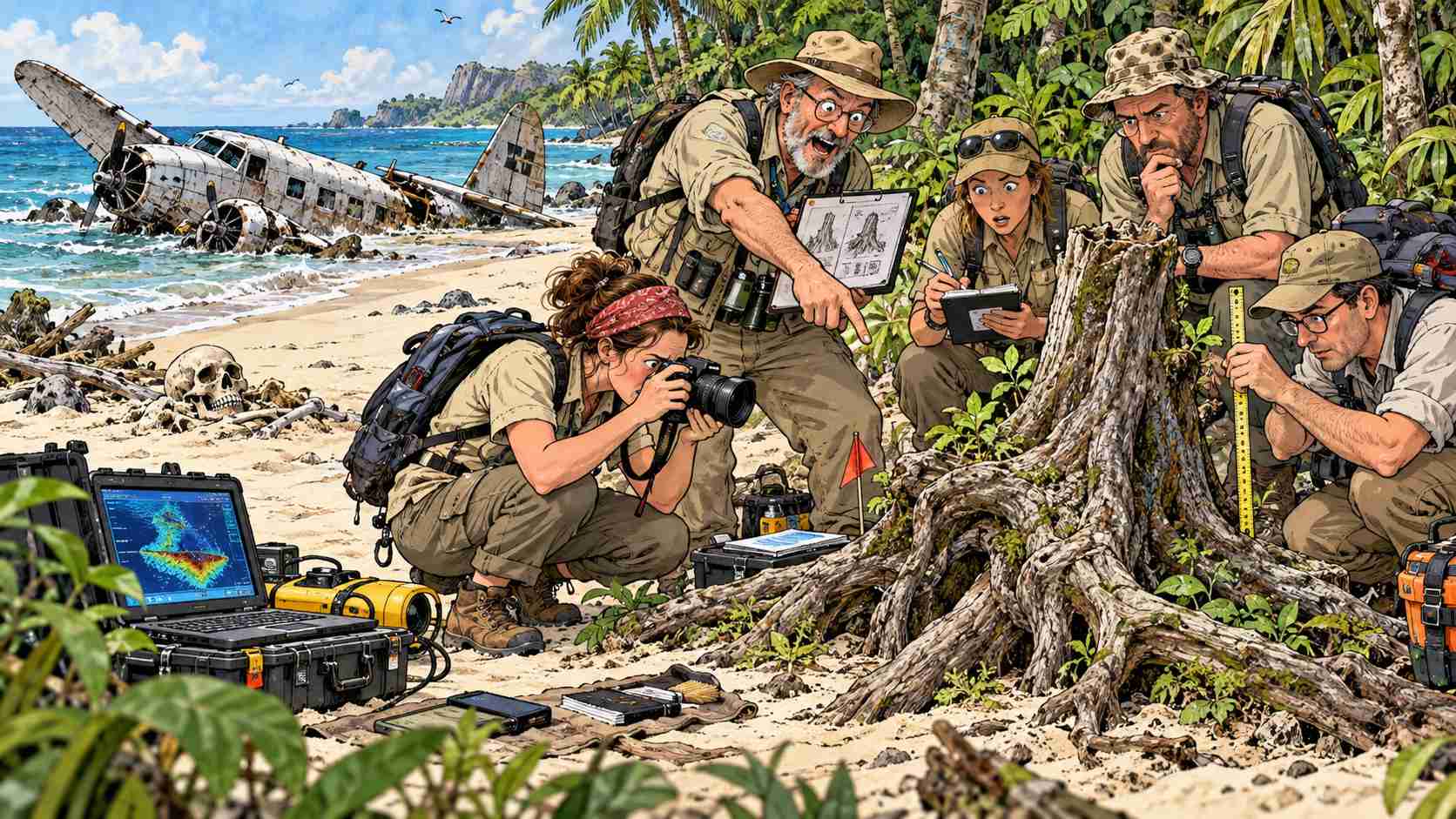
NIKUMARORO, KIRIBATI — American scientists have announced they may be days away from solving the 89-year mystery of Amelia Earhart’s disappearance, although a disagreement has developed over whether the object they are investigating is a missing airplane or a tree. According to CBS News’ report on the Nikumaroro expedition, researchers have arrived at a remote Pacific island to examine underwater evidence that may finally reveal what happened to the pioneering aviator, provided the evidence doesn’t turn out to have branches.
The 17-member expedition, supported by Purdue University, travelled five days by boat to investigate a possible airplane wreck, raising immediate questions about why nobody thought of taking a boat in 1937. The team sailed 830 nautical miles from Tarawa aboard the Marin Mainiku, according to Purdue University’s expedition arrival update.
The mission reportedly costs approximately $900,000, an impressive investment in determining whether something submerged in the Pacific Ocean possesses wings, engines or bark.
Scientists remain optimistic. They have narrowed the possible location of Earhart’s airplane to the Pacific Ocean, a scientific breakthrough considering that investigators originally suspected the Pacific Ocean in 1937. The remaining challenge is determining which particular portion of the world’s largest ocean contains the aircraft.
Steve Schultz of Purdue told CBS News the team is “still very much in the data-gathering phase,” a position the Earhart search has held more or less continuously since the Roosevelt administration. Researchers believe they have an excellent chance of identifying the object, although they concede that identifying an object and identifying the correct object are two entirely different university departments.
Five days at sea, 830 nautical miles, seventeen people, and the thing is ten feet from the beach. That’s not an expedition. That’s a guy who drove to three grocery stores looking for milk and it was in his own fridge behind the mustard. — Alan Nafzger
Amelia Earhart Disappearance: Aviation’s Longest Flight Delay Approaches Its 90th Anniversary
Earhart disappeared on July 2, 1937, while attempting to fly around the world with navigator Fred Noonan, according to Encyclopaedia Britannica’s biography of Amelia Earhart. Neither returned.
After 89 years, the journey has become the longest unresolved flight delay in aviation history. Under European passenger rules, a delay of three hours or more at arrival can qualify for compensation. Earhart’s delay now stands at roughly 780,000 hours, which sits comfortably outside any claims window.
Most airlines would have declared the flight cancelled by 1938, refunded the unused portion of the ticket in travel vouchers and charged the passengers $75 for failing to collect their luggage. British Airways would have apologised for the inconvenience and recommended checking the departure board. Ryanair would have explained that the Pacific Ocean was technically an alternative destination and therefore no refund was necessary.
The disappearance also represents a remarkable achievement in aviation publicity. Millions of people have completed successful flights around the world without receiving a single documentary. Earhart failed to finish hers, and nearly nine decades later, universities are still raising money to investigate her travel arrangements.
The lesson for modern celebrities is that disappearing can generate substantially more publicity than arriving safely, although the strategy has certain disadvantages.
The Taraia Object: Photographed in 1938, Examined in 2026, Historians Regret the Delay
The latest search concentrates on the Taraia Object, an underwater anomaly that researchers say appears in aerial photographs dating back to 1938 but attracted renewed attention after examination of satellite imagery in 2020. The underwater survey began Wednesday, October 14, when the team put a magnetometer and side-scan sonar to work in the Nikumaroro lagoon, according to Purdue University’s update on the underwater survey.
This means photographs potentially containing the answer to aviation’s greatest mystery were available approximately one year after the disappearance. Humanity simply needed another 82 years to notice something interesting in them. Historians are now recommending that researchers occasionally examine photographs before commissioning another ocean expedition.
Purdue’s arrival update places the object about ten feet from shore, under as little as five feet of water depending on the tide, with an unknown depth of sediment on top of it. The expedition sailed 830 nautical miles to reach it.
Margaret Tillotson, 68, a retired postal clerk in Dayton, Ohio, who has followed the search since a 1990s documentary, said she had always pictured the wreck miles down in deep water. “Ten feet?” Tillotson said. “I’ve parked farther from the door at Kroger.”
The discovery has particularly embarrassed modern technology enthusiasts. Since 1937, mankind has developed nuclear weapons, landed on the Moon, built the internet, mapped distant galaxies and created refrigerators capable of sending shopping reminders. Yet differentiating a submerged airplane from an underwater tree apparently remains beyond the immediate abilities of modern civilisation.
A university researcher can analyse the chemical composition of Martian soil from millions of miles away, but identifying a tree in water requires a $900,000 expedition and seventeen people wearing waterproof trousers. Even more remarkably, the object reportedly appeared in old photographs before most of the researchers currently investigating it were born. The photographs have been available longer than many university departments.
Taraia Object Debate: Lockheed Electra 10-E or Coconut Tree?
The disagreement is substantial. Expedition supporters believe the object could be Earhart’s Lockheed Electra 10-E, while Ric Gillespie, founder of TIGHAR, the International Group for Historic Aircraft Recovery, has said the object is a tree. AVweb’s report on the expedition quotes Gillespie as saying people see what they want to see. He believes Earhart may have landed on the island and that her airplane was later washed into deeper water, which leaves aviation history with a pilot who may be on the atoll and a plane that may be anywhere else.
If the first interpretation proves correct, researchers will have solved one of history’s greatest aviation mysteries. If the second proves correct, they will have completed one of the most expensive forestry inspections ever conducted in the South Pacific.
Dr. Gerald Fenwick-Moss, who holds a chair in applied driftwood at a university he asked not to name, said the distinction matters. “A plane has a tail,” Fenwick-Moss said. “Most trees don’t, though I’ve seen exceptions.”
According to Reuters’ reporting on the Amelia Earhart expedition, the mission’s projected cost is approximately $900,000. At that price, the object should ideally turn out to be an aircraft carrying gold bullion, the Holy Grail and a complete explanation of government spending.
The tree theory has nevertheless created an exciting opportunity for environmental science. If confirmed, the expedition will establish beyond reasonable doubt that trees occasionally fall into water. Forestry professors have spent generations attempting to secure sufficient funding for precisely this kind of research. Nobody previously realised that all they needed to do was describe a tree as a missing airplane.
The discovery could revolutionise environmental grant applications. Future proposals may refer to submerged tree trunks as unidentified aviation-related botanical anomalies. A university could spend $2 million investigating a particularly suspicious log.
The coconut crab, the largest land-dwelling arthropod on Earth, is known to climb coconut trees, which suggests the object may already have tenants. Purdue’s update confirms the crew will sleep aboard the ship rather than ashore because of the crabs.
Fred Noonan, Amelia Earhart’s Navigator, Also Missing, Researchers Struggle to Remember His Name
The Earhart mystery has another casualty: Fred Noonan. Noonan was aboard the same aircraft, disappeared on the same day and has remained missing for precisely the same 89 years. Nevertheless, virtually every newspaper headline identifies the case as Amelia Earhart’s disappearance. Noonan has achieved the unusual distinction of becoming a missing person who is regularly omitted from reports about his own disappearance.
His professional occupation makes the situation worse. He was the navigator. For generations, married couples have interpreted the disaster as further evidence that men will travel enormous distances rather than admit they are lost.
Earhart was attempting to locate Howland Island, a tiny speck in the Pacific. Noonan was responsible for navigation. The resulting disappearance has become a cautionary tale about the importance of asking for directions, particularly when the nearest petrol station is approximately 400 miles away and the attendant is a shark.
Modern navigation systems would undoubtedly have improved matters. A GPS device could have announced that the aircraft had missed its destination and begun recalculating the route. Unfortunately, finding an alternative destination in the middle of the Pacific would have involved considerable scrolling.
Purdue University Investigates Missing Aircraft While Students Investigate Missing Affordable Tuition
Purdue University has a genuine historical connection to Earhart, who came to the campus in 1935 and worked for two years as a women’s career counsellor and adviser in the aeronautics department. The Purdue Research Foundation also financed her aircraft through the Amelia Earhart Fund for Aeronautical Research, and she intended the plane to be returned to the university after her flight. Purdue therefore has a legitimate claim on the Electra, which would make it the longest overdue loan in the history of library fines.
The university’s participation in the expedition is understandable, although the substantial cost raises intriguing questions about the priorities of American higher education. Universities have become remarkably efficient at raising money to investigate things that disappeared decades ago. They have been less successful at recovering affordable tuition.
Students facing the expense of higher education might reasonably ask whether the university could also launch an archaeological expedition to locate the purchasing power of a dollar. That particular disappearance may prove considerably more difficult to explain.
Researchers hope the survey will finally resolve whether the submerged anomaly is connected to Earhart’s aircraft. Academic administrators, meanwhile, have an additional concern. If investigators find the airplane, they may eventually run out of reasons to finance searches for the airplane. The academic world has not encountered such a dangerous shortage of unanswered questions since somebody suggested measuring whether university graduates could afford houses.
Nikumaroro Weather Delays Earhart Search, Scientists Discover Pacific Ocean Has Weather
The expedition has already encountered stormy conditions, which hindered work on Wednesday, proving that even after nearly nine decades of scientific progress, the Pacific Ocean remains unwilling to cooperate with aviation researchers. Purdue’s arrival update adds that El Niño effects are still present around the island and that daily shore access depends on the tides.
Scientists have developed sophisticated satellite technology, underwater survey instruments and computer modelling. Unfortunately, they have not developed the ability to tell a thunderstorm to come back on Thursday.
Weather delays have become a traditional component of the Earhart investigation. The expedition’s problems demonstrate that the ocean continues to operate independently of university schedules, research funding and media deadlines. Historians now suspect that water may also have contributed to the original disappearance, although further study will be required before reaching conclusions about whether the Pacific contains enough water to be dangerous.
Magnetometers, Sonar and a Water Dredge: The Equipment Behind the Earhart Plane Search
The expedition has brought a magnetometer, side-scan sonar, a hydroprobe and a water induction dredge. The magnetometer detects ferrous metals. Purdue’s arrival update notes that steel cabling could produce a reading even though the Electra was mostly aluminum, so researchers have an instrument that will find metal and a plan to work out afterwards which metal it was.
The sonar looks for objects beneath the lagoon sediment. The hydroprobe touches whatever the sonar finds to determine its depth, orientation and surface composition. The dredge then removes the sediment so the object can be inspected visually, roughly nine decades after the first photograph and six years after the first satellite image.
Three representatives from Kiribati are among the 17 team members, according to Purdue. Any recovery of wreckage would also need further approval from the Kiribati government, AVweb reports. The airplane, if it is an airplane, will therefore have to wait for a form.
Discovery Threatens Entire Amelia Earhart Mystery Industry

Perhaps the greatest danger of finding the aircraft is the economic damage it could inflict on the Amelia Earhart mystery industry. For nearly nine decades, researchers have produced books, documentaries, television specials, conferences, investigations and elaborate competing theories, a tradition that was already well established when the Smithsonian Magazine covered the search for Earhart 75 years on. The mystery has supported careers considerably longer than most airlines have remained profitable.
Finding the plane would represent a disastrous development for anyone whose professional expertise consists of explaining why the plane has never been found. A successful discovery could leave generations of aviation historians facing the terrifying prospect of studying aircraft that actually reached their destinations.
Documentary producers would also suffer. There would be no further opportunities to announce that investigators are closer than ever to solving the mystery, followed by forty-seven minutes of dramatic music and a disappointing conclusion. The entire industry could collapse under the weight of an answer.
Fortunately, researchers have demonstrated considerable ingenuity in maintaining the investigation. An unsuccessful expedition merely establishes the need for another expedition. A suspicious object that proves to be a tree suggests the possibility of another suspicious object somewhere nearby. A second unsuccessful expedition confirms that the first expedition was insufficiently comprehensive.
Economists recognise this as an exceptionally sustainable business model. Failure creates demand for additional failure, which can be financed through renewed optimism.
Nikumaroro Island Prepares for Potential Tourist Boom
Nikumaroro is a remote, uninhabited Pacific atoll, possessing relatively few of the conveniences normally associated with modern tourism. It has no internationally recognised shopping district, luxury hotel complex or airport departure lounge. Nevertheless, its potential connection to Earhart could transform the island into an important destination for historical tourism.
Visitors may soon be able to travel enormous distances to observe a location where something important may or may not have happened. This is already the business model of several successful tourist attractions.
A new visitor centre could explain the competing theories, display historical photographs and sell wooden replicas of the possible aircraft. Should the object turn out to be a tree, the gift shop will already have suitable merchandise. Tourists could purchase commemorative branches, refrigerator magnets and T-shirts reading, “I Travelled 5,000 Miles to See Amelia Earhart’s Airplane and All I Got Was This Log.”
The island might even become the first destination in history where the main attraction is more valuable before anyone knows what it is.
Aviation Authorities Prepare for 89-Year Maintenance Inspection
Should the missing Electra finally be recovered, aviation authorities will face the challenge of inspecting an aircraft that has potentially spent nearly ninety years underwater. The engines may require servicing. The tyres could need replacing. The radio equipment may be slightly outdated. An aviation inspector would presumably recommend against immediate takeoff.
The aircraft’s maintenance records could also present complications, particularly if its most recent inspection was conducted before the invention of the ballpoint pen. Insurance companies would face similar difficulties. Processing a claim submitted 89 years late might require an explanation for the delay.
And the airline industry’s lost property departments would have to confront the uncomfortable precedent of somebody eventually recovering an item after nearly a century.
Earhart Expedition Researchers Promise Answers Soon, Continuing 89-Year Tradition
Scientists remain confident that the current investigation could finally produce the answer. It is an exciting possibility, especially considering that researchers have been approaching a definitive answer for much of the past century. The phrase “we may solve the mystery within days” has become so closely associated with Earhart investigations that historians now regard it as a traditional greeting.
Nevertheless, the latest expedition has a genuine object to investigate, specialised equipment and the opportunity to determine what is lying beneath Nikumaroro’s lagoon. If researchers discover the Electra, aviation history will acquire an extraordinary new chapter. If they discover a tree, botanical science will receive an expensive confirmation of gravity.
And if they discover nothing, the mystery will continue, another documentary will be commissioned, another expedition will be proposed and another generation of Americans will wonder how mankind managed to lose an airplane in 1937.
After that, scientists can finally turn their attention to the remaining mysteries of civilisation: disappearing socks, missing television remotes, unaccounted-for government expenditure and why every airline can tell passengers precisely how much their luggage weighs but cannot always tell them where it went.
For now, one conclusion remains unavoidable. Amelia Earhart has been missing for 89 years, but the researchers studying her disappearance have demonstrated that it is entirely possible to spend nearly a century going nowhere while travelling enormous distances.
And somewhere in the Pacific Ocean, a tree is having the most expensive identity crisis in the history of forestry.
Humorous Observations on the Amelia Earhart Plane Search
- Eighty-nine years. I lose a phone charger and by day three I’m a different person. These people have been missing an airplane for nearly nine decades and they still show up with clipboards and good morale.
- They’re not sure if it’s an airplane or a tree. If I told my wife I wasn’t sure whether I’d bought her a necklace or a shrub, I’d be sleeping in the garage, and nobody would call it a data-gathering phase.
- The crew is sleeping on the boat because of coconut crabs. You’ve got a PhD, a magnetometer and a $900,000 budget, and you got outvoted on where to sleep by a crab. The largest land bug on Earth read your grant proposal and said, “Nice try.”
- If they actually find the plane, forty-seven minutes of dramatic music goes out of business. Somewhere there’s a guy whose entire career is a cello and a map with a question mark on it. Do not take away the question mark. That man has a mortgage.
Disclaimer: This article uses satire to lampoon scientific uncertainty, academic spending, media hype and aviation bureaucracy. The expedition and historical disappearance are real; the comic situations and institutional reactions are satirical. Quotes attributed to Margaret Tillotson and Dr. Gerald Fenwick-Moss are fictional. This story is entirely a human collaboration between two sentient beings, the world’s oldest tenured professor and a philosophy major turned dairy farmer.
SOURCES: CBS News, Purdue University survey update, Purdue University arrival update, AVweb, Reuters.

Alan Nafzger was born in Lubbock, Texas, the son Swiss immigrants. He grew up on a dairy in Windthorst, north central Texas. He earned degrees from Midwestern State University (B.A. 1985) and Texas State University (M.A. 1987). University College Dublin (Ph.D. 1991). Dr. Nafzger has entertained and educated young people in Texas colleges for 37 years. Nafzger is best known for his dark novels and experimental screenwriting. His best know scripts to date are Lenin’s Body, produced in Russia by A-Media and Sea and Sky produced in The Philippines in the Tagalog language. In 1986, Nafzger wrote the iconic feminist western novel, Gina of Quitaque. He currently lives in Holloway, North London. Contact: [email protected]