Britain Successfully Drives Out $160 Billion in Wealth, Treasury Celebrates Historic Reduction in Inequality
Government congratulates itself after discovering the fastest way to redistribute billionaires is to redistribute them geographically
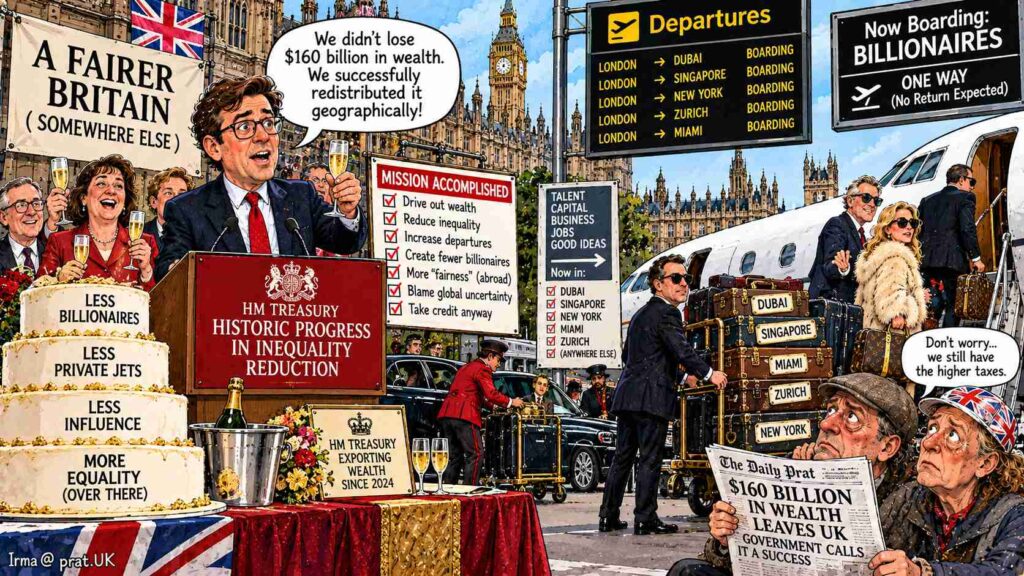
LONDON — Britain’s long-running experiment in making wealthy people feel simultaneously essential, suspicious and heavily invoiced has achieved a significant milestone: Bloomberg reports that people representing roughly $160 billion in wealth have loosened or severed their UK ties during the past two years. Importantly, that is the wealth associated with those departing fortunes, not $160 billion in lost tax revenue. Still, it is enough money to make Heathrow’s first-class lounge technically one of Britain’s leading export terminals.
Britain Successfully Drives Out Wealth
- Britain has finally discovered a painless wealth tax. Instead of taking the wealth, simply annoy the wealthy until they take themselves.
- The government wanted fewer billionaires. Success! Unfortunately, it had hoped the billions would remain behind as emotional-support assets.
- Nothing demonstrates confidence in your tax policy quite like watching your target demographic Google “residency requirements Monaco.”
- British politicians spent years demanding that billionaires “pay their fair share,” apparently forgetting that billionaires own passports.
- The rich are uniquely difficult taxpayers because their houses have wheels. Sometimes the wheels are attached to Gulfstreams.
Britain’s Bold New Export: Taxpayers and the UK Billionaire Exodus
Britain has always been an exporting nation.
Coal. Steel. Textiles. Financial services. James Bond. Television programmes in which six people renovate a cottage and discover mould.
Now Britain has entered the exciting global market for exporting people with accountants.
Bloomberg’s latest examination of the super-rich estimates that about $160 billion in fortunes is associated with individuals and families who have reduced or eliminated their UK ties during the past two years. The sum exceeds the wealth held by UK individuals remaining on the Bloomberg Billionaires Index, according to the report.
This does not mean Britain literally lost $160 billion.
The billionaires did not depart Dover towing pallets of sterling while Border Force officers shouted, “Stop! Those are our yachts!”
Much of the wealth consists of global businesses, securities, holdings and assets that were never sitting inside a Treasury biscuit tin.
But economics has a troublesome little feature called incentives.
Incentives are what governments use when they want people to buy electric cars, hire apprentices or insulate attics.
When incentives cause wealthy taxpayers to leave, however, they become “unexpected behavioural responses.”
It is the same principle by which putting cheese into a mousetrap is called behavioural economics, while removing the cheese and finding no mice is described as disappointing revenue performance.
The Non-Dom Becomes the Non-Here: UK Non-Dom Tax Abolition Explained
Britain’s former non-dom tax regime was dramatically restructured from 6 April 2025.
The old remittance-basis system disappeared. UK residents became generally taxable on worldwide income and gains, while qualifying newcomers received a four-year foreign-income-and-gains regime after at least ten consecutive years of non-UK residence. Inheritance-tax treatment also became more residence-based.
There are perfectly serious fairness arguments for the change.
Why should someone who has lived in Britain for decades receive different treatment merely because his permanent domicile supposedly remains somewhere containing palm trees and excellent private banking?
That question has merit.
Unfortunately, the competing question is less philosophical:
What happens if he leaves?
Governments prefer moral arguments because morality does not have luggage.
Capital does.
The Institute for Fiscal Studies warned before the reform that the revenue consequences depended heavily upon behavioural reactions, including whether existing non-doms left Britain and whether future wealthy arrivals simply chose another country. The IFS noted that around 37,000 remittance-basis non-doms collectively paid roughly £6 billion in income tax, National Insurance and capital gains tax in 2020-21.
That works out to an average of about £170,000 each.
Meaning Britain’s relationship with the non-dom was essentially:
“You disgust us.”
“Here’s £170,000.”
“We’ll tolerate you.”
Treasury Discovers Rich People Can Move: What the OBR Forecast
The Office for Budget Responsibility did, in fairness, anticipate migration.
Its January 2025 supplementary analysis assumed the reform could cause a 12% decline among affected non-doms without trusts and a 25% decline among certain non-doms with trusts and deemed domiciles, reflecting the larger liabilities some could face.
This is economist language for:
“Some of these people are going to look at the tax bill, look at Lake Como, and make a surprisingly quick decision.”
Earlier OBR modelling also expected behavioural responses, including migration and tax planning, to reduce the amount of revenue the reform would otherwise raise.
The fascinating thing about government fiscal modelling is that humans appear as a complication.
Without humans, every tax works beautifully.
Raise the rate to 80%, multiply by existing income and voilà, enough money for three hospitals, seventeen railway feasibility studies and a government website explaining why the hospitals have been postponed.
Then citizens interfere.
They retire earlier.
They incorporate businesses.
They change investments.
They stop selling assets.
They move income.
They move companies.
Occasionally they move themselves.
The Treasury calls this “elasticity.”
The taxpayer calls it Tuesday.
New Government Definition of Wealth Inequality: Nobody Has Anything
Officials should nevertheless remain optimistic.
The departure of billionaires provides Britain with an innovative method of reducing inequality without transferring a single pound to anybody.
Imagine a village containing nine people with £10 each and one billionaire.
The village has enormous wealth inequality.
Now convince the billionaire to move to Switzerland.
Presto.
Inequality collapses.
Nobody in the village has become richer, but the statistics are significantly less offensive.
This is the economic equivalent of curing obesity by removing all mirrors.
A new Treasury Equality Unit could therefore establish measurable annual targets.
Every billionaire who leaves reduces the top end of the wealth distribution.
Every millionaire departing improves the average.
Eventually Britain can achieve the glorious Scandinavian dream of perfect equality, except without Sweden’s corporations, Norway’s oil or Denmark’s Lego.
Heathrow Introduces Billionaire Departure Lounge
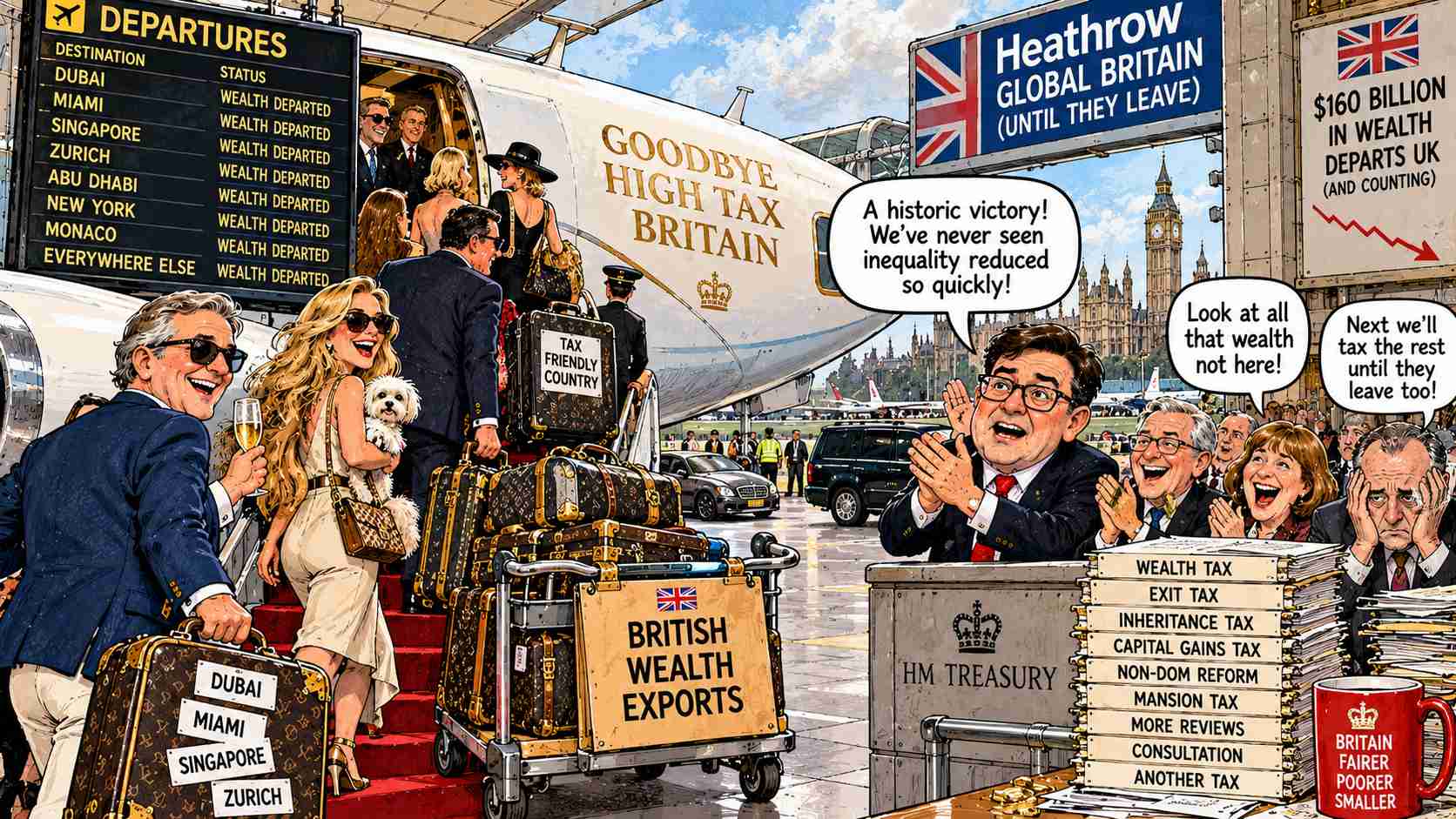
Witnesses at Heathrow reported unusual activity Sunday as several extremely wealthy passengers were seen approaching international departures carrying the traditional billionaire travel essentials: passport, sunglasses, tax counsel and an adviser whose entire professional vocabulary consists of jurisdiction names.
“I knew something was happening,” said terminal coffee-shop employee Barry Crumpet, 46. “Normally a man ordering a £7 cappuccino complains about the price. These fellows were smiling. Nobody smiles at Heathrow unless they’ve become non-resident.”
An economic consultant standing nearby explained that Britain had misunderstood the mobility of wealth.
“We assumed billionaires were geographically fixed,” said Professor Nigel Ledger, director of the Institute for Things That Seemed Obvious Later. “Our model treated them rather like North Sea oil platforms. Unfortunately, several have discovered aeroplanes.”
A Treasury official rejected criticism.
“The important thing is that everyone pays their fair share,” he said.
Asked whether someone living in another country would continue paying the same British share, he studied a wall for several minutes and requested that the question be submitted through the department’s media portal.
The $160 Billion Awkwardness: What Bloomberg’s Wealth Figure Really Measures
Again, Bloomberg’s $160 billion number should not be mistaken for money directly removed from the Treasury. It measures fortunes associated with ultra-rich people and families who have weakened or eliminated their UK connections.
Yet the number matters because countries compete for wealthy residents.
Wealthy households employ staff.
They buy property.
They consume services.
They finance companies.
They make investments.
They hire lawyers, architects, accountants, wealth managers and one mysterious person whose job title is simply “family adviser.”
They also pay VAT every time someone decides a perfectly functional Belgravia kitchen needs £400,000 of Italian marble.
The economic question is therefore not whether wealthy people should pay tax.
Of course they should.
The question is whether a tax system maximises sustainable revenue while keeping Britain attractive enough that internationally mobile entrepreneurs, executives and investors continue choosing Britain in the first place.
That question is less emotionally satisfying because the answer cannot fit on a protest sign.
Britain Competes With Places That Have Sunshine: UK Tax Competitiveness vs Dubai, Monaco and Switzerland
This brings Britain to its strategic disadvantage.
The country is competing for rich residents against jurisdictions possessing several dangerous economic weapons:
Lower taxes.
Predictable rules.
These are difficult advantages to defeat with a strongly worded Treasury consultation.
London still possesses enormous strengths: language, universities, culture, financial infrastructure, professional services, property, law and a time zone conveniently positioned between Asia and America.
But wealthy residents increasingly have choices.
Milan exists.
Dubai exists.
Switzerland exists.
Singapore exists.
Monaco exists, though technically Monaco is what happens when somebody accidentally turns a yacht marina into a sovereign nation.
Britain therefore cannot assume affluent foreigners will continue choosing London merely because their children enjoy Harry Potter.
Please Remain Until We Have Finished Taxing You
The most entertaining contradiction is political.
For years, Britain has heard that the wealthy are too powerful, too privileged and too lightly taxed.
Then some wealthy residents leave.
Suddenly newspapers calculate how much wealth disappeared.
Politicians worry about investment.
Property agents worry about buyers.
Private schools worry about pupils.
Wealth managers worry about clients.
Restaurants discover that morally questionable billionaires were apparently ordering quite a lot of morally questionable champagne.
This produces the extraordinary British policy position:
Rich people should leave us alone, but not literally.
They are expected to remain within convenient fiscal range while absorbing unlimited criticism with the stoicism of a cash machine being kicked by its customer.
A Helpful Five-Second Economics Lesson for Whitehall on Tax Policy and Behavioural Response
There is a useful principle here.
People respond to incentives.
Poor people do it.
Middle-class people do it.
Corporations do it.
Billionaires do it with better luggage.
This does not mean taxes must always be lowered.
It means policymakers must evaluate rates, bases, predictability, international competition and behavioural responses together, rather than imagining taxpayers are stationary objects whose only economic function is waiting patiently for the next Budget.
The OBR itself recognises migration as an important behavioural response when taxes affect internationally mobile populations.
So perhaps the revolutionary policy proposal is neither “tax billionaires nothing” nor “tax billionaires until their accountants begin speaking Italian.”
Perhaps Britain should build a competitive, predictable tax system where successful people pay substantial taxes and still conclude that staying is preferable to leaving.
Admittedly, this approach lacks the emotional thrill of shouting “PAY YOUR FAIR SHARE!”
But it possesses the unfashionable advantage of potentially collecting the share.
Britain Announces New Billionaire Replacement Programme
Whitehall sources insist contingency plans are already being developed.
Under the proposed Billionaire Replacement Strategy, every billionaire leaving Britain will be replaced by approximately 38,000 taxpayers earning £35,000, provided the government can locate somewhere affordable for them to live.
Economists immediately identified a problem.
Britain has not built those houses either.
Officials have therefore commissioned a £74 million feasibility study into whether billionaires can be persuaded to return by promising them first choice of parking at Heathrow.
The report is expected in 2034.
By then, officials are confident Switzerland may have run out of mountains.
10 Humorous Observations Before the Treasury Finds Another Tax
- A normal taxpayer responds to a higher tax bill by complaining. A billionaire responds by asking his family office whether Milan has good schools.
- Governments love taxing immovable property because Buckingham Palace cannot relocate to Dubai. Its owner is another matter.
- Britain has converted wealth inequality into international tourism.
- The Treasury apparently models billionaires as enormous oak trees permanently rooted in Surrey rather than human beings who know where Switzerland is.
- If enough rich people leave, Britain will achieve perfect equality when everyone remaining owes roughly the same amount to British Gas.
- The strangest feature of progressive taxation is that governments frequently speak about wealthy taxpayers as though losing them would be morally satisfying right up until the quarterly receipts arrive.
- Britain now has an unusual economic strategy: attract international capital with London, English law and financial expertise, then chase it through Heathrow shouting, “And another thing!”
- The government abolished the old non-dom system partly in the name of fairness. The billionaires responded with an equally fair system under which they pay taxes somewhere else.
- Economists call this “behavioural response.” Normal people call it “leaving.”
- Somewhere inside Whitehall, a spreadsheet still assumes a billionaire who dislikes British taxes will remain in Britain because the spreadsheet has no column marked “Italy.”
Disclaimer: This is satire built around genuine reporting and genuine tax-policy material. Bloomberg’s $160 billion figure represents wealth associated with ultra-rich individuals and families who have loosened or severed UK ties during the past two years; it is not an estimate that the British Treasury lost $160 billion in tax revenue. The absurd quotations, witnesses, institutes and bureaucratic initiatives above are comic devices.
This story is entirely a human collaboration between two sentient beings: the world’s oldest tenured professor and a philosophy major turned dairy farmer. Neither has yet established tax residence in Monaco, although one has examined the weather.